-
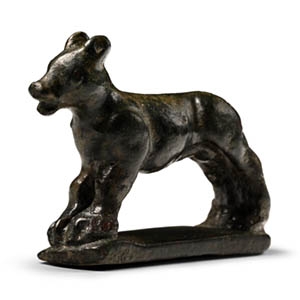
Roman Bronze Figure of a Hunting Dog
1st-2nd century A.D.Sold for (Inc. bp): £468
Modelled in the round on a tongue-shaped base with ears pricked and mouth open. 42.7 grams, 41 mm
Leo Mildenbury collection, Zurich, Switzerland. From the private collection of Mr K.A., acquired in the 1990s-early 2000s. -
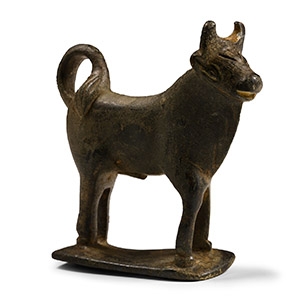
Roman Bronze Statuette of a Bull
Circa 1st-2nd century A.D.Sold for (Inc. bp): £527
Standing on a rectangular base, erect head and crescentic horns, curled tail with the tip resting on the back. 324 grams, 77 mm high
From the Jones family collection, Cambridge, UK, formed in 1971. Acquired Bonhams, London, 23 October 2012, lot 40. Private collection of Professor Kenneth Graham, London, UK. Accompanied by an original catalogue page and a copy of the original invoice. -
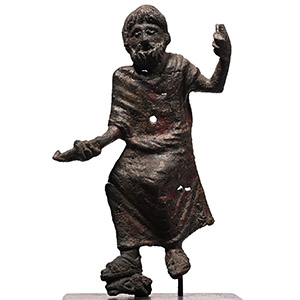
Large Roman Bronze Statuette of Jupiter
Circa 3rd century A.D.Sold for (Inc. bp): £468
Modelled in the half-round and hollow to the reverse, the god with knees flexed, one of his sandaled feet resting on a ram's head; left arm raised to hold a sceptre (absent) and right hand holding a thunderbolt; pierced at the midriff for attachment; mounted on a custom-made stand. 1.1 kg, 21.5 cm including stand
From a collection acquired on the UK art market from various auction houses and collections mostly before 2000. From an important Cambridgeshire estate; thence by descent.
The figurine of Jupiter seems to be a provincial work of Gallo-Roman origin. Contrary to the iconographic tradition of the king of the gods, he is usually depicted nude and with a cloak on his left arm, the statuette shows a Jupiter covered by a large cloak and vestis talaris, which also closely resembles the Gallo-Roman iconography of Jupiter-Sucellus. -
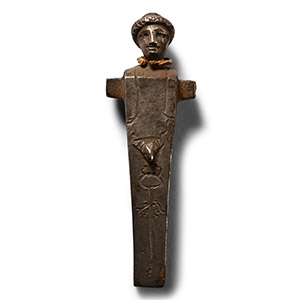
Roman Silver Miniature Herm
1st-3rd century A.D.Sold for (Inc. bp): £2,340
Comprising a square-section tapering body with lateral stub arms; head of Mercury (Greek Hermes) above with applied twisted gold collar, low-relief shoulder panels, genitals modelled in the round, low-relief horned figure below. 27 grams, 52 mm
Acquired in the mid 1980s-1990s. From the family collection of Mr S.A., Switzerland, thence by descent. Private collection since the late 1990s. This lot has been checked against the Interpol Database of stolen works of art and is accompanied by a search certificate number no.12103-218207.
This object, was likely votive and perhaps belonged to a small domestic altar of the Roman imperial era, reproduced in miniature size a Hermaic pillar. These were terminals made of stone or wood which were often placed on the roads, near crossings; they served to indicate the right path and therefore were supposed to protect travellers when travelling. In Roman times, these pillars were often topped with busts or portraits and were also found in the gardens of wealthy homes; gods (Hermes and Bacchus in particular) or philosophers were the subjects thus represented. -
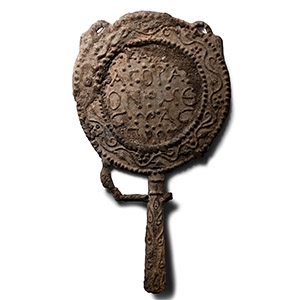
Roman Votive Lead Mirror with Inscription
3rd century A.D.Sold for (Inc. bp): £572
Comprising a discoid plate with running scroll border, lentoid-section handle with raised teardrop decoration; applied central reflective disc with Greek inscription to the reverse. 100 grams, 14 cm
Acquired in the mid 1980s-1990s. Private collection, Switzerland, thence by descent. Private collection, since the late 1990s. -
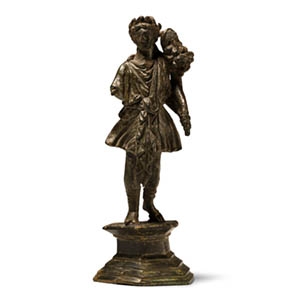
Roman Bronze Statuette of Lar Holding Cornucopia
2nd century A.D.Sold for (Inc. bp): £3,510
Possibly representing the god Silvanus, dressed in a short-sleeved tunic, gathered at the waist by a belt, wearing short boots and holding a cornucopia in his left arm; mounted on a polyhedral base. 264 grams, 13.2 cm
From a private family collection formed since the early 19th century, thence by descent. Property of a New Zealand legal professional. Accompanied by an academic report by Dr Raffaele D’Amato. This lot has been checked against the Interpol Database of stolen works of art and is accompanied by search certificate number no.12323-223710.
Most probably our specimen is from a private house, or private sacellum. The style of the statuette and comparison with other similar pieces points to a dating under the Trajan or Hadrian Empire. The true altar of the lares was the domestic fireplace, centre of the Roman domus, and their temple, the atrium. -
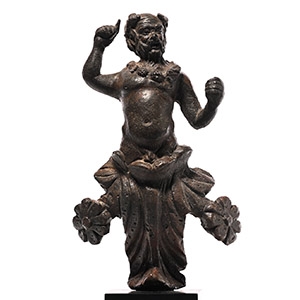
Roman Bronze Silenus Statuette
1st-2nd century A.D.Sold for (Inc. bp): £1,690
Bust and torso of Silenus in dramatic pose with right hand raised, wreath of leaves to the hair and garland of grapes and vine leaves to the chest; lower body developing to a scrolled foliage mount with lateral rosettes; mounted on a custom-made stand. 319 grams total, 13.5 cm including stand
with Bonhams, Knightsbridge, 8 April 1997, no.102. From an important Cambridgeshire estate; thence by descent.
The figure represents either Silenus himself, the aged and semi-bestial companion of Dionysus, or a satyr - a member of the feral group of which he was the leader. As a devotee of Dionysus, Silenus is often shown with Bacchantes, female celebrants in the cult of wine-drinking, music and other pleasurable pursuits. -
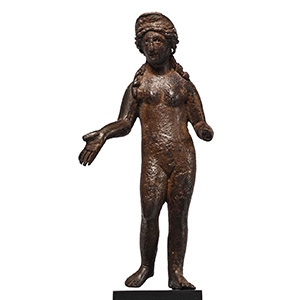
Roman Bronze 'Thames' Statuette of Venus
2nd-3rd century A.D.Sold for (Inc. bp): £1,690
The goddess modelled nude in contrapposto stance; the right hand extended to hold a patera (absent); the hair dressed in a chignon with diadem and two lateral twisted locks; loops to the ears for attachment of separate earrings; eyes modelled oversize to accept silver appliqués; mounted on a custom-made stand. 249 grams total, 14.5cm including stand
Found by Nigel Mills, Thames, UK. From a collection acquired on the UK art market from various auction houses and collections mostly before 2000. From an important Cambridgeshire estate; thence by descent.
In this type of sculptures of the goddess, the deity appears diademed, entirely naked, her hair curled behind a chignon from which braids fall to her shoulders. In her left hand, missing here, the goddess usually carried a fruit, flanked by a marine figure wrapped around a pole. -
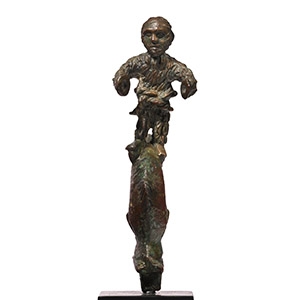
Roman Bronze Grotesque Silenus on Dolphin Handle
Circa 2nd century A.D.Sold for (Inc. bp): £390
Formed as a dolphin with hollow-formed curved body attached at the mouth to the base; standing on the dolphin's lower back, a grotesque bearded figure of Silenus with a furry body, and with a rope tied around his waist, his arms spread holding a cymbal in each hand; stub to the rear where the dolphin's tail joined to form a loop; mounted on a custom-made stand. 370 grams total, 17.5 cm including stand
From a collection acquired on the UK art market from various auction houses and collections mostly before 2000. From an important Cambridgeshire estate; thence by descent.
Silenus is here represented as Papposilenus, a representation of Silenus that emphasises his old age, particularly as a stock character in satyr play or comedy. His costuming includes a body stocking tufted with hair (mallōtos chitōn) that seems to have come into use in the mid-5th century B.C. -
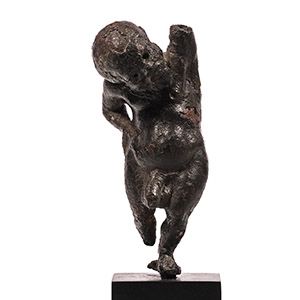
Hellenistic or Roman Bronze Grotesque Figure
Alexandria, 1st century B.C.-3rd century A.D.Sold for (Inc. bp): £338
Modelled standing nude in a contorted pose with left arm raised and right hand on the hip, head tilted; mounted on a custom-made stand. 257 grams total, 11.5cm including stand
From a collection acquired on the UK art market from various auction houses and collections mostly before 2000. From an important Cambridgeshire estate; thence by descent.
Rolland (p.104) notes that such grotesque 'pygmy' figures may have been intended as caricatures. They were already produced in Alexandria since the 1st century B.C., and considered to be charms against the evil eye. Beautiful statuettes of this typology are well known from the Roman period, perhaps produced in the workshops of Alexandria, Egypt, on the occasion of the visit of the Emperor Caracalla. -
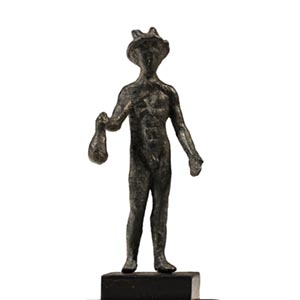
Roman Bronze Statuette of Mercury
Circa 2nd century A.D.Sold for (Inc. bp): £715
Modelled standing nude, wearing the winged petasos and with a bag of coins in his extended right hand; mounted on a custom-made stand. 85 grams total, 10.2 cm including stand
From a collection acquired on the UK art market from various auction houses and collections mostly before 2000. From an important Cambridgeshire estate; thence by descent.
This statuette of possible Gallo-Roman origin is part of a production of quickly cast votive bronzes, where the features of the body and face were barely highlighted. However, it presents very clearly the characteristic petasos with wings and the small bag, symbol of his protectorate over travellers, traders and thieves. -
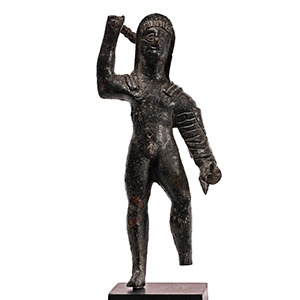
Etrusco-Roman Bronze Statuette of Hercules
1st century B.C.Sold for (Inc. bp): £546
Highly stylised figure of the god standing nude with lionskin over his left arm and club in his raised right hand; long segmented hair cascading to the shoulders; mounted on a custom-made stand. 222 grams, 13.5 cm including base
From a collection acquired on the UK art market from various auction houses and collections mostly before 2000. From an important Cambridgeshire estate; thence by descent.
The execution is far from naturalistic and was probably produced in a provincial workshop, possibly in Gaul or southern Britain.

