-
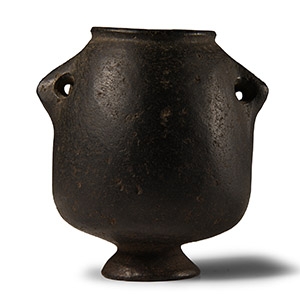
Egyptian Predynastic Basalt Vase
Naqada I-II, circa 3900-3300 B.C.Sold for (Inc. bp): £4,680
Barrel-shaped in profile with tapering neck and trumpet-shaped foot, two lateral pierced lug handles, flared rim (damaged). 330 grams, 86 mm
French private collection. From the 'Yvelines Department', Northern France. with Mme Digard, Drouot, Paris, 7 February 2011, no.107. Accompanied by a copy of a French cultural passport. This lot has been checked against the Interpol Database of stolen works of art and is accompanied by a search certificate number no.12072-218133. -
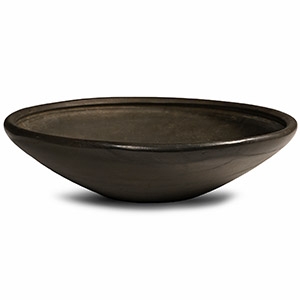
Egyptian Black Stone Lipped Bowl
2nd-3rd Dynasty, 2860-2640 B.C.Sold for (Inc. bp): £2,860
Shallow and broad in profile with carinated rim. 627 grams, 20 cm
From the private collection of Mr K.A., acquired in the 1990s-early 2000s. This lot has been checked against the Interpol Database of stolen works of art and is accompanied by a search certificate number no.12367-225768.
Stone vessels, made from various styles and types of stone, were commonly found in Early Dynastic and Old Kingdom tombs as funerary equipment. One of the most significant discoveries was the recovery of over 30,000 stone vessels in King Djoser's Step Pyramid complex. -
.jpg)
Egyptian Limestone False Door Relief Panel
Middle Kingdom, circa 1900-1750 B.C.Sold for (Inc. bp): £1,105
Rectangular panel from a false door stela carved in sunk relief with raised vertical borders framing a scene with a male figure wearing a knee-length kilt, collar and short wig, seated on a stool with lion-claw feet, holding a bolt of cloth in his left hand; before him, a pedestal table with splayed feet, the top laden with vertical loaves; traces of pigment to the collar, kilt and table; rear face dressed but plain. 4.12 kg, 28.7 cm
Acquired in the mid 1980s-1990s. Private collection, Switzerland, thence by descent. Private collection, since the late 1990s.
The ancient Egyptians believed the soul of the departed could move in and out of the tomb using a ‘false door.’ This door was identified by a recessed surface with a symbolic entrance at its centre. In the Middle Kingdom, the false door design was combined with other elements or represented by a raised border and cornice above on rectangular stelae. -
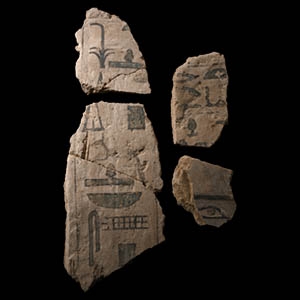
Egyptian Limestone Fragment Group
Middle Kingdom, 2035-1550 B.C.Sold for (Inc. bp): £1,404
Comprising four fragments of dressed and plastered wall, each with painted hieroglyphs in blue, green and black shades, some with low-relief modelling. 1.03 kg total, 10.1-27.7 cm
Acquired in the mid 1980s-1990s. Private collection, Switzerland, thence by descent. Private collection, since the late 1990s.
These fragments seem to be sections of tomb wall reliefs. They include portions of an offering formula, mention of a 'district', a festival, and the symbol of Anubis. The decoration in different parts of some Middle Kingdom tombs had scenes and texts applied in paint or executed with raised relief carving. -
.jpg)
Egyptian Quartzite Fragment with Hieroglyphs
New Kingdom, 1550-1069 B.C.Sold for (Inc. bp): £585
Dressed stela or shrine fragment inscribed with three vertical columns of enigmatic hieroglyphs; mounted on a plaque. 320 grams total, 13 cm wide including stand
From an American deceased estate, acquired between 1970-1989. with Bonhams, London, 28 October 2009, no.23. Private collection, Europe.
The second-to-last complete sign in the central register is a semi-hieratic version of the balancing post hieroglyph, suggesting an 18th Dynasty or later New Kingdom date. -
.jpg)
Egyptian Limestone Relief of a Ptolemaic King
Ptolemaic Period, 332-30 B.C.Sold for (Inc. bp): £14,300
Trapezoidal fragment bearing a low-relief depiction of a Ptolemaic king shown in profile, with characteristic plump cheeks, slightly upturned mouth, and internally detailed ear, wearing a long false beard, the Red or Dual Crown of Egypt with uraeus to the front, and a broad collar; the lower part of a cartouche to the right. 405 grams, 11 cm
Léon Rodrigues-Ely (1924–1973), Marseille, France. with Christie's, Paris, 6 May 2015, no.93. Private collection, Europe. Accompanied by a copy of an Art Loss Register certificate no.S00104585. This lot has been checked against the Interpol Database of stolen works of art and is accompanied by a search certificate number no.12369-226941.
Léon Rodrigues-Ely (1924–1973) was a prominent French collector based in Marseille, known for his keen interest in fine art and antiquities. Throughout his life, Rodrigues-Ely assembled an eclectic and esteemed collection, particularly focusing on European and Mediterranean artifacts. His passion for collecting was fuelled by a deep appreciation for history and culture, and he was well-regarded among art dealers and scholars alike. Many of the pieces in his collection were acquired from significant galleries and private collections across Europe, reflecting his dedication to preserving cultural heritage. Rodrigues-Ely’s collection continued to be highly sought after following his death, with several pieces passing through prestigious auction houses, cementing his legacy in the art world. -
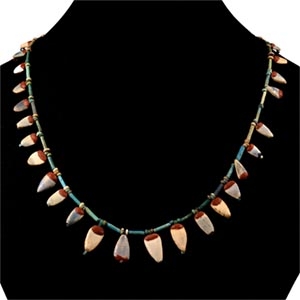
Egyptian Faience Bead Necklace with Petal Beads
New Kingdom, Amarna Period, 1550-1070 B.C.Sold for (Inc. bp): £572
Restrung using turquoise tubular beads interspersed with annular beads of various colours and graduated polychrome petal-shaped beads, some with a loop at each end. 9.19 grams, 52 cm long
From an early 20th century UK collection. Accompanied by a previous typed cataloguing card. -
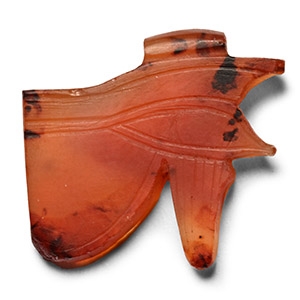
Egyptian Carnelian Eye of Horus Amulet
Circa 1000 B.C.Sold for (Inc. bp): £910
With exceptional eye detailing carved in low-relief to one face. 1.64 grams, 19 mm
Ex R. Liechti (1934-2010) Geneva, Switzerland, formed between 1950-1990s. Accompanied by a copy of an old collection inventory note.
The wedjat-eye amulet is a representation of the healed eye of the god Horus, featuring both human and falcon elements. The name wedjat in ancient Egyptian means ‘the one that is sound.’ According to Egyptian mythology, Horus' eye was wounded or taken by the god Seth and restored by Thoth. The wedjat-eye amulet was thought to protect its wearer and bestow the power of recovery and regeneration onto them. It was very popular and used by both the living and the dead. -
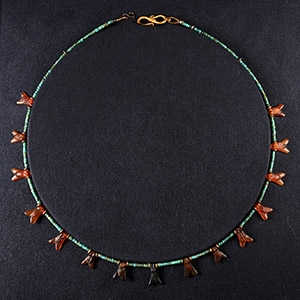
Egyptian Necklace with Fly Beads
New Kingdom, 18th Dynasty, 1550-1350 B.C. and laterSold for (Inc. bp): £1,430
Group of restrung annular turquoise beads with gilt-metal interstitial collars and carnelian fly amulets; S-hook and eye closure; with custom display box. 10.45 grams, 48.5 cm long
Ex Swiss collection, kept in London since the 1980s. Accompanied by a copy of a previous illustrated catalogue page.
Since Egyptian artists often depicted fly whisks in the hands of pharaohs and high officials, one might assume that flies were simply a nuisance. However, the Egyptians held flies in high regard due to their quick speed, reactions, and persistence. Small fly amulets first appeared in burials during the Naqada II Period, c. 3200 B.C. These amulets grew in popularity, and the materials used to make them expanded during the New Kingdom, including gold, silver, lapis lazuli, carnelian, amethyst, faience, and bone. Fly amulets were believed to protect against insect bites and to ward off troublesome airborne creatures through apotropaic magic. Some believe they may have even been intended to symbolise the fly’s fecundity. Additionally, pharaohs would bestow gold fly-shaped pendants as military awards to honour the bravery and fly-like persistence of soldiers in battle. -
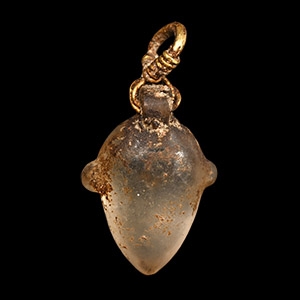
Egyptian Rock Crystal Heart Amulet
6th century B.C.Sold for (Inc. bp): £3,640
Carved with lateral triangular lugs and ribbed bale, gold wire suspension loop. 1.54 grams, 21 mm
Private collection. Acquired in 2009. Private collection, Europe. -
.jpg)
Phoenician Stone Scarab with Inscription
1st millennium B.C.Sold for (Inc. bp): £910
With detailing to the carapace, the underside divided into four registers, the top and bottom with a winged Horus plaque, one register with a winged scarab flanked by two falcons, the register below with lying sphinxes flanking an ankh; pierced longitudinally. 9.7 grams, 27 mm
Acquired in the mid 1980s-1990s. Private collection, Switzerland, thence by descent. Private collection, since the late 1990s. -
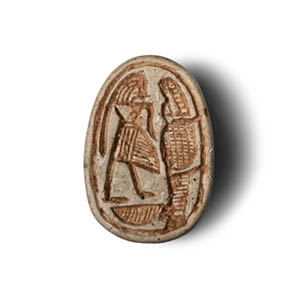
Egyptian Steatite Scarab
Second Intermediate Period, 17th-16th century B.C.Sold for (Inc. bp): £572
Finely carved scarab with naturalistically detailed legs and head, the underside decorated with a standing figure atop a neb hieroglyph facing a stylised crocodile. 4.06 grams, 21 mm
with Archeological Centre, 2015. Private collection, Europe.
Scarabs with this design have been discovered in the northern Delta of Egypt and Palestine. The influence of the crocodile god Sobek on the production of late middle Bronze Age settlers at Avaris in the Egyptian Delta likely contributed to the popularity of Egyptian-themed scarabs with crocodiles and standing figures found in Palestinian sites.

