
Auction Highlights
-
.jpg)
Egyptian Granite Head of a Dignitary
Sold for (Inc. bp): £28,600
Carved with soft facial features and carefully executed cosmetic lines around the eye, earring, and carefully detailed duplex wig with gently wavy curls; likely from the Ramesside Period; mounted on a custom-made stand. -
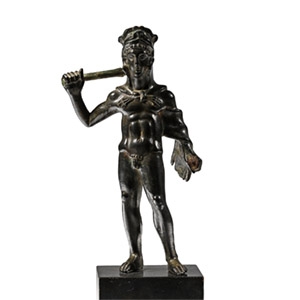
Etruscan Bronze Statuette of Herakles
Sold for (Inc. bp): £18,200
Modelled in the round with a muscular nude body, his club resting on his shoulder and the hair dressed in rows of tight, close-set curls underneath the Nemean lionskin hood with cloak billowing over his left arm, the paws tied across his chest; mounted on a custom-made display stand. -
.jpg)
Roman Marble Portrait of a Boy as Worshipper of Isis
Sold for (Inc. bp): £17,550
Carved head of a prepubescent worshipper of Isis, with soft facial features, long nose, small downturned mouth, heavy-lidded eyes, the whole giving the face a sombre or mournful appearance; the hair textured to indicate a short cut and combed forward across the scalp, sidelock above the right ear; mounted on a 16th century carved breccia upper body with leather cuirass and pteruges to right shoulder, cloak draped across the shoulders and fastened at the clavicle on the right side with a disc-brooch; socle base; some restoration. -
.jpg)
Larger Than Life-Size Roman Bronze Sandaled Foot
Sold for (Inc. bp): £39,000
Modelled in the round and originally part of a monumental statue, the naturalistic right foot encased in a trochades leather sandal with median reversed tongue secured with side straps and thick looped laces; the thick platform sole slightly curved, toes and nails well defined; mounted on a substantial custom-made display stand. -
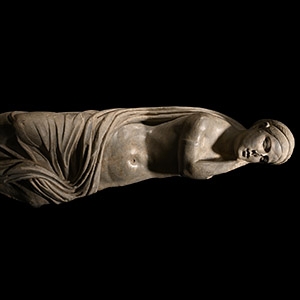
Life-Size Roman Marble Sleeping Girl from a Sarcophagus Lid
Sold for (Inc. bp): £20,800
Modelled in the half-round, nude with eyelids half-closed in sleep; a drapery partly covering the head and wrapping around the lower body under the hips; the hairstyle similar to those of the Antonine Dynasty, the peaceful face supported by the hands and the ear pierced to accept an earring; iron reinforcing rod to the feet and the right arm's armilla a later replacement; upper head restored in Parian marble. -
.jpg)
Byzantine Porphyry Relief with Cross Surrounded by Two Birds
Sold for (Inc. bp): £28,600
An imposing panel divided to four sections by a central cross on a stepped pedestal, the lower and upper arm with branch-like extensions; the upper quadrants with a circlet surrounding a palm tree-shaped motif; each lower quadrant with a bird in profile facing back; mounted on a custom-made display stand. -
.jpg)
Carved Marble Memento Mori Skull
Sold for (Inc. bp): £16,900
Carved skull on a short neck with musculature and blood vessels; mandible in place with some teeth in sockets, wisps of hair adhering to the dome of the skull; one zygomatic bone partly absent; square-section socle base. -
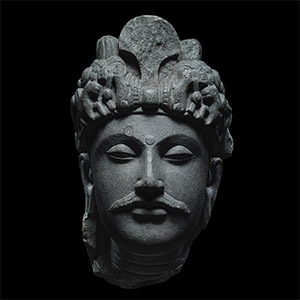
'The Kelton' Gandharan Head of a Bodhisattva
Sold for (Inc. bp): £24,700
Carved in the half-round head of a Bodhisattva (probably Maitreya) with fine detailing to the arched brow, aquiline nose, neat moustache and full lips; the eyes heavily lidded, urna to the forehead, long open lobes to the ears; the hair in multi-stranded curling locks gathered into an ushnisha with brow-band below; heavily cleaned, conserved, and mounted on a custom-made stand; supplied with original old wooden base with collector's label: 'Head of Bodhisattva / Fine grain schist / Gandhara, Northwest Pakistan / 4th century'.
-
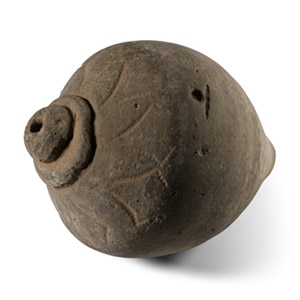
Byzantine 'Greek Fire' Ceramic Fire Bomb or Hand Grenade
9th-11th century A.D.Sold for (Inc. bp): £91
A ceramic missile, piriform in profile with lattice pattern to the shoulder, domed filler-hole, intended to be filled with explosive liquid and wick, used as a hand grenade. 722 grams, 14.2 cm
From a military inspired collection formed from the 1990s. Accompanied by an academic paper by military specialist Dr Raffaele D'Amato, dated 15 July 2019 and titled 'Eastern Roman Empire - Greek Fire Bomb or Hand Grenade (μεσαίον kακάβιον) 9th-11th century AD'.
Apart from the use of siphons or manual flame-throwers called cheirosiphona, special corps of Roman soldiers employed terracotta grenades, in the form of small jars, abundantly evidenced in archaeological excavations. They were called μεσαία kακαβιά or κυτροκακάβια where the former had a bulbous shape and the latter a more cylindrical form. -
.jpg)
Migration Period Iron Sword with Rock Crystal, Gold and Garnet Sword Bead
5th-6th century A.D.Sold for (Inc. bp): £1,235
Comprising a double-edged blade with pointed tip, battle nicks to both cutting edges; short bronze guard and a long tang; accompanied by a facetted rock crystal hilt pendant with a granulated gold mount above, set with a garnet cabochon; Eastern Roman or Alano-Gothic. 750 grams, 4-91.5 cm
From the private collection of a London gentleman, from his grandfather's collection formed before the early 1970s. Accompanied by an academic report by Dr Raffaele D’Amato. This lot has been checked against the Interpol Database of stolen works of art and is accompanied by a search certificate number no.12041-216428.
A characteristic type of the Migration period, originally used by nomadic people such as the Alans and Sarmatians. An important element of these swords was the presence (in tombs) of amber or rock crystal fittings, which some authors have identified being part of the pommel (Zasetskaya), and others as pendants hanging from the hilt of the sword. Interestingly the sword of grave 9 from the Necropolis of Novohryhorivka is decorated with a similar pendant, made of amber and fitted with a silver mount decorated with a filigree border. -
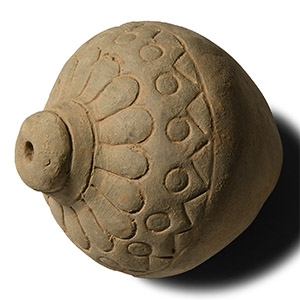
Byzantine 'Greek Fire' Ceramic Fire Bomb or Hand Grenade
9th-11th century A.D.Sold for (Inc. bp): £195
Piriform body with domed filler-hole, radiating petals surrounding the filler-hole, annulets and a zig-zag line beneath; intended to be filled with explosive liquid and wick, used as a hand grenade. 434 grams, 10.4 cm
From a specialist collection of militaria, London, UK, collected 1990s onwards. Accompanied by an academic paper by military specialist Dr Raffaele D'Amato, dated 15 July 2019 and titled 'Eastern Roman Empire - Greek Fire Bomb or Hand Grenade (μεσαίον kακάβιον) 9th-11th century AD'.
Apart from the use of siphons or manual flame-throwers called cheirosiphona, special corps of Roman soldiers employed terracotta grenades, in the form of small jars, abundantly evidenced in archaeological excavations. They were called μεσαία kακαβιά or κυτροκακάβια where the former had a bulbous shape and the latter a more cylindrical form. -
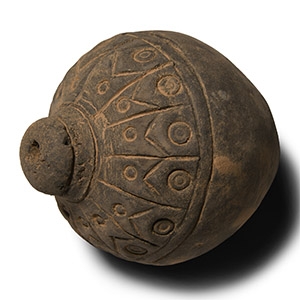
Byzantine 'Greek Fire' Ceramic Fire Bomb or Hand Grenade
9th-11th century A.D.Sold for (Inc. bp): £208
Piriform body with domed filler-hole, the upper body divided into segments radiating from the filler-hole, each with impressed chevron and annulet decoration; intended to be filled with explosive liquid and wick, used as a hand grenade. 427 grams, 11 cm
From a specialist collection of militaria, London, UK, collected 1990s onwards. Accompanied by an academic paper by military specialist Dr Raffaele D'Amato, dated 15 July 2019 and titled 'Eastern Roman Empire - Greek Fire Bomb or Hand Grenade (μεσαίον kακάβιον) 9th-11th century AD'.
Apart from the use of siphons or manual flame-throwers called cheirosiphona, special corps of Roman soldiers employed terracotta grenades, in the form of small jars, abundantly evidenced in archaeological excavations. They were called μεσαία kακαβιά or κυτροκακάβια where the former had a bulbous shape and the latter a more cylindrical form. -
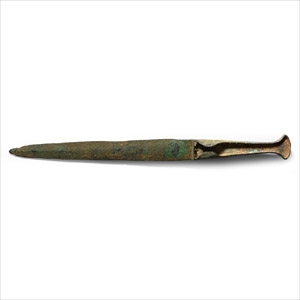
Luristan Bronze Short Sword
13th century B.C.Sold for (Inc. bp): £208
With lentoid-section blade, tongue-shaped in plan, with integral tapering hilt with flared finial, lateral flanges to accept a panel of bone to each face forming the grip. 195 grams, 33.5 cm
Acquired 1980-2015. Ex Abelita family collection.
The art of Luristan can be described as the art of nomadic herdsmen and horsemen with an emphasis on the crafting of small, easily portable objects, among these a great number of bronze weapons. The rich and noble aristocrats of the Luristan, Elamites, Hurrians, Lullubians, Kutians, and Kassites, went to battle splendidly equipped and wore magnificent bronze armour, using maces, spears and daggers as offensive weapons, alongside spears, bows and arrows. -
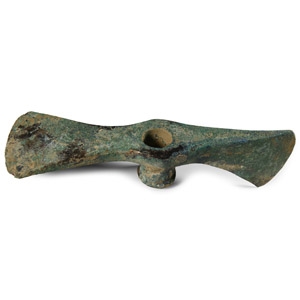
Large Luristan Bronze Adze-Axehead
2nd-1st millennium B.C.Sold for (Inc. bp): £130
With central shaft hole and blade set at right angle. 1.22 kg, 24.5 cm
From a 1990s German collection. Ex London, UK, gallery.
The adze-axe was a fundamental axe of many Bronze Age cultures of the world. Its form was one that lends itself to dual purposes - for war and peace. As a tool, it was used to shape wood in fabricating a variety of objects or even wooden beams for construction. As a weapon, its heavy mass and compact form make it a very deadly striking and chopping weapon, even able to defeat light armour. -
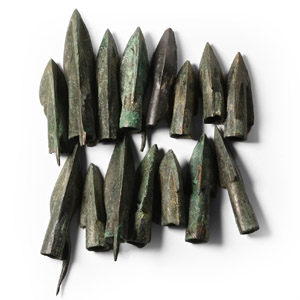
Greek Bronze Tri-Finned Arrowhead Collection
Circa 7th-3rd century B.C.Sold for (Inc. bp): £195
Comprising: seven arrowheads with a slender, lozenge-shaped blade and a socket extending near the tip, base of the socket with a side lug; eight socketted bronze arrowheads, mainly triangular or foliate in section, trilobate and with short socket. 77 grams total, 23-46 mm
UK private collection before 2000. Acquired on the UK art market. Property of a London gentleman.
The Scythians were famous for their archery abilities, and were often employed as mercenaries. The Athenian tyrant Pisistratus hired them and they participated in battles beside the Athenian phalanx as well as serving as a police corps keeping order within the city of Athens. This explains the great range of Scythian arrowheads found on the Greek sites. -
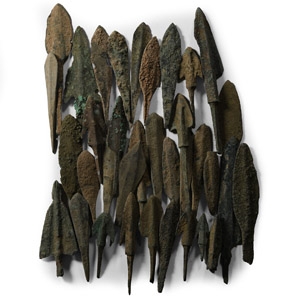
Luristan Bronze Arrowhead Collection
Circa late 2nd millennium-6th century B.C.Sold for (Inc. bp): £234
Including leaf-shaped, barbed and other types. 367 grams total, 3.4-10.7 cm
Ex London, UK, collection, 1990s.
A number of arrowheads of this type have been excavated in Luristan and in the South-Caspian region. Many parallels are from a burial context, but a large hoard of them was found in a non-funerary context. This type of arrowhead has been in use from the late 2nd millennium B.C. Other arrowheads are clearly Achaemenid. -
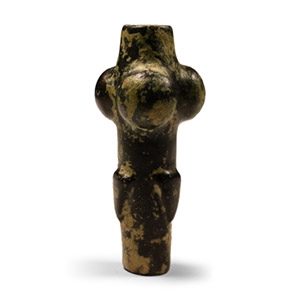
Luristan Bronze Bulbous Macehead
Circa 7th-6th century B.C.Sold for (Inc. bp): £182
With three round knobs at the top, radiating from the hollow shaft, with a further three heater-shaped projections below. 167 grams, 98 mm
Private collection, UK. -
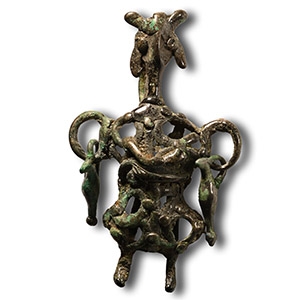
Amlash Bronze Figural Pendant
Circa 10th century B.C.Sold for (Inc. bp): £98
Fertility figure with openwork decoration, loop arms suspending pendants formed as slender figurative horned animals; suspension loop to reverse and cage-style torso. 74 grams, 97 mm
UK private collection before 2000. Acquired on the UK art market. Property of a London gentleman. -
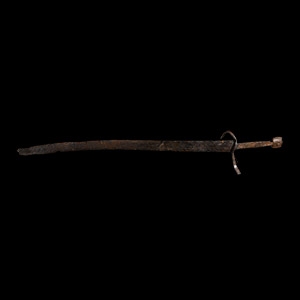
Medieval Iron Schiavonesca Type Sword with Latten Inlaid Crosses
Circa 15th century A.D.Sold for (Inc. bp): £468
Comprising a broad double-edged parallel-sided blade, flat-section at the upper third with a very shallow central fuller, elliptical-section at the lower end; flat guard with scooped lower edge, D-section arms horizontally S-curved; 'cat's head' type pommel, rectangular with scrolled upper edge and integral central boss to both faces; on the upper part of the blade an engraved three-armed workshop mark and two possibly later added brass inlaid marks including a cross fourchee inside and the image of a sword to one side; mounted on a wall display mount. 1.7 kg total, 1.11 m
In general good condition, point missing, blade structure with little delamination along the upper part, corrosion damages along the edges and on the surface, some material loss on the original surface.
Private collection, Munich, Germany, 1970s. Private collection, London, UK, 2014, acquired from the above.
The Schiavonesca sword was used by Dalmatian mercenaries serving in the Venetian state armies, and produced by the workshops of the Serenissima to which the marks probably belong. Many of these swords were produced in Dubrovnik, a Croatian city under Venetian rule. Oakeshott classified all the pommels of square shape in his Type Z. Certain morphological differences between them were individuated by Dr Aleksić as a criteria for distinguishing the distinct subtypes, in this case the type Z3 for the upper crenelleted edge. The cross-guards of type 12b, like in this case, have symmetrically and horizontally sharply bent arms in the opposite directions. The 'cat's head' pommel is also found on surviving examples of cross-hilted swords of the 14th century which can be traced into the hands of Slavonic soldiers stationed in southern Europe, employed in the European armies of this period. The independent representation of the cross fourchee usually inscribed in a circle is rather frequent on the swords with type 12 cross guards and type Z pommels from Hungary, Northern Balkans and the neighbouring regions (Aleksić, 2007, p.122). -
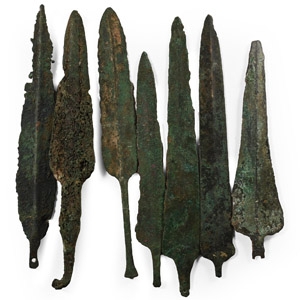
Western Asiatic Bronze Blade Collection
Early 1st millennium B.C.Sold for (Inc. bp): £117
Including four with tapering blades with broad flattened mid-ribs and rounded shoulders, tapered squared section tangs, two with tang pierced at tip; a similar blade with the tang bent at the tip; one spearhead with foliate blade and raised mid-rib; a short dagger with leaf-shaped blade and long rectangular-section tang. 528 grams total, 17.5-22.6 cm
Ex London collection, formed 1990-2000.
Moorey, Gordon and Khorasani created a classification of bladed weapons, according to which daggers are edged weapons no greater than 36cm in length, dirks (short swords) are between 36cm and 50cm in length, and swords are edged weapons greater than 50cm in length.
