
Auction Highlights
-
.jpg)
Egyptian Granite Head of a Dignitary
Sold for (Inc. bp): £28,600
Carved with soft facial features and carefully executed cosmetic lines around the eye, earring, and carefully detailed duplex wig with gently wavy curls; likely from the Ramesside Period; mounted on a custom-made stand. -
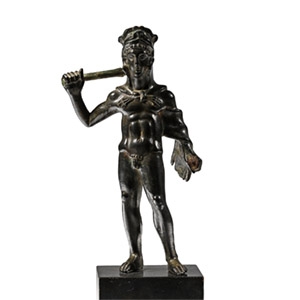
Etruscan Bronze Statuette of Herakles
Sold for (Inc. bp): £18,200
Modelled in the round with a muscular nude body, his club resting on his shoulder and the hair dressed in rows of tight, close-set curls underneath the Nemean lionskin hood with cloak billowing over his left arm, the paws tied across his chest; mounted on a custom-made display stand. -
.jpg)
Roman Marble Portrait of a Boy as Worshipper of Isis
Sold for (Inc. bp): £17,550
Carved head of a prepubescent worshipper of Isis, with soft facial features, long nose, small downturned mouth, heavy-lidded eyes, the whole giving the face a sombre or mournful appearance; the hair textured to indicate a short cut and combed forward across the scalp, sidelock above the right ear; mounted on a 16th century carved breccia upper body with leather cuirass and pteruges to right shoulder, cloak draped across the shoulders and fastened at the clavicle on the right side with a disc-brooch; socle base; some restoration. -
.jpg)
Larger Than Life-Size Roman Bronze Sandaled Foot
Sold for (Inc. bp): £39,000
Modelled in the round and originally part of a monumental statue, the naturalistic right foot encased in a trochades leather sandal with median reversed tongue secured with side straps and thick looped laces; the thick platform sole slightly curved, toes and nails well defined; mounted on a substantial custom-made display stand. -
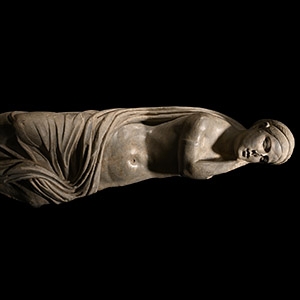
Life-Size Roman Marble Sleeping Girl from a Sarcophagus Lid
Sold for (Inc. bp): £20,800
Modelled in the half-round, nude with eyelids half-closed in sleep; a drapery partly covering the head and wrapping around the lower body under the hips; the hairstyle similar to those of the Antonine Dynasty, the peaceful face supported by the hands and the ear pierced to accept an earring; iron reinforcing rod to the feet and the right arm's armilla a later replacement; upper head restored in Parian marble. -
.jpg)
Byzantine Porphyry Relief with Cross Surrounded by Two Birds
Sold for (Inc. bp): £28,600
An imposing panel divided to four sections by a central cross on a stepped pedestal, the lower and upper arm with branch-like extensions; the upper quadrants with a circlet surrounding a palm tree-shaped motif; each lower quadrant with a bird in profile facing back; mounted on a custom-made display stand. -
.jpg)
Carved Marble Memento Mori Skull
Sold for (Inc. bp): £16,900
Carved skull on a short neck with musculature and blood vessels; mandible in place with some teeth in sockets, wisps of hair adhering to the dome of the skull; one zygomatic bone partly absent; square-section socle base. -
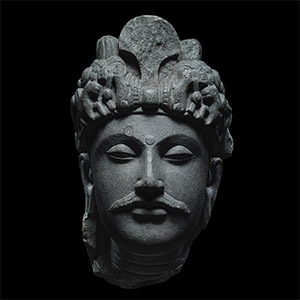
'The Kelton' Gandharan Head of a Bodhisattva
Sold for (Inc. bp): £24,700
Carved in the half-round head of a Bodhisattva (probably Maitreya) with fine detailing to the arched brow, aquiline nose, neat moustache and full lips; the eyes heavily lidded, urna to the forehead, long open lobes to the ears; the hair in multi-stranded curling locks gathered into an ushnisha with brow-band below; heavily cleaned, conserved, and mounted on a custom-made stand; supplied with original old wooden base with collector's label: 'Head of Bodhisattva / Fine grain schist / Gandhara, Northwest Pakistan / 4th century'.
-
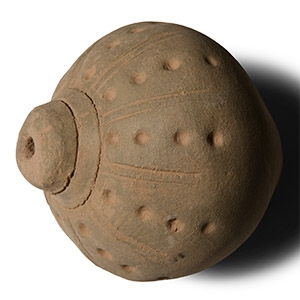
Byzantine 'Greek Fire' Ceramic Fire Bomb or Hand Grenade
9th-11th century A.D.Sold for (Inc. bp): £195
Piriform body with domed filler-hole, the upper body decorated with vertical rows of pellets separated by deep grooves; intended to be filled with explosive liquid and wick, used as a hand grenade. 444 grams, 10.2 cm
From a specialist collection of militaria, London, UK, collected 1990s onwards. Accompanied by an academic paper by military specialist Dr Raffaele D'Amato, dated 15 July 2019 and titled 'Eastern Roman Empire - Greek Fire Bomb or Hand Grenade (μεσαίον kακάβιον) 9th-11th century AD'.
Apart from the use of siphons or manual flame-throwers called cheirosiphona, special corps of Roman soldiers employed terracotta grenades, in the form of small jars, abundantly evidenced in archaeological excavations. They were called μεσαία kακαβιά or κυτροκακάβια where the former had a bulbous shape and the latter a more cylindrical form. -
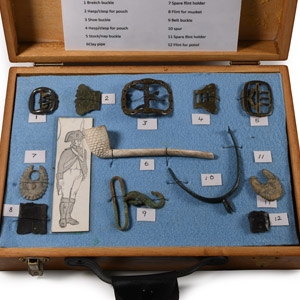
Cased British Military 'Published' Artefact Collection
Late 17th-early 19th century A.D.Sold for (Inc. bp): £124
Comprising: breech and shoe, hat, belt ands stock/nap bronze buckles; clasps for pouches; a clay pipe; spare flint holders; a flint for musket; a flint for pistol; a bronze spur; military buttons for Royal Marine, Artillery, Coldstream and Dragoon Guards from 1795 to 1820; an officer’s whistle; a bayonet holder. 1.36 kg total, case: 30.5 x 22 x 6.5 cm
From the collection of the famous author, writer and speaker, Gordon Bailey, Essex, UK; formed since 1968.
Various military items have been recovered from the military sites of the Napoleonic Wars. Buttons are the most common items, made of copper, with some signs of gilding and silvering. Also small buckles are frequent finds, as well as musket balls and musket parts. These latter are rare because the individual soldiers were responsible for the care and maintenance of their fire-arms. -
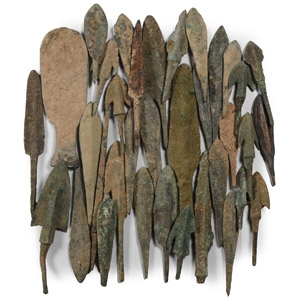
Mesopotamian Bronze Arrowhead Collection
Circa 1800-900 B.C.Sold for (Inc. bp): £234
Including triangular-section, barbed, paddle-shaped, and other types. 353 grams total, 4-12 cm
Ex London, UK, collection, 1990s.
Paddle-shaped arrowheads with a flat, comparatively wide mid-rib and the blade shaped to a point were typical of Old Babylonian Empire. The shoulders were pronounced and the arrowhead had a rectangular-section tapering tang. They are the majority in this group, which comprises also barbed triangular arrowheads of type V from Marlik-Luristan, and one interesting specimen of trilobate arrowhead. -
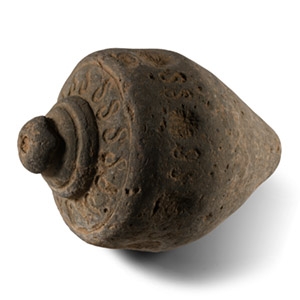
Byzantine 'Greek Fire' Ceramic Fire Bomb or Hand Grenade
9th-11th century A.D.Sold for (Inc. bp): £117
Piriform-conical body with S-shaped ornaments to the shoulder, interstitial panels of impressed alternate foliage and S-shaped horizontal ornaments, domed filler-hole, intended to be filled with explosive liquid and wick, used as a hand grenade. 650 grams, 12.5 cm
From a military inspired collection formed from the 1990s. Accompanied by an academic paper by military specialist Dr Raffaele D'Amato, dated 15 July 2019 and titled 'Eastern Roman Empire - Greek Fire Bomb or Hand Grenade (μεσαίον kακάβιον) 9th-11th century AD'.
This piece was a type of a ceramic fire grenade, similar to the ones used by the Eastern Romans but of Turco-Mongol type. Apart from the use of manual flame-throwers, special corps of soldiers employed terracotta grenades, in the form of small jars, abundantly evidenced in archaeological excavations, even in Far East, like in Burma. -
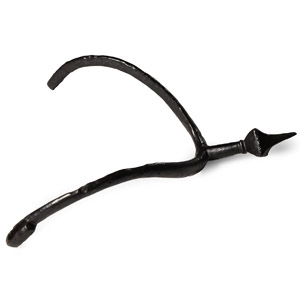
Norman Iron Prick Spur
11th-12th century A.D.Sold for (Inc. bp): £195
With abruptly curved arms ending in two loops, the prick with biconvex bulb. 52 grams, 12 cm
From the collection of the famous author, writer and speaker, Gordon Bailey, Essex, UK; formed since 1968.
The spur belongs to Western specimens of the 12th century, with more or less strongly curved spurs and short, strong, lowered spikes, whereby the majority of the spurs already have loops instead of rivet plates. -
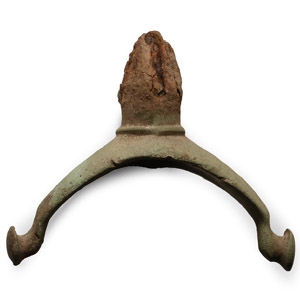
Roman Military Bronze Cavalry Spur
1st-2nd century A.D.Sold for (Inc. bp): £78
Crescentic in plan with carinated profile, discoid lug to each end, sturdy square-section ferrous stud to the centre. 45 grams, 64 mm
Private collection, UK, formed 1980s-1990s. -
.jpg)
Byzantine 'Greek Fire' Ceramic Fire Bomb or Hand Grenade
9th-11th century A.D.Sold for (Inc. bp): £98
With domed filler-hole, broad shoulder, alternating bands of crescent impressed detailing; intended to be filled with explosive liquid and wick, used as a hand grenade. 242 grams, 10.1 cm
From a collection acquired on the UK art market from various auction houses and collections mostly before 2000. From an important Cambridgeshire estate; thence by descent. Accompanied by an academic paper by military specialist Dr Raffaele D'Amato, dated 15 July 2019 and titled 'Eastern Roman Empire - Greek Fire Bomb or Hand Grenade (μεσαίον kακάβιον) 9th-11th century AD'.
Apart from the use of siphons or manual flame-throwers called cheirosiphona, special corps of Roman soldiers employed terracotta grenades, in the form of small jars, abundantly evidenced in archaeological excavations. Such were the γανωτα, vessels (sometimes also of bronze) used for Greek fire. They were called μεσαία kακαβιά or κυτροκακάβια where the former had a bulbous shape and the latter a more cylindrical form. -
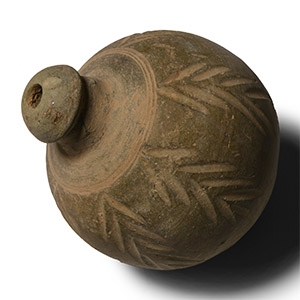
Byzantine 'Greek Fire' Ceramic Fire Bomb or Hand Grenade
9th-11th century A.D.Sold for (Inc. bp): £234
Piriform body with domed filler-hole, the body decorated with vertical palm leaf motifs; intended to be filled with explosive liquid and wick, used as a hand grenade. 300 grams, 10.1 cm
From a specialist collection of militaria, London, UK, collected 1990s onwards. Accompanied by an academic paper by military specialist Dr Raffaele D'Amato, dated 15 July 2019 and titled 'Eastern Roman Empire - Greek Fire Bomb or Hand Grenade (μεσαίον kακάβιον) 9th-11th century AD'.
Apart from the use of siphons or manual flame-throwers called cheirosiphona, special corps of Roman soldiers employed terracotta grenades, in the form of small jars, abundantly evidenced in archaeological excavations. They were called μεσαία kακαβιά or κυτροκακάβια where the former had a bulbous shape and the latter a more cylindrical form. -
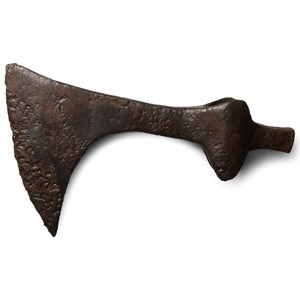
Viking Period Iron Broad Baltic Axe-Hammer
Circa 12th-13th century A.D.Sold for (Inc. bp): £494
Comprising a flat socket with lateral spurs, slender neck developing to a broad blade with curved edge, chin to the lower edge and point to the upper, rear square-section shank with disc hammer-face. 349 grams, 18.5 cm
Private collection, Arundel, West Sussex, UK, 1975-late 1990s.
During the mid 13th century, the axes were favourite weapons among the Baltic people. For example, the Curonian army included lightly armed soldiers who fought with spears, shields, fighting knives and axes. A heavily armed soldier could also carry a sword, a helmet, a shield and a wide-bladed axe. -
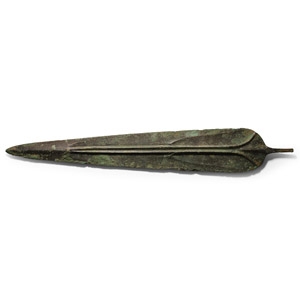
Luristan Wide-Bladed Bronze Sword with Blood Channels
1st millennium B.C.Sold for (Inc. bp): £390
Two-edged leaf-shaped blade with short rectangular tang, corrugated midrib extending almost to the tip and flared at the shoulders. 671 grams, 48.5 cm
Acquired 1980-2015. Ex Abelita family collection.
Luristan was hardly an ethnic or political entity, but the people of Luri had relations through warfare and trade with Sumerians, Lullubi, Assyrians, Babylonians and Elamites in a large time period, spanning from the 3rd to the 2nd millennium BC. The ruling elites of warrior horsemen were buried in the graves with their weapons and horses. -
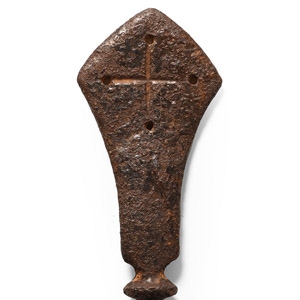
Medieval Iron Incendiary Fire Arrowhead with Pierced Cross
Circa 12th-14th century A.D.Sold for (Inc. bp): £338
The wide blade with an incised cross motif, pierced through at the end of each arm, long tang with a collar. 37 grams, 12.1 cm
Acquired on the French art market. From the private collection of a Buckinghamshire, UK, gentleman.
The central void was included to allow cloth soaked in tallow to be bound around the arrowhead; this was ignited before shooting. -
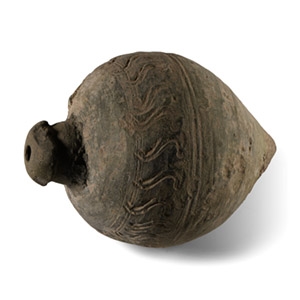
Byzantine 'Greek Fire' Ceramic Fire Bomb or Hand Grenade
9th-11th century A.D.Sold for (Inc. bp): £91
A piriform ceramic missile with band of S-scrolls to the shoulder, domed filler-hole, intended to be filled with explosive liquid and wick, used as a hand grenade. 533 grams, 12 cm
From a military inspired collection formed from the 1990s. Accompanied by an academic paper by military specialist Dr Raffaele D'Amato, dated 15 July 2019 and titled 'Eastern Roman Empire - Greek Fire Bomb or Hand Grenade (μεσαίον kακάβιον) 9th-11th century AD'.
Apart from the use of siphons or manual flame-throwers called cheirosiphona, special corps of Roman soldiers employed terracotta grenades, in the form of small jars, abundantly evidenced in archaeological excavations. They were called μεσαία kακαβιά or κυτροκακάβια where the former had a bulbous shape and the latter a more cylindrical form.
