
Auction Highlights
-
.jpg)
Egyptian Granite Head of a Dignitary
Sold for (Inc. bp): £28,600
Carved with soft facial features and carefully executed cosmetic lines around the eye, earring, and carefully detailed duplex wig with gently wavy curls; likely from the Ramesside Period; mounted on a custom-made stand. -
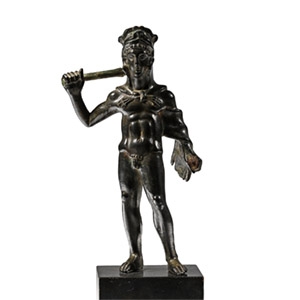
Etruscan Bronze Statuette of Herakles
Sold for (Inc. bp): £18,200
Modelled in the round with a muscular nude body, his club resting on his shoulder and the hair dressed in rows of tight, close-set curls underneath the Nemean lionskin hood with cloak billowing over his left arm, the paws tied across his chest; mounted on a custom-made display stand. -
.jpg)
Roman Marble Portrait of a Boy as Worshipper of Isis
Sold for (Inc. bp): £17,550
Carved head of a prepubescent worshipper of Isis, with soft facial features, long nose, small downturned mouth, heavy-lidded eyes, the whole giving the face a sombre or mournful appearance; the hair textured to indicate a short cut and combed forward across the scalp, sidelock above the right ear; mounted on a 16th century carved breccia upper body with leather cuirass and pteruges to right shoulder, cloak draped across the shoulders and fastened at the clavicle on the right side with a disc-brooch; socle base; some restoration. -
.jpg)
Larger Than Life-Size Roman Bronze Sandaled Foot
Sold for (Inc. bp): £39,000
Modelled in the round and originally part of a monumental statue, the naturalistic right foot encased in a trochades leather sandal with median reversed tongue secured with side straps and thick looped laces; the thick platform sole slightly curved, toes and nails well defined; mounted on a substantial custom-made display stand. -
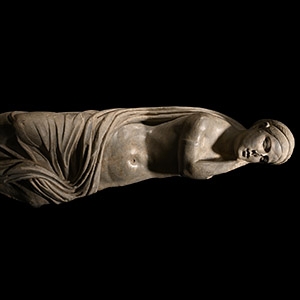
Life-Size Roman Marble Sleeping Girl from a Sarcophagus Lid
Sold for (Inc. bp): £20,800
Modelled in the half-round, nude with eyelids half-closed in sleep; a drapery partly covering the head and wrapping around the lower body under the hips; the hairstyle similar to those of the Antonine Dynasty, the peaceful face supported by the hands and the ear pierced to accept an earring; iron reinforcing rod to the feet and the right arm's armilla a later replacement; upper head restored in Parian marble. -
.jpg)
Byzantine Porphyry Relief with Cross Surrounded by Two Birds
Sold for (Inc. bp): £28,600
An imposing panel divided to four sections by a central cross on a stepped pedestal, the lower and upper arm with branch-like extensions; the upper quadrants with a circlet surrounding a palm tree-shaped motif; each lower quadrant with a bird in profile facing back; mounted on a custom-made display stand. -
.jpg)
Carved Marble Memento Mori Skull
Sold for (Inc. bp): £16,900
Carved skull on a short neck with musculature and blood vessels; mandible in place with some teeth in sockets, wisps of hair adhering to the dome of the skull; one zygomatic bone partly absent; square-section socle base. -
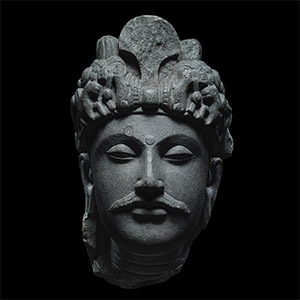
'The Kelton' Gandharan Head of a Bodhisattva
Sold for (Inc. bp): £24,700
Carved in the half-round head of a Bodhisattva (probably Maitreya) with fine detailing to the arched brow, aquiline nose, neat moustache and full lips; the eyes heavily lidded, urna to the forehead, long open lobes to the ears; the hair in multi-stranded curling locks gathered into an ushnisha with brow-band below; heavily cleaned, conserved, and mounted on a custom-made stand; supplied with original old wooden base with collector's label: 'Head of Bodhisattva / Fine grain schist / Gandhara, Northwest Pakistan / 4th century'.
-
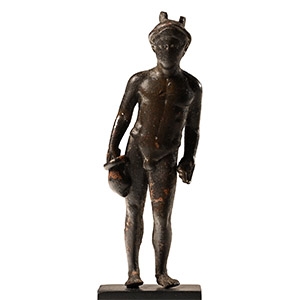
Roman Bronze Mercury Statuette
2nd century A.D.Sold for (Inc. bp): £845
Standing nude in contrapposto stance with winged petasos over his neat hair; left hand modelled open to accept a patera, right hand holding the marsupium coin-purse; free-running bronze arm-ring; mounted on a custom-made stand. 123 grams total, 10.8 cm including stand
Identified as Roman by the British Museum on 8th January 1996. From a collection acquired on the UK art market from various auction houses and collections mostly before 2000. From an important Cambridgeshire estate; thence by descent. -
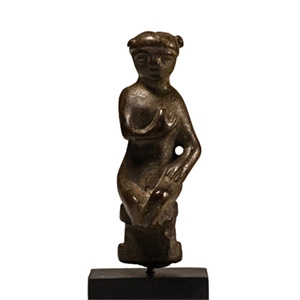
Gallo-Roman Bronze Statuette of Venus
2nd-3rd century A.D.Sold for (Inc. bp): £247
Modelled in the round figure of Venus (Aphrodite) seated nude on a columnar feature, her legs crossed, left hand placed on her thigh and right hand cupping her breasts; naive facial detailing with exaggerated lentoid eyes, hair parted in the middle and gathered in bunches; mounted on a custom-made stand. 152 grams total, 86 mm including stand
From a collection acquired on the UK art market from various auction houses and collections mostly before 2000. From an important Cambridgeshire estate; thence by descent. -
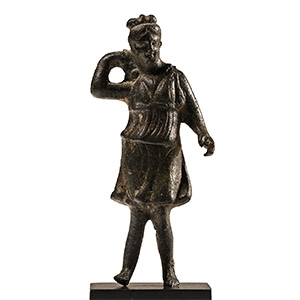
Roman Bronze Statuette of Diana
2nd-3rd century A.D.Sold for (Inc. bp): £390
The goddess advancing in active pose wearing a knee-length tunic gathered below her breasts, her hair tied above her crown; quiver to her right shoulder, right arm bent reaching for an arrow, left arm extended and hand open to grip a bow (absent); mounted on a custom-made stand. 105 grams total, 94 mm including stand
From a collection acquired on the UK art market from various auction houses and collections mostly before 2000. From an important Cambridgeshire estate; thence by descent. -
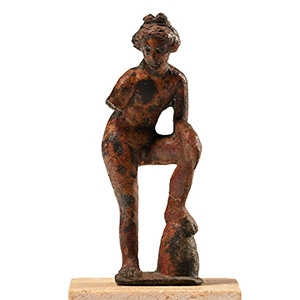
Roman Bronze Apollo Statuette
1st-2nd century A.D.Sold for (Inc. bp): £546
Modelled in the round standing nude with left foot resting on a pillar, the hair dressed in flowing tresses with top-knot; mounted on a custom-made stand. 115 grams total, 82 mm including stand
From a collection acquired on the UK art market from various auction houses and collections mostly before 2000. From an important Cambridgeshire estate; thence by descent.
Depictions of Apollo in association with the Omphalos usually show him seated upon it, as seen in the coinage of Antigonus I, circa 280-261 B.C. -
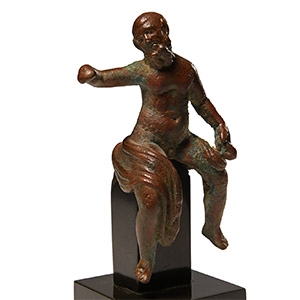
Roman Bronze Silenus Rider Figurine
1st-3rd century A.D.Sold for (Inc. bp): £845
Modelled in the round as a figure of a nude male with legs spread as if bestriding a horse; the bald head tilted an turned towards the right shoulder, with pointed ears, fleshy features and a full beard; a textile covering draped around the right thigh and lower body gathered in the left hand; the legs spread and feet dangling, with later holes for attachment pegs; the right arm extended perpendicular to the body and the hand bent round; the base of the spine with vestigial tail and the cloth draped as if on a horse's rump; mounted on a custom-made stand. 200 grams, 98 mm (362 grams total, 14 cm high including stand)
London art market, 1992.
The figure represents either Silenus himself, the aged and semi-bestial companion of Dionysus, or a Seilenos - a member of the feral group of which he was the leader. The attitude of the figure, with the right arm extended and the head tilted, suggests that there should have been an accompanying female figure to whom Silenus was paying full attention. As a devotee of Dionysus, Silenus is often shown with Bacchantes, female celebrants in the cult of wine-drinking, music and other pleasurable pursuits. -
.jpg)
Romano-Celtic Bronze Statuette of a Warrior Wearing Torc
Circa 1st-2nd century A.D.Sold for (Inc. bp): £78
Modelled in the round, standing with right leg bent, right arm raised and left extended before the body; with thick tousled hair, exaggerated torc to the neck, jacket with incised vertical lines, tight-fitting trousers and ankle-boots. 53 grams total, 67 mm
From a collection acquired on the UK art market from various auction houses and collections mostly before 2000. From an important Cambridgeshire estate; thence by descent.
The pose of the figure suggests that he is in the action of brandishing a weapon, or possibly holding the reins of a team of horses pulling a chariot. Caesar mentions the expert use of the war-chariot by the Britons (Conquest of Gaul, IV.33). The padded garment suggests a Celtic auxiliary in the Roman army. -
Life-Size Roman Marble Sleeping Girl from a Sarcophagus Lid
2nd century A.D.Sold for (Inc. bp): £20,800
Modelled in the half-round, nude with eyelids half-closed in sleep; a drapery partly covering the head and wrapping around the lower body under the hips; the hairstyle similar to those of the Antonine Dynasty, the peaceful face supported by the hands and the ear pierced to accept an earring; iron reinforcing rod to the feet and the right arm's armilla a later replacement; upper head restored in Parian marble. 104 kg, 110 cm long (120 kg, 117 cm including stand)
Acquired from G. Rihani, 1987. English private collection. Accompanied by a copy of the purchase invoice, 2 July 1987. Accompanied by an academic report by Dr Raffaele D'Amato. This lot has been checked against the Interpol Database of stolen works of art and is accompanied by search certificate number no.12231-218595
The girl shows exotic features, evocative of Roman North Africa, where a mixed Romano-Berber population lived in one of the richest provinces of the Empire. However, the hairstyle refers to those of the Antonine Dynasty, such as the portraits of the Empress Faustina the Elder. It represents probably a sarcophagus lid of a young noble girl, commissioned by her loving parents. Some restorations, today still visible, were done in ancient times: an iron rod at the feet for reinforcement, the armilla on the right arm sculpted at a later stage, the hole in the ear for the insertion of a lost metal or glass earring, the upper part of the head restored in antique with a portion of Parian marble. The sculpture is a Roman work, but it was inspired by a Hellenistic model, probably from Pergamon. -
.jpg)
Roman Marble Draped Torso of Asclepius
2nd-3rd century A.D.Sold for (Inc. bp): £9,750
Modelled in the round statue of the god standing with chest uncovered, calf-length himation draped to the left shoulder and arm, secured at the waist, held by the left hand; mounted on a custom-made stand. 28 kg total, 61 cm including stand
Private collection, England. Accompanied by an academic report by Dr Raffaele D'Amato. This lot has been checked against the Interpol Database of stolen works of art and is accompanied by search certificate number no.12232-215644. -
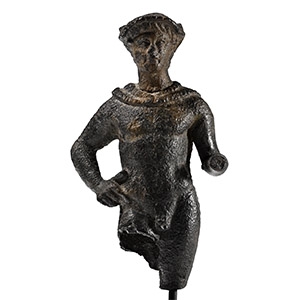
Roman Bronze Mercury Statuette
1st century A.D.Sold for (Inc. bp): £715
The figure standing nude with right hand pressed against the hip, left arm bent and forearm extended; narrow chlamys worn across the shoulders and down the back terminating at the rear of the knees; the facial features modelled in some detail with slight oversized eyes, perhaps to accept a silver inlay; petasos to the head with vestigial lateral wings; mounted on a custom-made stand. 778 grams total, 17.2 cm including stand
Acquired from Simon Shipp, circa 1997. Believed to be published in an old Den of Antiquity catalogue. From an important Cambridgeshire estate; thence by descent. -
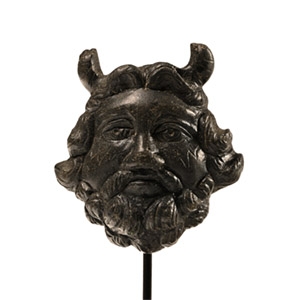
Roman Bronze Head Mount of Oceanus
1st-2nd century A.D.Sold for (Inc. bp): £845
Bust of Oceanus in high-relief, hollow to the reverse, with flowing hair and beard, large lentoid eyes and broad nose, with crab/lobster claws emerging from his locks; mounted on a custom-made stand. 68.2 grams total, 83 mm including stand
Identified by the British Museum as depicting Oceanus on 8th January 1996. From a collection acquired on the UK art market from various auction houses and collections mostly before 2000. From an important Cambridgeshire estate; thence by descent. Accompanied by a copy of the British Museum letter dated 8th January 1996. -
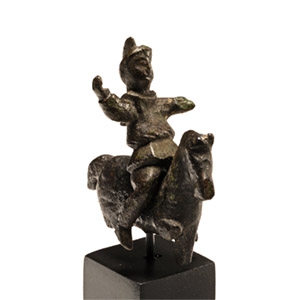
Roman Bronze Statuette of Mars on Horseback
2nd-3rd century A.D.Sold for (Inc. bp): £286
Wearing a crested helmet, cloak, bloused tunic and braccae, the god bestriding his mount with right arm raised and hand open to support a spear; mounted on a custom-made stand. 80.1 grams total, 68 mm including stand
From a collection acquired on the UK art market from various auction houses and collections mostly before 2000. From an important Cambridgeshire estate; thence by descent. -
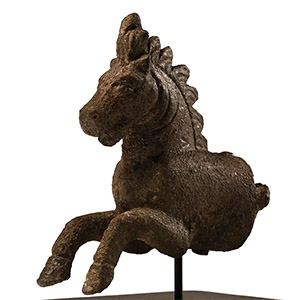
Roman Bronze Horse Protome
3rd century A.D.Sold for (Inc. bp): £494
Modelled in active leaping pose with forelegs extended, mane flying and mouth slightly open; hollow to the reverse with two attachment lugs; mounted on a custom-made stand. 173 grams total, 85 mm including stand
From a collection acquired on the UK art market from various auction houses and collections mostly before 2000. From an important Cambridgeshire estate; thence by descent.
