
Auction Highlights
-
.jpg)
Egyptian Granite Head of a Dignitary
Sold for (Inc. bp): £28,600
Carved with soft facial features and carefully executed cosmetic lines around the eye, earring, and carefully detailed duplex wig with gently wavy curls; likely from the Ramesside Period; mounted on a custom-made stand. -
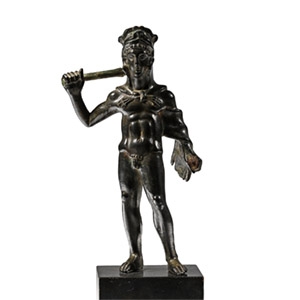
Etruscan Bronze Statuette of Herakles
Sold for (Inc. bp): £18,200
Modelled in the round with a muscular nude body, his club resting on his shoulder and the hair dressed in rows of tight, close-set curls underneath the Nemean lionskin hood with cloak billowing over his left arm, the paws tied across his chest; mounted on a custom-made display stand. -
.jpg)
Roman Marble Portrait of a Boy as Worshipper of Isis
Sold for (Inc. bp): £17,550
Carved head of a prepubescent worshipper of Isis, with soft facial features, long nose, small downturned mouth, heavy-lidded eyes, the whole giving the face a sombre or mournful appearance; the hair textured to indicate a short cut and combed forward across the scalp, sidelock above the right ear; mounted on a 16th century carved breccia upper body with leather cuirass and pteruges to right shoulder, cloak draped across the shoulders and fastened at the clavicle on the right side with a disc-brooch; socle base; some restoration. -
.jpg)
Larger Than Life-Size Roman Bronze Sandaled Foot
Sold for (Inc. bp): £39,000
Modelled in the round and originally part of a monumental statue, the naturalistic right foot encased in a trochades leather sandal with median reversed tongue secured with side straps and thick looped laces; the thick platform sole slightly curved, toes and nails well defined; mounted on a substantial custom-made display stand. -
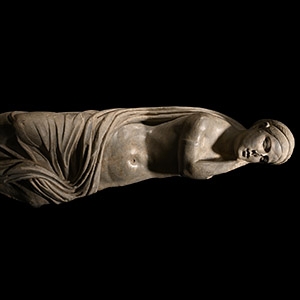
Life-Size Roman Marble Sleeping Girl from a Sarcophagus Lid
Sold for (Inc. bp): £20,800
Modelled in the half-round, nude with eyelids half-closed in sleep; a drapery partly covering the head and wrapping around the lower body under the hips; the hairstyle similar to those of the Antonine Dynasty, the peaceful face supported by the hands and the ear pierced to accept an earring; iron reinforcing rod to the feet and the right arm's armilla a later replacement; upper head restored in Parian marble. -
.jpg)
Byzantine Porphyry Relief with Cross Surrounded by Two Birds
Sold for (Inc. bp): £28,600
An imposing panel divided to four sections by a central cross on a stepped pedestal, the lower and upper arm with branch-like extensions; the upper quadrants with a circlet surrounding a palm tree-shaped motif; each lower quadrant with a bird in profile facing back; mounted on a custom-made display stand. -
.jpg)
Carved Marble Memento Mori Skull
Sold for (Inc. bp): £16,900
Carved skull on a short neck with musculature and blood vessels; mandible in place with some teeth in sockets, wisps of hair adhering to the dome of the skull; one zygomatic bone partly absent; square-section socle base. -
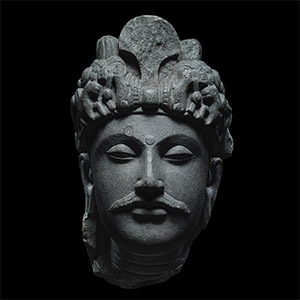
'The Kelton' Gandharan Head of a Bodhisattva
Sold for (Inc. bp): £24,700
Carved in the half-round head of a Bodhisattva (probably Maitreya) with fine detailing to the arched brow, aquiline nose, neat moustache and full lips; the eyes heavily lidded, urna to the forehead, long open lobes to the ears; the hair in multi-stranded curling locks gathered into an ushnisha with brow-band below; heavily cleaned, conserved, and mounted on a custom-made stand; supplied with original old wooden base with collector's label: 'Head of Bodhisattva / Fine grain schist / Gandhara, Northwest Pakistan / 4th century'.
-
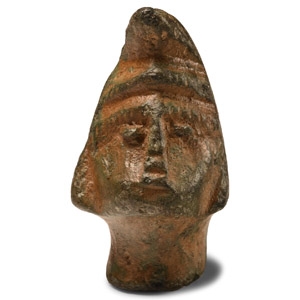
Roman Bronze Head of Mithras Weight
1st-4th century A.D.Sold for (Inc. bp): £130
With Phrygian cap worn with the point pulled forward, hatching to the hair and beard. 31.5 grams, 32 mm
Ex Simmons Gallery, London, UK. From a collection from North London, UK, 1990s. -
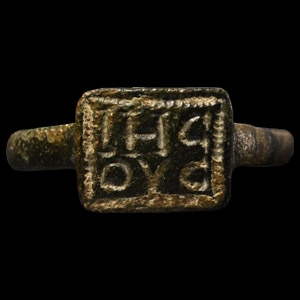
Late Roman Bronze Ring Inscribed 'Jesus'
4th-5th century A.D.Sold for (Inc. bp): £182
With rectangular bezel, inscribed 'IHC / OYC' (Iesous = 'Jesus'); shank split. 3.74 grams, 22.53 mm overall, 17.86 mm internal diameter (approximate size British N 1/2, USA 6 3/4, Europe 14.35, Japan 13)
From an old UK collection, 1980s. -
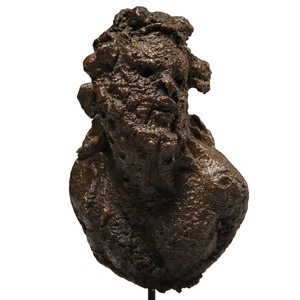
Roman Bronze Head of Silenus Applique
1st century A.D.Sold for (Inc. bp): £208
Modelled in the round with open reverse at the shoulders and chest; the bearded head turned towards the left shoulder, the hair decorated with a wreath of leaves, a goatskin mantle fastened below the right shoulder; the eye sockets set deep into the surface; mounted on a custom-made stand. 214 grams total, 11.7 cm including stand
From a collection acquired on the UK art market from various auction houses and collections mostly before 2000. From an important Cambridgeshire estate; thence by descent. -
.jpg)
Roman Bronze 'Colchester Type' Bow Brooch Collection
1st-2nd century A.D.Sold for (Inc. bp): £13
Group of bow-brooches, mainly Colchester Type with coiled spring. 48 grams total, 36-77 mm
Found near Bainton, East Riding of Yorkshire, UK. -
.jpg)
Roman and Later Artefact Group
1st-20th century A.D.Sold for (Inc. bp): £85
Comprising complete and fragmentary artefacts: a glass cameo; seal; implements; strap ends; mounting studs; brooches; weights; buckles; pendants; together with other miscellaneous artefacts. 498 grams total, 0.8-13.3 cm
Acquired on the UK art market. Property of a Ruislip, UK, gentleman, by inheritance. -
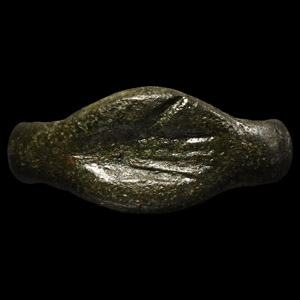
Roman Bronze Ring with Hand
2nd-3rd century A.D.Sold for (Inc. bp): £65
Wide hoop expanding to an oval-shaped intaglio with open hand. 3.18 grams, 20.88 mm overall, 17.14 mm internal diameter (approximate size British N, USA 6 1/2, Europe 13.72, Japan 13)
Private collection formed since the 1940s. UK art market. Property of an Essex, UK, gentleman. -
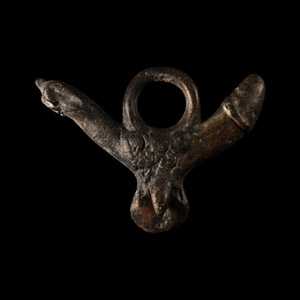
Large Roman Bronze Triple Phallic Pendant
1st-2nd century A.D.Sold for (Inc. bp): £104
Comprising male genitals flanked by an erect phallus and a hand in the fica gesture. 55 grams, 73 mm
From a collection acquired on the UK art market from various auction houses and collections mostly before 2000. From an important Cambridgeshire estate; thence by descent. -
.jpg)
Roman Bronze Flying Phallus
2nd-3rd century A.D.Sold for (Inc. bp): £546
Amuletic model phallus with swept lateral wings; mounted on a custom-made stand. 99 grams total, 67 mm high including stand
From a collection acquired on the UK art market from various auction houses and collections mostly before 2000. From an important Cambridgeshire estate; thence by descent. -
.jpg)
Roman Bronze Horse Brooch
Circa 2nd century A.D.Sold for (Inc. bp): £111
Formed as a standing horse, the hindlegs forming crossbar, tail forming hinged pin, forelegs forming catchplate; ring-and-dot motifs to shoulders, linear detailing to the mane. 11.8 grams, 35 mm
From a collection acquired on the UK art market from various auction houses and collections mostly before 2000. From an important Cambridgeshire estate; thence by descent. -
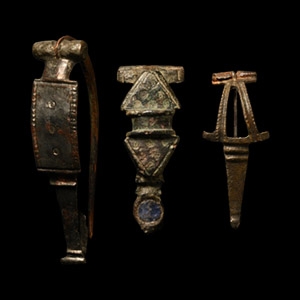
Roman Bronze Brooch Collection
2nd-3rd century A.D.Sold for (Inc. bp): £195
Including T-shaped, aucissa and other types; all complete with pins. 13 grams total, 35-50 mm
Property of the vendor's grandfather, thence by family descent, circa 1985. From the private collection of a New York, USA gentleman. -
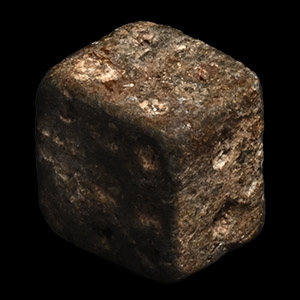
Roman Lead 'Loaded Dice' Gaming Piece
1st-2nd century A.D.Sold for (Inc. bp): £124
Cuboid with impressed point markings disposed 6:6, 2:3, 5:4; old collector's tag '250'. 9.24 grams, 11 mm
From the important private collection of dice and gaming pieces of Colin Narbeth, London, UK, collection no.250.
The die appears to have two broader faces each with two lines of three points flanking a larger central point, perhaps suggesting that the score could be either 1 or 6 according to context. -
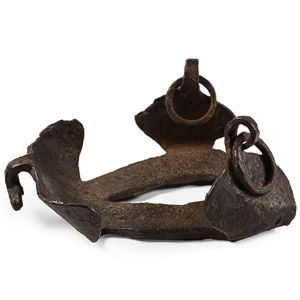
Iron 'Hippo Sandal' Military Horse Shoe
1st-4th century A.D.Sold for (Inc. bp): £286
Iron shoe with lateral curved plates with attachment rings rear panel with bar also for attachment. 363 grams, 15 cm
From the collection of the famous author, writer and speaker, Gordon Bailey, Essex, UK; formed since 1968.
Hipposandals (soleae ferreae) were used on horses with injured hooves, a sort of equine orthopaedic shoe used by the mulomedicus, i.e. a Roman military veterinarian. Another important function was that to protect the hooves of the horse from injuries and damages from hard objects. The hippo sandal of type 1 was formed from a sub-oval plate which tapered towards the front and rear with projections at the front, back and on either side. The heel was upturned at about 45 degrees and flared outwards. It would have terminated with a downward facing hook, now missing. The base of the sole was flat.
