
Auction Highlights
-
.jpg)
Egyptian Granite Head of a Dignitary
Sold for (Inc. bp): £28,600
Carved with soft facial features and carefully executed cosmetic lines around the eye, earring, and carefully detailed duplex wig with gently wavy curls; likely from the Ramesside Period; mounted on a custom-made stand. -
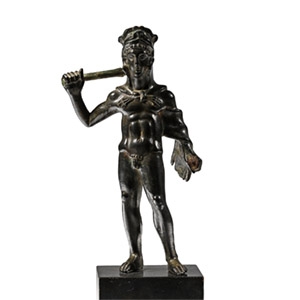
Etruscan Bronze Statuette of Herakles
Sold for (Inc. bp): £18,200
Modelled in the round with a muscular nude body, his club resting on his shoulder and the hair dressed in rows of tight, close-set curls underneath the Nemean lionskin hood with cloak billowing over his left arm, the paws tied across his chest; mounted on a custom-made display stand. -
.jpg)
Roman Marble Portrait of a Boy as Worshipper of Isis
Sold for (Inc. bp): £17,550
Carved head of a prepubescent worshipper of Isis, with soft facial features, long nose, small downturned mouth, heavy-lidded eyes, the whole giving the face a sombre or mournful appearance; the hair textured to indicate a short cut and combed forward across the scalp, sidelock above the right ear; mounted on a 16th century carved breccia upper body with leather cuirass and pteruges to right shoulder, cloak draped across the shoulders and fastened at the clavicle on the right side with a disc-brooch; socle base; some restoration. -
.jpg)
Larger Than Life-Size Roman Bronze Sandaled Foot
Sold for (Inc. bp): £39,000
Modelled in the round and originally part of a monumental statue, the naturalistic right foot encased in a trochades leather sandal with median reversed tongue secured with side straps and thick looped laces; the thick platform sole slightly curved, toes and nails well defined; mounted on a substantial custom-made display stand. -
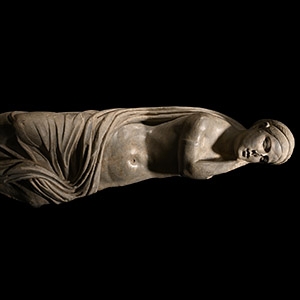
Life-Size Roman Marble Sleeping Girl from a Sarcophagus Lid
Sold for (Inc. bp): £20,800
Modelled in the half-round, nude with eyelids half-closed in sleep; a drapery partly covering the head and wrapping around the lower body under the hips; the hairstyle similar to those of the Antonine Dynasty, the peaceful face supported by the hands and the ear pierced to accept an earring; iron reinforcing rod to the feet and the right arm's armilla a later replacement; upper head restored in Parian marble. -
.jpg)
Byzantine Porphyry Relief with Cross Surrounded by Two Birds
Sold for (Inc. bp): £28,600
An imposing panel divided to four sections by a central cross on a stepped pedestal, the lower and upper arm with branch-like extensions; the upper quadrants with a circlet surrounding a palm tree-shaped motif; each lower quadrant with a bird in profile facing back; mounted on a custom-made display stand. -
.jpg)
Carved Marble Memento Mori Skull
Sold for (Inc. bp): £16,900
Carved skull on a short neck with musculature and blood vessels; mandible in place with some teeth in sockets, wisps of hair adhering to the dome of the skull; one zygomatic bone partly absent; square-section socle base. -
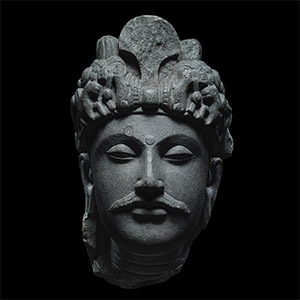
'The Kelton' Gandharan Head of a Bodhisattva
Sold for (Inc. bp): £24,700
Carved in the half-round head of a Bodhisattva (probably Maitreya) with fine detailing to the arched brow, aquiline nose, neat moustache and full lips; the eyes heavily lidded, urna to the forehead, long open lobes to the ears; the hair in multi-stranded curling locks gathered into an ushnisha with brow-band below; heavily cleaned, conserved, and mounted on a custom-made stand; supplied with original old wooden base with collector's label: 'Head of Bodhisattva / Fine grain schist / Gandhara, Northwest Pakistan / 4th century'.
-
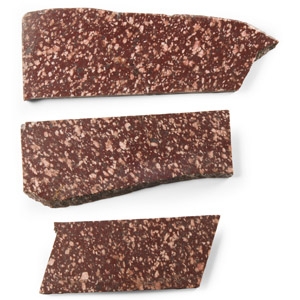
Roman Historic Cut & Polished Porphyry Slice Group
1st-5th century A.D. and laterSold for (Inc. bp): £234
Comprising three lacquered porphyry slices of rectangular shape, cut on both faces and polished on one face; probably from recycled material mined in ancient Roman times between the 1st and 5th century A.D.; intended for use as inlay panels. 82.8 grams total, 7.2-10.1 cm
From Egypt. Ex Mineral Imports, London, UK. Gregory, Bottley & Lloyd (Gregory's).
Mons Porphyrites (today Jabal Abu Dukhkhan) is the mountainous site of a group of ancient quarries in the Red Sea Hills of the inhospitable eastern desert in Egypt, a five day trip from the Nile during Roman times. They were discovered by Caius Cominus Leugas in 18 A.D., and during the Roman Empire the mines officially belonged to the emperor and were the only known source of the Imperial Porphyry, Mons Porphyrites. This dark purple stone was associated with royalty and used for prestigious sculpture and architecture. The location of the mines was lost some time in the 5th century, and rediscovered in the early 19th century. Excavations in the area have revealed the well-preserved quarries and the dwelling places of the quarry men, and also thousands of ostraca have been discovered containing messages that provide details of how the quarrying took place, and of how the highly skilled quarrymen ordered their food. -
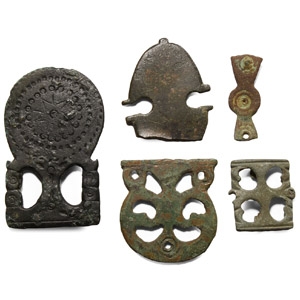
Roman Bronze Military Belt Mount Collection
4th-5th century A.D.Sold for (Inc. bp): £85
Comprising: an amphora-shaped strap end decorated with rings and dots, the centre ornamented by a star surrounded by small dots and circles; a shield-shaped strap end, with a concave crescent on each side; an openwork decorated fitting with a kidney shaped motif in each quarter; a shield-shaped decorated strap end, with kidney-shaped openwork design; and a propeller shaped mount. 75 grams total, 29-66 mm
From the collection of the famous author, writer and speaker, Gordon Bailey, Essex, UK; formed since 1968.
In Britain like in all of the West, all the elements intended for the embellishment of belts and harnesses also evolved towards new forms, the geometry of which bears witness to strong Germanic influences. Beside the typical propeller stiffener belts (Richborough), probably of Danubian origin, we have less ornate wide-belt types, represented by the Winchester example. Belt-plaques of triangular shape, often gilded, beast-shaped at the extremity, were excavated in the south of Britain (Cirencester). Rigid belt-plates with the buckle shaped like a dolphin came from Richborough, Wye and Sleaford (class 3, type B, Sommer), Tripontium, Mucking, Wycombe, Alwalton (type I-B, Hawkes, also in Richborough) and type Mainz, Savgar, Totanés (Colchester, often with associated propeller stiffeners). Type Hawkes I-A and I-B present similarities with the Simancas typologies, found in Lankhills. The type Tirig is attested at Lydney Park, the Böhme A in Richborough. Strap ends are usually heart-shaped or amphora-shaped (Richborough). These belt fittings were characteristic of the Roman army in Britain at the beginning of the 5th century. -
.jpg)
Roman Artefact Group
Circa 1st-5th century A.D.Sold for (Inc. bp): £59
A trio of artefacts comprising: a Roman copper-alloy coin, likely a sestertius, with worn designs to obverse and reverse, the reverse likely portraying the goddess Minerva leaning on a shield and wearing a helmet; a stone loom weight of conoid form, dated c.100 A.D. and discovered in Egypt; a Roman ceramic oil lamp dated c.500 A.D., piriform in plan with raised borders to the central opening and nozzle, decorative ribbing to the shoulder, conical handle and basal ring. 150 grams total, 33-92 mm
From an old UK collection. From the private collection of Alf Baxendale (1941-2016) part 2, keen Egyptologist, member of the Egyptology Society, trustee of the Amarna Trust; thence by descent. Accompanied by a copy of his obituary published in Horizon, The Amarna Project and Amarna Trust newsletter, Issue 18, 2017, p.21, by Barry John Kemp, CBE, FBA, Professor Emeritus of Egyptology at the University of Cambridge and directing excavations at Amarna in Egypt. -
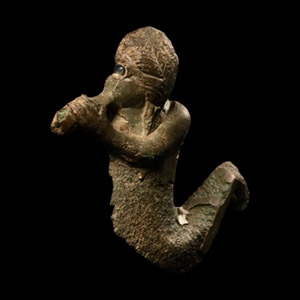
Roman Bronze Triton Mount
1st-2nd century A.D.Sold for (Inc. bp): £221
Long haired, human face with detailed scaly fish body, glass insert preserved in the eye, in the act of blowing to a seashell. 31.6 grams, 70 mm
From the collection of the famous author, writer and speaker, Gordon Bailey, Essex, UK; formed since 1968.
The Triton is in the typical position of playing an empty shell. The mount was an exceptional piece, with the eyes filled with glass, and would have decorated an ornate bowl or vessel. -
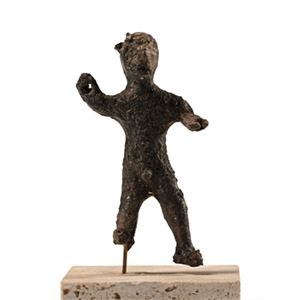
Roman Bronze Votive Statuette
1st century B.C.-1st century A.D.Sold for (Inc. bp): £78
Standing nude figure of a warrior with left hand extended, pierced to accept the grip of a shield, right hand raised, pierced to accept the shaft of a spear; mounted on a custom-made stand. 117 grams total, 82 mm including stand
From a collection acquired on the UK art market from various auction houses and collections mostly before 2000. From an important Cambridgeshire estate; thence by descent. -
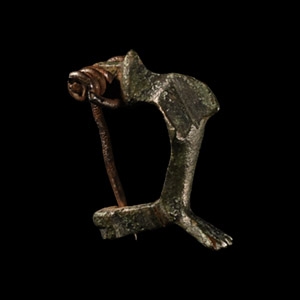
Roman Bronze Dolphin Brooch
Circa 2nd century A.D.Sold for (Inc. bp): £33
With deep curved bow, dorsal fin to the apex and fantail footplate, coiled spring and pin. 11.07 grams, 34 mm
Property of the vendor's grandfather, thence by family descent, circa 1985. From the private collection of a New York, USA gentleman. -
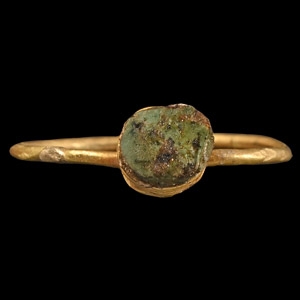
Roman Gold Ring with Turquoise
1st-4th century A.D.Sold for (Inc. bp): £176
Slender shank, gold cell with corrugated rim, inset turquoise stud. 0.68 grams, 18.61 mm overall, 13.15 mm internal diameter
Ex property of a late Japanese collector, 1970-2000s. -
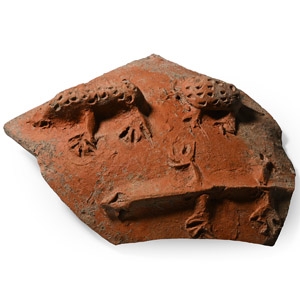
Redware Fragment with Amphibians
Roman, circa 2nd century A.D. or laterSold for (Inc. bp): £46
With curving profile, applied raised figures of a lizard, a frog and a turtle to the upper surface with incised detailing. 155 grams, 13 cm
Ex German art market, 2000s. Acquired from an EU collector living in London. From the collection of Surrey, UK, gentleman. -
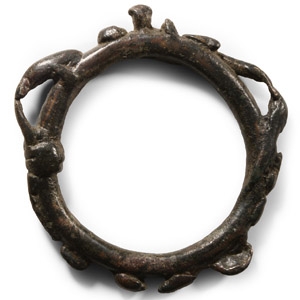
Roman Bronze Chariot Terret Ring with Animals
1st-4th century A.D.Sold for (Inc. bp): £195
Annular in form with integral collar and wreath detailing, animal forms to the outer edge; usage wear. 179 grams, 10.3 cm
From a collection acquired on the UK art market from various auction houses and collections mostly before 2000. From an important Cambridgeshire estate; thence by descent. -
.jpg)
Roman Coloured Glass Bracelet Group
Circa 2nd-4th century A.D.Sold for (Inc. bp): £124
Comprising one round-section in deep blue, one similar in deep red, and a D-section in pale blue/turquoise. 14.3 grams total, 42-55 mm
Formerly with a Bournemouth gentleman. Ex Essex collection. Property of a Scottish collector, acquired in 2013.
Bangles did not occur in a vacuum after the Roman invasion but were an integral part of globalising networks of cross-Channel trade and connections with the European mainland in the early first century A.D. According to J. Price bangles were first developed in southern Britain in the late Claudio-Neronian period (A.D. 43–65/70) and that in subsequent periods the craft of bangle-making quickly spread further north with the advance of the Roman army. -
.jpg)
Roman Redware Ram Pottery Sherd
Circa 4th-5th century A.D.Sold for (Inc. bp): £59
Fragment of a terracotta votive statuette representing a ram, detail to the horns, ears and fleece; set with a suspension ring on the reverse. 50 grams, 77 mm wide
Acquired 1960s-1990s. From the late Alison Barker collection, a retired London barrister.
Many figurines of this type have been found in the Hellenised Roman provinces of the east and one identical in the Athenian Agora. They are all rendered with incisions that are characteristic of the technique of the late fourth century. Many similar examples were found in the Kerameikos and some are in the National Museum of Archaeology, Athens. A similar technique is observable in the handles representing animal heads which occur on red pottery ornamented with white paint. -
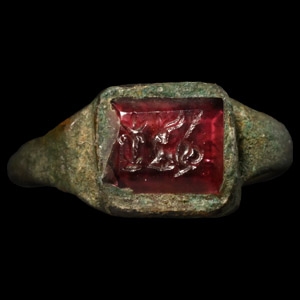
Roman Bronze Ring with Recumbent Deer Facing Back Gemstone
2nd-4th century A.D.Sold for (Inc. bp): £124
With a slender D-section hoop, square raised bezel set with red carnelian intaglio, engraved with a recumbent deer before a small tree, its head resting on its back and a long arrow piercing its back. 2.30 grams, 21.32 mm overall, 16.00 mm internal diameter (approximate size British K, USA 5 1/4, Europe 9.95, Japan 9)
Private collection formed since the 1940s. UK art market. Property of an Essex, UK, gentleman.
The iconography may refer to a version of a tradition in which Heracles shot the Ceryneian hind before it crossed the river Ladon.
