
Auction Highlights
-
.jpg)
Egyptian Granite Head of a Dignitary
Sold for (Inc. bp): £28,600
Carved with soft facial features and carefully executed cosmetic lines around the eye, earring, and carefully detailed duplex wig with gently wavy curls; likely from the Ramesside Period; mounted on a custom-made stand. -
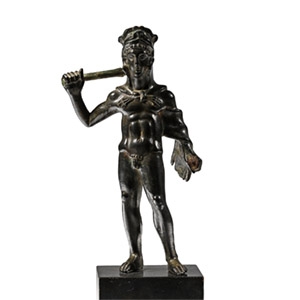
Etruscan Bronze Statuette of Herakles
Sold for (Inc. bp): £18,200
Modelled in the round with a muscular nude body, his club resting on his shoulder and the hair dressed in rows of tight, close-set curls underneath the Nemean lionskin hood with cloak billowing over his left arm, the paws tied across his chest; mounted on a custom-made display stand. -
.jpg)
Roman Marble Portrait of a Boy as Worshipper of Isis
Sold for (Inc. bp): £17,550
Carved head of a prepubescent worshipper of Isis, with soft facial features, long nose, small downturned mouth, heavy-lidded eyes, the whole giving the face a sombre or mournful appearance; the hair textured to indicate a short cut and combed forward across the scalp, sidelock above the right ear; mounted on a 16th century carved breccia upper body with leather cuirass and pteruges to right shoulder, cloak draped across the shoulders and fastened at the clavicle on the right side with a disc-brooch; socle base; some restoration. -
.jpg)
Larger Than Life-Size Roman Bronze Sandaled Foot
Sold for (Inc. bp): £39,000
Modelled in the round and originally part of a monumental statue, the naturalistic right foot encased in a trochades leather sandal with median reversed tongue secured with side straps and thick looped laces; the thick platform sole slightly curved, toes and nails well defined; mounted on a substantial custom-made display stand. -
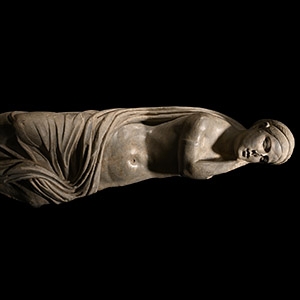
Life-Size Roman Marble Sleeping Girl from a Sarcophagus Lid
Sold for (Inc. bp): £20,800
Modelled in the half-round, nude with eyelids half-closed in sleep; a drapery partly covering the head and wrapping around the lower body under the hips; the hairstyle similar to those of the Antonine Dynasty, the peaceful face supported by the hands and the ear pierced to accept an earring; iron reinforcing rod to the feet and the right arm's armilla a later replacement; upper head restored in Parian marble. -
.jpg)
Byzantine Porphyry Relief with Cross Surrounded by Two Birds
Sold for (Inc. bp): £28,600
An imposing panel divided to four sections by a central cross on a stepped pedestal, the lower and upper arm with branch-like extensions; the upper quadrants with a circlet surrounding a palm tree-shaped motif; each lower quadrant with a bird in profile facing back; mounted on a custom-made display stand. -
.jpg)
Carved Marble Memento Mori Skull
Sold for (Inc. bp): £16,900
Carved skull on a short neck with musculature and blood vessels; mandible in place with some teeth in sockets, wisps of hair adhering to the dome of the skull; one zygomatic bone partly absent; square-section socle base. -
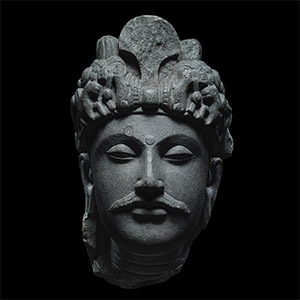
'The Kelton' Gandharan Head of a Bodhisattva
Sold for (Inc. bp): £24,700
Carved in the half-round head of a Bodhisattva (probably Maitreya) with fine detailing to the arched brow, aquiline nose, neat moustache and full lips; the eyes heavily lidded, urna to the forehead, long open lobes to the ears; the hair in multi-stranded curling locks gathered into an ushnisha with brow-band below; heavily cleaned, conserved, and mounted on a custom-made stand; supplied with original old wooden base with collector's label: 'Head of Bodhisattva / Fine grain schist / Gandhara, Northwest Pakistan / 4th century'.
-
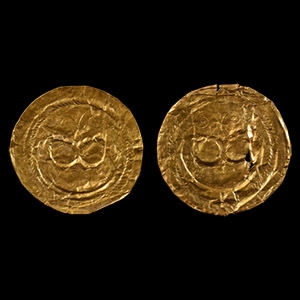
Roman Sheet Gold Phalera Cover Pair with Pelta Shields
4th-6th century A.D.Sold for (Inc. bp): £247
Comprising two discoid ornamental appliqués with beaded rims, each with repoussé pelta-shaped panel terminating in opposed bird-heads, surmounted by scrolled tendrils and a kantharos enclosed in a laurel crown. 7.28 grams total, 64-65 mm
Acquired in the early 1990s. From the collection of a London antiquarian. Accompanied by an academic report by Dr Raffaele D'Amato.
The subject represented on these two bracteae is a military shield in the form of a crescent, the so-called pelta, associated in the Late Roman iconography with the Amazon female warriors. This was not necessarily only an iconographic motif, considering that many shields of this typology were represented on the pedestal of the Column of Arcadius in Constantinople (circa 400 A.D.) and they seemed to be associated with the heavy cavalry of the Imperial guard (D’Amato-Negin, 2017, p.252). This could suggest that these gold sheets were applied upon phalerae or military decorations. -
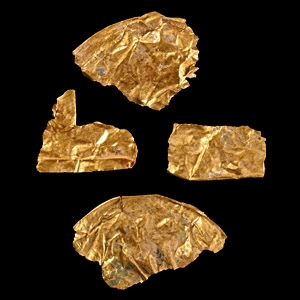
Roman Sheet Gold Phalera Cover Fragment Group
4th-5th century A.D.Sold for (Inc. bp): £65
Group of fragments of phalera covers with repoussé designs. 1.77 grams total, 10-37 mm
Acquired in the early 1990s. From the collection of an London antiquarian. -
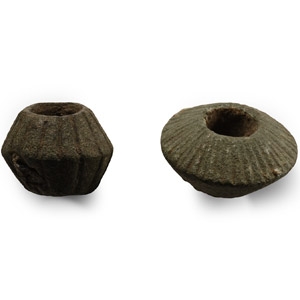
Roman Spindle Whorl Group
1st-4th century A.D.Sold for (Inc. bp): £13
Comprising a squat biconvex whorl with radiating lines to one face, and a taller version with lines to both faces. 53 grams total, 20-25 mm
From the collection of the famous author, writer and speaker, Gordon Bailey, Essex, UK; formed since 1968. -
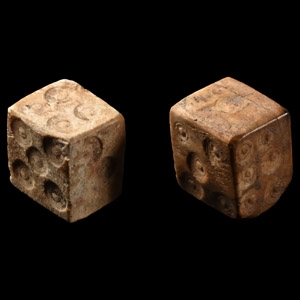
Roman Bone Gaming Dice Pair
2nd-4th century A.D.Sold for (Inc. bp): £221
Two roughly cuboid dice with ring and dot markings disposed 1:5, 2:4, 3:6; 1:2, 3:6, 4:5. 3.28 grams total, 11 mm each
Ex German art market, 2000s. Acquired from an EU collector living in London. From the collection of Surrey, UK, gentleman. -
.jpg)
Roman Black Glass and Other Bead Necklace String
1st century A.D. and laterSold for (Inc. bp): £46
Mainly composed of restrung opaque beads of various sizes, mainly irregular oblate and barrel shapes. 19.8 grams, 50 cm long
UK gallery, early 2000s. -
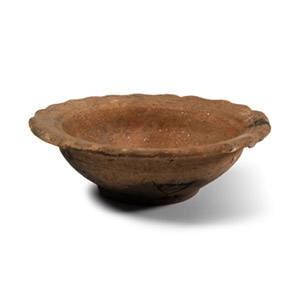
Roman Decorated Terracotta Dish
2nd-4th century A.D.Sold for (Inc. bp): £52
Squat in profile with low sidewall, basal ring, flared rim. 97 grams, 11.1 cm
From a collection acquired on the UK art market from various auction houses and collections mostly before 2000. From an important Cambridgeshire estate; thence by descent. -
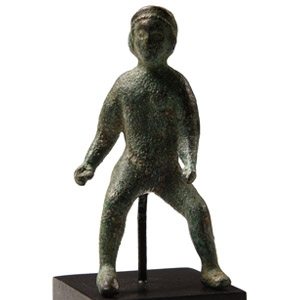
Gallo-Roman Bronze Rider Statuette
1st-2nd century A.D.Sold for (Inc. bp): £286
Modelled nude with legs thrust forward, left arm forward from the body, right arm held to the rear with hand forming a fist, diadem to the brow; mounted on a custom-made stand. 71 grams total, 78 mm including stand
From a collection acquired on the UK art market from various auction houses and collections mostly before 2000. From an important Cambridgeshire estate; thence by descent.
Unlike the British Museum statuette, our figure is represented in the heroic nudity of the warrior on horseback, even if the position is identical. It is very likely that the statuette represents one of the Dioscuri, Castor and Pollux, and perhaps it was part of a pair of twins on horseback. -
.jpg)
Roman Bronze and Other Mixed Artefact Group
Circa 6th century A.D.Sold for (Inc. bp): £234
Including brooches of various types; ornate openwork mounts; buckle plates and weights, together with other miscellaneous items. 144 grams total, 10-74 mm
Acquired on the UK art market. Property of a Ruislip, UK, gentleman, by inheritance. -
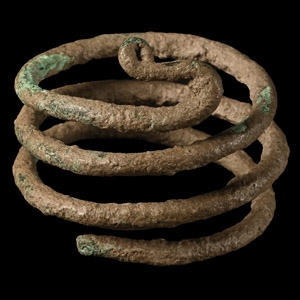
Roman Child's Coiled Bronze Snake Bracelet
1st-2nd century A.D.Sold for (Inc. bp): £33
Round-section rod with tapered ends, one reversed and with a loop finial. 23 grams, 41 mm
From a collection acquired on the UK art market from various auction houses and collections mostly before 2000. From an important Cambridgeshire estate; thence by descent. -
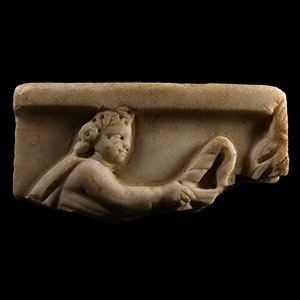
Roman Marble Relief Fragment with Phaethon
2nd-3rd century A.D.Sold for (Inc. bp): £468
Portion of a carved frieze with reserved border to the upper edge; panel with high-relief carving of youthful Phaethon in profile with mantle and himation, mop of curly hair, right arm extended holding reins extending to the mane of the horse at the right edge; drilled to accept mounting pegs. 1.05 kg, 17.2 cm
Private UK collection. Acquired in the 1980s. Property of a Cambridgeshire gentleman.
In the story, which appears in several versions, Phaethon was the son of Helios the sun-god who asked to validate his parentage by driving his father's chariot. Helios tried to dissuade him, but the youngster would not listen and eventually managed to take control, but was unable to master the horses and the celestial vehicle veered out of control - too close to the ground where it started fires and then too distant so that the ground froze. Eventually, Zeus took remedial action and hurled a thunderbolt, which killed the boy. His dead body fell into the river Eridanus, and his sisters, the Heliades, were turned to black poplar trees while they mourned him. -
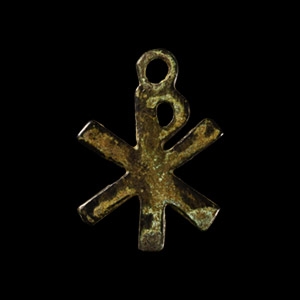
Late Roman Bronze Chi Rho Pendant
4th-6th century A.D.Sold for (Inc. bp): £143
Amuletic Christogram pendant with loop above. 2.71 grams, 37 mm
From a collection acquired on the UK art market from various auction houses and collections mostly before 2000. From an important Cambridgeshire estate; thence by descent. -
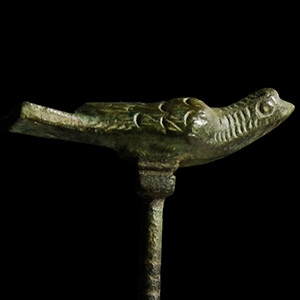
Roman Bronze Distaff with Bird Finial
4th-6th century A.D.Sold for (Inc. bp): £91
Comprising a slender stem with collar and baluster above the attachment loop; perching bird finial with incised plumage detailing. 28 grams, 18.5 cm
From a collection acquired on the UK art market from various auction houses and collections mostly before 2000. From an important Cambridgeshire estate; thence by descent.
