
Auction Highlights
-
.jpg)
Egyptian Granite Head of a Dignitary
Sold for (Inc. bp): £28,600
Carved with soft facial features and carefully executed cosmetic lines around the eye, earring, and carefully detailed duplex wig with gently wavy curls; likely from the Ramesside Period; mounted on a custom-made stand. -
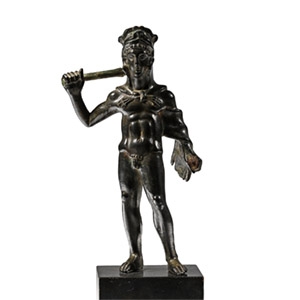
Etruscan Bronze Statuette of Herakles
Sold for (Inc. bp): £18,200
Modelled in the round with a muscular nude body, his club resting on his shoulder and the hair dressed in rows of tight, close-set curls underneath the Nemean lionskin hood with cloak billowing over his left arm, the paws tied across his chest; mounted on a custom-made display stand. -
.jpg)
Roman Marble Portrait of a Boy as Worshipper of Isis
Sold for (Inc. bp): £17,550
Carved head of a prepubescent worshipper of Isis, with soft facial features, long nose, small downturned mouth, heavy-lidded eyes, the whole giving the face a sombre or mournful appearance; the hair textured to indicate a short cut and combed forward across the scalp, sidelock above the right ear; mounted on a 16th century carved breccia upper body with leather cuirass and pteruges to right shoulder, cloak draped across the shoulders and fastened at the clavicle on the right side with a disc-brooch; socle base; some restoration. -
.jpg)
Larger Than Life-Size Roman Bronze Sandaled Foot
Sold for (Inc. bp): £39,000
Modelled in the round and originally part of a monumental statue, the naturalistic right foot encased in a trochades leather sandal with median reversed tongue secured with side straps and thick looped laces; the thick platform sole slightly curved, toes and nails well defined; mounted on a substantial custom-made display stand. -
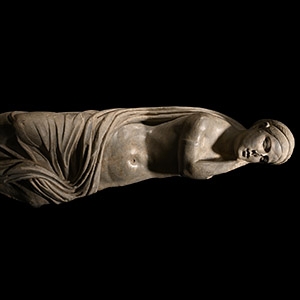
Life-Size Roman Marble Sleeping Girl from a Sarcophagus Lid
Sold for (Inc. bp): £20,800
Modelled in the half-round, nude with eyelids half-closed in sleep; a drapery partly covering the head and wrapping around the lower body under the hips; the hairstyle similar to those of the Antonine Dynasty, the peaceful face supported by the hands and the ear pierced to accept an earring; iron reinforcing rod to the feet and the right arm's armilla a later replacement; upper head restored in Parian marble. -
.jpg)
Byzantine Porphyry Relief with Cross Surrounded by Two Birds
Sold for (Inc. bp): £28,600
An imposing panel divided to four sections by a central cross on a stepped pedestal, the lower and upper arm with branch-like extensions; the upper quadrants with a circlet surrounding a palm tree-shaped motif; each lower quadrant with a bird in profile facing back; mounted on a custom-made display stand. -
.jpg)
Carved Marble Memento Mori Skull
Sold for (Inc. bp): £16,900
Carved skull on a short neck with musculature and blood vessels; mandible in place with some teeth in sockets, wisps of hair adhering to the dome of the skull; one zygomatic bone partly absent; square-section socle base. -
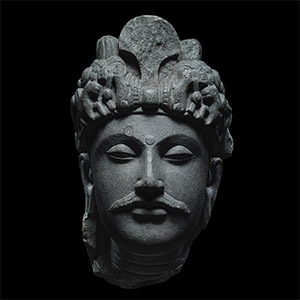
'The Kelton' Gandharan Head of a Bodhisattva
Sold for (Inc. bp): £24,700
Carved in the half-round head of a Bodhisattva (probably Maitreya) with fine detailing to the arched brow, aquiline nose, neat moustache and full lips; the eyes heavily lidded, urna to the forehead, long open lobes to the ears; the hair in multi-stranded curling locks gathered into an ushnisha with brow-band below; heavily cleaned, conserved, and mounted on a custom-made stand; supplied with original old wooden base with collector's label: 'Head of Bodhisattva / Fine grain schist / Gandhara, Northwest Pakistan / 4th century'.
-
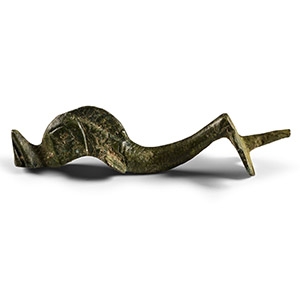
Roman Bronze Dolphin Furniture Mount
2nd-3rd century A.D.Sold for (Inc. bp): £85
Formed with undulating profile, flange base with dentilled edge and fixing spike, mouth terminating in a triangular support pad. 36.5 grams, 86 mm
Ex German art market, 2000s. Acquired from an EU collector living in London. From the collection of Surrey, UK, gentleman. -
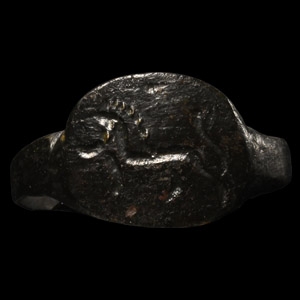
Roman Bronze Ring with Lion
2nd-3rd century A.D.Sold for (Inc. bp): £91
With a slender flat-section hoop expanding to a rounded bezel with a stylised advancing lion, pellet above. 1.29 grams, 17.97 mm overall, 16.70 mm internal diameter (approximate size British H, USA 3 3/4, Europe 6.18, Japan 6)
Private collection formed since the 1940s. UK art market. Property of an Essex, UK, gentleman. -
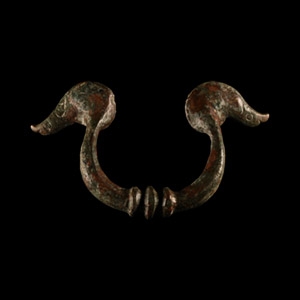
Roman Bronze Helmet Handle
1st-2nd century A.D.Sold for (Inc. bp): £104
Comprising a crescentic tapering shank with ribbed baluster to the centre; attachment points formed as wings with punched detailing. 65 grams, 92 mm
From a collection acquired on the UK art market from various auction houses and collections mostly before 2000. From an important Cambridgeshire estate; thence by descent.
Many such handles are formed as a pair of opposed dolphins, whence the conventional name 'dolphin mounts'. They were attached to infantry helmets so that they could be carried when not in use, or slung from a strap. -
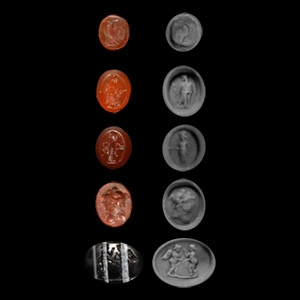
Gemstone Collection
Roman, 2nd century A.D. and laterSold for (Inc. bp): £910
Including two putti on a baseline, eagle perching, standing figure, female bust, in carnelian and other gemstones; each supplied with a museum-quality impression. 2.41 grams total, 8-13 mm
Private collection, England. -
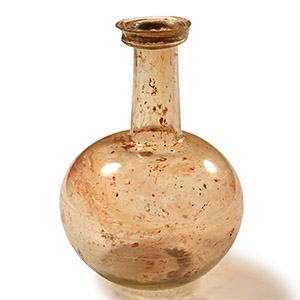
Roman Wheel-Cut Glass Vessel
3rd-4th century A.D.Sold for (Inc. bp): £494
With globular body and long tubular neck, dimple base, everted rim with gusset to the outer edge; wheel-cut horizontal lines to the body. 82 grams, 12.5 cm
Ex London, UK, collection, 1980-1990s.
This bottle belongs to a group of globular bottles with cylindrical necks (some longer than others) and plain or collar-like rims, which are decorated with parallel and/or intersecting circles or combinations of circles and other motifs. -
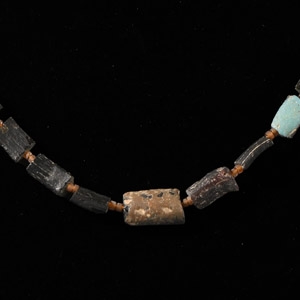
Roman Polychrome Glass Bead Necklace
1st-4th century A.D. and laterSold for (Inc. bp): £39
Comprising a necklace restrung from beads of drilled ancient glass bangle fragments. 11 grams, 72 cm
UK gallery, early 2000s. -
.jpg)
Roman Mixed Artefact Group
1st-3rd century A.D.Sold for (Inc. bp): £104
Comprising a lunar pendant with incised linear ornament and suspension loop; votive foot; coin of Claudius; coin of Maximian, London mint; tweezers with simple linear ornament; remains of an equal-arm brooch; lid from a seal box; discoid stud; remains of an implement; bezel and shoulders from a finger ring; stamped lead bar, possibly reading 'IOVIA' 'MARIN'(?). 60 grams total, 18-50 mm
Acquired on the UK market, 1990s. Property of a retired academic. -
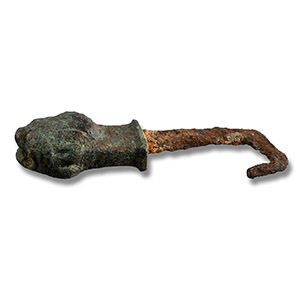
Roman Key with Bear's Head Handle
2nd-3rd century A.D.Sold for (Inc. bp): £111
With an iron shank; the handle with a large finial formed as a growling bear with stylised detailing. 87.7 grams, 93 mm
Ex German art market, 2000s. Acquired from an EU collector living in London. From the collection of Surrey, UK, gentleman. -
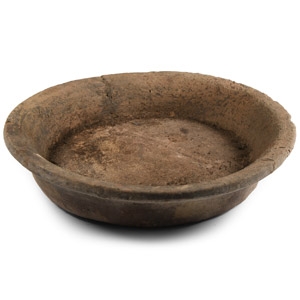
Roman Terracotta Bowl
2nd-4th century A.D.Sold for (Inc. bp): £46
Broad flat base with low sidewall and everted rim; repaired. 580 grams, 20 cm wide
From a collection acquired on the UK art market from various auction houses and collections mostly before 2000. From an important Cambridgeshire estate; thence by descent. -
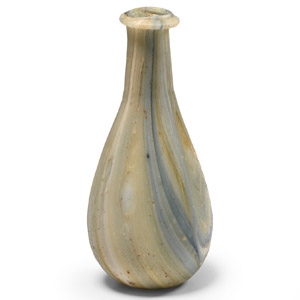
Roman Colour-Banded Mosaic Glass Bottle
Early-mid 1st century A.D.Sold for (Inc. bp): £1,430
From fused canes of opaque white, yellow, pale blue and dark blue, then inflated; the pear-shaped body with a flat base and cylindrical neck, the rim folded out. 20 grams, 76 mm
American private collection, 1990s. with Christie's, New York, 16 June 2006, no.4. From the private collection of Sheik Al Thani. Accompanied by a copy of the Christie's lot listing. -
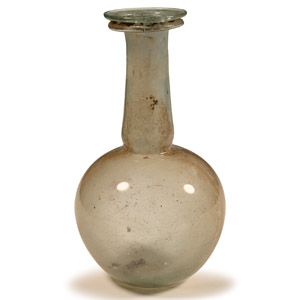
Roman Translucent Glass Bottle
1st-3rd century A.D.Sold for (Inc. bp): £195
Bulbous body with dimple base, tall tubular neck with rolled, stepped and folded rim. 66 grams, 15 cm
Ex London, UK, collection, 1980-1990s. -
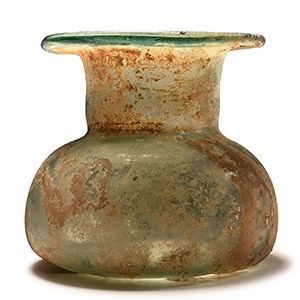
Roman Glass Candlestick Bottle
1st century B.C.-2nd century A.D.Sold for (Inc. bp): £221
A bulbous light blue bottle with dimpled base, wide neck and flared rim. 130 grams, 87 mm
Ex London, UK, collection, 1980-1990s.
A similar vessel was found in the cave 19-4 of Zikhron Yosef at Jerusalem. The shape suggests its use as candlestick or short jar. Small globular bottles, piriform bottles, or small bottles with long, narrow necks (today called candlestick bottles) held perfumes or other precious oils and replicated the shapes found in pottery, alabaster, and stone.
