
Auction Highlights
-
.jpg)
Egyptian Granite Head of a Dignitary
Sold for (Inc. bp): £28,600
Carved with soft facial features and carefully executed cosmetic lines around the eye, earring, and carefully detailed duplex wig with gently wavy curls; likely from the Ramesside Period; mounted on a custom-made stand. -
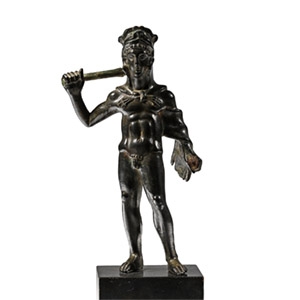
Etruscan Bronze Statuette of Herakles
Sold for (Inc. bp): £18,200
Modelled in the round with a muscular nude body, his club resting on his shoulder and the hair dressed in rows of tight, close-set curls underneath the Nemean lionskin hood with cloak billowing over his left arm, the paws tied across his chest; mounted on a custom-made display stand. -
.jpg)
Roman Marble Portrait of a Boy as Worshipper of Isis
Sold for (Inc. bp): £17,550
Carved head of a prepubescent worshipper of Isis, with soft facial features, long nose, small downturned mouth, heavy-lidded eyes, the whole giving the face a sombre or mournful appearance; the hair textured to indicate a short cut and combed forward across the scalp, sidelock above the right ear; mounted on a 16th century carved breccia upper body with leather cuirass and pteruges to right shoulder, cloak draped across the shoulders and fastened at the clavicle on the right side with a disc-brooch; socle base; some restoration. -
.jpg)
Larger Than Life-Size Roman Bronze Sandaled Foot
Sold for (Inc. bp): £39,000
Modelled in the round and originally part of a monumental statue, the naturalistic right foot encased in a trochades leather sandal with median reversed tongue secured with side straps and thick looped laces; the thick platform sole slightly curved, toes and nails well defined; mounted on a substantial custom-made display stand. -
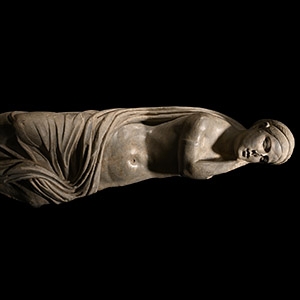
Life-Size Roman Marble Sleeping Girl from a Sarcophagus Lid
Sold for (Inc. bp): £20,800
Modelled in the half-round, nude with eyelids half-closed in sleep; a drapery partly covering the head and wrapping around the lower body under the hips; the hairstyle similar to those of the Antonine Dynasty, the peaceful face supported by the hands and the ear pierced to accept an earring; iron reinforcing rod to the feet and the right arm's armilla a later replacement; upper head restored in Parian marble. -
.jpg)
Byzantine Porphyry Relief with Cross Surrounded by Two Birds
Sold for (Inc. bp): £28,600
An imposing panel divided to four sections by a central cross on a stepped pedestal, the lower and upper arm with branch-like extensions; the upper quadrants with a circlet surrounding a palm tree-shaped motif; each lower quadrant with a bird in profile facing back; mounted on a custom-made display stand. -
.jpg)
Carved Marble Memento Mori Skull
Sold for (Inc. bp): £16,900
Carved skull on a short neck with musculature and blood vessels; mandible in place with some teeth in sockets, wisps of hair adhering to the dome of the skull; one zygomatic bone partly absent; square-section socle base. -
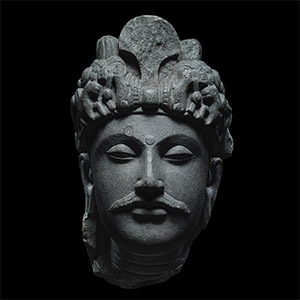
'The Kelton' Gandharan Head of a Bodhisattva
Sold for (Inc. bp): £24,700
Carved in the half-round head of a Bodhisattva (probably Maitreya) with fine detailing to the arched brow, aquiline nose, neat moustache and full lips; the eyes heavily lidded, urna to the forehead, long open lobes to the ears; the hair in multi-stranded curling locks gathered into an ushnisha with brow-band below; heavily cleaned, conserved, and mounted on a custom-made stand; supplied with original old wooden base with collector's label: 'Head of Bodhisattva / Fine grain schist / Gandhara, Northwest Pakistan / 4th century'.
-
.jpg)
Roman Glass Pendant Pair
1st-4th century A.D.Sold for (Inc. bp): £52
A pair of bullae with integral loops, both showing iridescence. 1.29 grams total, 15-16 mm
Collected from 1970-1999. From the collection of the late Mr S.M., London, UK.
Freeborn Roman boys wore bullae until they reached adulthood, being given them eight days after their birth, on the same day that they were named. This important marked boys acceptance into the family. Bullae made of gold would only have been affordable to the members of the elite, whilst the lower classes wore pendants made of less expensive materials. The feminine equivalent was a lunar (crescentic) pendant. -
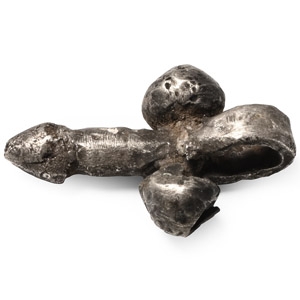
Roman Silver Phallic Pendant
1st-3rd century A.D.Sold for (Inc. bp): £117
Comprising a slender body with lateral testes, suspension loop behind. 4.44 grams, 23 mm
Ex German art market, 2000s. Acquired from an EU collector living in London. From the collection of Surrey, UK, gentleman. -
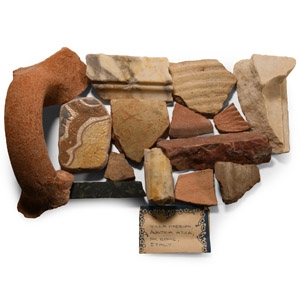
Roman Mixed Architectural and Pottery Group
1st century A.D. and laterSold for (Inc. bp): £65
Including Spartan Basalt, mined in Greece, cut and polished on one side; one marble fragment marked in pencil: 'VILLA / HADRIAN', another: 'OSTIA / ANTICA'; a large amphora handle; seven pottery fragments; a carved decorative edge stone; a marble core fragment; a later floor tile fragment; with an old handwritten slip with: 'VILLA HADRIAN, AUSTRIA ANTICA, Nr. ROME, ITALY.' and on the inside: 'AUSTRIA ANTICA / (Region in ancient Rome) / VILLA HADRIAN / (outside Rome)'. 1.57 kg total, 5-18.5 cm
Acquired on the UK market, since 1970. From the historic mineral collection of Richard Valentine Cain, London, UK, thence by descent. -
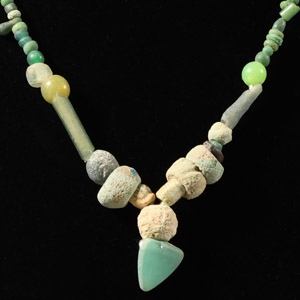
Roman Green Glass Bead Necklace String
1st-4th century A.D. and laterSold for (Inc. bp): £52
Restrung group of annular, spherical and melon beads with a later tabular dangle centrepiece. 22.6 grams, 35 cm
Acquired 1980-2015. Ex Abelita family collection. -
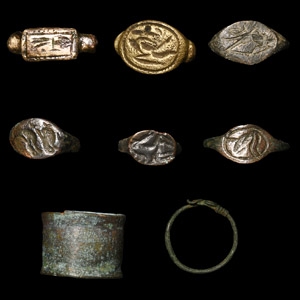
Roman to Medieval Bronze Ring Collection
1st-16th century A.D.Sold for (Inc. bp): £143
Including a broad hoop type with flared rims, a wire type with coils, an ellipsoid bezel type with low-relief horse and others. 30.9 grams total, 20-26 mm
UK private collection before 2000. Acquired on the UK art market. Property of a London gentleman. -
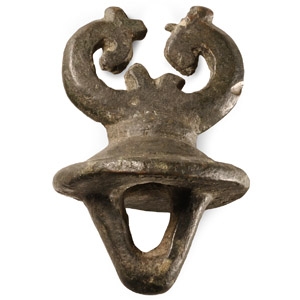
Roman Bronze Zoomorphic Furniture Finial
1st-2nd century A.D.Sold for (Inc. bp): £46
Formed a a stepped disc with opposed scrolls and spurs, substantial V-shaped loop below. 197 grams, 72 mm
From the private collection of M.Cummings, Lincolnshire, UK, 1990s. -
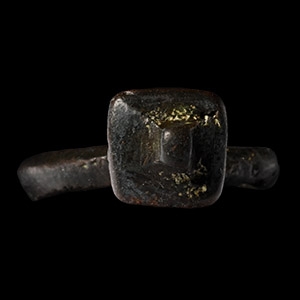
Roman Bronze Architectural Ring
4th-6th century A.D.Sold for (Inc. bp): £39
Narrow D-section hoop with inverted pyramid to the bezel and knop finial. 4.375 Grams, 29.97 mm.
Acquired on the UK art market. Property of a Essex, UK, collector. Accompanied by an old typed information card. -
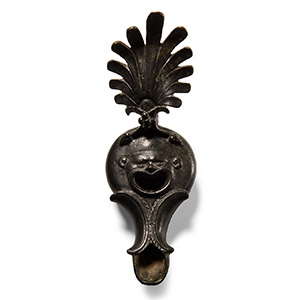
Roman Bronze Lamp with Theatrical Mask
1st-2nd century A.D.Sold for (Inc. bp): £3,380
Nozzle with quasi-volutes, theatrical mask surrounding the central opening; ring-handle with palmette attachment; base moulded. 220 grams, 13.3 cm
Acquired from Weber, Kohl. Ex private collection, Rhemish, Germany. with Gorny & Mosch, 14 December 2010, lot 499. Private collection, Europe. This lot has been checked against the Interpol Database of stolen works of art and is accompanied by search certificate number no.11800-206492.
The principal parts of a lamp were the body or reservoir which contained the oil (infundibulum); the flat circular top (discus) on which the design, if any, was placed, sometimes with an ornamented rim (margo), the nozzle, with a hole for the insertion of the wick (rostrum, nasus, myxus), the wick, known as ellydinium, the handle (ansa, manubrium). -
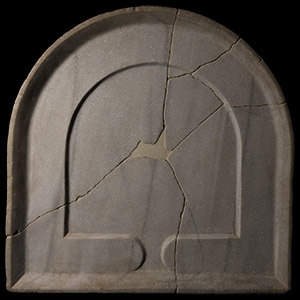
Large Late Roman Sigma-Shaped Marble Offering Table Top
Eastern Mediterranean, 4th-6th century A.D.Sold for (Inc. bp): £3,900
Semi-circular with raised and slightly everted edge, the top with a recessed area with a funnel-shaped outlet; for votive offerings within a church; restored. 84.5 kg including backplate, 91 cm wide
In general good condition, re-assembled.
Acquired in the late 1960s or early 1970s. Ex David Read collection. Accompanied by an academic report by Dr Raffaele D’Amato. This lot has been checked against the Interpol Database of stolen works of art and is accompanied by search certificate number no.12080-214035.
Marble tables such as the present example are called in archaeological terms sigma tables, in consideration of their resemblance to the Greek letter sigma. Sigma-shaped tables appeared in the banquet halls at the end of the 4th century and within Christian buildings from the following century. Most of the undecorated slabs were used as liturgical table tops for feasts to honour the deceased. This commemorative practice was known throughout the late Roman world in west and east, where it continued in the daily life of the citizens of the Eastern Roman Empire. In ecclesiastical settings, circular and sigma-shaped tables were used to collect offerings or for celebrating the agape, more generally as secondary furniture, while the rectangular form was preferred for use as an altar. -
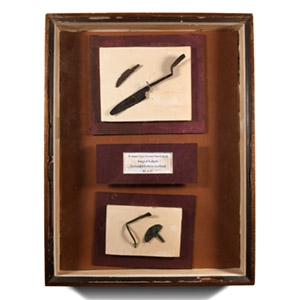
Roman Bronze Battlefield Surgical Scalpels
Circa 83-87 A.D.Sold for (Inc. bp): £546
Mounted in an old custom glazed presentation case with explanatory labels; found Inchtuthil, Scotland. 1.42 kg total, 38 x 29.2 cm
From the Roman legionary fortress Inchtuthil, Perthshire, 83-87 A.D. Private UK collection. Acquired in the 1980s. Property of a Cambridgeshire gentleman. -
.jpg)
Roman Bronze Military Belt Mount Group
Circa 2nd-3rd century A.D.Sold for (Inc. bp): £91
Group of three rectangular mounts each with a beaded border and low-relief motif. 12.2 grams total, 31-34 mm
Property of the vendor's grandfather, thence by family descent, circa 1985. From the private collection of a New York, USA gentleman. -
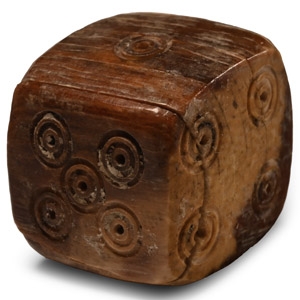
Late Roman Bone Dice Gaming Piece
4th-6th century A.D.Sold for (Inc. bp): £221
Cuboid with rounded edges and corners, ring-and-dot markings disposed 1:2, 3:4, 5:6; with old collector's identification tag '156'. 4.08 grams, 14 mm
Found Wiltshire, UK. From the important private collection of dice and gaming pieces of Colin Narbeth, London, UK, collection no.156.
