
Auction Highlights
-
.jpg)
Egyptian Granite Head of a Dignitary
Sold for (Inc. bp): £28,600
Carved with soft facial features and carefully executed cosmetic lines around the eye, earring, and carefully detailed duplex wig with gently wavy curls; likely from the Ramesside Period; mounted on a custom-made stand. -
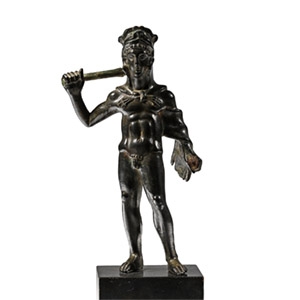
Etruscan Bronze Statuette of Herakles
Sold for (Inc. bp): £18,200
Modelled in the round with a muscular nude body, his club resting on his shoulder and the hair dressed in rows of tight, close-set curls underneath the Nemean lionskin hood with cloak billowing over his left arm, the paws tied across his chest; mounted on a custom-made display stand. -
.jpg)
Roman Marble Portrait of a Boy as Worshipper of Isis
Sold for (Inc. bp): £17,550
Carved head of a prepubescent worshipper of Isis, with soft facial features, long nose, small downturned mouth, heavy-lidded eyes, the whole giving the face a sombre or mournful appearance; the hair textured to indicate a short cut and combed forward across the scalp, sidelock above the right ear; mounted on a 16th century carved breccia upper body with leather cuirass and pteruges to right shoulder, cloak draped across the shoulders and fastened at the clavicle on the right side with a disc-brooch; socle base; some restoration. -
.jpg)
Larger Than Life-Size Roman Bronze Sandaled Foot
Sold for (Inc. bp): £39,000
Modelled in the round and originally part of a monumental statue, the naturalistic right foot encased in a trochades leather sandal with median reversed tongue secured with side straps and thick looped laces; the thick platform sole slightly curved, toes and nails well defined; mounted on a substantial custom-made display stand. -
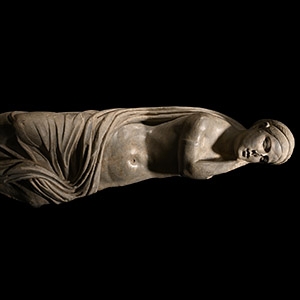
Life-Size Roman Marble Sleeping Girl from a Sarcophagus Lid
Sold for (Inc. bp): £20,800
Modelled in the half-round, nude with eyelids half-closed in sleep; a drapery partly covering the head and wrapping around the lower body under the hips; the hairstyle similar to those of the Antonine Dynasty, the peaceful face supported by the hands and the ear pierced to accept an earring; iron reinforcing rod to the feet and the right arm's armilla a later replacement; upper head restored in Parian marble. -
.jpg)
Byzantine Porphyry Relief with Cross Surrounded by Two Birds
Sold for (Inc. bp): £28,600
An imposing panel divided to four sections by a central cross on a stepped pedestal, the lower and upper arm with branch-like extensions; the upper quadrants with a circlet surrounding a palm tree-shaped motif; each lower quadrant with a bird in profile facing back; mounted on a custom-made display stand. -
.jpg)
Carved Marble Memento Mori Skull
Sold for (Inc. bp): £16,900
Carved skull on a short neck with musculature and blood vessels; mandible in place with some teeth in sockets, wisps of hair adhering to the dome of the skull; one zygomatic bone partly absent; square-section socle base. -
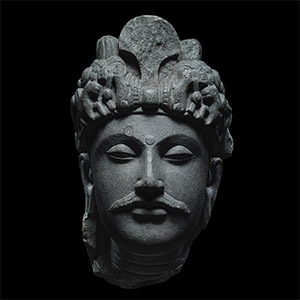
'The Kelton' Gandharan Head of a Bodhisattva
Sold for (Inc. bp): £24,700
Carved in the half-round head of a Bodhisattva (probably Maitreya) with fine detailing to the arched brow, aquiline nose, neat moustache and full lips; the eyes heavily lidded, urna to the forehead, long open lobes to the ears; the hair in multi-stranded curling locks gathered into an ushnisha with brow-band below; heavily cleaned, conserved, and mounted on a custom-made stand; supplied with original old wooden base with collector's label: 'Head of Bodhisattva / Fine grain schist / Gandhara, Northwest Pakistan / 4th century'.
-
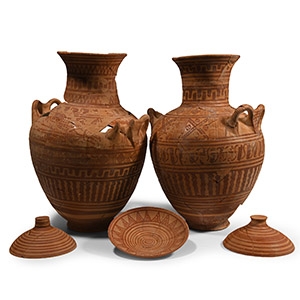
Large Greek Geometric Amphora Pair
8th century B.C.Sold for (Inc. bp): £2,340
Group of two fragmentary terracotta amphorae, one with much of the reverse absent, each with basal ring, broad shoulder and trumpet-shape mouth, two double-loop handles to the shoulder; painted horizontal bands of geometric ornamental motifs including meander, hatched lozenge, saltire, vesica and other designs; each with a domed lid. 4.3 kg total, 13 - 38.5 cm
Acquired it on the European art market since the 1970s. with Herakles Numismatik & Antiquitäten GmbH, München, Germany. Kept in the UK since the early 2000s. This lot has been checked against the Interpol Database of stolen works of art and is accompanied by a search certificate number no.12311-218585. -
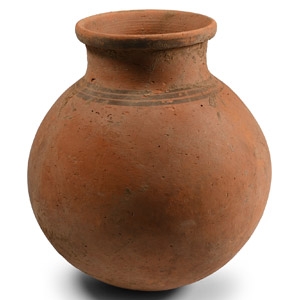
Greek Geometric Terracotta Vessel
Iron Age, 8th-7th century B.C.Sold for (Inc. bp): £59
With bulbous body and rounded base; short neck with everted rim, three painted circumferential bands below the neck. 562 grams, 17 cm
Ex London, UK, art market, 1990s. -
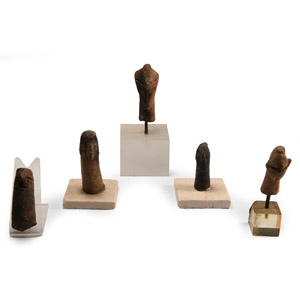
Cypriot Terracotta Idol Head Collection
1st millennium B.C.Sold for (Inc. bp): £524
Modelled in the round mainly with pinched facial detailing, mounted on display stands. 353 grams total, 5.5-11.3 cm including stand
From a collection acquired on the UK art market from various auction houses and collections mostly before 2000. From an important Cambridgeshire estate; thence by descent. -
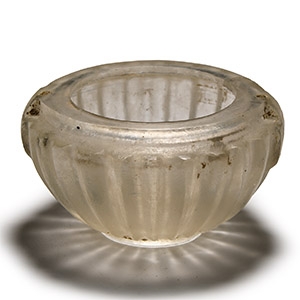
Hellenistic Ribbed Rock Crystal Bowl
3rd-2nd century B.C.Sold for (Inc. bp): £2,600
Of squat profile, with circumferential band of vertical ribbing to the exterior wall, broad flat rim incorporating two shallow lateral blocks, pierced vertically to accept a handle. 148 grams, 82 mm wide
Acquired from Galerie Serres, Paris, before 1980. Formerly in a French private collection. H.B. collection since 2012. Private collection, England. This lot has been checked against the Interpol Database of stolen works of art and is accompanied by a search certificate number no.12312-215584.
Glassmaking and glass-working were considered to be two separate crafts and took place in different regions during the Hellenistic period. Each craft was characterised by its own technological tradition, know-how and equipment. Glassmakers and glassworkers did not need to have an understanding of glass vessel manufacture and primary production respectively in order to carry out their tasks. Glassmaking had to take place as close as possible to the sources of the raw materials used, namely sand and mineral natron. Raw glass was traded throughout the Mediterranean in the form of ingots and it was then worked and shaped into vessels, inlays, jewellery, etc, in various locations. A lot of glass production took place on the Syro-Palestinian coast as well as the broader Levant and Egypt, with centres of manufacture in the royal capitals of Antioch and Alexandria. The reputation of the Alexandrian workshop is well-understood from luxury glass vessels decorated with Egyptian-style buildings or characteristic scenes found as far away as Italy and Afghanistan. -
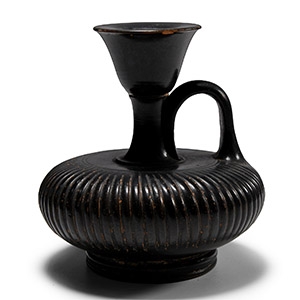
Greek Black-Glazed Ribbed Lekythos
Apulian, 4th-3rd century B.C.Sold for (Inc. bp): £351
With squat segmented body and gusseted basal ring, trumpet-shaped spout with loop handle to the rear. 248 grams, 12 cm
Believed to be acquired in the 1970s-1980s, thence by descent. English private collection. -
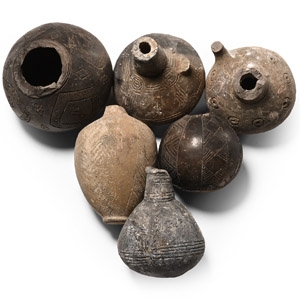
Cypriot Burnished Terracotta Vessel Group
Bronze Age, 2300-1650 B.C.Sold for (Inc. bp): £72
Mainly spherical with stub neck, incised detailing. 560 grams total, 57-87 mm
From a collection acquired on the UK art market from various auction houses and collections mostly before 2000. From an important Cambridgeshire estate; thence by descent. -
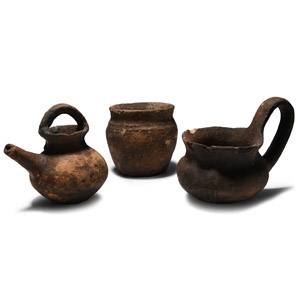
Cypriot Terracotta Flask Group
Early-Late Bronze Age, 2700-1200 B.C.Sold for (Inc. bp): £72
Comprising: a barrel-shaped jar with flared rim; a spouted vessel with strap handle; a dipper cup with flared rim. 625 grams total, 8.2-13.1 cm
From a collection acquired on the UK art market from various auction houses and collections mostly before 2000. From an important Cambridgeshire estate; thence by descent. -
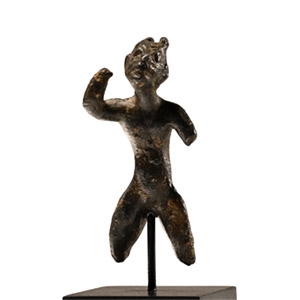
Hellenistic Bronze Sitting Statuette of a Demon
2nd-1st century B.C.Sold for (Inc. bp): £208
Modelled nude in seated pose with legs astride and right arm bent, the grotesque face slightly raised, horns to the crown; mounted on a custom-made stand; Eastern Greek. 71.5 grams total, 78 mm including stand
From a collection acquired on the UK art market from various auction houses and collections mostly before 2000. From an important Cambridgeshire estate; thence by descent. -
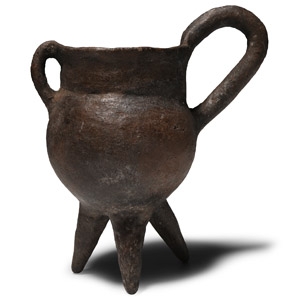
Cypriot Terracotta Tripod Jug
Early Bronze Age, 2300-2000 B.C.Sold for (Inc. bp): £130
With bulbous body, broad mouth, three radiating legs, small loop handle to the rim and larger opposite. 191 grams, 12.5 cm
From a collection acquired on the UK art market from various auction houses and collections mostly before 2000. From an important Cambridgeshire estate; thence by descent. -
.jpg)
Cypriot Wishbone Redware Dipper Cup
Middle Bronze Age I-II, circa 2000-1750 B.C.Sold for (Inc. bp): £111
Hemispherical body with wishbone anthropomorphic handle, burnished surface. 200 grams, 14.7 cm
From a collection acquired on the UK art market from various auction houses and collections mostly before 2000. From an important Cambridgeshire estate; thence by descent. Accompanied by an old identification tag. -
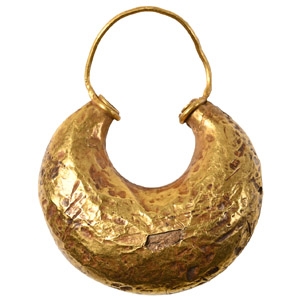
Eastern Greek Gold Hoop Earring
Circa 8th century B.C.Sold for (Inc. bp): £156
Comprising a tapering hoop with applied filigree collars, wire hoop. 4.88 grams, 35 mm
Swiss private collection, Basel, M.C. (b.1933) and R.C.B. (b.1929), thence by descent. -
.jpg)
Hellenistic Bronze Ring with Hoplite
Circa 2nd-1st century B.C.Sold for (Inc. bp): £111
Ellipsoid bezel with low-relief image of a warrior with pilos helmet, shield and xiphos short-sword. 6.93 grams, 22.90 mm overall, 20.17 mm internal diameter (approximate size British Q, USA 8, Europe 17.46, Japan 16)
Ex old English collection. London art market, pre 2000. Property of a London, UK, gentleman.
