
Auction Highlights
-
.jpg)
Egyptian Granite Head of a Dignitary
Sold for (Inc. bp): £28,600
Carved with soft facial features and carefully executed cosmetic lines around the eye, earring, and carefully detailed duplex wig with gently wavy curls; likely from the Ramesside Period; mounted on a custom-made stand. -
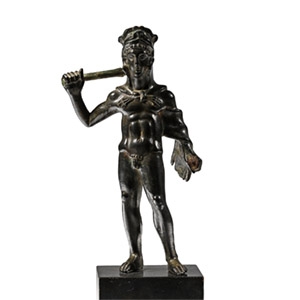
Etruscan Bronze Statuette of Herakles
Sold for (Inc. bp): £18,200
Modelled in the round with a muscular nude body, his club resting on his shoulder and the hair dressed in rows of tight, close-set curls underneath the Nemean lionskin hood with cloak billowing over his left arm, the paws tied across his chest; mounted on a custom-made display stand. -
.jpg)
Roman Marble Portrait of a Boy as Worshipper of Isis
Sold for (Inc. bp): £17,550
Carved head of a prepubescent worshipper of Isis, with soft facial features, long nose, small downturned mouth, heavy-lidded eyes, the whole giving the face a sombre or mournful appearance; the hair textured to indicate a short cut and combed forward across the scalp, sidelock above the right ear; mounted on a 16th century carved breccia upper body with leather cuirass and pteruges to right shoulder, cloak draped across the shoulders and fastened at the clavicle on the right side with a disc-brooch; socle base; some restoration. -
.jpg)
Larger Than Life-Size Roman Bronze Sandaled Foot
Sold for (Inc. bp): £39,000
Modelled in the round and originally part of a monumental statue, the naturalistic right foot encased in a trochades leather sandal with median reversed tongue secured with side straps and thick looped laces; the thick platform sole slightly curved, toes and nails well defined; mounted on a substantial custom-made display stand. -
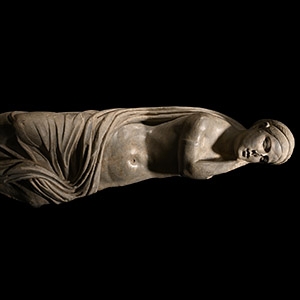
Life-Size Roman Marble Sleeping Girl from a Sarcophagus Lid
Sold for (Inc. bp): £20,800
Modelled in the half-round, nude with eyelids half-closed in sleep; a drapery partly covering the head and wrapping around the lower body under the hips; the hairstyle similar to those of the Antonine Dynasty, the peaceful face supported by the hands and the ear pierced to accept an earring; iron reinforcing rod to the feet and the right arm's armilla a later replacement; upper head restored in Parian marble. -
.jpg)
Byzantine Porphyry Relief with Cross Surrounded by Two Birds
Sold for (Inc. bp): £28,600
An imposing panel divided to four sections by a central cross on a stepped pedestal, the lower and upper arm with branch-like extensions; the upper quadrants with a circlet surrounding a palm tree-shaped motif; each lower quadrant with a bird in profile facing back; mounted on a custom-made display stand. -
.jpg)
Carved Marble Memento Mori Skull
Sold for (Inc. bp): £16,900
Carved skull on a short neck with musculature and blood vessels; mandible in place with some teeth in sockets, wisps of hair adhering to the dome of the skull; one zygomatic bone partly absent; square-section socle base. -
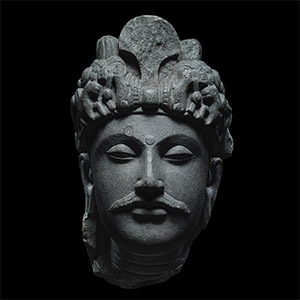
'The Kelton' Gandharan Head of a Bodhisattva
Sold for (Inc. bp): £24,700
Carved in the half-round head of a Bodhisattva (probably Maitreya) with fine detailing to the arched brow, aquiline nose, neat moustache and full lips; the eyes heavily lidded, urna to the forehead, long open lobes to the ears; the hair in multi-stranded curling locks gathered into an ushnisha with brow-band below; heavily cleaned, conserved, and mounted on a custom-made stand; supplied with original old wooden base with collector's label: 'Head of Bodhisattva / Fine grain schist / Gandhara, Northwest Pakistan / 4th century'.
-
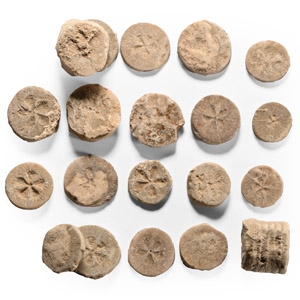
Egyptian Limestone 'Floral' Inlay Group
Roman Period, 30 B.C.-323 A.D. or earlierSold for (Inc. bp): £46
Group of discoid inlay plaques or gaming counters, crinoids with cinquefoil motif. 33 grams total, 13-18 mm
From a central London ADA dealership, 1980-1990.
Flowers were symbolic of rebirth due to the daily reopening of their petals after nightfall. As a result, they were widely used in domestic settings, religious and funerary contexts, and as adornments. Similar rosette discs, like those recovered from the Ramesside Period palace at Qantir, were used as decorative elements in royal palaces. -
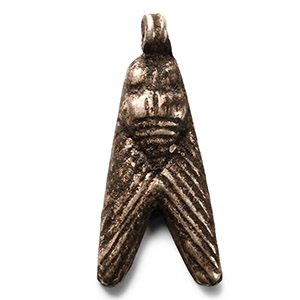
Egyptian Silver Fly Amulet
Late Period, 664-332 B.C.Sold for (Inc. bp): £182
With linear detailing to body and wings, loop above the neck. 1.1 grams, 20 mm
From an early 20th century collection.
Small fly amulets first appeared in burials during the Naqada II Period, c. 3200 B.C. These amulets grew in popularity and the materials used to make them expanded during the New Kingdom. They are crafted from a variety of materials such as gold, silver, lapis lazuli, carnelian, amethyst, faience, and bone. These amulets were thought to protect against insect bites and to ward off troublesome flying creatures through apotropaic magic. Some believe they may have even been intended to symbolise the fly’s fecundity. Additionally, pharaohs would bestow gold fly-shaped pendants as military awards to honour the bravery and fly-like persistence of soldiers in battle. -
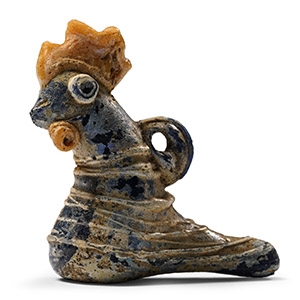
Phoenician Blue Glass Bird Pendant
425-200 B.C.Sold for (Inc. bp): £468
Hollow-formed amuletic pendant with applied trails to the body, iridescent surface, yellow glass detailing. 5.5 grams, 32 mm
From the collection of a gentleman, acquired on the London art market in the 1990s. -
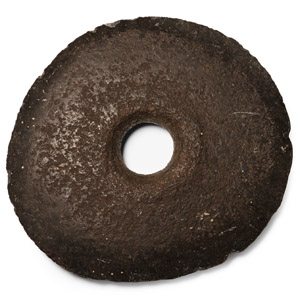
Egyptian Porphyry Disc-Mace
Neolithic Period, circa 2500-1500 B.C.Sold for (Inc. bp): £72
Circular in plan with worked cutting edge all round, socket with one chamfered face. 556 grams, 14 cm
Probably found Egypt, North Africa. Acquired on the British art market. From the collection of a South West London, UK, specialist Stone Age collector. -
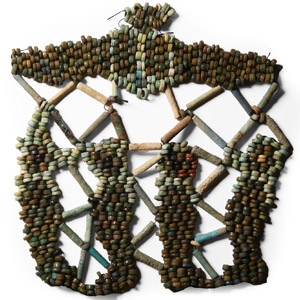
Egyptian Faience Beaded Sons of Horus Panel
Ptolemaic Period, 332-30 B.C.Sold for (Inc. bp): £130
Openwork restrung panel depicting Imsety, Hapy, Duamutef, and Qebehsenuef, the Four Sons of Horus with a winged scarab above; restrung. 21.4 grams, 12 cm
Ex Mariaud de Serres, Paris, France, 1990s. From a London, UK, collection.
Winged scarabs were often used as funerary amulets and believed to symbolise the deceased's rebirth and regeneration. The Four Sons of Horus were deities responsible for protecting the deceased's internal organs. Here, on the left, is the erect-eared jackal-headed Duamutef, who protects the stomach. Next is the falcon-headed Qebehsenuef, who protects the intestines. Then comes the human-headed Imsety, protector of the liver, and finally, the baboon-headed Hapy on the right, protector of the lungs. -
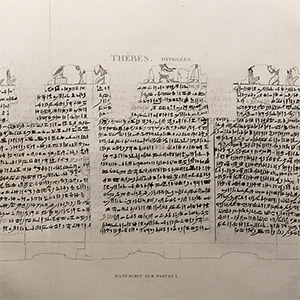
Large Egyptian Expedition Lithograph Print of Hieroglyphs
1820 A.D.Sold for (Inc. bp): £65
Leclerc - Thèbes - Hypogées - Manuscrit sur papyrus - Proof etching on laid paper of plate 69 from La Description de l’Égypte: Antiquités, Volume II: Commission des sciences et arts d’Égypte with later backing sheet. 350 grams, 132 x 65 cm
From the collection of a North American priest. Acquired between 1981-1996. Property of a North American collector.
Produced between February 1802 and 1830 on the orders of Napoleon Bonaparte; published between 1809 and 1828. Just 1,000 copies were distributed to various institutions, printed on on laid paper with an 'Égypte ancienne et moderne' watermark. The book is subtitled Recueil des observations et des recherches qui ont été faites en Égypte pendant l’expédition de l’Armée française, publié par les ordres de Sa Majesté l’Empereur Napoléon le Grand (Gathering of observations and discoveries which were made in Egypt during the expedition of the French army, published on the orders of His Majesty the Emperor Napoleon the Great). It was the world's first encyclopedia devoted exclusively to the remains of ancient Egypt. The plates of this book are the first to present the archaeological sites of Thebes (Luxor). The papyrus manuscript was recovered from the underground chambers (hypogea). The papyrus is now in the Bibliothèque Nationale, Paris. -
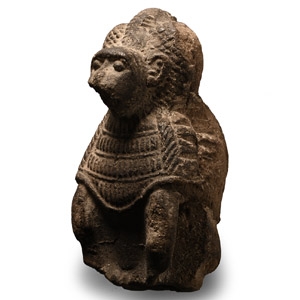
Romano-Egyptian Statuette of Thoth in Baboon Form
Roman Period, 30 B.C.-323 A.D.Sold for (Inc. bp): £312
Carved hardstone figure of a Hamadryas Baboon (papio hamadryus), sacred to Thoth, crouching with his forepaws resting on his knees and wearing a segmented and banded hood and collar with elaborately carved textural detailing; face chipped and lower body absent. 243 grams, 10.6 cm
Ex Yorkshire, UK, collection, 1960s-1980s.
The baboon was considered an embodiment of the god Thoth. The animal was associated with both the sun and the moon, often depicted wearing a moon and crescent headgear. Together, these aspects symbolised the cycle of rebirth, as it was believed that the deceased travelled through the night and was reborn at dawn. Thoth was highly regarded for his connection to knowledge, healing, and writing. Scribes would wear a Thoth baboon amulet to ensure continued professional success. In the Roman era, Thoth became the 'primary pseudonymous authority for diverse priestly texts' (Frankfurter, D., Religion in Roman Egypt,New Jersey, 1998, p.240). As some religious centres with animal cults were maintained in the Roman Period, it is possible that this figurine was a votive offering to the god. Baboon figurines have also been discovered in Isis sanctuaries in Rome. This discovery may indicate the mythological connection between the two deities, as Thoth provides words to Isis, enabling her to revive her husband, Osiris. -
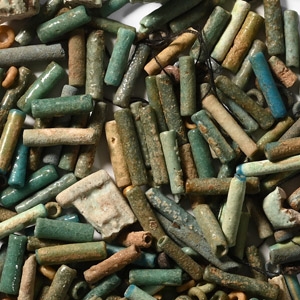
Egyptian Faience Bead and Amulet Group
Late Period, 664-332 B.C.Sold for (Inc. bp): £104
Comprising tubular and annular beads in blue, green and cream colours, the upper half of two Tawaret amulets, a fragmentary wedjat eye, the lower half of a seated figure, probably Isis, and a complete amulet of the god Shu. 22 grams total, 2-21 mm
From an early 20th century Home Counties, UK, collection. -
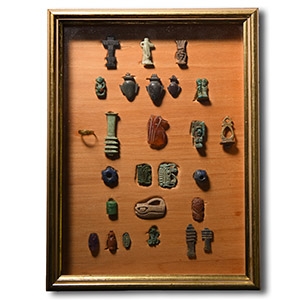
Egyptian Hardstone and Faience Amulets and Other Items
Late Period, 664-332 B.C. and laterSold for (Inc. bp): £2,210
A group of amulets in a glazed wooden frame, comprising: 1 –stone Sma amulet Although rather gruesome, as it represents an animal’s windpipe and lungs, this amulet symbolised the benign concepts of unity and ensured the integrity of the deceased’s body, which was deemed essential for entry into the Afterlife. Cf. Reisner, G.A., Catalogue général des antiquitéségyptiennes du Musée du Caire, Nos.12528-13595, Vol. II, Amulets, Cairo, 1958, p.52, no. 5582, and pl.III, for a similar black stone example. 2 – Tawaret amulet The goddess Tawaretis a female hippopotamus with the arms and legs of a lion and the back and tail of a crocodile. Despite her fearsome appearance, Tawaret was a household deity and protector of women in childbirth. Cf. Tinius, I., Altägypten in Braunschweig. Die Sammlungen des Herzog Anton Ulrich-Museums und des StädtischenMuseums, Wiesbaden, 2011, p.130, no.216, for similar. 3 – Bes amulet Bes emerged as one of ancient Egypt’s most favoured protective deities during the New Kingdom period and beyond. Despite his intimidating appearance, Bes served as the guardian and defender of pregnant women and children and was also thought to protect them from snakes. Cf. Petrie, W.M.F., Amulets. Illustrated by the Egyptian Collection in University College, London, 1914, pl. XXXIII 188e, for a similar example. 4 – faience Pataikos amulet Pataikos was first mentioned by the historian Herodotus, who refers to dwarf-like representations of Ptah. The name is still used today. These diminutive amulets symbolise Ptah’s immense magical power and protect the wearer from dangerous creatures such as snakes and crocodiles. Cf. Petrie, W.M.F., Amulets. Illustrated by the Egyptian Collection in University College, London, 1914, pl. XXXI, 176c, for a similar small example. 5 – three hardstone heart amulets According to ancient Egyptian beliefs, the heart (ib) was considered to be the centre of intelligence, emotions, and behaviour, as well as the storehouse of an individual's memories. During the Weighing of the Heart ceremony in the afterlife, the heart could advocate for the deceased and account for their lifetime of actions before Osiris. For this reason, heart amulets were placed on the mummy to safeguard the organ and ensure a favourable outcome during judgment. Cf. Andrews, C., and van Dijk, J., Objects for Eternity: Egyptian Antiquities from the W. Arnold Meijer Collection, Mainz am Rhein, 2006, p.128, no. 2.34b, for a similar brown jasper heart amulet. 6 – faience double falcon amulet This uncommon amulet represents two falcons wearing sun disc headdresses. One falcon may represent Horus, the god of the sky, war, and protection; the other perhaps another falcon deity such as Montu. Alternatively, they may be two ba-birds, representing an element of the deceased’s spirit, similar to our concept of soul. Cf. Camino, L., Papier-Lacostey, C., Collections égyptiennes du musée Antoine Vivenel de Compiègne, Compiègne, 2007, p.209, no.259, for a comparable amulet. 7 – Djed pillar The djed pillar symbolised the concepts of 'enduring' and 'stability' and was a common funerary amulet from the Old Kingdom onwards. It was first associated with the gods Ptah and Sokar but later became a symbol of Osiris, representing the god's backbone. In this context, the djed pillar appears in Chapter 155 of the Book of the Dead, concerned with the deceased's resurrection. Cf. Andrews, C., Amulets of Ancient Egypt, London, 1994, p.83, no.84c, for an example with similar detailing. 8 – carnelian wedjat eye The wedjat-eye amulet represents the healed eye of the god Horus, featuring both human and falcon elements. The name wedjat in ancient Egyptian means ‘the one that is sound.’ According to Egyptian mythology, Horus' eye was wounded or taken by the god Seth and restored by Thoth. The wedjat-eye amulet was thought to protect its wearer and bestow the power of recovery and regeneration onto them. It was very popular and used by both the living and the dead. Cf. Lacovara, P., and Markowitz, Y.J., Jewels of the Nile: Ancient Egyptian Treasures from the Worcester Art Museum, Worcester MA, 2020, p.113, no.19, for a similar carnelian example. 9 – faience Shu amulet This Egyptian faience amulet is a schematic depiction of the god Shu, depicted kneeling with his hands upraised, supporting a sun disc. According to Egyptian mythology, Shu was sneezed out by the creator god Atum, initiating the universe’s creation. Shu represents the air that separates the sky and the earth. He is also responsible for holding up the sky, represented by the goddess Nut, thus allowing the cyclical journey of the sun to take place. In the context of the afterlife, Shu allowed the deceased to traverse unhindered on their journey towards rebirth. Shu amulets were placed on the lower part of the deceased's torso, between the mummy bandages. Shu could also serve as a magical amulet at the birth of the living, symbolising a protector of new life. Cf. Camino, L., Papier-Lacostey, C., Collections égyptiennes du musée Antoine Vivenel de Compiègne, Compiègne, 2007, p.174, no.193, for a comparable amulet. 10 – two faiencewedjat eye amulets Both represent less common variants of the wedjat amulet. On these, a series of small front-facing uraei run across the top of the amulet, with a larger uraeus depicted in profile on either side of the eye. Cf. World Museum Liverpool, M11893aa, for a similar, though less well-defined example. 11 – stone wedjat eye Cf. Petrie, W.M.F., Amulets. Illustrated by the Egyptian Collection in University College, London, 1914, pl. XXIV139e, for a similar example. 12 - carnelian Bes amulet This somewhat cursorily fashioned example of a Bes amulet may date to around a century before the New Kingdom. Cf. Thomas, G.A., A Handbook of the Egyptian Collection (Chicago: The Art Institute of Chicago, 1923), p. 130, for a similar example. 13 – carnelian poppy pendant Amulets in the form of poppies were used to heal and alleviate pain and to ward off death. These amulets were also linked to Osiris, the Egyptian deity of agriculture, death, and the afterlife. Cf. Lacovara, P., and Markowitz, Y.J., Jewels of the Nile: Ancient Egyptian Treasures from the Worcester Art Museum, Worcester MA, 2020, p.145, no.2, for a necklace composed of similar examples. 14 – faience uraeus amulet The uraeus represents a rearing cobra and symbolises royal power and authority, as well as the Lower Egyptian goddess Wadjet. The uraeus amulet was worn to ensure the protective power that was granted to the pharaoh. Cf. Petrie, W.M.F., Amulets. Illustrated by the Egyptian Collection in University College, London, 1914, pl. IV58f, for this amulet type. 15 – two lapis lazuli djed pillars Cf. Tinius, I., Altägypten in Braunschweig. Die Sammlungen des Herzog Anton Ulrich-Museums und des StädtischenMuseums, Wiesbaden, 2011, p.166, no.323, for a similar example of the taller pillar; Lacovara, P., and Markowitz, Y.J., Jewels of the Nile: Ancient Egyptian Treasures from the Worcester Art Museum, Worcester MA, 2020, p.115, no.1, for a similar example of the shorter pillar. 773 grams total, 23 x 17.5 cm
Ex H.M. Barker. Private collection, England. -
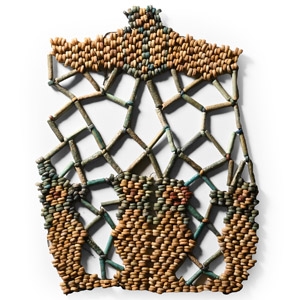
Egyptian Faience Mummy Bead Panel with Four Sons of Horus
Ptolemaic Period, 332-30 B.C.Sold for (Inc. bp): £117
Restrung as an openwork panel with a winged scarab above and the Four Sons of Horus below as two opposing pairs; restrung with some later beads. 34.6 grams, 15 cm
From an early 20th century Home Counties, UK, collection.
These elements would have been placed on the chest and body below a beadwork mummy mask. Winged scarabs were often used as funerary amulets and believed to symbolise the deceased's rebirth and regeneration. The Four Sons of Horus protected the deceased's internal organs. Here, on the left, is the erect-eared jackal-headed Duamutef who protects the stomach, followed by the falcon-headed Qebehsenuef, who protects the intestines, then the human-headed Imsety, protector of the liver and, finally, the baboon-headed Hapy on the right, protector of the lungs. -
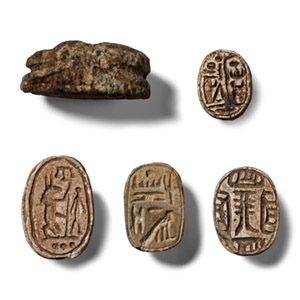
Egypto-Phoenician Hardstone Scarab Group
Late 1st millennium B.C.Sold for (Inc. bp): £650
Comprising five scarabs: one with a djed pillar surrounded by nwb signs; one with a jackal-headed Anubis holding a staff before a figure, with the scales of Maat above; one with a seated baboon sporting a crescent and sun disc headdress facing a royal cartouche of Thutmose III men-kheper-Re; one with a standing bird and other hieroglyphs; the largest one with worn underside. 1.97 grams total, 14-26 mm
From an early 20th century Home Counties, UK, collection.
The scarab, which represented the dung beetle, was the most popular amulet in ancient Egypt for approximately two thousand years until the Ptolemaic Period when it gradually fell out of favour. The popularity of scarabs extended beyond the borders of Egypt, and they were also distributed and produced in other regions, such as Phoenicia and Israel. The beetle is named khepri, derived from the verb 'to come into existence', and was considered the embodiment of the creator god Khepri, who was self-engendered. The ancient Egyptians mistakenly believed that the young beetle emerging from the dung ball was the result of an act of self-creation. -
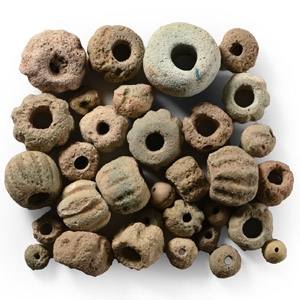
Egyptian Pottery Necklace Bead Group
Roman Period, 30 B.C.-323 A.D.Sold for (Inc. bp): £39
Comprising a group of modelled unglazed pottery grooved melon beads some faience. 39.4 grams total, 6-18 mm
Ex London, UK, collection, 1990s.
