
Auction Highlights
-
.jpg)
Egyptian Granite Head of a Dignitary
Sold for (Inc. bp): £28,600
Carved with soft facial features and carefully executed cosmetic lines around the eye, earring, and carefully detailed duplex wig with gently wavy curls; likely from the Ramesside Period; mounted on a custom-made stand. -
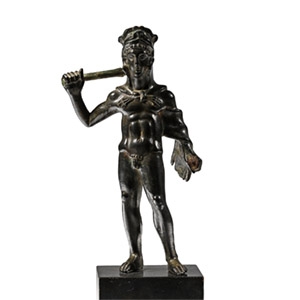
Etruscan Bronze Statuette of Herakles
Sold for (Inc. bp): £18,200
Modelled in the round with a muscular nude body, his club resting on his shoulder and the hair dressed in rows of tight, close-set curls underneath the Nemean lionskin hood with cloak billowing over his left arm, the paws tied across his chest; mounted on a custom-made display stand. -
.jpg)
Roman Marble Portrait of a Boy as Worshipper of Isis
Sold for (Inc. bp): £17,550
Carved head of a prepubescent worshipper of Isis, with soft facial features, long nose, small downturned mouth, heavy-lidded eyes, the whole giving the face a sombre or mournful appearance; the hair textured to indicate a short cut and combed forward across the scalp, sidelock above the right ear; mounted on a 16th century carved breccia upper body with leather cuirass and pteruges to right shoulder, cloak draped across the shoulders and fastened at the clavicle on the right side with a disc-brooch; socle base; some restoration. -
.jpg)
Larger Than Life-Size Roman Bronze Sandaled Foot
Sold for (Inc. bp): £39,000
Modelled in the round and originally part of a monumental statue, the naturalistic right foot encased in a trochades leather sandal with median reversed tongue secured with side straps and thick looped laces; the thick platform sole slightly curved, toes and nails well defined; mounted on a substantial custom-made display stand. -
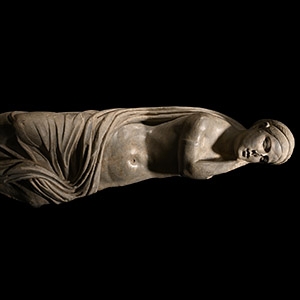
Life-Size Roman Marble Sleeping Girl from a Sarcophagus Lid
Sold for (Inc. bp): £20,800
Modelled in the half-round, nude with eyelids half-closed in sleep; a drapery partly covering the head and wrapping around the lower body under the hips; the hairstyle similar to those of the Antonine Dynasty, the peaceful face supported by the hands and the ear pierced to accept an earring; iron reinforcing rod to the feet and the right arm's armilla a later replacement; upper head restored in Parian marble. -
.jpg)
Byzantine Porphyry Relief with Cross Surrounded by Two Birds
Sold for (Inc. bp): £28,600
An imposing panel divided to four sections by a central cross on a stepped pedestal, the lower and upper arm with branch-like extensions; the upper quadrants with a circlet surrounding a palm tree-shaped motif; each lower quadrant with a bird in profile facing back; mounted on a custom-made display stand. -
.jpg)
Carved Marble Memento Mori Skull
Sold for (Inc. bp): £16,900
Carved skull on a short neck with musculature and blood vessels; mandible in place with some teeth in sockets, wisps of hair adhering to the dome of the skull; one zygomatic bone partly absent; square-section socle base. -
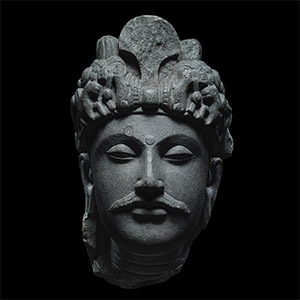
'The Kelton' Gandharan Head of a Bodhisattva
Sold for (Inc. bp): £24,700
Carved in the half-round head of a Bodhisattva (probably Maitreya) with fine detailing to the arched brow, aquiline nose, neat moustache and full lips; the eyes heavily lidded, urna to the forehead, long open lobes to the ears; the hair in multi-stranded curling locks gathered into an ushnisha with brow-band below; heavily cleaned, conserved, and mounted on a custom-made stand; supplied with original old wooden base with collector's label: 'Head of Bodhisattva / Fine grain schist / Gandhara, Northwest Pakistan / 4th century'.
-
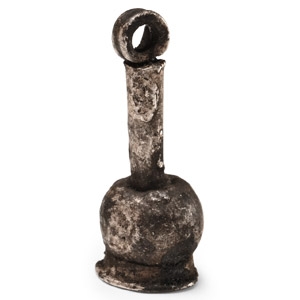
Egyptian Silver Poppy Head Amulet
Late Period, 664-332 B.C.Sold for (Inc. bp): £59
With bulb and disc finial, integral shank and gusseted suspension loop. 1 grams, 17 mm
From an early 20th century collection.
Amulets in the form of poppies were used to heal and alleviate pain and to ward off death. These types of amulets were also linked to Osiris, the Egyptian deity of agriculture, death, and the afterlife. -
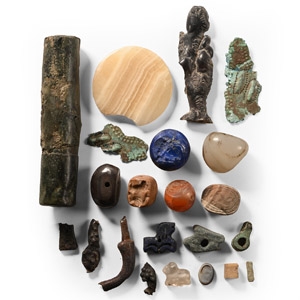
Egyptian Alabaster Kohl Pot Lid and Other Items
Late Period, 664-332 B.C. and laterSold for (Inc. bp): £130
Including oblate beads, scarab with the underside carved with a human figure and winged gryphon, a rock crystal dog, sheet bronze fragments, a bronze cylindrical case, and other items. 126 grams total, 7-89 mm
Collected from 1970-1999. From the collection of the late Mr S.M., London, UK. -
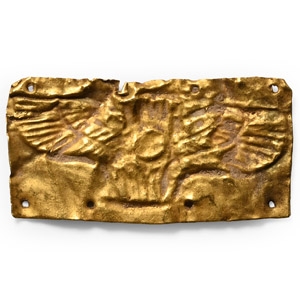
Egyptian Gold Winged Plaque
1st millennium B.C.Sold for (Inc. bp): £208
Rectangular foil plaque with repoussé design of a winged scarab; edges pierced for attachment. 0.47 grams, 22 mm
From the collection of a gentleman, acquired on the London art market in the 1990s. -
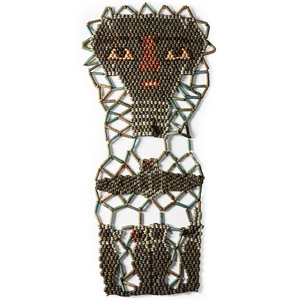
Egyptian Faience Mummy Bead Mask with Scarab and Four Sons of Horus
Ptolemaic Period, 332-30 B.C.Sold for (Inc. bp): £316
A netted beadwork panel of annular and tubular glazed composition beads in blues, greens, black, cream and red-brown colours, depicting a mummy face mask with false beard, a scarab with extended wings below, the 'Four Sons of Horus’ beneath the scarab, joined together with areas of open netting of tubular beads; restrung with some later beads. 58 grams, 25.5 cm
Ex Mariaud de Serres, Paris, France, 1980-1990s. From a London, UK, collection.
Winged scarabs were often used as funerary amulets and believed to symbolise the deceased's rebirth and regeneration. The Four Sons of Horus were deities responsible for protecting the deceased's internal organs. Here, on the left, is the baboon-headed Hapy, protector of the lungs, then the human-headed Imsety, protector of the liver, followed by the falcon-headed Qebehsenuef, who protects the intestines and, finally, the jackal-headed Duamutef on the right (note his erect ears are indicated), who protected the stomach. These internal organs were often placed in canopic jars with the head of the respective Son of Horus. Amulets depicting these deities were placed within the mummy wrappings. -
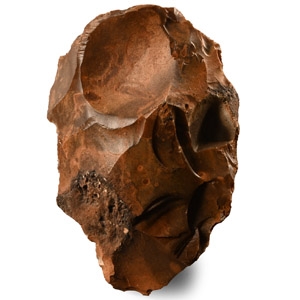
Stone Age Egyptian Flint Axehead
Lower Palaeolithic Period, circa 450,000-280,000 B.P.Sold for (Inc. bp): £46
Biconvex in section with irregular curved edge. 389 grams, 12.3 cm
Found Egypt, North Africa. From the British art market in the 1970s-1980s. Acquired via inheritance, 1988. From the collection of a South West London, UK, specialist Stone Age collector. -
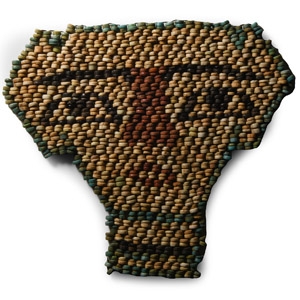
Egyptian Faience Beaded Mummy Mask
Ptolemaic Period, 332-30 B.C.Sold for (Inc. bp): £234
Restrung netted beadwork panel of annular and tubular glazed composition beads in blues, greens, black, cream and red-brown colours, depicting a mummy face mask with false beard. 67 grams, 16 cm
Ex Mariaud de Serres, Paris, France, 1990s. From a London, UK, collection. -
.jpg)
Egyptian Silver Signet Ring
Late Period, 664-332 B.C.Sold for (Inc. bp): £312
With a round-section hoop, the wide bezel encrusted but with decoration beneath. 7.11 grams, 26.03 mm overall, 18.22 mm internal diameter (approximate size British O 1/2, USA 7 1/4, Europe 15.61, Japan 15)
Collected from 1969-1999. From the collection of the late Mr S.M., London, UK. -
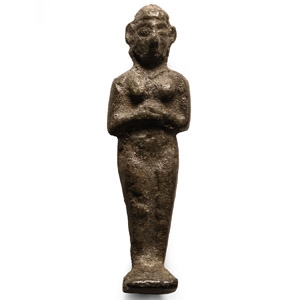
Phoenician Bronze Statuette of a Naked Female
6th-4th century B.C.Sold for (Inc. bp): £169
Modeled in the round with arms folded across the abdomen, standing nude on a square base. 107 grams, 94 mm
Acquired in Egypt by Lieutenant James Alexander Goodman in the 1920s. Thence by descent to his grandson.
Lieutenant Goodman served in the 4th Battalion Welsh Regiment during World War I and saw action in Palestine during the capture of Bethlehem, (for which he won an MC). After the war, he setup a business selling Fordson trucks and tractors in Alexandria, Egypt. A keen antiquarian, he collected ancient objects during his time in Alexandria and when he visited the pyramids at Giza. After his first marriage failed, he returned to the UK in the early 1930s. On his death in 1959, he passed his small collection of Egyptian objects on to his second wife, Ruby Goodman. On Ruby’s death in 1994, they were left to their second daughter, Rosemary Johnson, (née Goodman), and are currently in the possession of her son. -
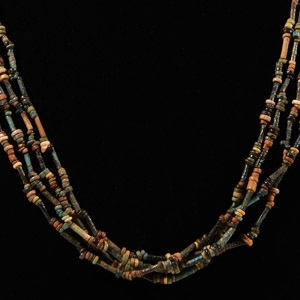
Egyptian Multi-Stranded Mummy Bead Necklace
Late Period, 664-332 B.C.Sold for (Inc. bp): £98
Multi-stranded designer necklace composed of beads of mainly annular and tubular types. 21 grams, 74 cm
Acquired before 1979. From the private collection of Mr F. A., South Kensington, London, UK; thence by descent 2014.
For thousands of years, artisans in Egypt created vibrant ceramics to echo the beauty of rare jewels. These ornaments were created with almost every material, colour, and texture imaginable and they come from across Egypt and beyond: vibrant blue lapis lazuli from Afghanistan, glossy black obsidian from Turkey, and aqua-green turquoise from the Sinai. They were worn in life and, after death, they served as precious ornamentation for mummies. -
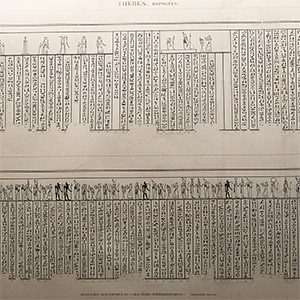
Large Egyptian Expedition Lithograph Print with Hieroglyphs
1820 A.D.Sold for (Inc. bp): £111
Willemin - Thèbes - Hypogées - Manuscrit sur papyrus en caractères hiéroglyphiques. Troisième partie - Proof etching on laid paper of plate 74 from La Description de l’Égypte: Antiquités, Volume II: Commission des sciences et arts d’Égypte with later backing sheet. 360 grams, 136 x 66 cm
From the collection of a North American priest. Acquired between 1981-1996. Property of a North American collector.
Produced between February 1802 and 1830 on the orders of Napoleon Bonaparte; published between 1809 and 1828. Just 1,000 copies were distributed to various institutions, printed on on laid paper with an 'Égypte ancienne et moderne' watermark. The book is subtitled Recueil des observations et des recherches qui ont été faites en Égypte pendant l’expédition de l’Armée française, publié par les ordres de Sa Majesté l’Empereur Napoléon le Grand (Gathering of observations and discoveries which were made in Egypt during the expedition of the French army, published on the orders of His Majesty the Emperor Napoleon the Great). It was the world's first encyclopedia devoted exclusively to the remains of ancient Egypt. The plates of this book are the first to present the archaeological sites of Thebes (Luxor). The papyrus manuscript was recovered from the underground chambers (hypogea). The original papyrus is now held in the Bibliothèque Nationale (1-19), Paris (Papyrus Cadet). -
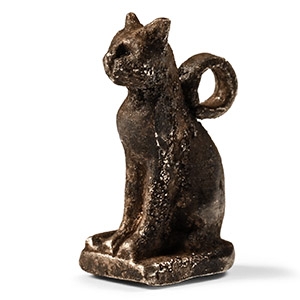
Egyptian Silver Cat Amulet
Late Period, 664-332 B.C.Sold for (Inc. bp): £260
Modelled seated on a tongue-shaped base, with fur detailing and suspension loop to the back. 1.58 grams, 12 mm
From an early 20th century collection.
The cat was sacred to Bastet, a protective mother goddess and the daughter of the sun god Re. Amulets provided the wearer with the goddess's protection. -
.jpg)
Egyptian Turquoise Faience Amphora
Roman Period, 1st-2nd century A.D.Sold for (Inc. bp): £1,235
A turquoise blue faience jar probably made in Roman Egypt, in a form similar to that of a Greek column krater, with a broad shoulder and rim, two angled strap handles with scalloped ends, band of raised scales to the shoulder, lotus leaves to the body and shoulder; restored. 2.2 kg, 21 cm wide
Fine condition, restored.
Acquired on the European art market mid 1990s. with Bonhams, Knightsbridge, 22 September 1998, lot 31. with Bonhams, Knightsbridge, 22 April 1999, lot 641. with Christie's, London, 18 October 2005, lot 10. Previously with Mansour Gallery, London W1. Property of a North West London gentleman. Accompanied by a copy of the relevant Christie's and Bonhams catalogue pages.
