
Auction Highlights
-
.jpg)
Egyptian Granite Head of a Dignitary
Sold for (Inc. bp): £28,600
Carved with soft facial features and carefully executed cosmetic lines around the eye, earring, and carefully detailed duplex wig with gently wavy curls; likely from the Ramesside Period; mounted on a custom-made stand. -
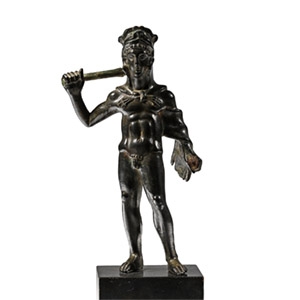
Etruscan Bronze Statuette of Herakles
Sold for (Inc. bp): £18,200
Modelled in the round with a muscular nude body, his club resting on his shoulder and the hair dressed in rows of tight, close-set curls underneath the Nemean lionskin hood with cloak billowing over his left arm, the paws tied across his chest; mounted on a custom-made display stand. -
.jpg)
Roman Marble Portrait of a Boy as Worshipper of Isis
Sold for (Inc. bp): £17,550
Carved head of a prepubescent worshipper of Isis, with soft facial features, long nose, small downturned mouth, heavy-lidded eyes, the whole giving the face a sombre or mournful appearance; the hair textured to indicate a short cut and combed forward across the scalp, sidelock above the right ear; mounted on a 16th century carved breccia upper body with leather cuirass and pteruges to right shoulder, cloak draped across the shoulders and fastened at the clavicle on the right side with a disc-brooch; socle base; some restoration. -
.jpg)
Larger Than Life-Size Roman Bronze Sandaled Foot
Sold for (Inc. bp): £39,000
Modelled in the round and originally part of a monumental statue, the naturalistic right foot encased in a trochades leather sandal with median reversed tongue secured with side straps and thick looped laces; the thick platform sole slightly curved, toes and nails well defined; mounted on a substantial custom-made display stand. -
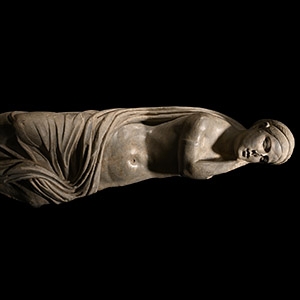
Life-Size Roman Marble Sleeping Girl from a Sarcophagus Lid
Sold for (Inc. bp): £20,800
Modelled in the half-round, nude with eyelids half-closed in sleep; a drapery partly covering the head and wrapping around the lower body under the hips; the hairstyle similar to those of the Antonine Dynasty, the peaceful face supported by the hands and the ear pierced to accept an earring; iron reinforcing rod to the feet and the right arm's armilla a later replacement; upper head restored in Parian marble. -
.jpg)
Byzantine Porphyry Relief with Cross Surrounded by Two Birds
Sold for (Inc. bp): £28,600
An imposing panel divided to four sections by a central cross on a stepped pedestal, the lower and upper arm with branch-like extensions; the upper quadrants with a circlet surrounding a palm tree-shaped motif; each lower quadrant with a bird in profile facing back; mounted on a custom-made display stand. -
.jpg)
Carved Marble Memento Mori Skull
Sold for (Inc. bp): £16,900
Carved skull on a short neck with musculature and blood vessels; mandible in place with some teeth in sockets, wisps of hair adhering to the dome of the skull; one zygomatic bone partly absent; square-section socle base. -
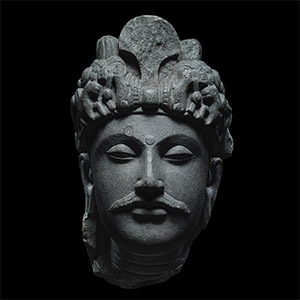
'The Kelton' Gandharan Head of a Bodhisattva
Sold for (Inc. bp): £24,700
Carved in the half-round head of a Bodhisattva (probably Maitreya) with fine detailing to the arched brow, aquiline nose, neat moustache and full lips; the eyes heavily lidded, urna to the forehead, long open lobes to the ears; the hair in multi-stranded curling locks gathered into an ushnisha with brow-band below; heavily cleaned, conserved, and mounted on a custom-made stand; supplied with original old wooden base with collector's label: 'Head of Bodhisattva / Fine grain schist / Gandhara, Northwest Pakistan / 4th century'.
-
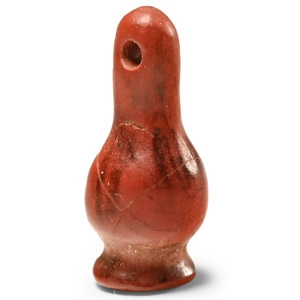
Egyptian Jasper Poppy Head Amulet
New Kingdom, 18th-19th Dynasty, circa 1550-1213 B.C.Sold for (Inc. bp): £104
Polished and with integral pierced suspension loop. 0.78 grams, 15 mm
From an early 20th century collection.
Amulets in the form of poppies were used to heal, alleviate pain, and ward off death. This type of amulet was also associated with Osiris, the Egyptian deity of agriculture, death, and the afterlife. -
.jpg)
Egyptian Gold Lotus Type Pendant
Late Period, 664-332 B.C.Sold for (Inc. bp): £364
With palmette motif and filigree hoop. 0.15 grams, 8 mm
Acquired 1980-2015. Ex Abelita family collection.
Flora-form amulets are thought to symbolise new life, like the growing plants they copied. Many gold palmette elements were found in the New Kingdom tomb of Aper-el at Saqqara, featuring pierced holes rather than a hoop for attachment (Cf. Zivie, A., Découverte à Saqqarah: Le vizir oublié, Paris, 1990, p.149 no.94 for examples). -
.jpg)
Egyptian Multi-Stranded Mummy Bead Necklace
Late Period, 664-332 B.C.Sold for (Inc. bp): £156
Multi-stranded designer necklace composed of beads of mainly annular and tubular types. 23 grams total, 66 cm long
Acquired before 1979. From the private collection of Mr F. A., South Kensington, London, UK; thence by descent 2014.
For thousands of years, artisans in Egypt created vibrant ceramics to echo the beauty of rare jewels. These ornaments were created with almost every material, colour, and texture imaginable and they come from across Egypt and beyond: vibrant blue lapis lazuli from Afghanistan, glossy black obsidian from Turkey, and aqua-green turquoise from the Sinai. They were worn in life and, after death, they served as precious ornamentation for mummies -
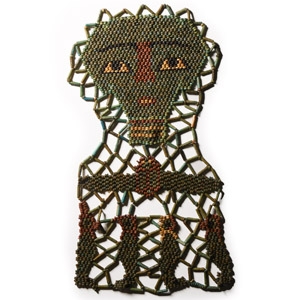
Egyptian Faience Beaded Mummy Mask with Sons of Horus
Ptolemaic Period, 332-30 B.C.Sold for (Inc. bp): £358
Restrung netted beadwork panel of annular and tubular glazed composition beads in blues, greens, black, cream and red-brown colours, depicting a mummy face-mask with false beard, a scarab with extended wings below, the 'Four Sons of Horus’ beneath the scarab, joined together with areas of open netting of tubular beads; restrung with some later beads. 72 grams, 26 cm
Ex Mariaud de Serres, Paris, France, 1990s. From a London, UK, collection.
The Four Sons of Horus were deities responsible for protecting the internal organs of the deceased. Here, on the left, we can see the jackal-headed Duamutef, who protected the stomach, followed by the falcon-headed Qebehsenuef, protector of the intestines, then the human-headed Imsety, who protected the liver and, finally, the baboon-headed Hapy, protected the lungs, on the right. -
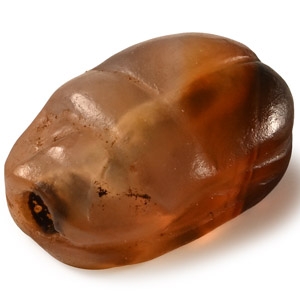
Egyptian Hardstone Scarab with Ankh
Late Period, 664-332 B.C.Sold for (Inc. bp): £124
Plano-convex in profile with segmented upper face and incised ankh to the underside. 1.05 grams, 13 mm
From the private collection of the late Mrs Belinda Ellison, long time member of the Egyptian Exploration Society, c.1940-2020. -
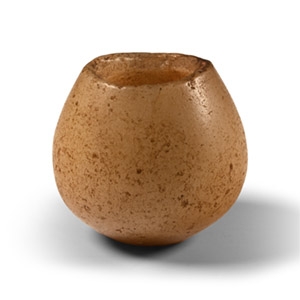
Egyptian Alabaster Vase
New Kingdom, circa 1550-1315 B.C. or earlierSold for (Inc. bp): £156
Round in profile with flattened underside, squared rim (possibly incomplete); with old collector's manuscript note: 'Old Kingdom between 3000-1200 B.C.'. 52 grams, 39 mm
Ex Yorkshire, UK, collection, 1960s-1980s. Accompanied by an old handwritten identification slip. -
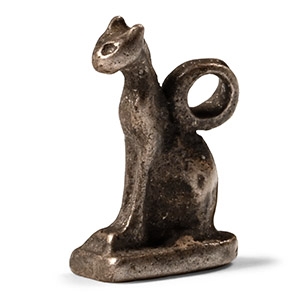
Egyptian Silver Cat Amulet
Late Period, 664-332 B.C.Sold for (Inc. bp): £260
Modelled seated on a tongue-shaped base, with facial detailing and suspension loop to the back. 0.33 grams, 8 mm
From an early 20th century collection.
The cat was sacred to Bastet, a protective mother goddess and the daughter of the sun god Re. Amulets provided the wearer with the goddess's protection. -
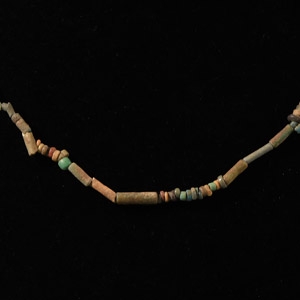
Egyptian Mummy Bead Necklace
Late Period, 664-332 B.C.Sold for (Inc. bp): £46
Restrung group of glazed composition beads, mainly tubular and annular types. 3.58 grams, 50 cm long
From a private Paris collection, France, 1960s. From the personal collection of Derek Rogers, Suffolk, UK. -
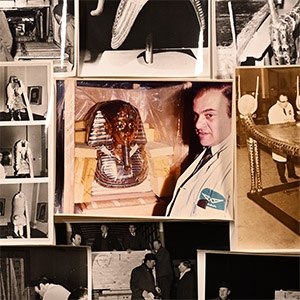
Original Press Photographs of the 1972 Tutankhamun Exhibition
1972 A.D.Sold for (Inc. bp): £39
Comprising monochrome glossy photographs with printed caption to the reverse: 'Tutankhamun's Funerary Couch. The divine cow in the final stages of wrapping, being embraced by Mr. T.G.H. James, Assistant Keeper of the British Museum'; 'The six stages in the packing of the gilded wooden statue of Tutankhamun; one of a pair that stood sentinel at the entrance to the inner chamber'; 'Colin Ashby of Walford Wingate Forwarders Ltd in the course of packing the major item in the Tutankhamun collection at the Cairo Museum. The funerary mask from Tutankhamun's mummy is made of beaten gold and is the finest ever found.' (Colour photo); 'The funerary mask from Tutankhamun's mummy made of beaten gold and the finest ever found. (Please credit the Cairo Museum)'; 'Part of the carefully-packed contents of Tutankhamun's tomb at London Airport on arrival from Cairo. Lt.Col. E.C. Easter MBE, Chairman of Walford Wingate Forwarders Ltd. the company responsible for the entire packing and surface transportation operation, supervises the off-loading of part of the world's most fabulous treasure.' (2 photographs); 'Never has B.O.A.C.'s slogan been more assuring. the innocent looking cargo being unloaded at London Airport is part of a priceless consignment from Cairo for the forthcoming exhibition of the contents of Tutankhamun's tomb to be held at the British Museum. Flown in by the R.A.F. and B.O.A.C. under British Government indemnity, the world's greatest treasure trove was packed and handled by Walford Wingate Forwarders Ltd.'; 'Tutankhamun's Funerary Couch. Preliminary inspection of Tutankhamun's funerary couch by Messrs Ashby and Burnett of Walford Wingate Forwarders Ltd.'; 'Tutankhamun's Funerary Couch. One of the divine cows separated from the couch in the early stages of wrapping'. 102 grams total, 25.2 x 17.7 - 25.3 x 20.4 cm
Property of a Cambridgeshire, UK, gentleman. -
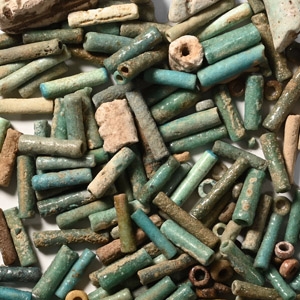
Egyptian Faience Bead and Amulet Group
Late Period, 664-332 B.C.Sold for (Inc. bp): £117
Comprising mainly blue and green tubular beads with some annular beads and fragmentary amulets, including the head of a hare and a portion of a hedjet crown. 19 grams total, 2-19 mm
From an early 20th century Home Counties, UK, collection. -
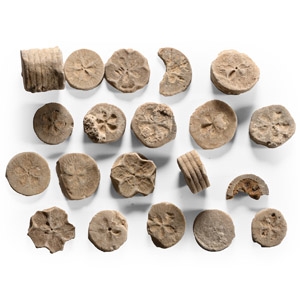
Egyptian Limestone 'Floral' Inlay Group
Roman Period, 30 B.C.-323 A.D. or earlierSold for (Inc. bp): £26
Group of discoid inlay plaques or gaming counters, crinoids with cinquefoil motif. 35 grams total, 14-18 mm
From a central London ADA dealership, 1980-1990.
Flowers were symbolic of rebirth due to the daily reopening of their petals after nightfall. As a result, they were widely used in domestic settings, religious and funerary contexts, and as adornments. Similar rosette discs, like those recovered from the Ramesside Period palace at Qantir, were used as decorative elements in royal palaces. -
.jpg)
Egyptian Faience Eye of Horus
Late New Kingdom, circa 1300-1075 B.C.Sold for (Inc. bp): £130
Openwork wedjat eye pendant with suspension loop above and slender frame. 0.78 grams, 21 mm
Acquired 1970s onwards. Private collection of Michael O'Hara, Cambridgeshire, UK.
The wedjat eye amulet symbolised the eye of the falcon god Horus. According to ancient Egyptian mythology, Horus’ eye was gouged out by his treacherous uncle Seth and then healed by Thoth. While these amulets could be worn for protection in daily life, they also played a significant role in the funerary sphere. Wedjat eye amulets were believed to offer protection to the deceased’s mummy and could serve as substitutes for daily food offerings.
