
Auction Highlights
-
.jpg)
Egyptian Granite Head of a Dignitary
Sold for (Inc. bp): £28,600
Carved with soft facial features and carefully executed cosmetic lines around the eye, earring, and carefully detailed duplex wig with gently wavy curls; likely from the Ramesside Period; mounted on a custom-made stand. -
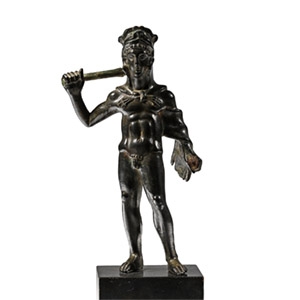
Etruscan Bronze Statuette of Herakles
Sold for (Inc. bp): £18,200
Modelled in the round with a muscular nude body, his club resting on his shoulder and the hair dressed in rows of tight, close-set curls underneath the Nemean lionskin hood with cloak billowing over his left arm, the paws tied across his chest; mounted on a custom-made display stand. -
.jpg)
Roman Marble Portrait of a Boy as Worshipper of Isis
Sold for (Inc. bp): £17,550
Carved head of a prepubescent worshipper of Isis, with soft facial features, long nose, small downturned mouth, heavy-lidded eyes, the whole giving the face a sombre or mournful appearance; the hair textured to indicate a short cut and combed forward across the scalp, sidelock above the right ear; mounted on a 16th century carved breccia upper body with leather cuirass and pteruges to right shoulder, cloak draped across the shoulders and fastened at the clavicle on the right side with a disc-brooch; socle base; some restoration. -
.jpg)
Larger Than Life-Size Roman Bronze Sandaled Foot
Sold for (Inc. bp): £39,000
Modelled in the round and originally part of a monumental statue, the naturalistic right foot encased in a trochades leather sandal with median reversed tongue secured with side straps and thick looped laces; the thick platform sole slightly curved, toes and nails well defined; mounted on a substantial custom-made display stand. -
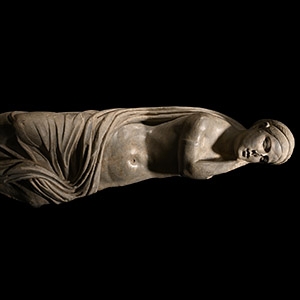
Life-Size Roman Marble Sleeping Girl from a Sarcophagus Lid
Sold for (Inc. bp): £20,800
Modelled in the half-round, nude with eyelids half-closed in sleep; a drapery partly covering the head and wrapping around the lower body under the hips; the hairstyle similar to those of the Antonine Dynasty, the peaceful face supported by the hands and the ear pierced to accept an earring; iron reinforcing rod to the feet and the right arm's armilla a later replacement; upper head restored in Parian marble. -
.jpg)
Byzantine Porphyry Relief with Cross Surrounded by Two Birds
Sold for (Inc. bp): £28,600
An imposing panel divided to four sections by a central cross on a stepped pedestal, the lower and upper arm with branch-like extensions; the upper quadrants with a circlet surrounding a palm tree-shaped motif; each lower quadrant with a bird in profile facing back; mounted on a custom-made display stand. -
.jpg)
Carved Marble Memento Mori Skull
Sold for (Inc. bp): £16,900
Carved skull on a short neck with musculature and blood vessels; mandible in place with some teeth in sockets, wisps of hair adhering to the dome of the skull; one zygomatic bone partly absent; square-section socle base. -
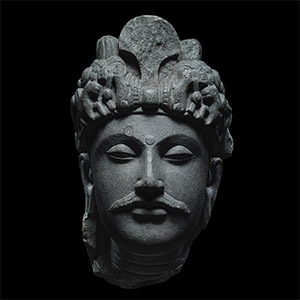
'The Kelton' Gandharan Head of a Bodhisattva
Sold for (Inc. bp): £24,700
Carved in the half-round head of a Bodhisattva (probably Maitreya) with fine detailing to the arched brow, aquiline nose, neat moustache and full lips; the eyes heavily lidded, urna to the forehead, long open lobes to the ears; the hair in multi-stranded curling locks gathered into an ushnisha with brow-band below; heavily cleaned, conserved, and mounted on a custom-made stand; supplied with original old wooden base with collector's label: 'Head of Bodhisattva / Fine grain schist / Gandhara, Northwest Pakistan / 4th century'.
-
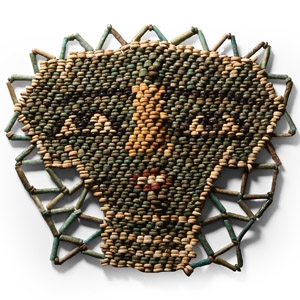
Egyptian Faience Mummy Bead Mask
Ptolemaic Period, 332-30 B.C.Sold for (Inc. bp): £286
A panel of small glazed composition beads in various colours representing a mummy face mask with false beard with netted border; restrung with some later beads. 42 grams, 13.5 cm
Ex Mariaud des Serres, Paris, France, 1990s. -
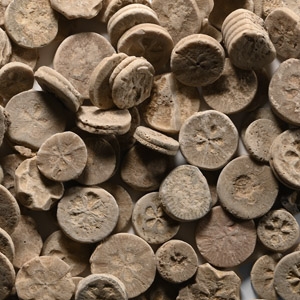
Egyptian Limestone 'Floral' Inlay Group
Roman Period, 30 B.C.-323 A.D.Sold for (Inc. bp): £72
Group of discoid inlay plaques or gaming counters, crinoids with cinquefoil motif. 105 grams total, 7-19 mm
From a central London ADA gallery, 1990s. -
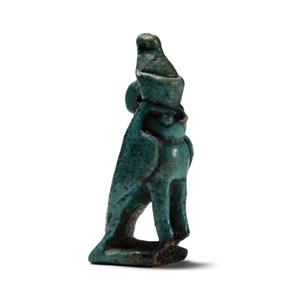
Large Egyptian Blue Glazed Horus Amulet
Late New Kingdom-Third Intermediate Period, circa 1300-700 B.C.Sold for (Inc. bp): £234
Modelled in the round as a perching falcon on a rectangular base and wearing the double-crown; loop to rear of head. 12.5 grams, 54 mm
From an old Suffolk, UK, collection. Acquired in the UK before 1980. From the personal collection of Derek Rogers, Suffolk, UK.
The falcon amulet was a symbol of Horus, the god of the sky, war, and protection. -
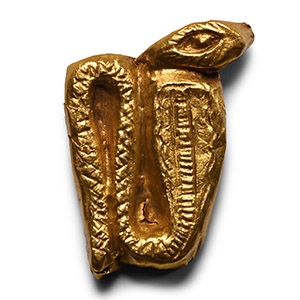
Egyptian Gold Uraeus Appliqué
Late Period, 664-332 B.C.Sold for (Inc. bp): £195
Sheet-gold repoussé mount with S-curved serpentine body, ovoid head; edges recurved. 0.87 grams, 21 mm
From an old UK collection, 1980s. -
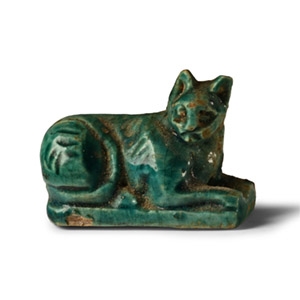
Egyptian Blue Glazed Bastet Amulet
New Kingdom, 18th Dynasty, circa 1504-1452 B.C.Sold for (Inc. bp): £338
Modelled resting on a rectangular base, with fur-texture detailing and hieroglyph to the underside. 2.01 grams, 17.59 mm
From an old Suffolk, UK, collection. Acquired in the UK before 1980. From the personal collection of Derek Rogers, Suffolk, UK.
The cat was sacred to Bastet, a protective mother goddess and the daughter of the sun god Re. Amulets provided the wearer with the goddess's protection. Her name means ‘she of the bast [ointment jar],’ which may have contained a substance favoured by or exclusive to royalty. Originally, Bastet was depicted as a woman with the head of a lioness, but by the New Kingdom, she was typically depicted with a cat's head. She is sometimes shown with kittens, emphasising her maternal role as a fierce protector of offspring. -
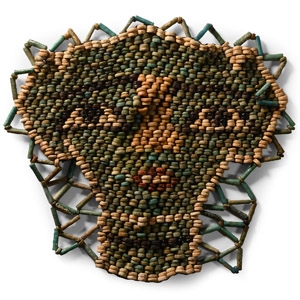
Egyptian Faience Mummy Bead Mask with Netting
Ptolemaic Period, 332-30 B.C.Sold for (Inc. bp): £364
A netted beadwork panel of annular and tubular glazed composition beads in blues, greens, black, cream and red-brown colours, depicting a mummy face-mask with false beard; restrung with some later beads. 52.7 grams, 14.5 cm wide
Ex Mariaud de Serres, Paris, France, 1980-1990s. From a London, UK, collection. -
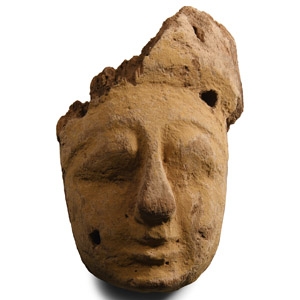
Egyptian Painted Wooden Mask
Late Period, 664-332 B.C.Sold for (Inc. bp): £364
D-shaped in plan with carved facial detailing, thick nose and narrow mouth, with ochre-coloured painted finish; pierced for attachment. 170 grams, 20 cm
with a London, UK gallery, 1971-early 2000s.
This is the face and front portion of a wig belonging to a mummiform wooden coffin. It was attached using wooden dowels, the holes for which are visible. -
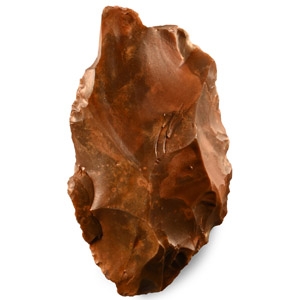
Egyptian Flint Handaxe
Lower Palaeolithic Period, circa 450,000-280,000 B.P.Sold for (Inc. bp): £33
Irregular in plan with biconvex section. 380 grams, 14 cm
Found Egypt, North Africa. From the British art market in the 1970s-1980s. Acquired via inheritance, 1988. From the collection of a South West London, UK, specialist Stone Age collector. -
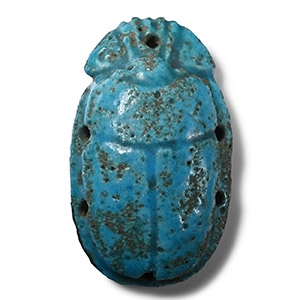
Large Egyptian Blue Faience Scarab
750-332 B.C.Sold for (Inc. bp): £572
With boldly indicated head, clypeus, prothorax, and elytra; flat underside; holes at the head, back, and sides for attachment. 19.5 grams, 50 mm
with Beaussant Lefèvre, 17 November 2015, no.48. Acquired by the present owner from the above.
Scarabs were often used as funerary amulets and were believed to symbolise the rebirth and regeneration of the deceased. -
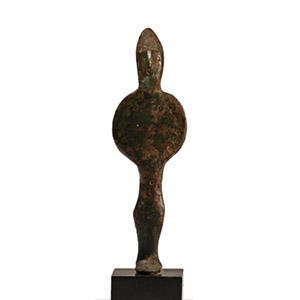
Phoenician Bronze Figure
1st millennium B.C.Sold for (Inc. bp): £624
Modelled in the round with tall conical cap, pinched face, flat discoid upper body and single-piece legs, ovoid foot; lightly punched eyes, navel and nipples, horseshoe punch-detailing to edges; mounted on a display stand. 56 grams total, 10.3 cm including stand
From a collection acquired on the UK art market from various auction houses and collections mostly before 2000. From an important Cambridgeshire estate; thence by descent.
This figurine bears a resemblance to other simply crafted figurines found in temple deposits at Byblos and other Phoenician sites. The tall conical cap seen on many of these figurines is reminiscent of the hedjet Egyptian crown, underscoring the robust cultural and commercial ties between the Levant and Egypt. -
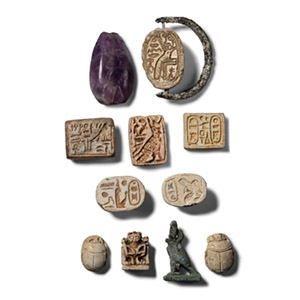
Egyptian Faience Scarab Collection
Mainly 15th-14th century B.C.Sold for (Inc. bp): £1,690
Including a white scarab with cartouche of Thutmose III; a white rectangle with two cartouches of Thutmose III, a white rectangle with hieroglyphs to one face for Amenhotep III and to the reverse those for Teje, one of his wives; and other items. 22.7 grams total, 12-28 mm
Acquired in the mid 1980s-1990s. Private collection, Switzerland, thence by descent. Private collection, since the late 1990s. -
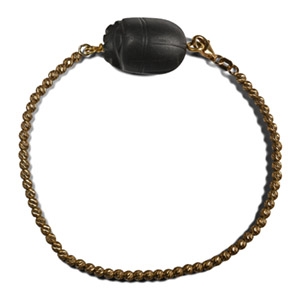
Egyptian Hardstone Scarab in Gold Bracelet
Late Period, 664-332 B.C. and laterSold for (Inc. bp): £572
Scarab, plano-convex in section with incised carapace and leg detailing, stylised djed pillar to the underside; mounted in a 20th-century gold bracelet. 12.30 grams, 22.5 cm
From the private collection of the late Mrs Belinda Ellison, long time member of the Egyptian Exploration Society, c.1940-2020.
