
Auction Highlights
-
.jpg)
Egyptian Granite Head of a Dignitary
Sold for (Inc. bp): £28,600
Carved with soft facial features and carefully executed cosmetic lines around the eye, earring, and carefully detailed duplex wig with gently wavy curls; likely from the Ramesside Period; mounted on a custom-made stand. -
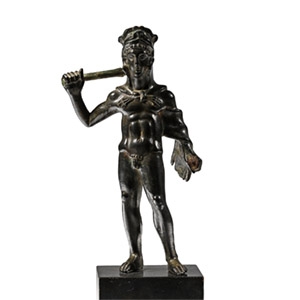
Etruscan Bronze Statuette of Herakles
Sold for (Inc. bp): £18,200
Modelled in the round with a muscular nude body, his club resting on his shoulder and the hair dressed in rows of tight, close-set curls underneath the Nemean lionskin hood with cloak billowing over his left arm, the paws tied across his chest; mounted on a custom-made display stand. -
.jpg)
Roman Marble Portrait of a Boy as Worshipper of Isis
Sold for (Inc. bp): £17,550
Carved head of a prepubescent worshipper of Isis, with soft facial features, long nose, small downturned mouth, heavy-lidded eyes, the whole giving the face a sombre or mournful appearance; the hair textured to indicate a short cut and combed forward across the scalp, sidelock above the right ear; mounted on a 16th century carved breccia upper body with leather cuirass and pteruges to right shoulder, cloak draped across the shoulders and fastened at the clavicle on the right side with a disc-brooch; socle base; some restoration. -
.jpg)
Larger Than Life-Size Roman Bronze Sandaled Foot
Sold for (Inc. bp): £39,000
Modelled in the round and originally part of a monumental statue, the naturalistic right foot encased in a trochades leather sandal with median reversed tongue secured with side straps and thick looped laces; the thick platform sole slightly curved, toes and nails well defined; mounted on a substantial custom-made display stand. -
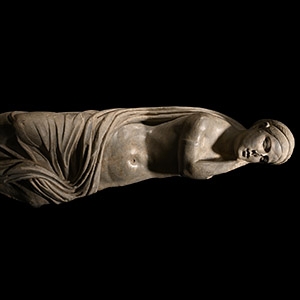
Life-Size Roman Marble Sleeping Girl from a Sarcophagus Lid
Sold for (Inc. bp): £20,800
Modelled in the half-round, nude with eyelids half-closed in sleep; a drapery partly covering the head and wrapping around the lower body under the hips; the hairstyle similar to those of the Antonine Dynasty, the peaceful face supported by the hands and the ear pierced to accept an earring; iron reinforcing rod to the feet and the right arm's armilla a later replacement; upper head restored in Parian marble. -
.jpg)
Byzantine Porphyry Relief with Cross Surrounded by Two Birds
Sold for (Inc. bp): £28,600
An imposing panel divided to four sections by a central cross on a stepped pedestal, the lower and upper arm with branch-like extensions; the upper quadrants with a circlet surrounding a palm tree-shaped motif; each lower quadrant with a bird in profile facing back; mounted on a custom-made display stand. -
.jpg)
Carved Marble Memento Mori Skull
Sold for (Inc. bp): £16,900
Carved skull on a short neck with musculature and blood vessels; mandible in place with some teeth in sockets, wisps of hair adhering to the dome of the skull; one zygomatic bone partly absent; square-section socle base. -
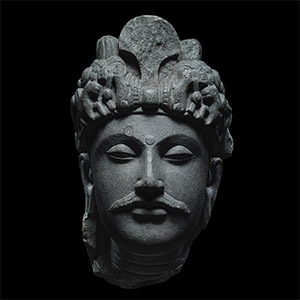
'The Kelton' Gandharan Head of a Bodhisattva
Sold for (Inc. bp): £24,700
Carved in the half-round head of a Bodhisattva (probably Maitreya) with fine detailing to the arched brow, aquiline nose, neat moustache and full lips; the eyes heavily lidded, urna to the forehead, long open lobes to the ears; the hair in multi-stranded curling locks gathered into an ushnisha with brow-band below; heavily cleaned, conserved, and mounted on a custom-made stand; supplied with original old wooden base with collector's label: 'Head of Bodhisattva / Fine grain schist / Gandhara, Northwest Pakistan / 4th century'.
-
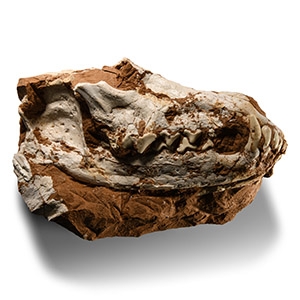
Natural History - Fossil Wolf Skull in Matrix
Late Pliocene-early Pleistocene Period, circa 5.3 million-60,000 years B.P.Sold for (Inc. bp): £1,170
The majority of Canis teilhardi skull in matrix with some other bone fragments. 1.28 kg, 19 cm
From the private collection of a London gentleman formed since 2003. -
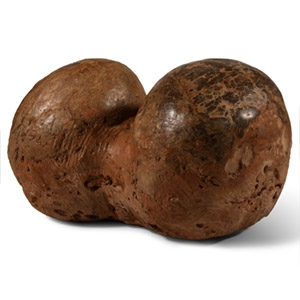
Natural History - Hadrosaur Dinosaur Egg Pair
Cretaceous Period, 100 million years B.P.Sold for (Inc. bp): £780
A pair of Charonosaurus sp. hadrosaur eggs on a matrix retaining evidence of the original leathery surface. 8.85 kg, 27.5 cm
Acquired 1983-1990. Private collection, Hove, UK.
Hadrosaurs were large dinosaurs, growing up to 10 metres in length, belonging to the ‘Duck-Billed’ group of dinosaurs. They are considered the ‘herd animal’ of the Cretaceous, having been found buried together in their thousands. Dinosaur egg fossils are known from approximately two-hundred sites around the word, particularly in Asia. This nest comes from the Xixia Formation, Henan region of China, which produces some of the best preserved eggs in the world. These eggs can yield entire embryos within them, making them an essential tool for understanding the biology of these creatures. -
.jpg)
Natural History - Complete Ice Age Juvenile Woolly Mammoth Tusk
Pleistocene Period, 2.6 million-11,700 years B.P.Sold for (Inc. bp): £2,470
A right-side 'fossil' tusk of the extinct Mammuthus Primigenius; ivory yellow-brown in colour and finely preserved with the typically marked curvature of this species; with custom-made display stand. 2.29 kg total, 54 cm wide including stand
From the Siberian Tundra. From the private collection of Mr J S, Northamptonshire, UK. Property of a Cambridgeshire gentleman.
Mammoths were animals of the Ice Age; they co-existed with and were hunted by early man; Siberia is famed for discoveries of frozen mammoth carcasses (see 'Dima' and 'Lyuba' for examples) and for the hut circles where mammoth bones and tusks were used as building materials; tusks have been traded for at least 2,000 years and in modern times, Siberian natives still hunt for them and use the fossil ivory as raw material. -
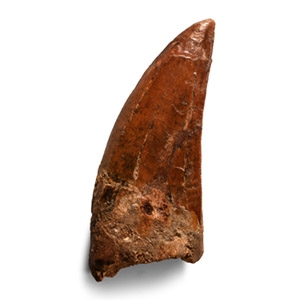
Natural History - Large Fossil Carcharodontosaurus North African 'T-Rex' Tooth
Cretaceous Period, circa 145-93 million years B.P.Sold for (Inc. bp): £546
From Carcharodontosaurus saharicus, of large size, displaying some serrations. 64 grams, 95 mm
From a Cambridgeshire, UK, collection.
The Carcharodontosaurus saharicus was one of the largest predators (larger than its distant North American T-Rex cousin) of all time and is also related to Allosaurus and the South American Giganotosaurus. -
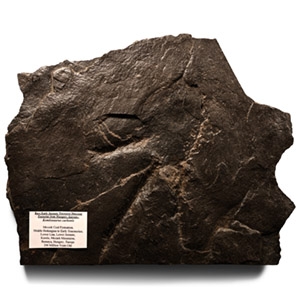
Natural History - Fossil Theropod Dinosaur Footprint
Lower Jurassic Period, circa 200 million years B.P.Sold for (Inc. bp): £338
Komlosaurus carbonis footprint on an irregular matrix with information ticket. 2.79 kg, 34 cm
From the Mecsek Coal Formation, Middle Hettangian to Early Sinemurian, Lower Lias, Lower Jurassic, Komlo, Mecsek Mountains, Baranya, Hungary. From the private collection of Mr J S, Northamptonshire, UK. Property of a Cambridgeshire gentleman. -
.jpg)
Egyptian Faience Scarab with Hieroglyphs
Late Period, 664-332 B.C.Sold for (Inc. bp): £624
Naturalistic detailing to the blue stained body and legs with section of openwork between the front and back legs; hieroglyphs on base giving the good luck message 'When Amun is behind you, do not fear'; pierced for suspension. 1.72 grams, 15 mm
Ex collection of Emil Saad, Paris-Alexandria. -
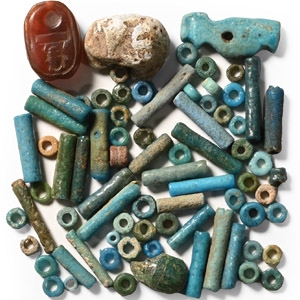
Egyptian Faience Bead and Scarab Group
Mainly Late Period, 664-332 B.C.Sold for (Inc. bp): £117
Comprising mainly blue tubular and annular beads, and a small Tawaret(?) amulet; a fragmentary glass bead(?) with some iridescence, a fragmentary scarab and a carnelian scarab with the throne name of Thutmose III, men-kheper-Re, to the underside, chipped. 8 grams total, 2-17 mm
Ex Belinda Elliston collection. -
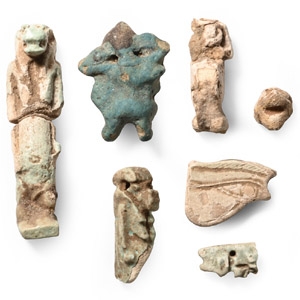
Egyptian Faience Amulet Group
Mainly Late Period, 664-332 B.C.Sold for (Inc. bp): £65
Comprising fragmentary amulets including, a wedjat-eye of Horus, Tawaret, a seated Isis, a Tawaret in two parts, and Bes. 27 grams total, 11-31 mm
From an early 20th century Home Counties, UK, collection. -
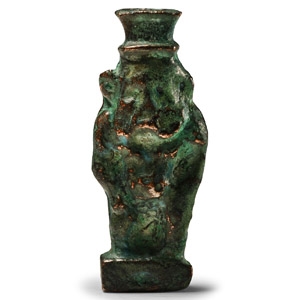
Egyptian Bronze Bes Statuette
Late Period-Ptolemaic Period, 664-30 B.C.Sold for (Inc. bp): £65
Standing on a rectangular base with flared modius type headdress; modelled in the round with tail to the reverse; re-patinated. 21 grams, 37 mm
UK private collection before 2000. Acquired on the UK art market. Property of a London gentleman.
From the New Kingdom onwards, Bes became one of ancient Egypt's most popular apotropaic deities. Despite his rather fearful appearance, Bes was the patron and protector of pregnant women and children and was also believed to protect them from harmful creatures like snakes. -
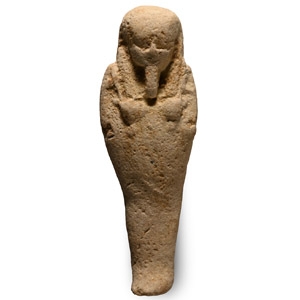
Egyptian White Faience Shabti
Ptolemaic Period, 332-30 B.C.Sold for (Inc. bp): £111
Modelled in the half-round with rounded facial features, lappet wig, false beard and crossed arms holding a pick and a hoe. 18 grams, 78 mm
Ex H. Norry collection, 1980s-1990s.
One of the primary purposes of shabti figures was to carry out heavy manual tasks on behalf of a person in the afterlife, and they were often depicted with necessary implements in their hands, such as baskets, picks, and hoes. Over time, the number of shabtis in a standard elite burial increased, from one in the Eighteenth Dynasty to several in the Nineteenth Dynasty, to one for every day of the year by the Third Intermediate Period. The high number of shabtis remained a feature in the Late and Ptolemaic Periods. -
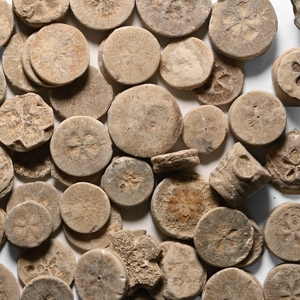
Egyptian Limestone 'Floral' Inlay Group
Roman Period, 30 B.C.-323 A.D. or earlierSold for (Inc. bp): £85
Group of discoid inlay plaques or gaming counters, crinoids with cinquefoil motif. 80 grams total, 12-19 mm
From a central London ADA gallery, 1990s.
Flowers were symbolic of rebirth due to the daily reopening of their petals after nightfall. As a result, they were widely used in domestic settings, religious and funerary contexts, and as adornments. Similar rosette discs, like those recovered from the Ramesside Period palace at Qantir, were used as decorative elements in royal palaces. -
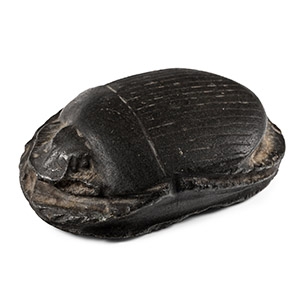
Egyptian Stone Scarab
Late Period, 664-332 B.C.Sold for (Inc. bp): £572
Black hardstone scarab with finely carved head, eyes, clypeus, prothorax, elytra, and legs; plain underside. 38 grams, 48 mm
Ex Irene Newman, Birdham, Chichester, West Sussex, England. with Stride & Son Auctioneers, Chichester, West Sussex, England, 23 April 2015, no.1599 [Part]. Acquired by the present owner at the above sale.
The scarab, representing the dung beetle, was a popular amulet in ancient Egypt for about two thousand years until the Ptolemaic Period. It extended beyond Egypt and was exported to and manufactured in regions like Phoenicia and Israel. The beetle is named khepri and was considered the embodiment of the creator god Khepri. The Egyptians believed that the beetle emerging from the dung ball was an act of self-creation.
