
Auction Highlights
-
.jpg)
Egyptian Granite Head of a Dignitary
Sold for (Inc. bp): £28,600
Carved with soft facial features and carefully executed cosmetic lines around the eye, earring, and carefully detailed duplex wig with gently wavy curls; likely from the Ramesside Period; mounted on a custom-made stand. -
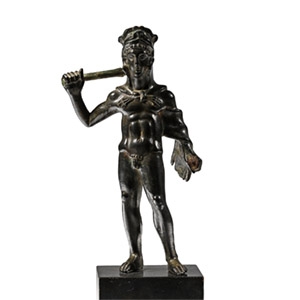
Etruscan Bronze Statuette of Herakles
Sold for (Inc. bp): £18,200
Modelled in the round with a muscular nude body, his club resting on his shoulder and the hair dressed in rows of tight, close-set curls underneath the Nemean lionskin hood with cloak billowing over his left arm, the paws tied across his chest; mounted on a custom-made display stand. -
.jpg)
Roman Marble Portrait of a Boy as Worshipper of Isis
Sold for (Inc. bp): £17,550
Carved head of a prepubescent worshipper of Isis, with soft facial features, long nose, small downturned mouth, heavy-lidded eyes, the whole giving the face a sombre or mournful appearance; the hair textured to indicate a short cut and combed forward across the scalp, sidelock above the right ear; mounted on a 16th century carved breccia upper body with leather cuirass and pteruges to right shoulder, cloak draped across the shoulders and fastened at the clavicle on the right side with a disc-brooch; socle base; some restoration. -
.jpg)
Larger Than Life-Size Roman Bronze Sandaled Foot
Sold for (Inc. bp): £39,000
Modelled in the round and originally part of a monumental statue, the naturalistic right foot encased in a trochades leather sandal with median reversed tongue secured with side straps and thick looped laces; the thick platform sole slightly curved, toes and nails well defined; mounted on a substantial custom-made display stand. -
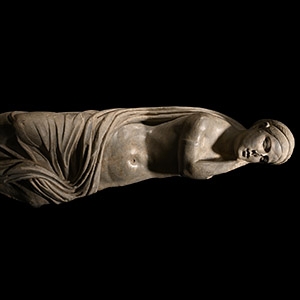
Life-Size Roman Marble Sleeping Girl from a Sarcophagus Lid
Sold for (Inc. bp): £20,800
Modelled in the half-round, nude with eyelids half-closed in sleep; a drapery partly covering the head and wrapping around the lower body under the hips; the hairstyle similar to those of the Antonine Dynasty, the peaceful face supported by the hands and the ear pierced to accept an earring; iron reinforcing rod to the feet and the right arm's armilla a later replacement; upper head restored in Parian marble. -
.jpg)
Byzantine Porphyry Relief with Cross Surrounded by Two Birds
Sold for (Inc. bp): £28,600
An imposing panel divided to four sections by a central cross on a stepped pedestal, the lower and upper arm with branch-like extensions; the upper quadrants with a circlet surrounding a palm tree-shaped motif; each lower quadrant with a bird in profile facing back; mounted on a custom-made display stand. -
.jpg)
Carved Marble Memento Mori Skull
Sold for (Inc. bp): £16,900
Carved skull on a short neck with musculature and blood vessels; mandible in place with some teeth in sockets, wisps of hair adhering to the dome of the skull; one zygomatic bone partly absent; square-section socle base. -
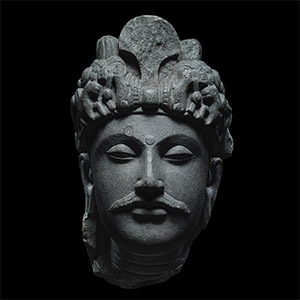
'The Kelton' Gandharan Head of a Bodhisattva
Sold for (Inc. bp): £24,700
Carved in the half-round head of a Bodhisattva (probably Maitreya) with fine detailing to the arched brow, aquiline nose, neat moustache and full lips; the eyes heavily lidded, urna to the forehead, long open lobes to the ears; the hair in multi-stranded curling locks gathered into an ushnisha with brow-band below; heavily cleaned, conserved, and mounted on a custom-made stand; supplied with original old wooden base with collector's label: 'Head of Bodhisattva / Fine grain schist / Gandhara, Northwest Pakistan / 4th century'.
-
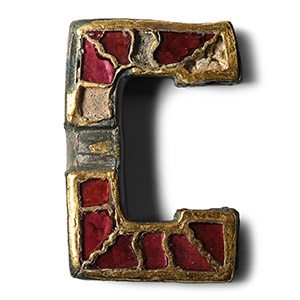
Merovingian Gold and Garnet Buckle Loop
6th century A.D.Sold for (Inc. bp): £910
Rectangular in plan with heavy gilding to the upper face and sidewall, inset stepped cloison garnets in prepared cells with traces of the resin setting; couch for the tongue at centre of the forward edge; old collector's label '20075 812' to underside. 17.04 grams, 38 mm
Private collection, Switzerland. Acquired from Gorny & Mosch, Munich, Germany, in 2013. Ex SVV Prunier, 11 July 2021, no.76 (part). -
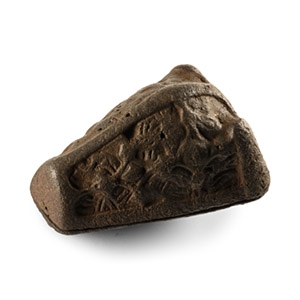
Viking Bronze Boar Brooch
10th-11th century A.D.Sold for (Inc. bp): £520
Decorative upper surface attached to a plain back-plate with spring-lugs and catchplate intact; the upper face divided by a heavy cast median rib with geometric ornament in the outer panels, arranged symmetrically along the rib with a similar transverse band; the corners of the wider end reinforced with vertical posts ending in heavy lobed ‘ears’; the upper-end panel with a continuation of the median rib, traces of ornamental interlace; the lower-end panel plain; hollow-cast. 98 grams, 57 mm
From a North Yorkshire, UK, private collection. Acquired from Adam Partridge Auctioneers, Macclesfield, UK. Property of Mr A.B., an American collector. -
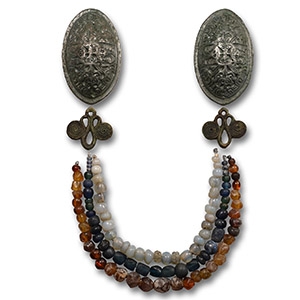
Viking Age Bronze Borre Style Tortoise Brooch Set
10th-12th century A.D.Sold for (Inc. bp): £1,170
Comprising: two elliptical bronze tortoise brooches, each domed with raised ornament of four Borre-style faces with pellet eyes to the centre of a panel of body parts and hatching with two more faces to the narrow ends, wide flange, catchplate, pin-hinge and pendant attachment bar to the reverse; two suspension links, each an omega-shaped loop with lateral coiled ends and ring above; three swags of graduated beads (restrung) - upper: pale blue glass oblate beads, crystal annular beads, melon beads; middle: deep blue and dark green glass and lapis lazuli polyhedral and annular beads; lower: oblate and polyhedral amber and glass beads. 310 grams total, 57 cm total long
From the private collection of a London gentleman, from his grandfather's collection formed before the early 1970s.
The most characteristic items of Viking period women's jewellery are oval brooch pairs, called 'tortoise brooches' in the literature. As in this example, the brooches themselves were usually connected by swags of coloured beads or by chains supporting tools such as tweezers or a small knife, as well as amulets. -
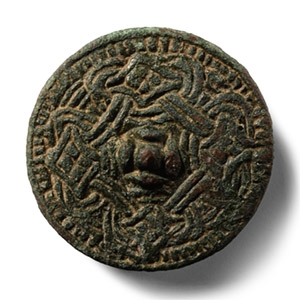
'The Holt' Anglo-Scandinavian Viking Bronze Borre Brooch
11th century A.D.Sold for (Inc. bp): £910
With low-relief Borre style looped tendrils motif, lug and catch to the reverse. 10.4 grams, 29 mm
Found near Holt, Norfolk, UK. From an old private collection of Norfolk, UK, gentleman, formed since 1998. -
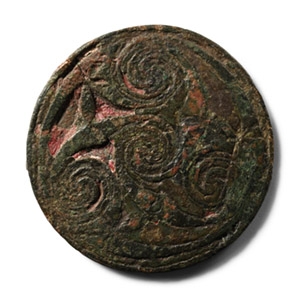
Anglo-Saxon Enamelled Bronze Hanging Bowl Mount
6th century A.D.Sold for (Inc. bp): £1,690
With raised circumferential border to the obverse; decorated with high-relief La Tène designs featuring elaborate curvilinear tendrils and triskele-style swirls enclosing an area of fine-line trumpet spiral designs on an enamelled field. 7.1 grams, 31 mm
Found Lincolshire, UK. From an old private collection of Norfolk, UK, gentleman, formed since 1998. -
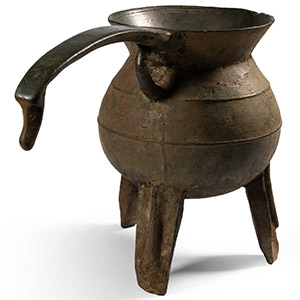
'The Harling' Medieval Bronze Handled Posnet Cauldron
14th century A.D.Sold for (Inc. bp): £8,450
Shaped as a small cauldron with a long curved handle decorated with five incuse circles extending from the rim to the swan-head finial and with loop handle beneath; spherical body, slightly oblate at the base with an everted rim and casting seams, three splayed stub legs with ribbed profile; offered with objects recovered from the same archaeological context: a struck flint flake; two bone fragments; a fragment of pottery. 3.1 kg total, 3.8-32 cm
Located whilst searching with a metal detector and archaeologically excavated by Norfolk Archaeology Unit, near Harling, Norfolk, UK, on Wednesday 8th November 2023. Accompanied by a copy of the British Museum's Portable Antiquities Scheme (PAS) report no.NMS-C1D619 which includes a photograph of the cauldron in situ before excavation. This lot has been checked against the Interpol Database of stolen works of art and is accompanied by search certificate no.12165-219623.
Bronze cauldrons played a role in ritual practices in the Middle Ages and beyond. It appears that many of the bronze cauldrons have been deliberately deposited, although the reasons for this were not always clear. There are strong indications that this often took place at the beginning of a large-scale project. This may have been the construction of a castle or a rampart, of a city wall, the building of a dyke, a dangerous crossing of the sea, the cultivation of a piece of farmland or the reclamation of a peat bog. For all types of projects, salvation and blessing could be requested in the form of a deliberate deposit of a bronze cauldron. This custom is directly comparable with the Medieval ritual of placing coins under the foundation stone of a building. -
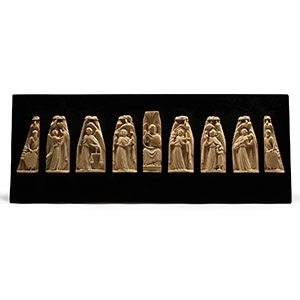
Medieval Archangels and Other Carved Bone Plaques by the Embriachi Workshop
Italy, Florence, circa 1400 A.D.Sold for (Inc. bp): £7,800
Group of nine carved bone panels from a casket, most with a tapering upper third and openwork vegetation at the top; comprising: young man resting his hands on a teardrop shield, beside a fir-tree, looking right; winged nimbate angel in floor-length robe reaching upwards towards a three-horned crown; winged nimbate angel in floor-length robe holding a naked sword in her right hand and scales in her left; winged nimbate figure in floor-length robe holding a serpent in each hand, with three faces conjoined; winged angel in floor-length robe sitting on a dais, holding a discoid object with a bifid handle (perhaps a lute); winged nimbate angel in floor-length robe holding a chalice in her right hand and cross in her left; winged nimbate angel in floor-length robe holding a flaming torch in her right hand and grasping the raised hands of a child with her left; winged nimbate angel in floor-length robe with two ewers, pouring liquid from one to the other; young man resting his hands on a teardrop shield, beside a fir-tree, looking left; mounted on a wooden display stand. 1.08 kg total, 48.5 cm wide including stand
Acquired Delchar, London, 2011. Private collection, Suffolk, UK. This lot has been checked against the Interpol Database of stolen works of art and is accompanied by a search certificate number no.12291-221716.
The Bottega degli Embriachi was an important producer of artworks carved in bone (and occasionally ivory) in a framework of inlaid wood. It was active in Northern Italy from circa 1375 A.D. until circa 1433. It relocated from Florence to Venice about 1395. The Bottega was especially known for 'marriage caskets' with tall columnar lids, with carved bone figural panels. Some of the panels here are evidently Christian (the figure with the cross and chalice) while others are perhaps purely symbolic (Justice with sword and scales) and some are simply puzzling (e.g. the three-faced figure with serpents). -
.jpg)
Medieval Knight's Bronze Limoges Buckle Plate with Rampant Lion Fighting a Human-Headed Snake
12th-13th century A.D.Sold for (Inc. bp): £169
Rectangular plaque with two attachment holes and flange to rear, enamel design with rampant lion and figure; additional later rivet head close to one corner. 13.8 grams, 33 mm
Found North Norfolk, UK. From an old private collection of Norfolk, UK, gentleman, formed since 1998. -
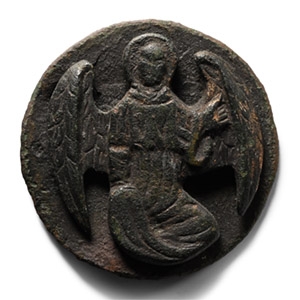
Medieval Bifacial Gilt Bronze Altar Cross Mount
14th-15th century A.D.Sold for (Inc. bp): £208
Roundel with low-relief enamelled rosette to one face, to the other an applied high-relief figure of an angel with wings spread, nimbus to the head, holding the hem of his robe in his right hand; secondary piercing behind the angel's wing. 56.2 grams, 48 mm
Found near Horsham St. Faith, Norfolk, UK. From an old private collection of Norfolk, UK, gentleman, formed since 1998. Accompanied by a copy of the British Museum's Portable Antiquities Scheme (PAS) report no.NMS-EED2A2. -
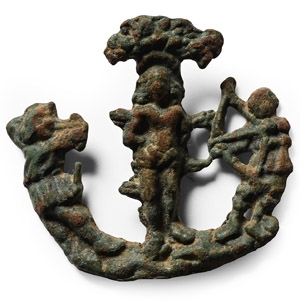
Medieval Bronze St. Edmunds Pilgrim's Badge
1450-1525 A.D.Sold for (Inc. bp): £416
Flat openwork badge with low-relief design of King (St.) Edmund of East Anglia tied to a tree flanked by two bowmen aiming at him, in a foliage setting; scar for attachment pin to reverse. 35.3 grams, 28 mm
Found Kettering, Northamptonshire, UK. From an old private collection of Norfolk, UK, gentleman, formed since 1998. -
.jpg)
Medieval Gilt Bronze Ostensorium with Semi-Precious Gemstones
Germany, Cologne, circa 1430 A.D.Sold for (Inc. bp): £6,760
Comprising a tubular shank with lower plain collar and median ribbed and fluted collar, teardrop-shaped head with transverse tubular 'monstrance' or viewing aperture, knop to the apex of the teardrop on each face; obverse with ellipsoid and circular cells enclosing precious and semi-precious stones in a variety of shapes and colours; reverse with ring of domed studs and two hinged fastenings; mounted on a custom-made stand. 902 grams total, 32.4 cm high including stand
Mercier & Cie, 16 April 2023, no.214. This lot has been checked against the Interpol Database of stolen works of art and is accompanied by a search certificate number no.12292-221721. -
.jpg)
Ethiopian Bronze Processional Cross
Early 15th century A.D.Sold for (Inc. bp): £1,105
Openwork flat-section panel with interlaced tendril design engraved with the Virgin and Child to one face and two archangels to the other in low-relief; tapering tubular socket with circumferential ribbing, lateral angled spurs. 406 grams, 29.5 cm
Acquired in 2002 from a private collection in Lisbon, Portugal. Ex central London gallery.
