
Auction Highlights
-
.jpg)
Egyptian Granite Head of a Dignitary
Sold for (Inc. bp): £28,600
Carved with soft facial features and carefully executed cosmetic lines around the eye, earring, and carefully detailed duplex wig with gently wavy curls; likely from the Ramesside Period; mounted on a custom-made stand. -
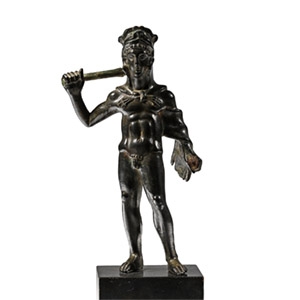
Etruscan Bronze Statuette of Herakles
Sold for (Inc. bp): £18,200
Modelled in the round with a muscular nude body, his club resting on his shoulder and the hair dressed in rows of tight, close-set curls underneath the Nemean lionskin hood with cloak billowing over his left arm, the paws tied across his chest; mounted on a custom-made display stand. -
.jpg)
Roman Marble Portrait of a Boy as Worshipper of Isis
Sold for (Inc. bp): £17,550
Carved head of a prepubescent worshipper of Isis, with soft facial features, long nose, small downturned mouth, heavy-lidded eyes, the whole giving the face a sombre or mournful appearance; the hair textured to indicate a short cut and combed forward across the scalp, sidelock above the right ear; mounted on a 16th century carved breccia upper body with leather cuirass and pteruges to right shoulder, cloak draped across the shoulders and fastened at the clavicle on the right side with a disc-brooch; socle base; some restoration. -
.jpg)
Larger Than Life-Size Roman Bronze Sandaled Foot
Sold for (Inc. bp): £39,000
Modelled in the round and originally part of a monumental statue, the naturalistic right foot encased in a trochades leather sandal with median reversed tongue secured with side straps and thick looped laces; the thick platform sole slightly curved, toes and nails well defined; mounted on a substantial custom-made display stand. -
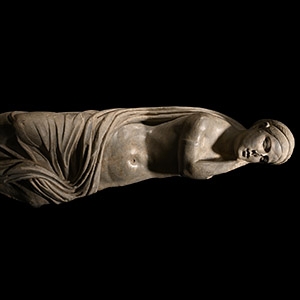
Life-Size Roman Marble Sleeping Girl from a Sarcophagus Lid
Sold for (Inc. bp): £20,800
Modelled in the half-round, nude with eyelids half-closed in sleep; a drapery partly covering the head and wrapping around the lower body under the hips; the hairstyle similar to those of the Antonine Dynasty, the peaceful face supported by the hands and the ear pierced to accept an earring; iron reinforcing rod to the feet and the right arm's armilla a later replacement; upper head restored in Parian marble. -
.jpg)
Byzantine Porphyry Relief with Cross Surrounded by Two Birds
Sold for (Inc. bp): £28,600
An imposing panel divided to four sections by a central cross on a stepped pedestal, the lower and upper arm with branch-like extensions; the upper quadrants with a circlet surrounding a palm tree-shaped motif; each lower quadrant with a bird in profile facing back; mounted on a custom-made display stand. -
.jpg)
Carved Marble Memento Mori Skull
Sold for (Inc. bp): £16,900
Carved skull on a short neck with musculature and blood vessels; mandible in place with some teeth in sockets, wisps of hair adhering to the dome of the skull; one zygomatic bone partly absent; square-section socle base. -
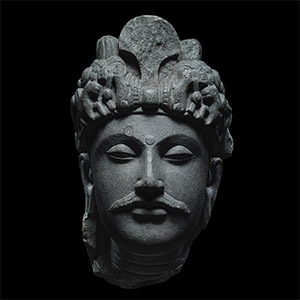
'The Kelton' Gandharan Head of a Bodhisattva
Sold for (Inc. bp): £24,700
Carved in the half-round head of a Bodhisattva (probably Maitreya) with fine detailing to the arched brow, aquiline nose, neat moustache and full lips; the eyes heavily lidded, urna to the forehead, long open lobes to the ears; the hair in multi-stranded curling locks gathered into an ushnisha with brow-band below; heavily cleaned, conserved, and mounted on a custom-made stand; supplied with original old wooden base with collector's label: 'Head of Bodhisattva / Fine grain schist / Gandhara, Northwest Pakistan / 4th century'.
-
.jpg)
Indus Valley Etched Orange Carnelian Necklace Bead Group
Circa 2nd millennium B.C. or laterSold for (Inc. bp): £195
Composed of polished carnelian beads including spherical, conical, drum, oval and other types, etched with geometric designs. 41 grams total, 6-14 mm
UK gallery, early 2000s. -
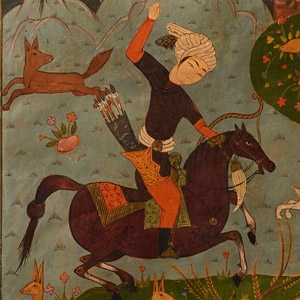
Mughal Hunting Scene Miniature
Circa 1680 A.D.Sold for (Inc. bp): £364
Rectangular card panel with painted scene of a landscape with two huntsmen; in the foreground a mounted archer holds his bow ready to nock an arrow while a fox and deer flee from him, and another deer lies dead with an arrow in the throat; the huntsman with brightly coloured tunic and trousers, dark riding coat, quiver at his hip; in the background, a fowler prepares to send out his bird of prey perched on his wrist, while his horse advances into undergrowth where a deer is hiding; mounted in a dark green card reveal. 354 grams, 46 x 36 cm
Acquired on the UK art market. Scottish private collection. -
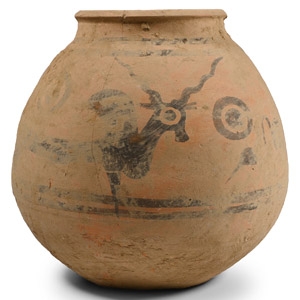
Indus Valley Terracotta Vessel with Zebus
3rd-2nd millennium B.C.Sold for (Inc. bp): £130
Of bulbous shape with low neck; a painted frieze of stylised zebus with emphasised humps and curving horns, ring-and-dot motifs to the field. 875 grams, 17 cm
Ex London, UK, art market, 1990s. -
.jpg)
Buddhist Ceramic Prayer Bead String
20th century A.D.Sold for (Inc. bp): £7
Restrung; composed of green-coloured beads of mainly spherical types. 20.4 grams, 71 cm long
UK gallery, early 2000s. -
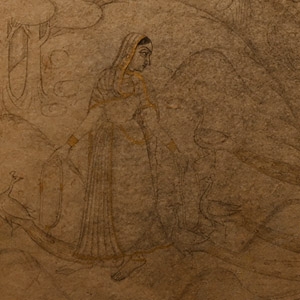
Mughal Drawing of a Princess with Peacocks
Circa 1780-1800 A.D.Sold for (Inc. bp): £140
Rectangular card with inked border and reveal, liquid gold border with flower and tendril motif to each corner; detailed scene with a princess in the foreground advancing left but looking right towards three peacocks following her; in each of her hands a cord with a bell; waterway extending from centre to right edge and returning across lower edge, with waterlilies and other vegetation, swans (right) and ducks (top); to the rear, a group of trees, and another at right beyond the waterway; at the middle top, trees, rocky hills and a city in the distance; liquid gold to the princess's outer garments, black ink outline to her hair and face. 19 grams, 26.2 x 21 cm
Acquired on the UK art market. Scottish private collection. -
.jpg)
Indus Valley Etched Orange Carnelian Bead Necklace String
Circa 3rd millennium B.C. or laterSold for (Inc. bp): £104
Composed of restrung graduated and polished beads, each etched with a white geometric design on both faces. 14.6 grams, 48 cm long
UK gallery, early 2000s. -
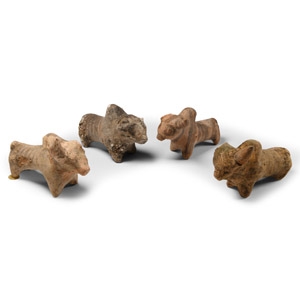
Indus Valley Painted Terracotta Bull Group
3rd millennium B.C. or laterSold for (Inc. bp): £130
Each a zebu with hump to the shoulders and dewlap beneath the neck. 313 grams total, 78-88 mm
From a collection acquired on the UK art market from various auction houses and collections mostly before 2000. From an important Cambridgeshire estate; thence by descent. -
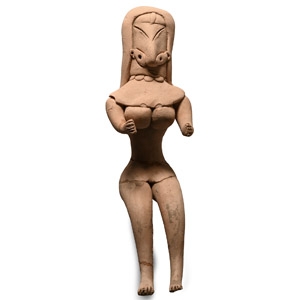
Indus Valley Terracotta Fertility Idol
2nd-1st millennium B.C. or laterSold for (Inc. bp): £111
Modelled in the round with large D-shaped headdress, pinched nose, applied eyes, multi-strand applied collars; seated pose with knees slightly bent, arms extended; repaired. 56 grams, 12.4 cm
Ex Martin Schoyen London collection, previously with Alexander Gotz, London, UK. -
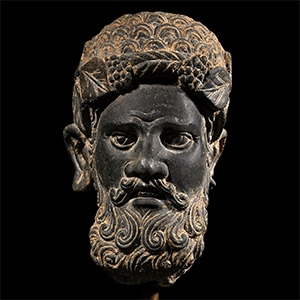
Gandharan Head of Dionysus
2nd-4th century A.D. or laterSold for (Inc. bp): £1,040
A carved schist head with tightly curled hair, wreath to the brow with a vine-leaf at each temple, curled moustache and beard, ears with long lobes; mounted on a custom-made stand. 3.75 kg, 29.5 cm
Acquired 1960-1980s. From an important London, W1, collection. Private collection, England.
With the arrival of Greek colonists into Central Asia and Northern India and the establishment of the Indo-Greek kingdom, came Greek culture and religion which merged with that of the local population. Greek deities, such as Dionysus, were often merged with Buddhist deities, or worshipped in their own right. The image of Dionysus as a mature male with beard and wreath is often referred to as the Indian Dionysus as it depicts the god after his triumphant return from the East with his retinue of Maenads. The adventures of Dionysus in India are recounted in the Greek epic poem, the Dionysiaca. The image of Dionysus returning from India in a chariot pulled by tigers was a favourite for Classical artists and often appeared on sarcophagi as an allegory for the rebirth of the soul. Drinking wine, dancing, and music making were popular subjects for the embellishment of early Buddhist religious centres. The Buddha condemned intoxicants, and music and dance were considered unfit for the monastic community, although they were tolerated in lay contexts. The reason for the depiction of scenes of revelry, along with the Greek god Dionysus, may be the earlier, pre-Buddhist practices celebrating abundance and agricultural prosperity, which involved wine drinking. Dionysus may have been transformed and and understood in the Gandharan context as the South Asian god Indra, whom lay followers would have known as the deity who rules over the paradise known as the Trayastrimsa heaven. As the lay Buddhist community was more concerned with having a positive rebirth (enlightenment being out of reach for all but the most learned of monks) the idea of being reborn in a heaven associated with Indra would no doubt have been attractive. It is thought that the influence of Dionysus on Indian culture may have inspired the development of the Hindu deities Shiva and Krishna, both of whom share similar characteristics to the Greek god. -
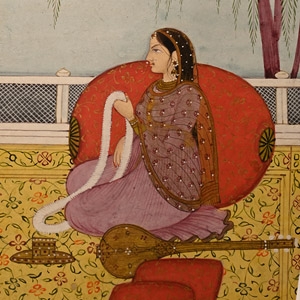
Indian Painting of a Noblewoman
Kangra Region, Circa 1780 A.D.Sold for (Inc. bp): £234
In a rectangular white card reveal with ellipsoid opening, hand-painted watercolour scene depicting a noblewoman in a garden, resting against a large decorated pillow, wearing a transparent shawl with floral detailing over a lavender-coloured robe, sitar and water vessel beside her and two red pillows on a decorated yellow mat with flowers and tendrils; fences in foreground and behind the figure, and willow tree beyond; liquid gold detailing to the shawl, sitar and vessel. 152 grams, 31 x 25.2 cm
Acquired on the UK art market. Scottish private collection. -
.jpg)
Indus Valley Decorated Terracotta Bowl
3rd-2nd millennium B.C.Sold for (Inc. bp): £130
Biconvex in profile with basal ring and slightly flared mouth, painted geometric panels to the shoulder. 324 grams, 97 mm high
Acquired 1980-2015. Ex Abelita family collection. -
.jpg)
Deccan Bronze Ewer with Cat-Head Handle
Late 19th century A.D.Sold for (Inc. bp): £20
Featuring a squat body, domed lid with hinge and central spike, strap handle with cat's head detailing, long spout with writhen mouth and flared foot; spout repaired. 2.4 kg, 33 cm
Fair condition; spout repaired.
Acquired on the European art market in the 1990s. Ex property of a Suffolk collector.
