
Auction Highlights
-
.jpg)
Egyptian Granite Head of a Dignitary
Sold for (Inc. bp): £28,600
Carved with soft facial features and carefully executed cosmetic lines around the eye, earring, and carefully detailed duplex wig with gently wavy curls; likely from the Ramesside Period; mounted on a custom-made stand. -
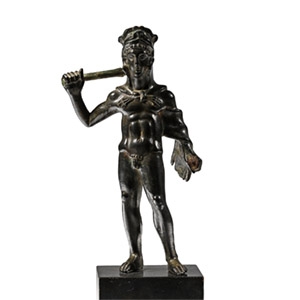
Etruscan Bronze Statuette of Herakles
Sold for (Inc. bp): £18,200
Modelled in the round with a muscular nude body, his club resting on his shoulder and the hair dressed in rows of tight, close-set curls underneath the Nemean lionskin hood with cloak billowing over his left arm, the paws tied across his chest; mounted on a custom-made display stand. -
.jpg)
Roman Marble Portrait of a Boy as Worshipper of Isis
Sold for (Inc. bp): £17,550
Carved head of a prepubescent worshipper of Isis, with soft facial features, long nose, small downturned mouth, heavy-lidded eyes, the whole giving the face a sombre or mournful appearance; the hair textured to indicate a short cut and combed forward across the scalp, sidelock above the right ear; mounted on a 16th century carved breccia upper body with leather cuirass and pteruges to right shoulder, cloak draped across the shoulders and fastened at the clavicle on the right side with a disc-brooch; socle base; some restoration. -
.jpg)
Larger Than Life-Size Roman Bronze Sandaled Foot
Sold for (Inc. bp): £39,000
Modelled in the round and originally part of a monumental statue, the naturalistic right foot encased in a trochades leather sandal with median reversed tongue secured with side straps and thick looped laces; the thick platform sole slightly curved, toes and nails well defined; mounted on a substantial custom-made display stand. -
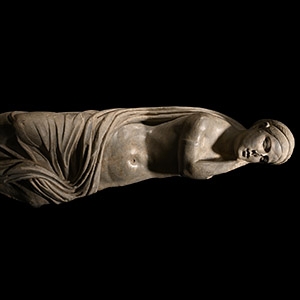
Life-Size Roman Marble Sleeping Girl from a Sarcophagus Lid
Sold for (Inc. bp): £20,800
Modelled in the half-round, nude with eyelids half-closed in sleep; a drapery partly covering the head and wrapping around the lower body under the hips; the hairstyle similar to those of the Antonine Dynasty, the peaceful face supported by the hands and the ear pierced to accept an earring; iron reinforcing rod to the feet and the right arm's armilla a later replacement; upper head restored in Parian marble. -
.jpg)
Byzantine Porphyry Relief with Cross Surrounded by Two Birds
Sold for (Inc. bp): £28,600
An imposing panel divided to four sections by a central cross on a stepped pedestal, the lower and upper arm with branch-like extensions; the upper quadrants with a circlet surrounding a palm tree-shaped motif; each lower quadrant with a bird in profile facing back; mounted on a custom-made display stand. -
.jpg)
Carved Marble Memento Mori Skull
Sold for (Inc. bp): £16,900
Carved skull on a short neck with musculature and blood vessels; mandible in place with some teeth in sockets, wisps of hair adhering to the dome of the skull; one zygomatic bone partly absent; square-section socle base. -
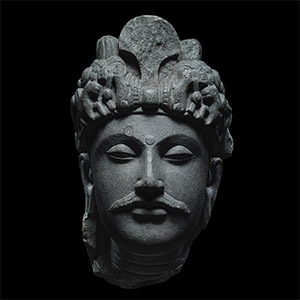
'The Kelton' Gandharan Head of a Bodhisattva
Sold for (Inc. bp): £24,700
Carved in the half-round head of a Bodhisattva (probably Maitreya) with fine detailing to the arched brow, aquiline nose, neat moustache and full lips; the eyes heavily lidded, urna to the forehead, long open lobes to the ears; the hair in multi-stranded curling locks gathered into an ushnisha with brow-band below; heavily cleaned, conserved, and mounted on a custom-made stand; supplied with original old wooden base with collector's label: 'Head of Bodhisattva / Fine grain schist / Gandhara, Northwest Pakistan / 4th century'.
-
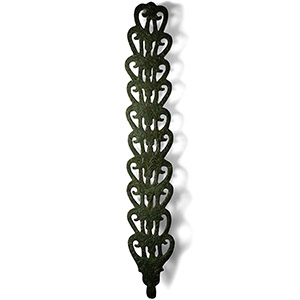
Scythian Bronze Zoomorphic Openwork Horse Chamfron
4th century B.C.Sold for (Inc. bp): £8,450
The edges formed of opposed curving serpent heads, each pair flanking a central zoomorphic head, possibly representing a horse or a beast; the animals with incised detailing to their bodies and heads; a large horse(?) head to the lower edge with its muzzle forming the point of the chamfron; two loops to the reverse. 283 grams, 39.5 cm
From the Gorovits family collection, since at least the 1940s. Private collection, London. Accompanied by an academic report by Dr Raffaele D’Amato. This lot has been checked against the Interpol Database of stolen works of art and is accompanied by search certificate number no. 17178-221462.
Bronze open-worked frontlets like this one were found with horses in the Barrow-mound no.5 of the Ulyap burial-ground in the Kuban basin, and their secure dating to the 4th century B.C. was established by the Thasian amphoras found in the respective graves (nn. 14-15-21, see Leskov, 1990, figs.180,183). The incised decoration of the chamfron finds various parallels both on frontlets from Barrow-Mounds nos. 4/1913 and 4/1917 near Elizavetinskaya Kossack-Village, in Kuban Basin, and from Gyuenos in Abkhazia (Galanina, 2010, pl.7,12). The piece belongs to a rare type of chamfron, known only from finds in the Scythian and Meotian burials of 5th-4th centuries B.C. -
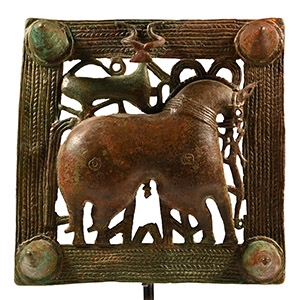
Large Transcaucasian Armour Belt Clasp
1st century B.C.-2nd century A.D.Sold for (Inc. bp): £11,960
Openwork belt fastening-plate comprising: square frame with parallel bands of ropework, a tall conical boss with basal flange at each corner; central figure of an advancing horse with head bowed, hollow to the reverse, with braided halter to the neck and bridle to the muzzle; incised ring-and-dot motif to shoulder and hip; above the horse's back a small quadruped with head turned to face the viewer, triangular muzzle and two curved horns (perhaps an ibex); openwork vegetation around the beasts and between the horse's legs, long-tailed animal gripping the halter (perhaps a squirrel); fixing loop and triangular catch to the reverse; mounted on a custom-made stand. 752 grams total, 24.5 cm high including stand
German art market. European private collection, 1970s-early 2000s. Acquired from the above; thence by descent. Private collection, London, UK. Accompanied by an academic report by Dr Raffaele D'Amato. This lot has been checked against the Interpol Database of stolen works of art and is accompanied by a search certificate number no.12284-221444.
Many bronze belt fittings of this type are in the collection of the Metropolitan Museum of Art, New York, (Muscarella, 1988, items 581-4). Muscarella (p.440) notes that a total of 181 were known at the time of his publication (1988). -
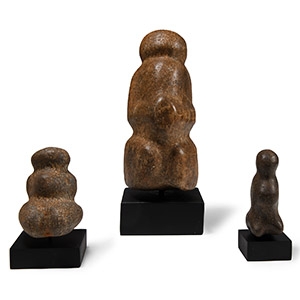
Stone Age Goddess Idol Collection
Neolithic Period, circa 6th-4th millennium B.C. or laterSold for (Inc. bp): £5,460
Group of three carved and polished figurines with rounded heads and broad shoulders, folded arms resting on each side of the protruding belly, legs folded beneath the body; each mounted on a custom-made stand. 1.65 kg total, 8.5-18 cm including stand
From a collection acquired on the UK art market from various auction houses and collections mostly before 2000. From an important Cambridgeshire estate; thence by descent. Accompanied by an academic report by Dr Raffaele D’Amato. This lot has been checked against the Interpol Database of stolen works of art and is accompanied by search certificate number no.12159-217186.
Most scholars consider these as symbols of the fertility cult and as evidence of the existence of a matriarchal society as a form of organisation of the earliest human society. The people of the Stone Age may have considered figures such as this to represent women and mothers with their life-giving powers, or as depictions of the ancestors. -
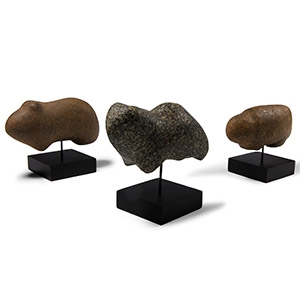
Stone Age Animal Idol Group
Neolithic Period, circa 6th-4th millennium B.C. or laterSold for (Inc. bp): £3,640
Comprising three carved and polished stone figurines, possibly representing bovines or pigs, with stylised heads and stub legs; each mounted on a custom-made stand. 952 grams total, 9.6-10.5 cm including stand
From a collection acquired on the UK art market from various auction houses and collections mostly before 2000. From an important Cambridgeshire estate; thence by descent. Accompanied by an academic report by Dr Raffaele D’Amato.
Animal figurines seem to be a recurring feature in the earlier Neolithic settlements, in the Balkans and in the Levant. It is significant that in the Neolithic Mediterranean the depicted animals seem to be domesticated, thus suggesting that its reference points were within the confines of the community. -
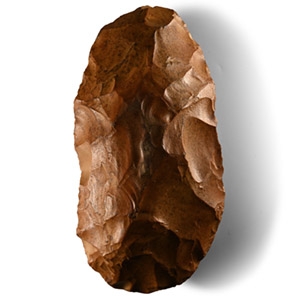
Massive European Stone Age Flint Axehead
Neolithic Period, circa 4000-2000 B.C.Sold for (Inc. bp): £715
Substantial cleaver pre-form with rounded butt. 22 grams, 24.5 cm
Found continental Europe. Ex Victor Brox collection, UK, formed during the 1980s-1990s. From the collection of a South West London, UK, specialist Stone Age collector.
Preforms such as this unusually large and undamaged example were widely traded during Neolithic times and were a valuable commodity in communities which lacked suitable material for stone tool production. There has been research showing signs of wear from rubbing against cloth, suggesting that they might have been carried over long distances. -
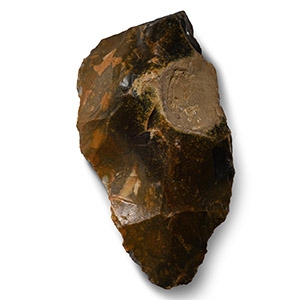
Very Large Stone Age Handaxe from St Meme
Lower Palaeolithic Period, circa 450,000-250,000 years B.P.Sold for (Inc. bp): £286
Substantial pointed handaxe with some cortex; deep 'autumn glossy' patina. 1 kg, 16 cm
Found St Meme, France. Acquired on the UK art market in the 1970s. From the collection of famous UK musician and amateur archaeologist, Victor Brox (1941-2023), formed in the 1980s-1990s. From the private collection of an East Anglian, UK, collector. -
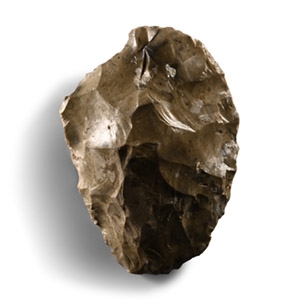
Stone Age Knapped Flint Handaxe
Lower Palaeolithic Period, 480,000-250,000 B.C.Sold for (Inc. bp): £169
Substantial cleaver, ovate in profile with rounded cutting edge, chipped from usage; grey flint with soft tan patination. 370 grams, 12.6 cm
From the collection of Jean-Claude Debenne (1936-2020), an amateur prehistorian and former member of the French Society of Prehistory and the Prehistoric Association of the South-West, as well as an Honorary Member of the Geological Club of Ile-de-France. This collection of flints was assembled between the 1950s and 1990s and originates from Ile-de-France, Oise, and Val-d'Oise. -
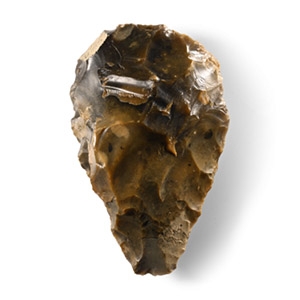
Stone Age Knapped Flint Handaxe
Lower Palaeolithic Period, 480,000-250,000 B.C.Sold for (Inc. bp): £468
Ovoid in profile and biconvex in section with narrow tip (absent) and broad butt; small portion of cortex to butt. 225 grams, 11.1 cm
From the collection of Jean-Claude Debenne (1936-2020), an amateur prehistorian and former member of the French Society of Prehistory and the Prehistoric Association of the South-West, as well as an Honorary Member of the Geological Club of Ile-de-France. This collection of flints was assembled between the 1950s and 1990s and originates from Ile-de-France, Oise, and Val-d'Oise. -
.jpg)
Stone Age Polished Axehead
Neolithic Period, circa 4th-3rd millennium B.C.Sold for (Inc. bp): £416
With broad curved cutting edge tapering body and narrow tip, polished surfaces. 164 grams, 14 cm
From a collection acquired on the UK art market from various auction houses and collections mostly before 2000. From an important Cambridgeshire estate; thence by descent. -
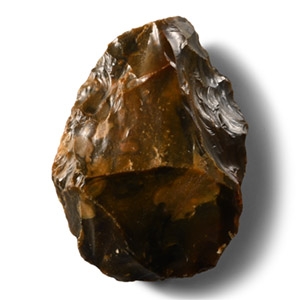
Stone Age Knapped Flint Handaxe
Lower Palaeolithic Period, 480,000-250,000 B.C.Sold for (Inc. bp): £312
Rounded irregular ovate cleaver with remains of cortex to one face; mottled patination. 206 grams, 93 mm
From the collection of Jean-Claude Debenne (1936-2020), an amateur prehistorian and former member of the French Society of Prehistory and the Prehistoric Association of the South-West, as well as an Honorary Member of the Geological Club of Ile-de-France. This collection of flints was assembled between the 1950s and 1990s and originates from Ile-de-France, Oise, and Val-d'Oise. -
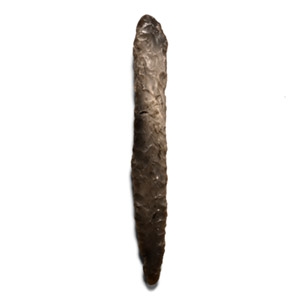
Stone Age Knapped Flint Dagger
Neolithic Period, 4,000-2,000 B.C.Sold for (Inc. bp): £208
Narrow lentoid-section blade with remains of cortex to the base; repaired. 42 grams, 15 cm
Formerly in the collection of Lars Otto Johan Holst (1863-1936), a veterinary surgeon who was active in Ronneby, southern Sweden from around 1887. with Skanes Auktionsverk, 31 May 2014, no. 464 [Part]. -
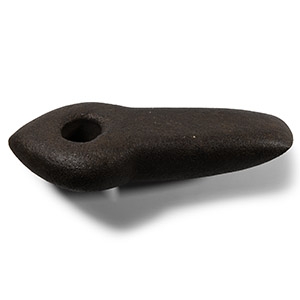
Large Stone Age Polished and Pierced Adze-Head
Neolithic Period, circa 5th-3rd millennium B.C.Sold for (Inc. bp): £390
The blade triangular in section with chamfered forward edge, slightly curved blade, tapering discoid body with sand-drilled socket. 664 grams, 18 cm
From a collection acquired on the UK art market from various auction houses and collections mostly before 2000. From an important Cambridgeshire estate; thence by descent.
