
Auction Highlights
-
.jpg)
Egyptian Granite Head of a Dignitary
Sold for (Inc. bp): £28,600
Carved with soft facial features and carefully executed cosmetic lines around the eye, earring, and carefully detailed duplex wig with gently wavy curls; likely from the Ramesside Period; mounted on a custom-made stand. -
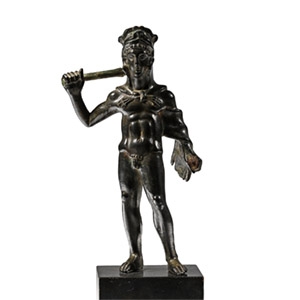
Etruscan Bronze Statuette of Herakles
Sold for (Inc. bp): £18,200
Modelled in the round with a muscular nude body, his club resting on his shoulder and the hair dressed in rows of tight, close-set curls underneath the Nemean lionskin hood with cloak billowing over his left arm, the paws tied across his chest; mounted on a custom-made display stand. -
.jpg)
Roman Marble Portrait of a Boy as Worshipper of Isis
Sold for (Inc. bp): £17,550
Carved head of a prepubescent worshipper of Isis, with soft facial features, long nose, small downturned mouth, heavy-lidded eyes, the whole giving the face a sombre or mournful appearance; the hair textured to indicate a short cut and combed forward across the scalp, sidelock above the right ear; mounted on a 16th century carved breccia upper body with leather cuirass and pteruges to right shoulder, cloak draped across the shoulders and fastened at the clavicle on the right side with a disc-brooch; socle base; some restoration. -
.jpg)
Larger Than Life-Size Roman Bronze Sandaled Foot
Sold for (Inc. bp): £39,000
Modelled in the round and originally part of a monumental statue, the naturalistic right foot encased in a trochades leather sandal with median reversed tongue secured with side straps and thick looped laces; the thick platform sole slightly curved, toes and nails well defined; mounted on a substantial custom-made display stand. -
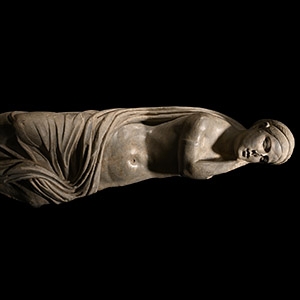
Life-Size Roman Marble Sleeping Girl from a Sarcophagus Lid
Sold for (Inc. bp): £20,800
Modelled in the half-round, nude with eyelids half-closed in sleep; a drapery partly covering the head and wrapping around the lower body under the hips; the hairstyle similar to those of the Antonine Dynasty, the peaceful face supported by the hands and the ear pierced to accept an earring; iron reinforcing rod to the feet and the right arm's armilla a later replacement; upper head restored in Parian marble. -
.jpg)
Byzantine Porphyry Relief with Cross Surrounded by Two Birds
Sold for (Inc. bp): £28,600
An imposing panel divided to four sections by a central cross on a stepped pedestal, the lower and upper arm with branch-like extensions; the upper quadrants with a circlet surrounding a palm tree-shaped motif; each lower quadrant with a bird in profile facing back; mounted on a custom-made display stand. -
.jpg)
Carved Marble Memento Mori Skull
Sold for (Inc. bp): £16,900
Carved skull on a short neck with musculature and blood vessels; mandible in place with some teeth in sockets, wisps of hair adhering to the dome of the skull; one zygomatic bone partly absent; square-section socle base. -
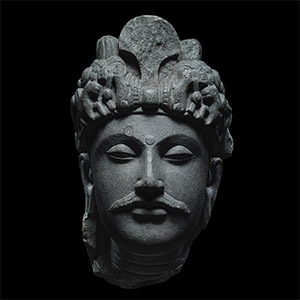
'The Kelton' Gandharan Head of a Bodhisattva
Sold for (Inc. bp): £24,700
Carved in the half-round head of a Bodhisattva (probably Maitreya) with fine detailing to the arched brow, aquiline nose, neat moustache and full lips; the eyes heavily lidded, urna to the forehead, long open lobes to the ears; the hair in multi-stranded curling locks gathered into an ushnisha with brow-band below; heavily cleaned, conserved, and mounted on a custom-made stand; supplied with original old wooden base with collector's label: 'Head of Bodhisattva / Fine grain schist / Gandhara, Northwest Pakistan / 4th century'.
-
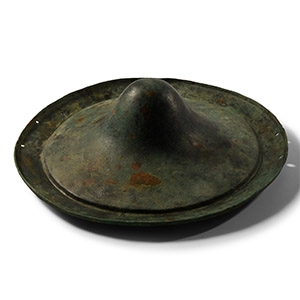
Large Bronze Age Shield Boss
8th century B.C.Sold for (Inc. bp): £195
A hammered discoid shield raised from a single sheet, displaying a central conoid boss; two pairs of circular piercings to the perimeter. 297 grams, 26.5 cm wide
UK private collection before 2000. Acquired on the UK art market. Property of a London gentleman.
These kind of shields, of small dimensions, were used by infantry or horse-archers of Luristan and neighbouring cultures (Elamites, Zagros Tribesmen, like Hurrians, Lullubians, Kutians, and Kassites, Assyrians), as well as by Urartu, West-Iranian and Northern Caucasian civilisations around the Caspian Sea. The bronze boss was probably attached to a leather and wooden background. -
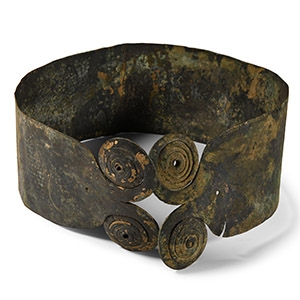
Luristan Bronze Armour Belt with Double Scroll Terminals
9th-7th century B.C.Sold for (Inc. bp): £169
A broad hammered military belt or cuirass band with plain surface, the terminals shaped as a double spiral ornament, holes in the centre of both ends for fastening. 330 grams, 22 cm
UK private collection before 2000. Acquired on the UK art market. Property of a London gentleman.
The rich and noble aristocrats of Luristan, Elamites, Hurrians, Lullubians, Kutians, and Kassites, went to battle splendidly equipped and used magnificent bronze armours. For metal sheets used for quiver plaques and bronze protective belts or shields, they used the hammering technique (Čakoškāri). -
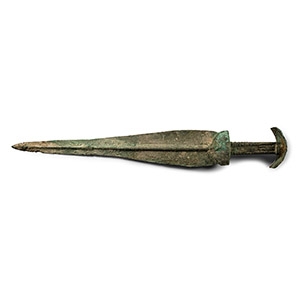
Western Asiatic Bronze Short Sword
1800-1600 B.C.Sold for (Inc. bp): £715
With a rectangular grooved tang with vertical lines running to the crescent pommel, the rhomboid ricasso extending over the blade, blade with raised ridge tapering to a point. 533 grams, 49 cm
Ex London, UK, collection, 1990s. -
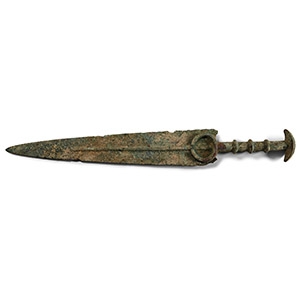
Luristan Bronze Short Sword with Integral Hilt with Crescent Pommel
14th-10th century B.C.Sold for (Inc. bp): £468
A short sword or dagger with slender triangular blade, low round midrib with flat upper face, annular guard and remains of scooped shoulders, columnar grip with three gusseted hoops, crescent pommel. 520 grams, 43.7 cm
Acquired 1980-2015. Ex Abelita family collection.
These kind of bronze daggers or dirks, typical of Marlik culture, were cast in a one piece mould according to Negahban, although in some specimens the penannular guard was later cast into the blade. The separate sets of encircling ribs on the grips are again typical of swords from the Marlik area. -
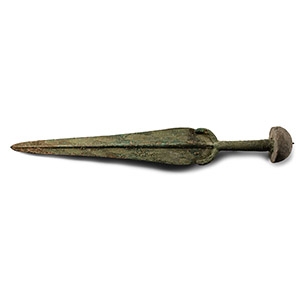
Western Asiatic Bronze Short Sword with Mushroom Pommel
Late 2nd-early 1st millennium B.CSold for (Inc. bp): £780
The hilt with mushroom-shaped pommel, round grip, crescentic guard, long sloping blade with rectangular sectioned mid-ridge. 1.04 kg, 56.5 cm
Ex London, UK, collection, 1990s.
This category of swords has been classified by Khorasani as 'swords with a mushroom pommel' and are usually characterised by a solid-cast hilt with a penannular guard, a ribbed or variously decorated grip and the conical hollow-cast mushroom pommel. Usually the blade is multi-fullered and tapers to a sharp tip. Moorey considers them to be from the end of the 2nd millennium B.C. -
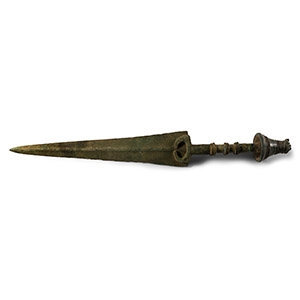
Luristan Bronze Short Dagger with Integral Hilt
14th-10th century B.C.Sold for (Inc. bp): £845
A short sword or dagger with slender triangular blade, low round midrib, penannular guard, scooped shoulders, columnar grip with three gusseted hoops, truncated-conical pommel decorated with parallel horizontal circles. 477 grams, 42.5 cm
Acquired 1980-2015. Ex Abelita family collection.
These kind of bronze daggers or dirks, typical of Marlik culture, were cast in a one piece mould according to Negahban, although in some specimens the penannular guard was later cast into the blade. The separate sets of encircling ribs on the grips are again typical of swords from the Marlik area. -
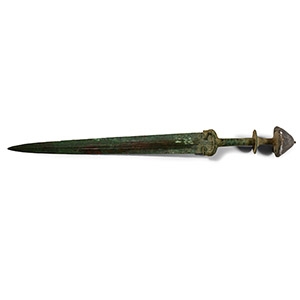
Western Asiatic South Caspian Bronze Sword
9th-8th century B.C.Sold for (Inc. bp): £878
With penannular guard and a multi-fullered double edged blade tapering to a sharp point, solid cast hilt made of a round handle with two decorative discs under the stone mushroom pommel. 1.06 kg, 71 cm
Acquired 1980-2015. Ex Abelita family collection.
In this sword it is possible that hilt and blade were not cast as one unit, but rather that the hilt was cast onto the blade. The thick guard is related to the crescent type, but here is almost rectangular, albeit with rounded shoulders, like in the blade of Metropolitan published by Muscarella. -
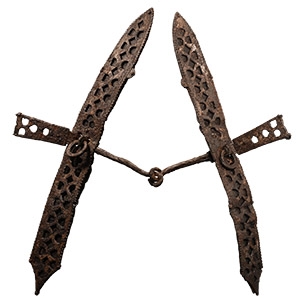
Large Medieval Eurasian Iron Knight's Military Horse Bit
12th-13th century A.D.Sold for (Inc. bp): £1,105
The snaffle bit with two rectangular openwork cheekpieces decorated with an openwork plaque, the surface ornamented with scales and lozenge elements. 624 grams, 37.5 cm
From the private collection of a London gentleman, from his grandfather's collection formed before the early 1970s.
The snaffle bits consisted of two parts: a bit, which was placed in the horse's mouth, and cheekpieces, which were connected to the reins and head strap. -
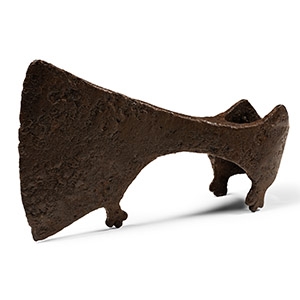
Viking Age Iron 'Gotland Type' Axe Head
Circa 9th-13th century A.D.Sold for (Inc. bp): £702
With curved blade and trefoil-shaped chin to the lower edge, round socket with triangular flanges to the upper edge and trefoil-shaped flanges to the lower face. 635 grams, 16.5 cm
From the private collection of a London gentleman, from his grandfather's collection formed before the early 1970s.
The axe head was made in a particular shape showing elements of plant ornamentation and it may have been used both as a battle axe and working axe. Most men were farmers or labourers on a farm and rarely carried a weapon other than a knife and an axe. Nevertheless, battle, the hunt and the ability to ride were important elements of what constituted the ideal Viking man. -
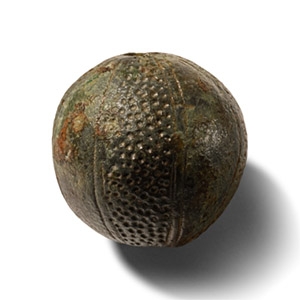
Medieval Bronze Sword Pommel
Circa 14th century A.D.Sold for (Inc. bp): £182
Hollow-formed spherical pommel with rectangular slot to the underside to accept the tang, and smaller slot above to accommodate the piebed end; segmented outer face with alternating plain and pointillé surfaces. 119 grams, 39 mm
Found Suffolk, UK. -
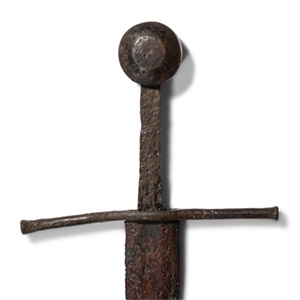
Medieval Iron Single-Handed Sword
Late 11th-13th century A.D.Sold for (Inc. bp): £1,950
Double-edged tapering blade with rounded point, shallow fuller and a parallel-sided lower guard (cross style 2), the grip gently tapering, discoid pommel of type I with chamfered sides. 1.2 kg, 1.01 m
From the private collection of a London gentleman, from his grandfather's collection formed before the early 1970s. Accompanied by an academic report by Dr Raffaele D'Amato. This lot has been checked against the Interpol Database of stolen works of art and is accompanied by search certificate number no.12177-221435.
The sword belongs to the type of ‘war swords’, although it is challenging to establish if it belongs to the type XI or type XII of Oakeshott's classification. It corresponds well with an English sword of type XI kept in the Tower Armoury (Dufty, 1974, plate 2, letter a), found in a peat bog near Newbury; but it also presents many characteristics of swords of type XII: it presents similarity to two swords excavated by Dr Jorma Leppaaho in 1950, from late Viking graves, one having a cross guard identical to our specimen and the other an identical pommel (Oakeshott, 1991, p.69, lett. V and VI); and another similar specimen is (a water find from Denmark) preserved in the Nationalmuseet of Copenhagen. In general the taper of the blade points more to the nature of the XII typology. -
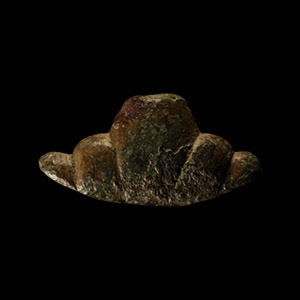
Anglo-Scandinavian Viking Bronze Five-Lobed Sword Pommel
Late 10th-early 11th century A.D.Sold for (Inc. bp): £442
Of Petersen's Type S (Wheeler Type III) with five graduated lobes; the lower face a swept arc; pierced through the tallest lobe to accept the tang of the sword's blade. 67 grams, 54 mm
Found Market Rasen, Lincolnshire Wolds, UK, 1970s. Property of Mr A.B., an American collector.
