
Auction Highlights
-
.jpg)
Egyptian Granite Head of a Dignitary
Sold for (Inc. bp): £28,600
Carved with soft facial features and carefully executed cosmetic lines around the eye, earring, and carefully detailed duplex wig with gently wavy curls; likely from the Ramesside Period; mounted on a custom-made stand. -
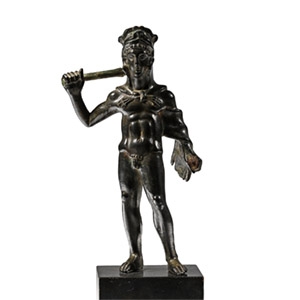
Etruscan Bronze Statuette of Herakles
Sold for (Inc. bp): £18,200
Modelled in the round with a muscular nude body, his club resting on his shoulder and the hair dressed in rows of tight, close-set curls underneath the Nemean lionskin hood with cloak billowing over his left arm, the paws tied across his chest; mounted on a custom-made display stand. -
.jpg)
Roman Marble Portrait of a Boy as Worshipper of Isis
Sold for (Inc. bp): £17,550
Carved head of a prepubescent worshipper of Isis, with soft facial features, long nose, small downturned mouth, heavy-lidded eyes, the whole giving the face a sombre or mournful appearance; the hair textured to indicate a short cut and combed forward across the scalp, sidelock above the right ear; mounted on a 16th century carved breccia upper body with leather cuirass and pteruges to right shoulder, cloak draped across the shoulders and fastened at the clavicle on the right side with a disc-brooch; socle base; some restoration. -
.jpg)
Larger Than Life-Size Roman Bronze Sandaled Foot
Sold for (Inc. bp): £39,000
Modelled in the round and originally part of a monumental statue, the naturalistic right foot encased in a trochades leather sandal with median reversed tongue secured with side straps and thick looped laces; the thick platform sole slightly curved, toes and nails well defined; mounted on a substantial custom-made display stand. -
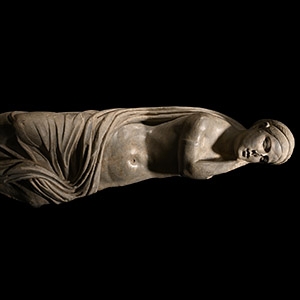
Life-Size Roman Marble Sleeping Girl from a Sarcophagus Lid
Sold for (Inc. bp): £20,800
Modelled in the half-round, nude with eyelids half-closed in sleep; a drapery partly covering the head and wrapping around the lower body under the hips; the hairstyle similar to those of the Antonine Dynasty, the peaceful face supported by the hands and the ear pierced to accept an earring; iron reinforcing rod to the feet and the right arm's armilla a later replacement; upper head restored in Parian marble. -
.jpg)
Byzantine Porphyry Relief with Cross Surrounded by Two Birds
Sold for (Inc. bp): £28,600
An imposing panel divided to four sections by a central cross on a stepped pedestal, the lower and upper arm with branch-like extensions; the upper quadrants with a circlet surrounding a palm tree-shaped motif; each lower quadrant with a bird in profile facing back; mounted on a custom-made display stand. -
.jpg)
Carved Marble Memento Mori Skull
Sold for (Inc. bp): £16,900
Carved skull on a short neck with musculature and blood vessels; mandible in place with some teeth in sockets, wisps of hair adhering to the dome of the skull; one zygomatic bone partly absent; square-section socle base. -
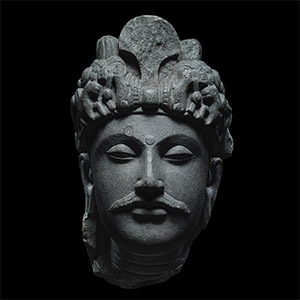
'The Kelton' Gandharan Head of a Bodhisattva
Sold for (Inc. bp): £24,700
Carved in the half-round head of a Bodhisattva (probably Maitreya) with fine detailing to the arched brow, aquiline nose, neat moustache and full lips; the eyes heavily lidded, urna to the forehead, long open lobes to the ears; the hair in multi-stranded curling locks gathered into an ushnisha with brow-band below; heavily cleaned, conserved, and mounted on a custom-made stand; supplied with original old wooden base with collector's label: 'Head of Bodhisattva / Fine grain schist / Gandhara, Northwest Pakistan / 4th century'.
-
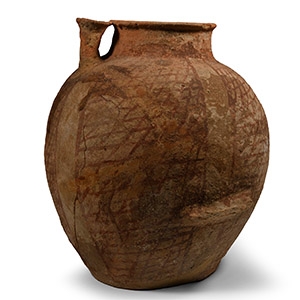
Western Asiatic Net-Painted Terracotta Storage Vessel with Ledge Handles
Bronze Age, 3rd millennium B.C.Sold for (Inc. bp): £364
Biconvex globular body with broad neck, everted rim, two ledge handles below the equator, band of painted hatching to the shoulder and vertical post handle. 4 kg, 34 cm high
From a collection acquired on the UK art market from various auction houses and collections mostly before 2000. From an important Cambridgeshire estate; thence by descent. -
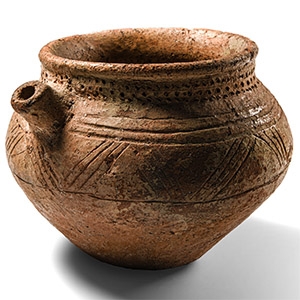
Mesopotamian Terracotta Pouring Vessel
3rd millennium B.C.Sold for (Inc. bp): £520
Formed as a pouring vessel with carinated body and short cylindrical spout, neck decorated with three concentric bands of pricked dots, incised bands below, combed chevrons to the equator featuring three raised knops to the rear. 438 grams, 11.8 cm wide
Acquired in Europe before 1990. -
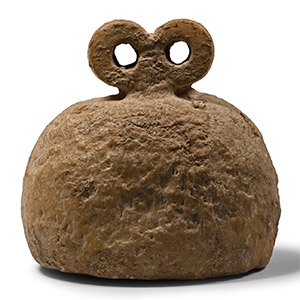
Sumerian Alabaster Eye Idol
4th-3rd millennium B.C.Sold for (Inc. bp): £1,950
Formed as a squat, oblate body and dressed upper with two piercings forming eyes; flat underside. 298 grams, 72 mm
Fine condition
Acquired in the mid 1980s-1990s. Private collection, Switzerland, thence by descent. Private collection, since the late 1990s. Accompanied by an academic report by Dr Raffaele D’Amato. This lot has been checked against the Interpol Database of stolen works of art and is accompanied by search certificate number no.12186-222131. -
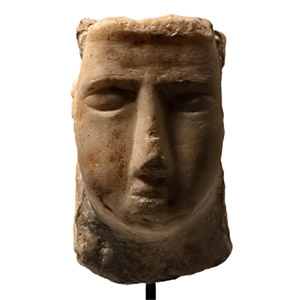
South Arabian Alabaster Head of a Man
3rd-1st century B.C.Sold for (Inc. bp): £1,430
Tongue-shaped carved bust reserved on an unworked block; bas-relief facial detailing with long vertical D-section nose, slit mouth and two shallow lentoid eyes; mounted on a custom-made stand. 2.42 kg total, 22.5 cm including stand
with Arte Primitivo, New York. American private collection, New York, before 2000. -
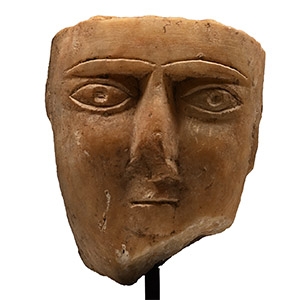
South Arabian Alabaster Head of a Woman
1st century B.C.-1st century A.D.Sold for (Inc. bp): £1,170
Carved in the half-round, the eyes with drilled pupils to accept inserts; mounted on a custom-made display stand. 3.49 kg total, 22.5 cm high including stand
From the collection of Dr Mohammed Saïd Farsi (1936-2019), acquired between 1960-1990 at Christie's, Sotheby's and Mayfair galleries.
The eyes of these beautiful statues were inlaid with blue glass or lapis lazuli. These portraits could have been inserted in a funerary stele, but most probably this portrait comes from a statue similar to the 'Myriam of Tamna', as can be understood from the flat back, to which braided hair in plaster was probably attached. -
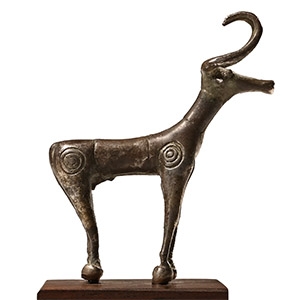
Syro-Hittite Silver Standing Stag
12th-8th century B.C.Sold for (Inc. bp): £13,000
Modelled in the round standing with head raised, recurved horns or antlers, slender muzzle with mouth detailing, incised ring-and-dot motif to shoulders and hips; mounted on a custom-made stand. 69.2 grams total, 80 mm high including stand
London art market, 1978. This lot has been checked against the Interpol Database of stolen works of art and is accompanied by a search certificate number no.12263-220844.
Stylistically, the item shares features with the Hattian stag figurine found in the royal tombs in Alacahöyük (now in the Museum of Anatolian Civilizations, Ankara, Turkey) and dating from the period 2100-2000 B.C. The use of ring-and-dot embellishments to the flanks is suggestive of some cultural continuity. The animal depicted is probably an ibex rather than a European stag. However, a date of manufacture in the period after the fall of the Hittite Empire in the 12th century B.C. seems more probable. -
.jpg)
Bactrian Camel Applique
3rd-2nd millennium B.C.Sold for (Inc. bp): £650
A finely modelled two-humped camel, shown in a dynamic pose, possibly in the act of kneeling and balancing its body weight on its bent back and front legs; mounted in a display frame. 245 grams total, 17.5 cm including frame
Ex London, UK, gallery, 1971-early 2000s. Property of a London gentleman.
Camels were a symbol of wealth and well-being. The importance of the Bactrian camel is attested in the ancient sources. The two-humped Bactrian camel, object of many seal representations, was already widespread in North India during the first quarter of the 2nd millennium B.C. It was probably an Aryan introduction. The Mitanni came from Bactria and Margiana and maintained a close connection with their regions of origin, via Khorasan, as can be suggested by the presence of Bactrian camels on the Mitanni seals. -
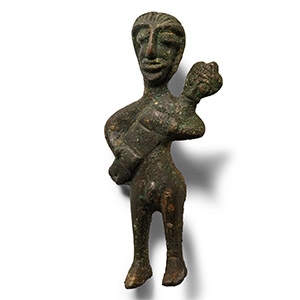
Amlash Bronze Mother and Child Amulet
1st millennium B.C.Sold for (Inc. bp): £312
Figurine with large piriform head, standing nude holding a baby across her chest; with keeled nose and bulbous eyes, exaggerated lentoid mouth; the baby wrapped in covering, with pellet eyes; loop to rear of head. 29.9 grams, 61 mm
UK private collection before 2000. Acquired on the UK art market. Property of a London gentleman. -
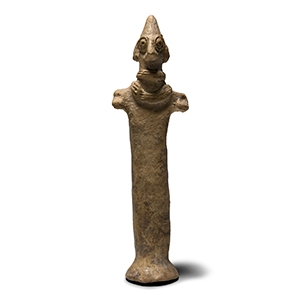
Western Asiatic Terracotta Idol
3rd-2nd millennium B.C.Sold for (Inc. bp): £1,040
Free-standing; modelled with a pinched, bird-like head and face with large applied circular eyes, two ornamental collars, stub arms and splayed foot. 43 grams, 14.1 cm high
Acquired in the 1970s. Ex European private collection. -
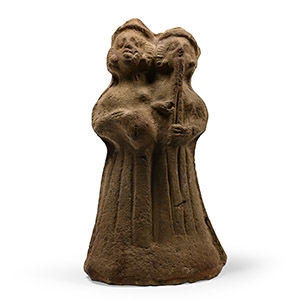
Old Babylonian Terracotta Figure of Musicians
1900-1600 B.C.Sold for (Inc. bp): £650
Moulded as two females posed side-by-side with long flared skirts, one holding a small percussion instrument and the other with a pipe raised to her mouth, each with segmented hair and conical cap, casting seams to the lateral edges, hollow underside. 116 grams, 10.5 cm
Ex Monique Sancey Collection, Neuchâtel, Switzerland. with Bonhams, 14 May 2003, no.229. European private collection. -
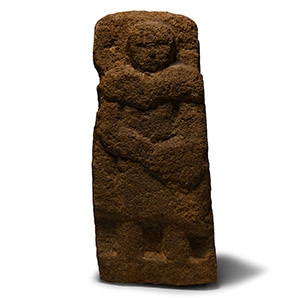
Phoenician Stone Figure
Circa 5th-3rd century B.C.Sold for (Inc. bp): £520
Wedge-shaped in section with figure carved in the half-round to one face, warrior with armoured covering to the shoulders and chest, knee-length tunic. 2.65 kg, 23.3 cm
From a collection acquired on the UK art market from various auction houses and collections mostly before 2000. From an important Cambridgeshire estate; thence by descent. -
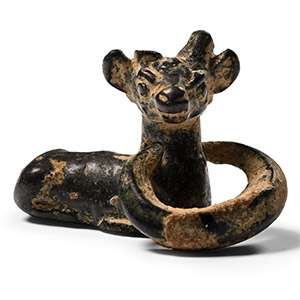
Syro-Phoenician Two Shekel Deer Weight
1st millennium B.C.Sold for (Inc. bp): £572
Modelled in the round as a figure pierced at the neck to accept a mounting ring. 14.6 grams, 30 mm
Collected from 1970-1999. From the collection of the late Mr S.M., London, UK.
