
Auction Highlights
-
.jpg)
Greek Marble Head of Dionysus
Sold for (Inc. bp): £23,400
Carved in the half-round in three-quarter view, youthful male head with stern features, hair gathered in a browband, horns to the brow; from a frieze or relief; mounted on a custom-made stand. -
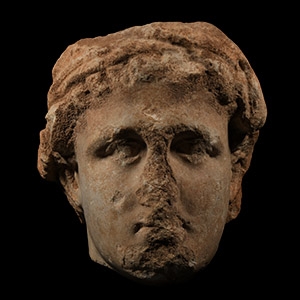
Greek Marble Head of a Ruler
Sold for (Inc. bp): £31,200
Carved in the round with thick wreath of laurel leaves to the brow, short tousled hair, stern face with thick jaw; mounted on a custom-made stand. -
.jpg)
Roman Veined Marble Torso of an Athlete
Sold for (Inc. bp): £48,100
Standing contrapposto with his weight on his right leg and the left leg brought slightly forward; the musculature of the torso displaying well-defined pectoral muscles, prominent abdominal muscles and wide shoulders, the back with equally toned musculature and well-formed rounded buttocks; the veining of the marble accentuating the idealised anatomy; the now-absent head was most probably turned towards the supporting leg and the left arm would have been raised; mounted on a custom-made display stand. -
.jpg)
Large Middle Elamite Cylinder Seal of Kidnu, Chief Overseer of King Tan-Ruhurater II
Sold for (Inc. bp): £15,600
A high-status green chalcedony seal with frieze depicting a seated figure in horned headdress facing a standing figure with arms outstretched, small monkey to the legs; six columns of Akkadian cuneiform text transliterated as: 1. ki-di-nu UGULA KUŠ-MEŠ 2. GAL šà tan-dru-hu- 3. ra-te-er EŠŠANA šu-ši 4. u an-za-an ARAD 5. šà dha-te-ri-iš 6. šak(?) ì-lí-šu 'Kidinu, chief overseer of the equerries(?) of Tan-Ruhurater, King of Susa and Anzan, servant of Haterishshak, his god'. The seal's owner was an official of King Tan-Ruhurater II (circa 1450 B.C.), king of Susa and Anzan. The title used to describe Kidinu is sometimes translated 'high official', elsewhere 'horse groom' or 'animal trainer'; the Elamite deity Haterish is otherwise unknown. -
.jpg)
Mesopotamian Torch Bearer Stand with Lion Tamer
Sold for (Inc. bp): £46,800
A substantial torch bearer depicting a male lion or panther standing with legs firmly planted on a rectangular base, tail extending to the ground, with a massive circular shaped armature or candelabra issuing from its back and wearing an elaborate muzzle, the eyes retaining shell inlay with a circular hollow for the pupils; to the right of the beast a kneeling nude male wearing a large belt-armour and a diadem, eyes inlaid, left hand extended to the side and holding the lion's leash.
-
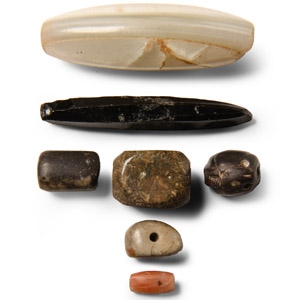
Western Asiatic Stone Weight Collection
1st millennium B.C.Sold for (Inc. bp): £26
Fusiform, obate and other types in banded agate, haematite and other materials. 59 grams total, 12-58 mm
Ex Simmons gallery, 1990s. From a North London, UK, collection. -
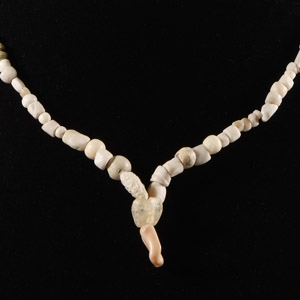
Western Asiatic Stone and Other Bead Necklace String
1st millennium B.C. and laterSold for (Inc. bp): £33
Restrung designer necklace with two central feature beads; composed of graduated beads of various types of stone, glass and shell. 19.6 grams, 42 cm long
UK gallery, early 2000s.
Similar beads were found during the excavations of the royal tombs of Nimrud. Thousands of beads were discovered in the sarcophagi, including those of Nimrud’s Queens; they probably originally formed part of wide collars with multiple strands. -
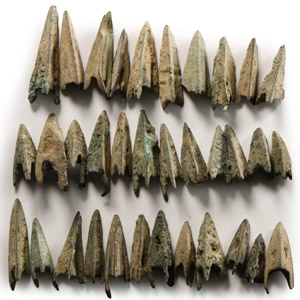
Greek Bronze Arrowhead Group
Circa 5th-3rd century B.C.Sold for (Inc. bp): £260
Mainly socketed triangular-section types. 103 grams total, 20-39 mm
Acquired 1980-2015. Ex Abelita family collection. -
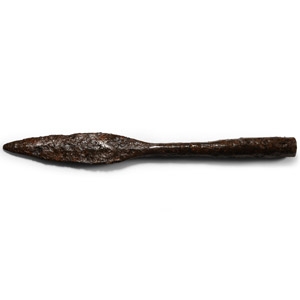
Anglo-Saxon Iron Socketted Spearhead
5th-7th century A.D.Sold for (Inc. bp): £208
Lentoid-section leaf-shaped blade with slender neck and long closed socket; Swanton's Group D1. 190 grams, 26 cm
Found near Wetwang, East Yorkshire, UK. Acquired circa 2005. Ian Wilkinson collection, Nottinghamshire, UK.
A small number of leaf-shaped blades measuring between some 16 and 28 cm in length are similar to the smaller leaf-shaped pieces of the Swanton series C, except that they tend to be more slender overall. The socket is always narrowly split up its entire length. -
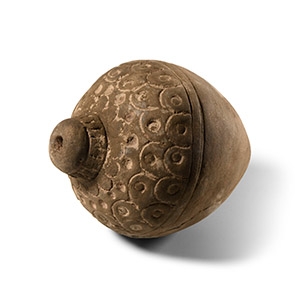
Byzantine 'Greek Fire' Ceramic Fire Bomb or Hand Grenade
9th-11th century A.D.Sold for (Inc. bp): £169
Piriform body with overlapping impressed roundels to the shoulder replicating scale armour, domed filler-hole, intended to be filled with explosive liquid and wick, used as a hand grenade. 337 grams, 10.8 cm
From a specialist collection of militaria, London, UK, collected 1990s onwards. Accompanied by an academic paper by military specialist Dr Raffaele D'Amato, dated 15 July 2019 and titled 'Eastern Roman Empire - Greek Fire Bomb or Hand Grenade (μεσαίον kακάβιον) 9th-11th century AD'.
Apart from the use of siphons or manual flame-throwers called cheirosiphona, special corps of Roman soldiers employed terracotta grenades, in the form of small jars, abundantly evidenced in archaeological excavations. They were called μεσαία kακαβιά or κυτροκακάβια where the former had a bulbous shape and the latter a more cylindrical form. -
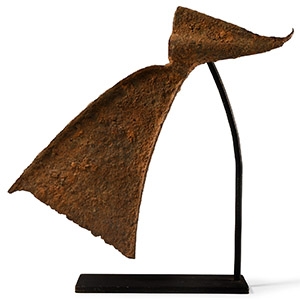
Western Asiatic Iron Axehead
Circa 14th-16th century A.D.Sold for (Inc. bp): £26
With swept blade and triangular socket with extension to the rear; accompanied by a custom-made display stand. 659 grams total including stand, axehead: 24.5 cm
Acquired 1980-2015. Ex Abelita family collection. -
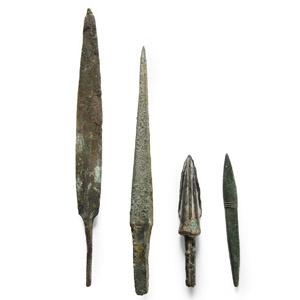
Western Asiatic Bronze Arrowhead Collection
1st millennium B.C.Sold for (Inc. bp): £33
Including a slender leaf-shaped type, square-section tanged type and others. 67.1 grams total, 5.8-12.3 cm
From a collection acquired on the UK art market from various auction houses and collections mostly before 2000. From an important Cambridgeshire estate; thence by descent. -
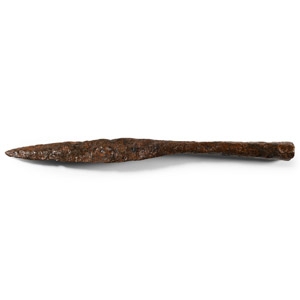
Anglo-Saxon Iron Socketted Spearhead
6th-8th century A.D.Sold for (Inc. bp): £163
Lentoid-section narrow blade with thick shoulder, closed socket; Swanton's Group I2. 159 grams, 26 cm
Found near Wetwang, East Yorkshire, UK. Acquired circa 2005. Ian Wilkinson collection, Nottinghamshire, UK.
The spear-heads of group I2 belong to a larger number of blades with more slender and regularly curved leaf-shapes than previous types. The majority present profiles more regularly curved from junction to tip, the broader part of the blade near the middle, with the fuller comformably longer. All of the group are much of the length varying between some 25 and 35 cm. -
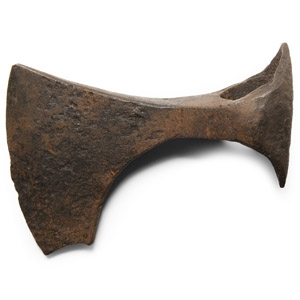
Viking Age Baltic Bearded Iron Axehead
12th-13th century A.D.Sold for (Inc. bp): £234
With short curved blade and spur beneath the chin, narrow neck, deep socket with extended edges to the reverse. 360 grams, 12 cm
From the collection of a Californian, USA, gentleman, dating back to the late 1960s.
The Curonians were known as fierce warriors and sailors who were involved in several wars and alliances with the Swedish, Danish and Icelandic Vikings. Baltic tribes created an original and impressive set of weaponry. They included battle knives, battle axes and spears and javelins with medium sized heads of a characteristic shape. -
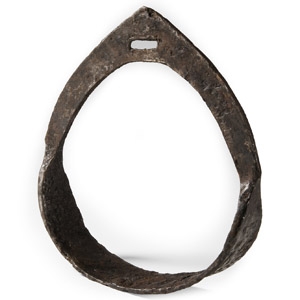
Viking Age Iron Stirrup with Laten Inlay
9th-11th century A.D.Sold for (Inc. bp): £72
Comprising an ovoid body with a rectangular void to accept a strap; the lower section broad with a rib to the underside, the upper flat in section with latten panel inlay to one face. 291 grams, 16 cm
From the private collection of a London gentleman, from his grandfather's collection formed before the early 1970s. -
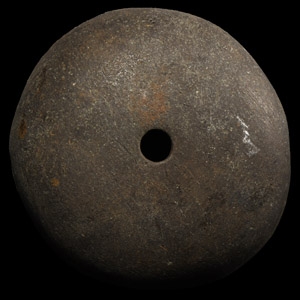
Large Romano-British Bronze Catapult Fitting
1st century A.D.Sold for (Inc. bp): £20
Substantial cast cupola with socket to the apex; possibly from a field artillery piece. 110 grams, 67 mm
Reputed to have been excavated near Viables in Hampshire at the end of the 19th century. From the estate of the late Jennifer Simmonds. Acquired from Jacobs & Hunt auctioneers, Petersfield, Hampshire, UK.
The circular umbo does not correspond to any known central shield boss, as it also lacks the lower edge; instead, it finds a good correspondence with the circular bosses that reinforced the lower and upper frame of a catapult, equipped with a central bronze cover. -
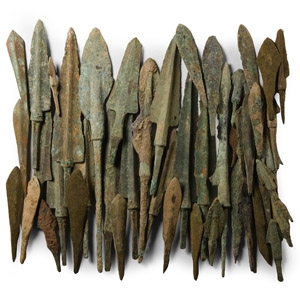
Luristan Arrowhead Collection
13th-7th century B.C.Sold for (Inc. bp): £390
Comprising forty-five arrowheads of various types, including triangular, lanceolate and leaf-shaped; mainly tanged, some barbed. 557 grams total, 3.2-17.1 cm
Acquired 1980-2015. Ex Abelita family collection.
