
Auction Highlights
-
.jpg)
Greek Marble Head of Dionysus
Sold for (Inc. bp): £23,400
Carved in the half-round in three-quarter view, youthful male head with stern features, hair gathered in a browband, horns to the brow; from a frieze or relief; mounted on a custom-made stand. -
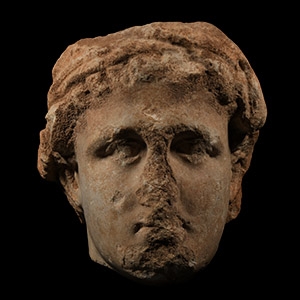
Greek Marble Head of a Ruler
Sold for (Inc. bp): £31,200
Carved in the round with thick wreath of laurel leaves to the brow, short tousled hair, stern face with thick jaw; mounted on a custom-made stand. -
.jpg)
Roman Veined Marble Torso of an Athlete
Sold for (Inc. bp): £48,100
Standing contrapposto with his weight on his right leg and the left leg brought slightly forward; the musculature of the torso displaying well-defined pectoral muscles, prominent abdominal muscles and wide shoulders, the back with equally toned musculature and well-formed rounded buttocks; the veining of the marble accentuating the idealised anatomy; the now-absent head was most probably turned towards the supporting leg and the left arm would have been raised; mounted on a custom-made display stand. -
.jpg)
Large Middle Elamite Cylinder Seal of Kidnu, Chief Overseer of King Tan-Ruhurater II
Sold for (Inc. bp): £15,600
A high-status green chalcedony seal with frieze depicting a seated figure in horned headdress facing a standing figure with arms outstretched, small monkey to the legs; six columns of Akkadian cuneiform text transliterated as: 1. ki-di-nu UGULA KUŠ-MEŠ 2. GAL šà tan-dru-hu- 3. ra-te-er EŠŠANA šu-ši 4. u an-za-an ARAD 5. šà dha-te-ri-iš 6. šak(?) ì-lí-šu 'Kidinu, chief overseer of the equerries(?) of Tan-Ruhurater, King of Susa and Anzan, servant of Haterishshak, his god'. The seal's owner was an official of King Tan-Ruhurater II (circa 1450 B.C.), king of Susa and Anzan. The title used to describe Kidinu is sometimes translated 'high official', elsewhere 'horse groom' or 'animal trainer'; the Elamite deity Haterish is otherwise unknown. -
.jpg)
Mesopotamian Torch Bearer Stand with Lion Tamer
Sold for (Inc. bp): £46,800
A substantial torch bearer depicting a male lion or panther standing with legs firmly planted on a rectangular base, tail extending to the ground, with a massive circular shaped armature or candelabra issuing from its back and wearing an elaborate muzzle, the eyes retaining shell inlay with a circular hollow for the pupils; to the right of the beast a kneeling nude male wearing a large belt-armour and a diadem, eyes inlaid, left hand extended to the side and holding the lion's leash.
-
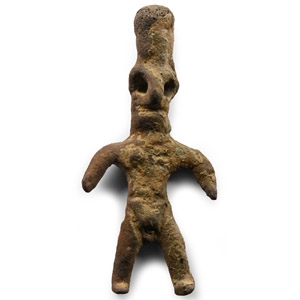
Syro-Hittite Bronze Figure of a Man
2nd millennium B.C.Sold for (Inc. bp): £130
Modelled in the round as a standing figure with pinched facial features and hollowed-out eyes, arms held out. 15.58 grams, 54 mm
UK private collection before 2000. On the UK art market. Property of a London gentleman. -
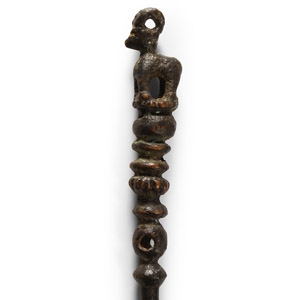
Luristan Bronze Pin with Ibex
1st millennium B.C.Sold for (Inc. bp): £104
With a tapering round-section shank, balustered finial topped with a standing ibex. 11.7 grams, 10.1 cm
UK private collection before 2000. On the UK art market. Property of a London gentleman. -
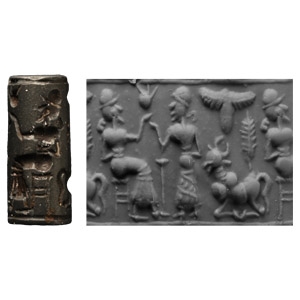
Late Babylonian Stone Cylinder Seal with Presentation Scene
Circa 900-600 B.C.Sold for (Inc. bp): £520
The scene in a single register presenting a seated figure, possibly a deity, with a raised arm, a worshipper before him with one raised arm; a crouching horned quadruped behind the worshipper, a winged figure above; accompanied by a museum-quality impression. 5.69 grams, 22 mm
From the property of late Mr SM, London, UK, 1969-1999. -
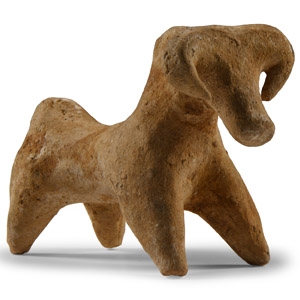
Amorite Terracotta Bull
Late 3rd-early 2nd millennium B.C.Sold for (Inc. bp): £338
Modelled in the round, with humped shoulder and downturned horns. 60 grams, 83 mm
Private collection Mr S.A., acquired in 1991. Thence by descent.
The figurine was modelled simplistically and only the presence of a hump and horns makes it possible to identify the animal as a zebu, which was common in the prehistoric Mesopotamian world. Similar figurines, which reproduced animals and humans, are typical of Amorite art, named after a group of semi-nomadic populations who lived in the north-western part of the Near East in the 3rd and 2nd millennium B.C. From the 20th century B.C., the incursions and armed pressure that the Amorites exerted on the kingdom of Ur overthrew the existing dynasties and created several kingdoms throughout Mesopotamia whose dynasties retained a strong attachment to their original culture. -
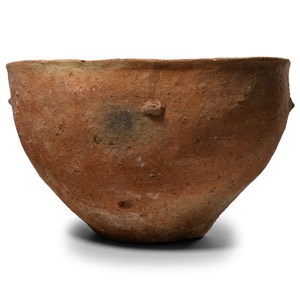
Trans Jordan Terracotta Bowl
Early Bronze Age I, 3rd millennium B.C.Sold for (Inc. bp): £117
Of hemispherical profile with everted rim, five radiating ledge handles to the shoulder. 1.64 kg, 25.5 cm wide
From an important collection of terracotta pre 1988, London and Geneva. -
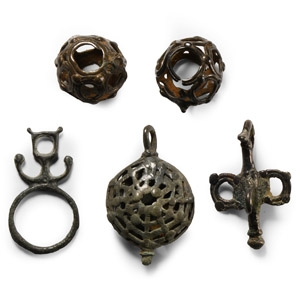
Amlash Bronze Openwork Pendant Group
2nd-1st millennium B.C.Sold for (Inc. bp): £72
Comprising: two large openwork beads; a domed cage-work pendant; an anthropomorphic pendant; an elongated pendant with four loops. 91 grams total, 33-56 mm
UK private collection before 2000. On the UK art market. Property of a London gentleman. -
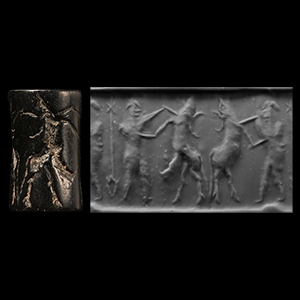
Akkadian Cylinder Seal with Combat Scene
Circa 2400-2200 B.C.Sold for (Inc. bp): £338
Black stone with two standing figures each spearing antelope rampant standing on their on their hind legs. 12.5 grams, 26 mm
From a collection acquired from various auction houses in the UK. From the estate of Mr R.W., a private Wiltshire, UK, collector; thence by descent. -
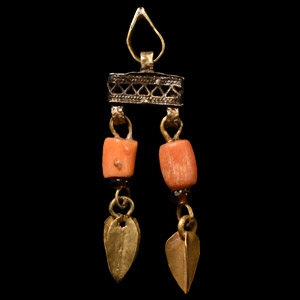
Western Asiatic Gold Openwork Pendant
Circa 1st millennium B.C.Sold for (Inc. bp): £117
Comprising an openwork body with two symmetrical pendants hanging from each corner, the pendants composed of a tubular coral bead with an arrow-like gold breloque below. 1.21 grams, 30 mm
Acquired 1980-2015. Ex Abelita family collection. Accompanied by an old collection ticket. -
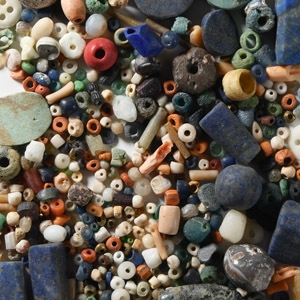
Western Asiatic and Other Stone Bead Group
1st millennium B.C. and laterSold for (Inc. bp): £98
Including tabular, annular, polyhedral, tubular and other types. 99 grams total, 2-25 mm
From the private collection of the late Mrs Belinda Ellison, a long time member of the Egyptian Exploration Society, c.1940-2020. -
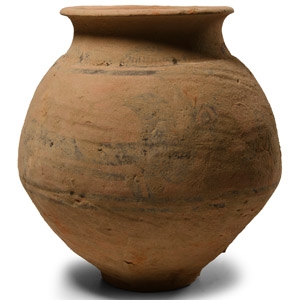
Western Asiatic Painted Terracotta Jar
1st millennium B.C.Sold for (Inc. bp): £72
With rounded profile, low foot and rounded everted rim to the mouth, painted horizontal bands to the shoulder enclosing a frieze of zebus. 819 grams, 18 cm
Acquired 1990s-2000s. From the late David Gold (d.2015) collection of pottery.
David Gold and his brother were famous for setting up the first clothes shop in Carnaby Street and dressed the famous in the swinging 1960s, making Carnaby Street famous. -
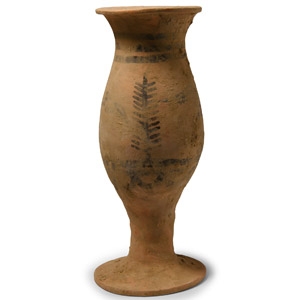
Western Asiatic Painted Terracotta Vase
1st millennium B.C.Sold for (Inc. bp): £104
With fusiform body and broad carinated rim, short stem and flared base; circumferential painted bands and frond motifs. 428 grams, 21.5 cm
Acquired 1990s-2000s. From the late David Gold (d.2015) collection of pottery.
David Gold and his brother were famous for setting up the first clothes shop in Carnaby Street and dressed the famous in the swinging 1960s, making Carnaby Street famous. -
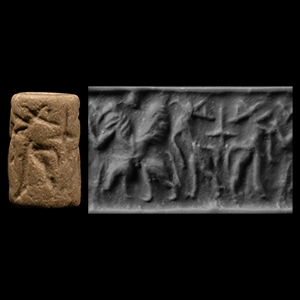
Akkadian Cylinder Seal with Combat Scene
2300-2200 B.C.Sold for (Inc. bp): £156
Limestone with lions and quadrupeds; accompanied by an old scholarly note, typed and signed by W.G. Lambert, late Professor of Assyriology, University of Birmingham, 1970-1993, which states: 'Cylinder Seal of Fawn Stone, 17 x 10.5 mm. The design shows two crossed lions in the middle, each attacking a domestic horned animal on the outside of the scene. There is a simple linear device as a terminal. This is an Akkadian seal, c. 2300-2200 B.C., from Mesopotamia or an adjacent area. It is in [sic] good state of preservation.' 2.8 grams, 16 mm
Property of a London gentleman; part of his family collection since the 1970s. From a collection acquired from various auction houses in the UK. From the estate of Mr R.W., a private Wiltshire, UK, collector; thence by descent. Accompanied by a original typed and signed scholarly note by the late W.G. Lambert, Professor of Assyriology at the University of Birmingham, 1970-1993.
