
Auction Highlights
-
.jpg)
Greek Marble Head of Dionysus
Sold for (Inc. bp): £23,400
Carved in the half-round in three-quarter view, youthful male head with stern features, hair gathered in a browband, horns to the brow; from a frieze or relief; mounted on a custom-made stand. -
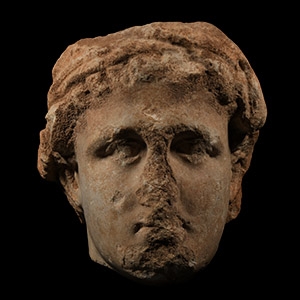
Greek Marble Head of a Ruler
Sold for (Inc. bp): £31,200
Carved in the round with thick wreath of laurel leaves to the brow, short tousled hair, stern face with thick jaw; mounted on a custom-made stand. -
.jpg)
Roman Veined Marble Torso of an Athlete
Sold for (Inc. bp): £48,100
Standing contrapposto with his weight on his right leg and the left leg brought slightly forward; the musculature of the torso displaying well-defined pectoral muscles, prominent abdominal muscles and wide shoulders, the back with equally toned musculature and well-formed rounded buttocks; the veining of the marble accentuating the idealised anatomy; the now-absent head was most probably turned towards the supporting leg and the left arm would have been raised; mounted on a custom-made display stand. -
.jpg)
Large Middle Elamite Cylinder Seal of Kidnu, Chief Overseer of King Tan-Ruhurater II
Sold for (Inc. bp): £15,600
A high-status green chalcedony seal with frieze depicting a seated figure in horned headdress facing a standing figure with arms outstretched, small monkey to the legs; six columns of Akkadian cuneiform text transliterated as: 1. ki-di-nu UGULA KUŠ-MEŠ 2. GAL šà tan-dru-hu- 3. ra-te-er EŠŠANA šu-ši 4. u an-za-an ARAD 5. šà dha-te-ri-iš 6. šak(?) ì-lí-šu 'Kidinu, chief overseer of the equerries(?) of Tan-Ruhurater, King of Susa and Anzan, servant of Haterishshak, his god'. The seal's owner was an official of King Tan-Ruhurater II (circa 1450 B.C.), king of Susa and Anzan. The title used to describe Kidinu is sometimes translated 'high official', elsewhere 'horse groom' or 'animal trainer'; the Elamite deity Haterish is otherwise unknown. -
.jpg)
Mesopotamian Torch Bearer Stand with Lion Tamer
Sold for (Inc. bp): £46,800
A substantial torch bearer depicting a male lion or panther standing with legs firmly planted on a rectangular base, tail extending to the ground, with a massive circular shaped armature or candelabra issuing from its back and wearing an elaborate muzzle, the eyes retaining shell inlay with a circular hollow for the pupils; to the right of the beast a kneeling nude male wearing a large belt-armour and a diadem, eyes inlaid, left hand extended to the side and holding the lion's leash.
-
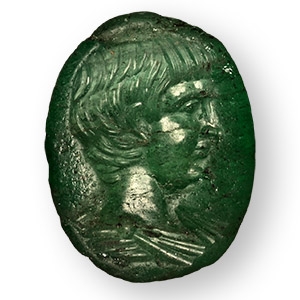
Roman Emerald Gemstone with Portrait of Young Nero
51-55 A.D.Sold for (Inc. bp): £6,500
Depicting Nero as a young boy, either as crown prince or within the first year of his reign in his first known portrait type, unequivocal with his long hair fringe. 2.17 grams, 17 mm
Ex Paul Munro Walker collection, Bournemouth, UK, 1970s. Private collection of Alexander Cotton, Hampshire, UK, sold October 1986. From a London gentleman's, UK, collection, in the 1990s. This lot has been checked against the Interpol Database of stolen works of art and is accompanied by a search certificate number no.12104-216215.
Dr Ittai Gradel writes: 'Date is AD 51-55. On most glyptic portraits from shortly after he became emperor, so 54-55, he is shown laurelled ... However, on the coins he is shown also bare-headed even as emperor in 54-55 (second coin, denarius). Again, on coins his bust is shown draped only before he became emperor in 54 (first coin, aureus), but cameos show him draped also as emperor (as e. g. the Marlborough one: but there are several known). It is therefore not possible to say if the emerald shows him as crown prince or as emperor, and I cannot date it more precisely than 51-55.' -
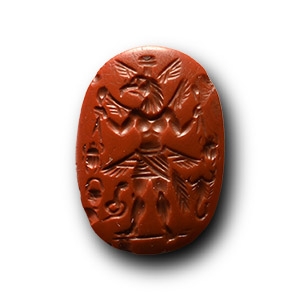
Late Roman Gnostic Carnelian Gemstone
4th-7th century A.D.Sold for (Inc. bp): £1,235
Bifacial ellipsoid insert with lip to one face; obverse depicting a kilted figure with avian head and with wings on his head, shoulders and hips holding symbols and flanked by a scorpion, scarab, serpent and other items; reverse with lion-headed serpent, surrounding enigmatic legend 'XAYMNOMNABMXMXIM'; supplied with a museum-quality impression of each face. 1.92 grams, 22 mm
From the property of late Mr SM, London, UK, 1969-1999. -
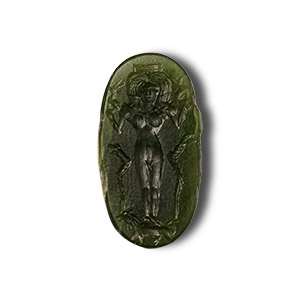
Roman Gnostic Green Gemstone
2nd-3rd century A.D.Sold for (Inc. bp): £910
Ellipsoid with intaglio nude female flanked by serpents; supplied with a museum-quality impression. 2.41 grams, 25 mm
From the glyptic collection of Mr X; thence by descent. Acquired Hotel des Ventes, Drouot, Eve SVV, Paris, France, 28 June 2017, no.156 (Part). Property of a French collector. -
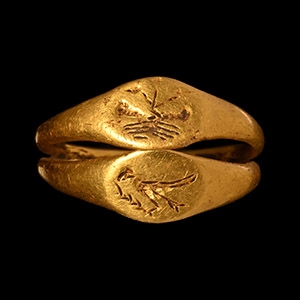
Roman Gold Marriage Ring with Clasped Hands and Eagle
1st-2nd century A.D.Sold for (Inc. bp): £2,080
Bifid form with parallel bands and lentoid bezels, one with low-relief clasped hands motif, the other with a bird holding a frond. 3.45 grams, 17.96 mm overall, 15.19 mm internal diameter (approximate size British G 1/2, USA 3 1/2, Europe 5.55, Japan 5)
Ex German art market, 2000s. Acquired from an EU collector living in London. From the collection of Surrey, UK, gentleman. -
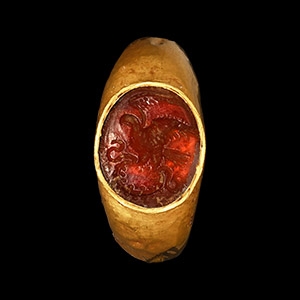
Roman Gold Ring with Gemstone
1st-2nd century A.D. and laterSold for (Inc. bp): £2,860
Hollow-formed finger ring with broad plaque; with a later gemstone of an eagle and snake within a wreath; supplied with a museum-quality impression. 2.28 grams, 24.52 mm overall, 16.95 mm internal diameter (approximate size British I, USA 4 1/4, Europe 7.44, Japan 7)
Acquired in the mid 1980s-1990s. From the family collection of Mr S.A., Switzerland, thence by descent. Private collection since the late 1990s. This lot has been checked against the Interpol Database of stolen works of art and is accompanied by a search certificate number no.12107-218183. -
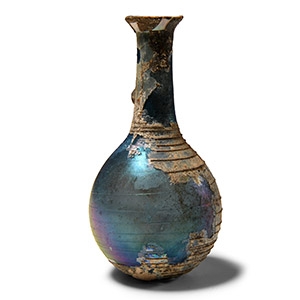
Roman Blue Glass Flask with Fine Trailing
1st-4th century A.D.Sold for (Inc. bp): £1,170
Iridescent blue glass flask with bulbous body and flared mouth, fine applied spiral trail to the neck and body. 18.5 grams, 10 cm
Ex property of a late Japanese collector, 1970-2000s. -
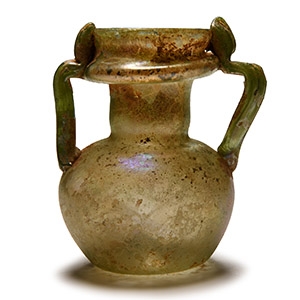
Roman Double-Handled Flask
1st-3rd century A.D.Sold for (Inc. bp): £845
Aqua glass jar with bulbous body, broad neck, double-folded flange rim, two lateral strap handles extending from the mouth to the shoulder. 49 grams, 10 cm high
Acquired on the German art market, 1989-1995. with The Museum Gallery, 19 Bury Place, London, WC, UK, 1998-2003. Property of a London based academic, 2003-present. -
.jpg)
Roman Honey-Coloured Glass Amphora
1st-4th century A.D.Sold for (Inc. bp): £2,080
With broad rounded shoulder tapering to a conical foot, cylindrical neck and everted mouth with rolled rim, applied trail handles and collar; tip restored; supplied with a display stand. 97 grams, 18 cm (220 grams total, 20 cm including stand)
Ex property of a late Japanese collector, 1970-2000s. This lot has been checked against the Interpol Database of stolen works of art and is accompanied by a search certificate number no.12108-217865. -
.jpg)
Roman Translucent Glass Bowl
3rd century A.D.Sold for (Inc. bp): £494
Translucent aqua glass with moulded texture to the outer face. 209 grams, 16 cm wide
From the collection of a late East Anglian teacher and antiquarian who retired to the Isle of Wight in Hampshire, UK. He amassed a large collection of objects between the 1960s-1980s. -
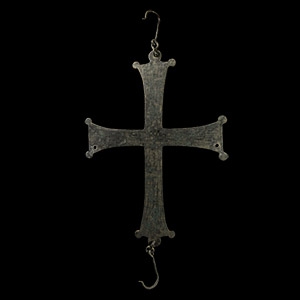
Huge Byzantine Hanging Bronze Lobed Cross
Circa 8th-10th century A.D.Sold for (Inc. bp): £1,560
Substantial cross pattée with pierced lobes to the vertical arms, each end provided with a link and hook; lateral arms pieced to accept similar links; intended for the suspension of polycandela multiple-candle chandeliers. 1.12 kg, 55.5 cm including hook
Ex Surrey, UK, collection of a gentleman, 1960-2000s.
In 563 A.D., Paul the Silentiary visited Hagia Sophia in Constantinople and described the wondrous lighting effects, ‘Thus is everything clothed in beauty…no words are sufficient to describe the illumination in the evening: you might say that some nocturnal sun filled the majestic church with light.’ The church was lit by polycandela, an early type of candelabra that held glass oil lamps rather than candles. The lamps were either conical or shaped like round bowls with an elongated stem attached beneath. Amidst the burning of incense and the chanting of prayers, the flickering light must have helped to inspire pious devotion. Contemporaries certainly attest to this feeling and among the surviving accounts, that of Arculf, Bishop of Gaul, is particularly affecting. In 670 he went on a pilgrimage to Jerusalem and visited the Church of the Ascension, ‘…to the customary light of the eight lamps…on the night of the feast of the Lord’s Ascension it is usual to add innumerable other lamps; and under the terrible and wondrous gleaming of these, pouring out copiously through the shutters of the windows, all Mount Olivet seems not alone to be illuminated, but even to be on fire, and the whole city, situated on the lower ground nearby, seems to be lit up.’ -
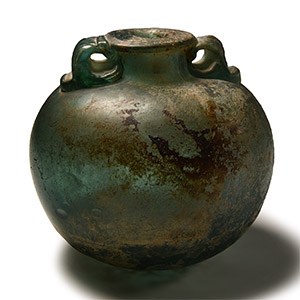
Late Byzantine Green Glass Aryballos
6th-8th century A.D.Sold for (Inc. bp): £1,105
Substantial jar with dimple base, trumpet-shaped mouth with brad rim and flanked by two loop handles. 329 grams, 94 mm wide
From the early 19th century collection of General Sir George Cockburn (1763-1847), Shanganagh Castle, Co Wicklow, Ireland, sold at auction between 1935-1939. From the collection of the late Dr J.D.H. Widdness, Dublin, Ireland. Accompanied by a handwritten letter by Dr Widdness explaining the bottle's history and provenance, plus a typed transcription. Accompanied by a copy of an old black and white photograph of Dr Widdness holding and admiring the bottle while sitting in his study. -
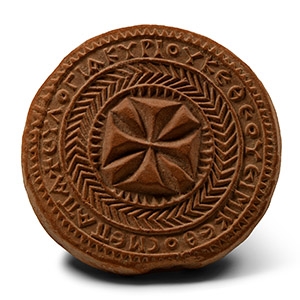
Large Byzantine Terracotta Bread Stamp
Circa 10th-11th century A.D.Sold for (Inc. bp): £5,720
Discoid in plan with integral stub handle; central Maltese cross with herringbone ring and epigraphic band, radiating dentilled rim; the inscription '+ ΕΥΛΟΓΙΑ ΚΥΡΙΟΥ ΚΕ ΘΕΟΥ ΕΙΜΙ ΚΕ ΘΟC ΜΕ ΠΑΠΑ' (With the blessing of Lord and God I am with the Father). 495 grams, 12.6 cm wide
From the collection of Sir Daniel Donohue [1919-2014] and the Countess Bernardine [1904-1968], Los Angeles, USA; the collection was assembled in the 1950-1960s, but before March 1968. with Bonhams, London, 13 April 2011, no.310 (part). Accompanied by a copy of the relevant Bonhams catalogue pages. Accompanied by a copy of an Art Loss Register certificate no.S00120713. This lot has been checked against the Interpol Database of stolen works of art and is accompanied by a search certificate number no.12109-218144.
The cross is surrounded by a zig-zag frieze enclosed within a long inscription in medieval Greek, this confirms the use of the seal in a liturgical context. The practice of preparing bread for Holy Eucharist and Antidoron is still in use in the churches of the East.
