
Auction Highlights
-
.jpg)
Greek Marble Head of Dionysus
Sold for (Inc. bp): £23,400
Carved in the half-round in three-quarter view, youthful male head with stern features, hair gathered in a browband, horns to the brow; from a frieze or relief; mounted on a custom-made stand. -
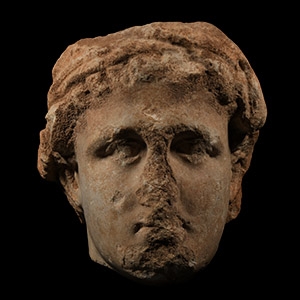
Greek Marble Head of a Ruler
Sold for (Inc. bp): £31,200
Carved in the round with thick wreath of laurel leaves to the brow, short tousled hair, stern face with thick jaw; mounted on a custom-made stand. -
.jpg)
Roman Veined Marble Torso of an Athlete
Sold for (Inc. bp): £48,100
Standing contrapposto with his weight on his right leg and the left leg brought slightly forward; the musculature of the torso displaying well-defined pectoral muscles, prominent abdominal muscles and wide shoulders, the back with equally toned musculature and well-formed rounded buttocks; the veining of the marble accentuating the idealised anatomy; the now-absent head was most probably turned towards the supporting leg and the left arm would have been raised; mounted on a custom-made display stand. -
.jpg)
Large Middle Elamite Cylinder Seal of Kidnu, Chief Overseer of King Tan-Ruhurater II
Sold for (Inc. bp): £15,600
A high-status green chalcedony seal with frieze depicting a seated figure in horned headdress facing a standing figure with arms outstretched, small monkey to the legs; six columns of Akkadian cuneiform text transliterated as: 1. ki-di-nu UGULA KUŠ-MEŠ 2. GAL šà tan-dru-hu- 3. ra-te-er EŠŠANA šu-ši 4. u an-za-an ARAD 5. šà dha-te-ri-iš 6. šak(?) ì-lí-šu 'Kidinu, chief overseer of the equerries(?) of Tan-Ruhurater, King of Susa and Anzan, servant of Haterishshak, his god'. The seal's owner was an official of King Tan-Ruhurater II (circa 1450 B.C.), king of Susa and Anzan. The title used to describe Kidinu is sometimes translated 'high official', elsewhere 'horse groom' or 'animal trainer'; the Elamite deity Haterish is otherwise unknown. -
.jpg)
Mesopotamian Torch Bearer Stand with Lion Tamer
Sold for (Inc. bp): £46,800
A substantial torch bearer depicting a male lion or panther standing with legs firmly planted on a rectangular base, tail extending to the ground, with a massive circular shaped armature or candelabra issuing from its back and wearing an elaborate muzzle, the eyes retaining shell inlay with a circular hollow for the pupils; to the right of the beast a kneeling nude male wearing a large belt-armour and a diadem, eyes inlaid, left hand extended to the side and holding the lion's leash.
-
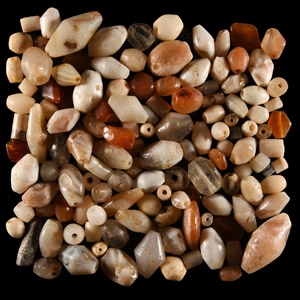
Western Asiatic Mixed Agate and Carnelian Bead Group
1st millennium B.C. and laterSold for (Inc. bp): £468
Mainly bicones, spheres and oblate shapes. 280 grams total, 6-34 mm
Acquired 1980-2015. Ex Abelita family collection. -
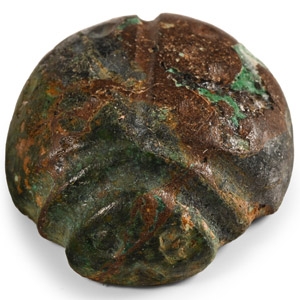
Western Asiatic Stone Ladybird Amulet
Circa 1st millennium B.C.Sold for (Inc. bp): £52
Plano-convex body with incuse pellet 'spots', incised facial and carapace details. 6.5 grams, 22 mm
UK private collection before 2000. On the UK art market. Property of a London gentleman. -
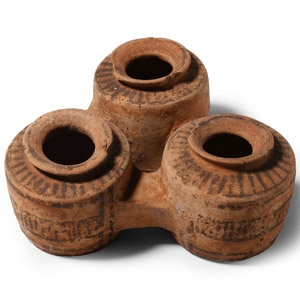
Western Asiatic Painted Terracotta Kernos
1st millennium B.C.Sold for (Inc. bp): £169
Three drum-shaped ceramic vessels each with a flared rim and flat underside, connected by spurs at the equator; painted linear motifs to the mouths, shoulders and sidewalls. 350 grams, 13 cm
From a collection acquired on the UK art market from various auction houses and collections mostly before 2000. From an important Cambridgeshire estate; thence by descent.
In the typology of ancient Greek pottery, the kernos (κέρνος or κέρχνος, plural kernoi) was a stone tray to which were attached several small vessels for holding offerings. Its unusual design is described in literary sources, which also list the ritual ingredients it might contain. The kernos was used primarily in the cults of Demeter and Kore, and of Cybele and Attis. -
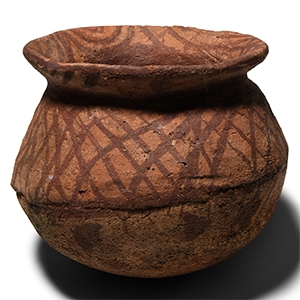
Canaanite Net Painted Jar
Bronze Age, circa 2nd millennium B.C.Sold for (Inc. bp): £65
Of biconvex profile formed with a rounded base and flared shoulder, everted rim; applied red-paint trellis design to the shoulder and rim. 519 grams, 14 cm wide
From a collection acquired on the UK art market from various auction houses and collections mostly before 2000. From an important Cambridgeshire estate; thence by descent.
The jar belongs to the Early Bronze Period I or II of Canaan, in red decoration with net pattern, and it is unusual having an oval cross-section. Many of these jars were found at Tell el-Far'ah. -
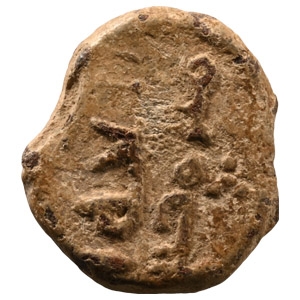
Western Asiatic Inscribed Lead Document Bulla
Circa 8th-9th century A.D.Sold for (Inc. bp): £20
Discoid with two line inscription to both sides. 10 grams, 21 mm
From the property of late Mr SM, London, UK, 1969-1999. -
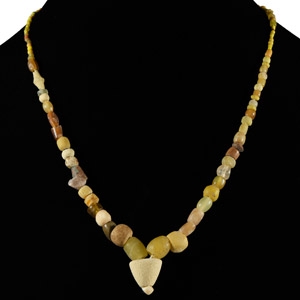
Western Asiatic Mixed Bead Necklace
1st millennium B.C. and laterSold for (Inc. bp): £20
A restrung designer necklace comprising plano-convex, barrel-shaped, oblate and other beads, the centrepiece a pendant cone. 27.9 grams, 42 mm
Acquired on the London, UK, art market in the 1990s. Ex London, UK, gallery. -
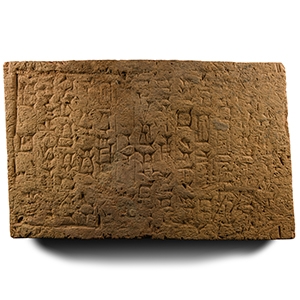
Temple Brick Section of Nebuchadnezzar II, King of Babylon
Circa 604-562 B.C.Sold for (Inc. bp): £5,200
A rectangular-section panel with fourteen columns of cuneiform text mentioning the foundation of a temple by Nebuchadnezzar II, translating as 'King of Babylon provisioner of Esagil and Ezida prime son of Nabopolassar, King of Babylon and Ebabbara, the temple of Shamash in Larsa..[...]. 1.05 kg, 21 x 13 cm
Formerly in a private collection since 1980. Acquired from the private collection of L.H., Staffordshire, UK. Previously the property of an East Sussex, UK, gentleman. From a collection acquired from various auction houses in the UK. From the estate of Mr R.W., a private Wiltshire, UK, collector; thence by descent. Accompanied by a copy of a five-page specialist report by James Brenchley. This lot has been checked against the Interpol Database of stolen works of art and is accompanied by search certificate no.12315 -215546.
The construction of the Hanging Gardens of Babylon and the destruction of Jerusalem's temple are ascribed to Nebuchadnezzar II. He is featured in the biblical Book of Daniel and is mentioned in several other books of the Bible. -
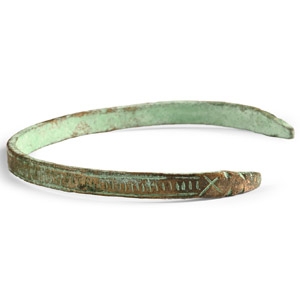
Western Asiatic Bronze Decorated Bracelet
Late 1st millennium B.C.Sold for (Inc. bp): £20
Comprising a flat-section penannular body with a medial panel of vertical lines; the finials formed as serpent or beast heads. 16.2 grams, 72 mm
UK private collection before 2000. On the UK art market. Property of a London gentleman. -
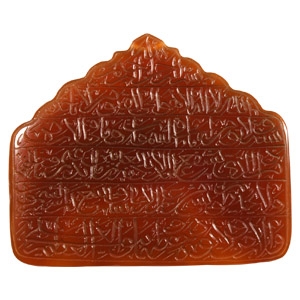
Qajar Calligraphic Pendant with Kufic Inscription
20th century A.D.Sold for (Inc. bp): £72
Pentagonal carnelian plaque with dentilled lower edges, six transverse bands of calligraphic script. 81 grams. 96 mm
with a London, UK gallery 1971-early 2000s. -
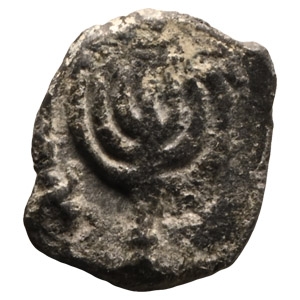
Jewish Lead Sealing with Menorah
Circa 4th century A.D. or earlierSold for (Inc. bp): £260
Discoid with an impressed menorah to one side, the reverse with an eagle(?). 1.27 grams, 13 mm
From the property of late Mr SM, London, UK, 1969-1999. -
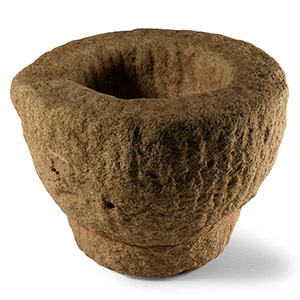
Western Asiatic Limestone Mortar
1st millennium B.C.Sold for (Inc. bp): £72
With short columnar base and bulbous upper body, broad rim with pouring lip. 4.85 kg, 13 cm
From a collection acquired on the UK art market from various auction houses and collections mostly before 2000. From an important Cambridgeshire estate; thence by descent.
The later (2nd -3rd century A.D.) Rabbinic tradition emphasised the difference between the permanent mortar (makhtesh kevua) and the movable one (makhtesh metaltelet), with the first being automatically sold with the house, but the second sold only if expressly stated by the vendor. This form of movable mortar was common in the Levant throughout the second half of the 1st millennium B.C. -
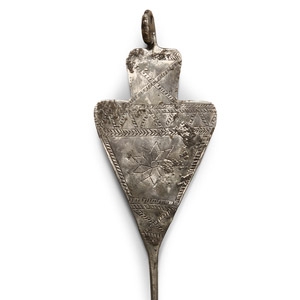
Western Asiatic Decorated Silver Pin
3rd century B.C.-2nd century A.D.Sold for (Inc. bp): £26
With triangular body, comprising a central rosette and herringbone borders; stem of the pin at the apex, rectangular panel above and S-curved securing loop. 17.5 grams, 16 cm
UK private collection before 2000. On the UK art market. Property of a London gentleman.
