
Auction Highlights
-
.jpg)
Greek Marble Head of Dionysus
Sold for (Inc. bp): £23,400
Carved in the half-round in three-quarter view, youthful male head with stern features, hair gathered in a browband, horns to the brow; from a frieze or relief; mounted on a custom-made stand. -
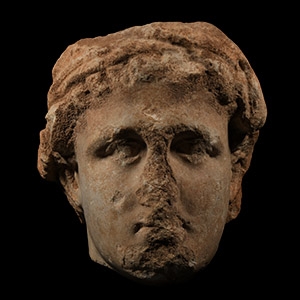
Greek Marble Head of a Ruler
Sold for (Inc. bp): £31,200
Carved in the round with thick wreath of laurel leaves to the brow, short tousled hair, stern face with thick jaw; mounted on a custom-made stand. -
.jpg)
Roman Veined Marble Torso of an Athlete
Sold for (Inc. bp): £48,100
Standing contrapposto with his weight on his right leg and the left leg brought slightly forward; the musculature of the torso displaying well-defined pectoral muscles, prominent abdominal muscles and wide shoulders, the back with equally toned musculature and well-formed rounded buttocks; the veining of the marble accentuating the idealised anatomy; the now-absent head was most probably turned towards the supporting leg and the left arm would have been raised; mounted on a custom-made display stand. -
.jpg)
Large Middle Elamite Cylinder Seal of Kidnu, Chief Overseer of King Tan-Ruhurater II
Sold for (Inc. bp): £15,600
A high-status green chalcedony seal with frieze depicting a seated figure in horned headdress facing a standing figure with arms outstretched, small monkey to the legs; six columns of Akkadian cuneiform text transliterated as: 1. ki-di-nu UGULA KUŠ-MEŠ 2. GAL šà tan-dru-hu- 3. ra-te-er EŠŠANA šu-ši 4. u an-za-an ARAD 5. šà dha-te-ri-iš 6. šak(?) ì-lí-šu 'Kidinu, chief overseer of the equerries(?) of Tan-Ruhurater, King of Susa and Anzan, servant of Haterishshak, his god'. The seal's owner was an official of King Tan-Ruhurater II (circa 1450 B.C.), king of Susa and Anzan. The title used to describe Kidinu is sometimes translated 'high official', elsewhere 'horse groom' or 'animal trainer'; the Elamite deity Haterish is otherwise unknown. -
.jpg)
Mesopotamian Torch Bearer Stand with Lion Tamer
Sold for (Inc. bp): £46,800
A substantial torch bearer depicting a male lion or panther standing with legs firmly planted on a rectangular base, tail extending to the ground, with a massive circular shaped armature or candelabra issuing from its back and wearing an elaborate muzzle, the eyes retaining shell inlay with a circular hollow for the pupils; to the right of the beast a kneeling nude male wearing a large belt-armour and a diadem, eyes inlaid, left hand extended to the side and holding the lion's leash.
-
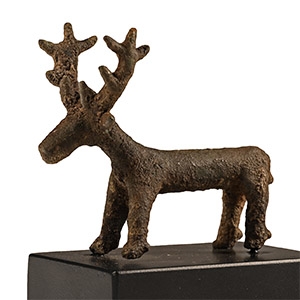
Hittite Bronze Statuette of a Stag
2nd-1st millennium B.C.Sold for (Inc. bp): £390
Modelled in the round, the stag standing with legs firmly set, ears and antlers carefully modelled; mounted on a custom-made display stand. 291 grams total, 88 mm including stand
From a collection acquired on the UK art market from various auction houses and collections mostly before 2000. From an important Cambridgeshire estate; thence by descent.
In Anatolia, cult objects in the form of a deer found in the Royal Cemetery of Alaca Höyük, dating to the 3rd millennium B.C., suggest worship of this animal. This continued during the Hittite period where bronze statuettes of this type were widespread. The cult was widespread in the Mediterranean-Aegean world. Even on the remote island of Sardinia, similar cultic and votive statuettes were made. -
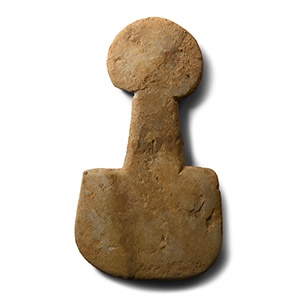
Western Asiatic Anatolian Kusura Type Marble Idol
Early Bronze Age II, circa 2700-2100 B.C.Sold for (Inc. bp): £624
With D-shaped body, tapering shank and disc finial. 26 grams, 99 mm
From a collection acquired on the UK art market from various auction houses and collections mostly before 2000. From an important Cambridgeshire estate; thence by descent. -
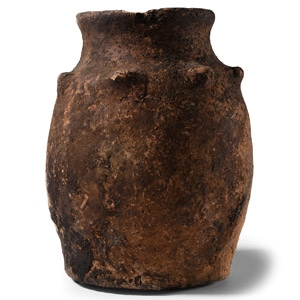
Western Asiatic Terracotta Storage Vessel
Early Bronze Age, 3rd-2nd millennium B.C.Sold for (Inc. bp): £46
Barrel-shaped with slightly flared base, rounded rim, row of projecting lugs to the shoulder. 1.1 kg, 16.5 cm high
From a collection acquired on the UK art market from various auction houses and collections mostly before 2000. From an important Cambridgeshire estate; thence by descent. -
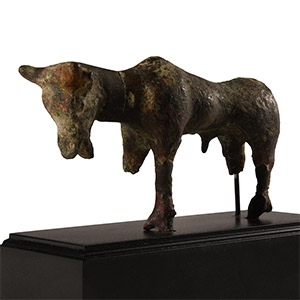
Western Asiatic Bronze Bull Statuette
1st millennium B.C.Sold for (Inc. bp): £143
Modelled standing with head lowered and mouth open; mounted on a custom-made display stand. 602 grams total, 12.7 cm wide including stand
From a collection acquired on the UK art market from various auction houses and collections mostly before 2000. From an important Cambridgeshire estate; thence by descent. -
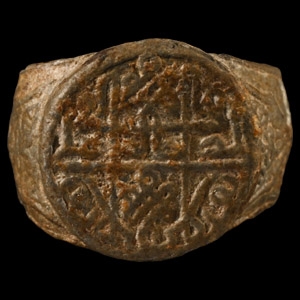
Western Asiatic Bronze Ring with Calligraphy
12th-13th century A.D.Sold for (Inc. bp): £39
With a wide hoop embellished with foliate design, raised lozenge-shaped plaque to the base; raised bezel with net-design to the outer edge, the bezel intricate calligraphy design. 12.25 grams, 27.67 mm overall, 17.98 x 21.12 mm internal diameter (approximate size British O 1/2, USA 7 1/4, Europe 15.61, Japan 15)
UK private collection before 2000. On the UK art market. Property of a London gentleman. -
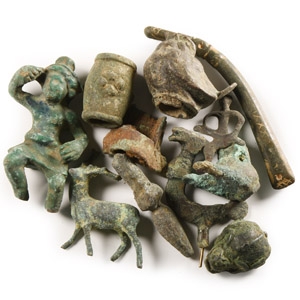
Western Asiatic and Other Mixed Bronze Artefact Group
1st millennium B.C. and laterSold for (Inc. bp): £98
Including gladiator figurine, model stag, petronel, barrel-shaped bead and other items. 287 grams total, 27-85 mm
From a collection acquired on the UK art market from various auction houses and collections mostly before 2000. From an important Cambridgeshire estate; thence by descent. -
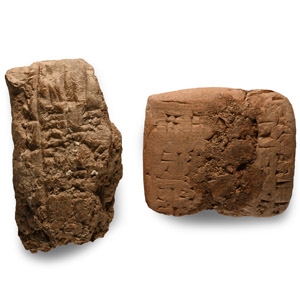
Mesopotamian Cuneiform Tablet Fragment Group
2nd millennium B.C.Sold for (Inc. bp): £195
Group of two pillow-shaped clay tablets each with cuneiform text to one broad face; repaired. 93.8 grams total, 48-61 mm
Specialised collection of cuneiform texts, the property of a London gentleman and housed in London before 1992. Thence by descent to family members. Examined by Professor Wilfrid George Lambert FBA (1926-2011), historian, archaeologist, and specialist in Assyriology and Near Eastern archaeology, in the late 1980s and early 1990s. This small collection is exceptional for the variety of types, including some very rare and well preserved examples. -
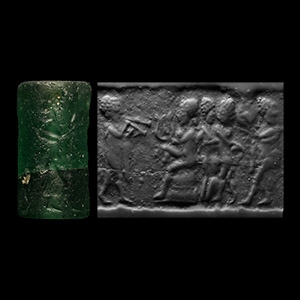
Western Asiatic Green Glass Cylinder Seal with Entertainment Scene
Early 1st millennium B.C.Sold for (Inc. bp): £715
With frieze of entertainers: standing nude figure with curly hair holding a syrinx to her mouth facing a seated nude female playing a curved lyre; to her rear, three nude female dancers; supplied with a museum-quality impression. 16.55 grams, 31 mm
From the property of late Mr SM, London, UK, 1970-1990s, thence by descent. Examined by Professor Wilfrid George Lambert FBA (1926-2011), historian, archaeologist, and specialist in Assyriology and Near Eastern archaeology, in the late 1980s and early 1990s.
Glass is very rarely used in this period for cylinder seals. -
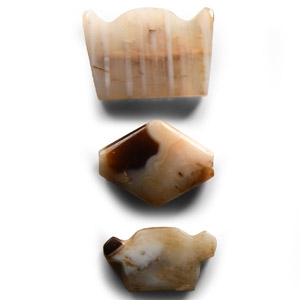
Western Asiatic Agate Amulet Group
1st millennium B.C. and laterSold for (Inc. bp): £39
Including lozengiform type pierced longitudinally, and two rectangular plaques with lateral lobes pierced transversely. 18.7 grams total, 29-34 mm
From a collection acquired on the UK art market from various auction houses and collections mostly before 2000. From an important Cambridgeshire estate; thence by descent. -
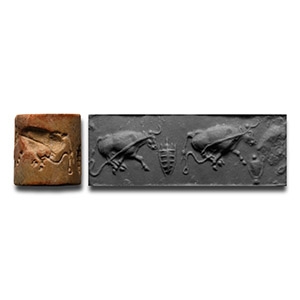
Western Asiatic Stone Cylinder Seal with Advancing Bulls
Early 2nd millennium B.C.Sold for (Inc. bp): £2,210
With frieze depicting two bovines advancing, each with a bridle and trailing a rope, amphorae in the field; old collector's label '10100' to base; possibly unfinished as centre not pierced; supplied with a museum-quality impression. 36.6 grams, 27 mm
Private collection, London, UK; acquired prior to 2010. -
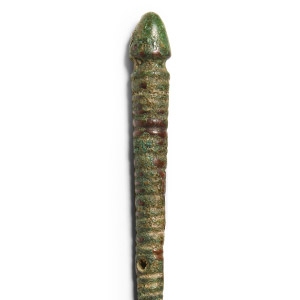
Luristan Bronze Cloak Pin
1st millennium B.C.Sold for (Inc. bp): £46
With median piercing and ribbed detailing, conical finial; the surface with areas of corrosion, the very tip absent; old collector's label '10355'. 23.2 grams, 12.2 cm
Private collection, London, UK; acquired on the UK art market 1970s-1980s. -
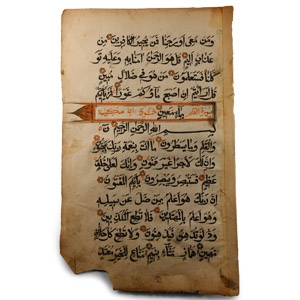
Paper Qu'ran Page
Circa 18th-19th century A.D.Sold for (Inc. bp): £33
With thirteen lines of Naskh script text to each side, red interlinear diacritics, rosettes, and a header bar; cramped marginal note at one edge. 12 grams, 33.8 x 20.6 cm
From the private collection of M. Cummings, Lincolnshire, UK, 1990s.
