
Auction Highlights
-
.jpg)
Greek Marble Head of Dionysus
Sold for (Inc. bp): £23,400
Carved in the half-round in three-quarter view, youthful male head with stern features, hair gathered in a browband, horns to the brow; from a frieze or relief; mounted on a custom-made stand. -
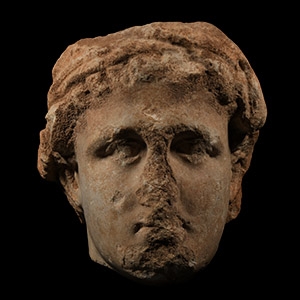
Greek Marble Head of a Ruler
Sold for (Inc. bp): £31,200
Carved in the round with thick wreath of laurel leaves to the brow, short tousled hair, stern face with thick jaw; mounted on a custom-made stand. -
.jpg)
Roman Veined Marble Torso of an Athlete
Sold for (Inc. bp): £48,100
Standing contrapposto with his weight on his right leg and the left leg brought slightly forward; the musculature of the torso displaying well-defined pectoral muscles, prominent abdominal muscles and wide shoulders, the back with equally toned musculature and well-formed rounded buttocks; the veining of the marble accentuating the idealised anatomy; the now-absent head was most probably turned towards the supporting leg and the left arm would have been raised; mounted on a custom-made display stand. -
.jpg)
Large Middle Elamite Cylinder Seal of Kidnu, Chief Overseer of King Tan-Ruhurater II
Sold for (Inc. bp): £15,600
A high-status green chalcedony seal with frieze depicting a seated figure in horned headdress facing a standing figure with arms outstretched, small monkey to the legs; six columns of Akkadian cuneiform text transliterated as: 1. ki-di-nu UGULA KUŠ-MEŠ 2. GAL šà tan-dru-hu- 3. ra-te-er EŠŠANA šu-ši 4. u an-za-an ARAD 5. šà dha-te-ri-iš 6. šak(?) ì-lí-šu 'Kidinu, chief overseer of the equerries(?) of Tan-Ruhurater, King of Susa and Anzan, servant of Haterishshak, his god'. The seal's owner was an official of King Tan-Ruhurater II (circa 1450 B.C.), king of Susa and Anzan. The title used to describe Kidinu is sometimes translated 'high official', elsewhere 'horse groom' or 'animal trainer'; the Elamite deity Haterish is otherwise unknown. -
.jpg)
Mesopotamian Torch Bearer Stand with Lion Tamer
Sold for (Inc. bp): £46,800
A substantial torch bearer depicting a male lion or panther standing with legs firmly planted on a rectangular base, tail extending to the ground, with a massive circular shaped armature or candelabra issuing from its back and wearing an elaborate muzzle, the eyes retaining shell inlay with a circular hollow for the pupils; to the right of the beast a kneeling nude male wearing a large belt-armour and a diadem, eyes inlaid, left hand extended to the side and holding the lion's leash.
-
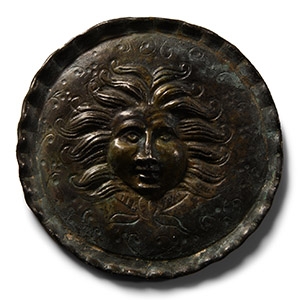
Roman Silver Phalera with Medusa
1st-2nd century A.D.Sold for (Inc. bp): £936
Discoid with fluted rim, central raised gorgoneion within scrolled tendrils. 13.8 grams, 59 mm
Ex German art market, 2000s. Acquired from an EU collector living in London. From the collection of Surrey, UK, gentleman.
Military phalerae with representations of Medusa or the Gorgoneion were popular among the Roman army. They decorated horse harnesses and officers' armour. They were also used as appliqués for scabbards, caskets, or other items in military use. Our phalera is classical in style, recalling the style of the Gorgoneia of the Nemi's ship, and it could also have been used as decorative item for furniture. -
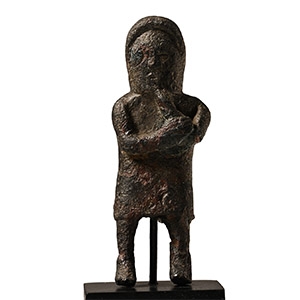
'The East Lindsey' Romano-British Bronze Hooded Male Statuette
43-150 A.D.Sold for (Inc. bp): £1,170
Standing adorant, wearing a knee-length tunic, the right arm held across the body to support the left hand raised to the mouth; mounted on a custom-made display stand. 102 grams total, 83 mm including stand
Found whilst searching with a metal detector in East Lindsey, Lincolnshire, UK, on Wednesday 19th August 1998. From a collection acquired on the UK art market from various auction houses and collections mostly before 2000. From an important Cambridgeshire estate; thence by descent. Accompanied by a copy of the British Museum's Portable Antiquities Scheme (PAS) report no.NLM995.
This small statuette of a male figure in short hooded cloak (cucullus) has the left arm raised towards the chin, and the right arm lies on left arm just below the wrist. A similar statuette in PAS is identified as possibly depicting an adorant. -
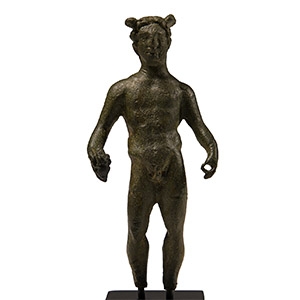
Published 'The Brixton Deverill' Romano-British Bronze Mercury Statuette
1st-2nd century A.D.Sold for (Inc. bp): £975
Modelled in the round, the god standing nude and wearing the winged petasos and holing the marsupium coin-purse in his right hand; left hand modelled with thumb and forefinger closed to grip the now absent caduceus; mounted on a custom-made display stand. 91 grams, 98 mm including stand
Found Wiltshire, UK, before 1974. Accompanied by a copy of an article titled A Figurine of Mercury from Brixton Deverill, by Martin Henig.
Mercury is often shown wearing a chlamys but the present figure is one of a known group which features his nude form. The modelling is of good quality. -
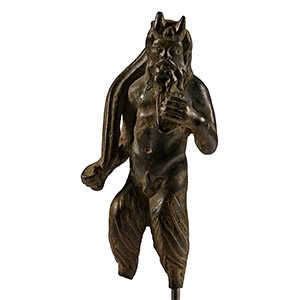
Roman Bronze Figure of Pan
1st-early 2nd century A.D.Sold for (Inc. bp): £4,290
The god standing nude supporting a cornucopia on his right shoulder and a syrinx in his left hand; ithyphallic with furry legs and short tail; mounted on a custom-made stand. 323 grams total, 16.5 cm including stand
Acquired from Sasson Ancient Art, Jerusalem, Israel, in 2008. From the Keane private collection, Kent, UK. Accompanied by an original signed certificate of authenticity, export approval, and invoice (US $9,500.00), from Sasson Ancient Art. Accompanied by a copy of the Israel Antiquities Authority export licence. This lot has been checked against the Interpol Database of stolen works of art and is accompanied by a search certificate number no.12100-216768 -
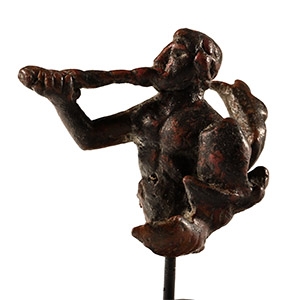
Roman Bronze Statuette of Triton Sounding a Horn
1st-2nd century A.D.Sold for (Inc. bp): £442
Bare-chested with fish-tail extending to the rear, raising a periwinkle-shell horn to his lips; left arm supporting a ship under sail; mounted on a custom-made display stand. 65 grams total, 64 mm including stand
From a collection acquired on the UK art market from various auction houses and collections mostly before 2000. From an important Cambridgeshire estate; thence by descent.
The small statuette was possibly part of a scene representing Poseidon and Amphitrite. The riches of the sea and the dangers of navigation were merged by the ancients into a famous myth known as the wedding procession between Poseidon and the Nereid Amphitrite. Involved in the procession were nereids, tritons and hippocampi. -
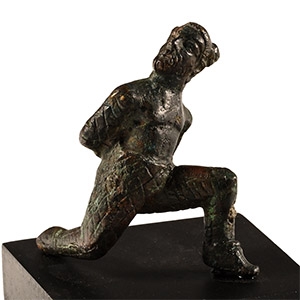
Roman Bronze Statuette of a Germanic Captive
Late 2nd century A.D.Sold for (Inc. bp): £975
Modelled with arms held behind the back, legs astride and left knee bent, head angled upwards over the right shoulder; the trousers and sleeves with incised crosshatched pattern, plain shoes; the hair drawn up in the 'Swabian knot' style above the right ear; mounted on a custom-made display stand. 93 grams total, 62 mm including stand
From a collection acquired on the UK art market from various auction houses and collections mostly before 2000. From an important Cambridgeshire estate; thence by descent.
Statuettes of foreign ‘barbarian’ prisoners of this type have been found along the Danube. Their spread coincides with the Marcomannic wars of the Emperor Marcus Aurelius. The Swabian knot in this warrior’s hair has parallels with the warrior depicted on the contemporary Sarcophagus of Portonaccio, which represents a battle between Romans and Germanic Gauls. -
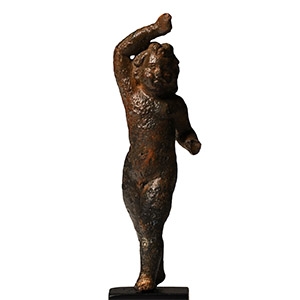
Roman Bronze Statuette of a Putto
1st-2nd century A.D.Sold for (Inc. bp): £520
Modelled in the round, standing nude with one arm raised above the head and the other bent, probably from a larger ensemble of figures; mounted on a custom-made display stand. 104 grams total, 10.9 cm including stand
From a collection acquired on the UK art market from various auction houses and collections mostly before 2000. From an important Cambridgeshire estate; thence by descent.
The figure lacks the small dorsal wings which are normally present on a putto, although the curled locks of hair are typical of the type. During the Roman imperial period, children were widely represented in the art of both the public and private spheres. Images of both mortal and divine children appeared in the artworks and furnishings of the home, on the tomb monuments and burial containers associated with the funerary realm. -
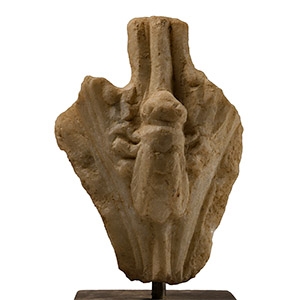
Roman Marble Cicada Fragment
1st-2nd century A.D.Sold for (Inc. bp): £780
Fragment of carved marble arcade with reserved cicada modelled in the half-round at the base; mounted on a custom-made display stand. 1.07 kg total, 16.8 cm high including stand
From the property of the late Mr SM, London, UK, 1969-1999. -
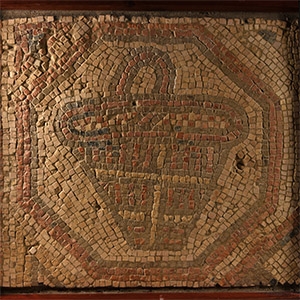
Roman Mosaic of a Basket
1st-4th century A.D.Sold for (Inc. bp): £2,600
Rectangular mosaic fragment depicting a basket with a looped handle inside an octagonal border; part of a larger design; possibly some reconstitution and set in a modern frame and matrix. 19 kg, 69.5 x 59.5 cm including frame
Ex Ancient World, York, Yorkshire, UK. Acquired circa 1995. Property of a London, UK, collector. -
.jpg)
Over Life-Size Gallo-Roman Limestone Head of an Athlete
3rd-4th century A.D.Sold for (Inc. bp): £5,720
With short hair, cut and combed in regular lines, furrowed brow and wide deep-set eyes, small fleshy mouth, intense and powerful expression; weather-worn surface; mounted on a later 18th century stand. 16.35 kg total, 35 cm including stand
Acquired in the 1930s. From the family collection of Mr F. Morand, France. From the M.J. collection, Wales, UK. Accompanied by an academic report by Dr Raffaele D'Amato. This lot has been checked against the Interpol Database of stolen works of art and is accompanied by a search certificate number no.12070-217746.
The head shows a late Roman appearance in its features and hairstyle. The expression, the short thick neck and the style of the hair combined with the somewhat uncouth and forceful expression may indicate a local Gallo-Roman character. -
Roman Veined Marble Torso of an Athlete
1st-2nd century A.D.Sold for (Inc. bp): £48,100
Standing contrapposto with his weight on his right leg and the left leg brought slightly forward; the musculature of the torso displaying well-defined pectoral muscles, prominent abdominal muscles and wide shoulders, the back with equally toned musculature and well-formed rounded buttocks; the veining of the marble accentuating the idealised anatomy; the now-absent head was most probably turned towards the supporting leg and the left arm would have been raised; mounted on a custom-made display stand. 42.95 kg total, 64 cm high including stand
Formerly in a French private collection in Compiègne, since the 1960s. Acquired from Galerie Chenel, 2015. Accompanied by a copy of a French cultural passport no.166817. Accompanied by an academic report by Dr Laura Maria Vigna.
The model of the sculpture recalls the Polykleitian tradition. In particular, the tension of the muscles of the athletic body recalls the Doryphoros of Polykleitos, a famous bronze sculpture erected in Argos in around 450-440 B.C., as evidenced by a stele found there. The statue represented a hero, perhaps Achilles, or a winning athlete. Many Hellenistic and Roman copies of this sculpture are preserved, most notably in marble. These include the Tiberian-era Doryphoros in the National Museum of Naples, from Pompeii, the nude male statue, a copy of the Doryphoros of Polykleitos, in the Doria Pamphilj Collection, dated to the end of the 1st century A.D. The raised left shoulder is reminiscent of the Diadumenos, a work by the same artist made in Argos in around 430-420 B.C., depicting an athlete girding his head with ribbons or fillets, a symbol of victory, known from many copies. The Polykleitos original and the subsequent copies were enormously popular and became canonical representations of physical perfection and refinement. -
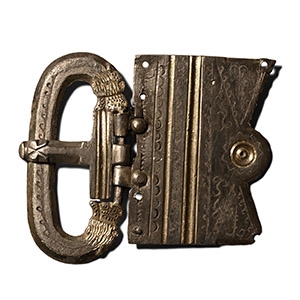
Late Roman Gilt Silver Buckle with Dragon Heads
5th century A.D.Sold for (Inc. bp): £442
Comprising a trapezoid-section loop with running wave design and panther-mask terminals, tongue with ribbed oblong plaque and cut design; a rectangular plaque with extension to rear edge of two triangles and a semi-circle, decorated with bands of triangles, crescents, swirls and indented lines, extension with central gilt circle from which expands two triangular panels, filled with swirl design; rivet holes to the edge for attachment. 37.1 grams, 66 mm
UK collection formed in the 1980s. Ex property of a North London gentleman.
