
Auction Highlights
-
.jpg)
Greek Marble Head of Dionysus
Sold for (Inc. bp): £23,400
Carved in the half-round in three-quarter view, youthful male head with stern features, hair gathered in a browband, horns to the brow; from a frieze or relief; mounted on a custom-made stand. -
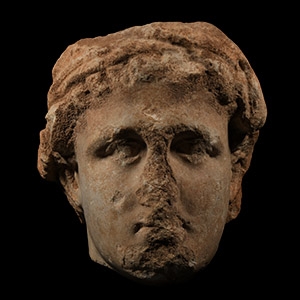
Greek Marble Head of a Ruler
Sold for (Inc. bp): £31,200
Carved in the round with thick wreath of laurel leaves to the brow, short tousled hair, stern face with thick jaw; mounted on a custom-made stand. -
.jpg)
Roman Veined Marble Torso of an Athlete
Sold for (Inc. bp): £48,100
Standing contrapposto with his weight on his right leg and the left leg brought slightly forward; the musculature of the torso displaying well-defined pectoral muscles, prominent abdominal muscles and wide shoulders, the back with equally toned musculature and well-formed rounded buttocks; the veining of the marble accentuating the idealised anatomy; the now-absent head was most probably turned towards the supporting leg and the left arm would have been raised; mounted on a custom-made display stand. -
.jpg)
Large Middle Elamite Cylinder Seal of Kidnu, Chief Overseer of King Tan-Ruhurater II
Sold for (Inc. bp): £15,600
A high-status green chalcedony seal with frieze depicting a seated figure in horned headdress facing a standing figure with arms outstretched, small monkey to the legs; six columns of Akkadian cuneiform text transliterated as: 1. ki-di-nu UGULA KUŠ-MEŠ 2. GAL šà tan-dru-hu- 3. ra-te-er EŠŠANA šu-ši 4. u an-za-an ARAD 5. šà dha-te-ri-iš 6. šak(?) ì-lí-šu 'Kidinu, chief overseer of the equerries(?) of Tan-Ruhurater, King of Susa and Anzan, servant of Haterishshak, his god'. The seal's owner was an official of King Tan-Ruhurater II (circa 1450 B.C.), king of Susa and Anzan. The title used to describe Kidinu is sometimes translated 'high official', elsewhere 'horse groom' or 'animal trainer'; the Elamite deity Haterish is otherwise unknown. -
.jpg)
Mesopotamian Torch Bearer Stand with Lion Tamer
Sold for (Inc. bp): £46,800
A substantial torch bearer depicting a male lion or panther standing with legs firmly planted on a rectangular base, tail extending to the ground, with a massive circular shaped armature or candelabra issuing from its back and wearing an elaborate muzzle, the eyes retaining shell inlay with a circular hollow for the pupils; to the right of the beast a kneeling nude male wearing a large belt-armour and a diadem, eyes inlaid, left hand extended to the side and holding the lion's leash.
-
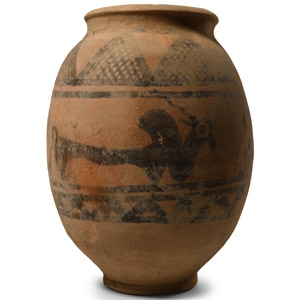
Western Asiatic Terracotta Jar
1st millennium B.C.Sold for (Inc. bp): £169
Fusiform in profile with broad carinated rim to the mouth, horizontal geometric bands enclosing a frieze of zebus. 1.06 kg, 21 cm
Ex London, UK, gallery, 1980s. From a UK private collection. -
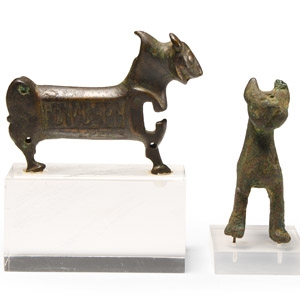
Western Asiatic Bronze Attachment Group
Circa 12th-14th century A.D.Sold for (Inc. bp): £65
Comprising: one side of a feline padlock with Kufic inscription to the flank; foreparts of a feline figurine with ledge to rear; each mounted on a display frame. 152 grams total, 63-79 mm including stand
Ex European collection since 1970. with Hermann Historica, Munich, Germany, Auction 95, no.6031 (Part). Property of a French collector. -
.jpg)
Akkadian Cylinder Seal with Water-God Enki
23rd-22nd century B.C.Sold for (Inc. bp): £1,105
Mottled chalcedony with judgement scene; the water-god Enki seated confronts a human flanked by robed and bearded supporters, two columns of cuneiform text, chipped. 4.55 grams, 20 mm
Ex Cohen Antiques, London W8. From the M. Cloake collection, acquired in 1977. From a collection acquired from various auction houses in the UK. From the estate of Mr R.W., a private Wiltshire, UK, collector; thence by descent. -
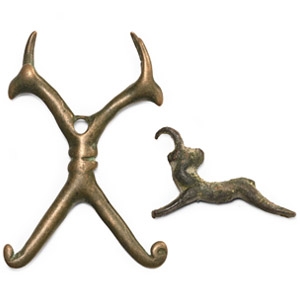
Western Asiatic Bronze Ibex Artefact Group
1st millennium B.C.Sold for (Inc. bp): £33
Comprising: a mount formed as a leaping ibex facing back, pierced through the legs; X-shaped pendant with the upper arms formed as ibex heads, curving terminals to lower arms. 48 grams total, 45-76 mm
UK private collection before 2000. On the UK art market. Property of a London gentleman. -
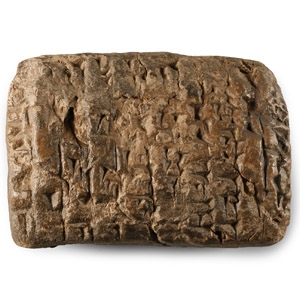
Mesopotamian Cuneiform Tablet
2nd millennium B.C.Sold for (Inc. bp): £598
Pillow-shaped clay tablet with cuneiform text to both broad faces; chipped. 60.7 grams, 59 mm
Specialised collection of cuneiform texts, the property of a London gentleman and housed in London before 1992. Thence by descent to family members. Examined by Professor Wilfrid George Lambert FBA (1926-2011), historian, archaeologist, and specialist in Assyriology and Near Eastern archaeology, in the late 1980s and early 1990s. This small collection is exceptional for the variety of types, including some very rare and well preserved examples. -
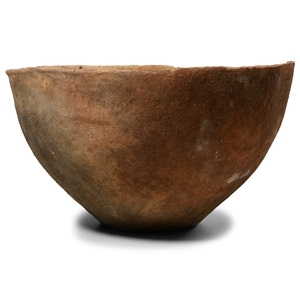
Trans Jordan Terracotta Bowl
Early Bronze Age I, 3rd millennium B.C.Sold for (Inc. bp): £39
Of squat profile with slightly chamfered rim. 1.06 kg, 21.5 cm wide
From an important collection of terracotta pre 1988, London and Geneva. -
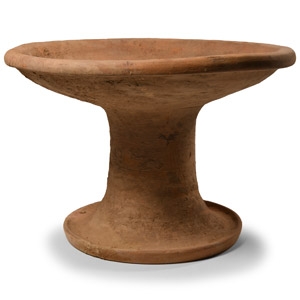
Bactrian Terracotta Chalice
1st millennium B.C. or laterSold for (Inc. bp): £124
Sturdy columnar stem flaring to the broad base with carinated rim, band of pained geometric ornament; the bowl broad and dished with concentric ring detailing. 2.49 kg, 28.5 cm wide
Acquired 1980-2015. Ex Abelita family collection. -
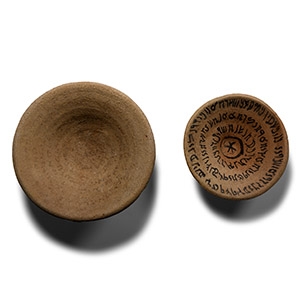
Aramaic Terracotta Magic Bowl with Cursive Script
4th-8th century A.D.Sold for (Inc. bp): £468
An unglazed terracotta trumpet-shaped bowl with the faint remains of Aramaic-script to the inside; accompanied by a smaller bowl with three concentric rings of recently overpainted pseudo Aramaic-script to the upper face. 277 grams total, 9.5-12.4 cm
Acquired on the German art market, 1989-1995. with The Museum Gallery, 19 Bury Place, London, WC1, UK, 1998-2003. Property of a London based academic, 2003-present.
Aramaic incantation bowls are particular to the Sassanian period and have been found in regions of modern Iraq. These simple ceramic bowls, also known as magic bowls, each contain an Aramaic inscription, written in ink, which spirals from the centre. The bowls seem to have played an important part in domestic life. For example, during excavation in Nippur in 1889, one or more incantation bowls were found in each house together with domestic artefacts, most often in doorways or under floorboards in the corner of rooms. The bowls are predominantly apotropaic, and the inscriptions tend to protect their owners from misfortunes such as those faced in child-birth, illness and evil spirits. -
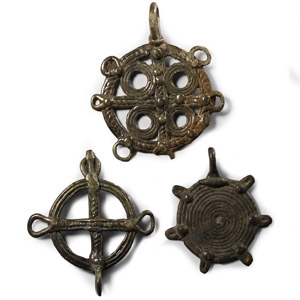
Amlash Bronze Openwork Pendant Group
2nd millennium B.C.Sold for (Inc. bp): £72
Comprising: one with spiralling plaque and pellets to loops on the outer perimeter; one with openwork geometric design composed of central cross and circle in each quarter, embellished with pellets and loops to perimeter; one with a central cross and four loops to the outer edge. 55.1 grams total, 54-69 mm
UK private collection before 2000. On the UK art market. Property of a London gentleman. -
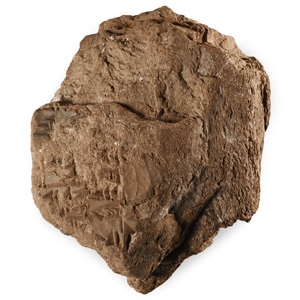
Ur III Terracotta Cuneiform Tablet Fragment
Circa 2000 B.C.Sold for (Inc. bp): £65
Irregular fragment with remains of original surface bearing columns of cuneiform text. 106 grams, 73 mm
Acquired from Ancient Art, London, UK, in 1985. From the personal collection of a West London, UK, gentleman. -
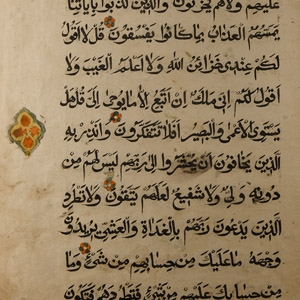
Paper Qu'ran Page
Circa 18th-19th century A.D.Sold for (Inc. bp): £33
With thirteen lines of Naskh script text to each side, red interlinear diacritics, rosettes, and handwritten note at bottom. 11 grams, 34.4 x 21.5 cm
From the private collection of M. Cummings, Lincolnshire, UK, 1990s. -
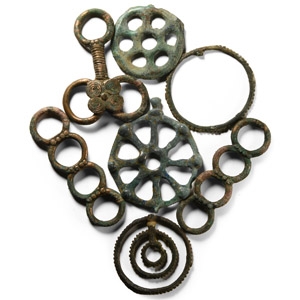
Amlash Bronze Openwork Artefact Group
2nd-1st millennium B.C.Sold for (Inc. bp): £72
Comprising: a wheel-type pendant; an annular mount with notched outer edge; a similar mount with inner rings; an annular mount with circular openings; two mounts with four openings to each, raised bosses separating the openings; a strap divider with spiral decoration. 149 grams total, 46-80 mm
UK private collection before 2000. On the UK art market. Property of a London gentleman.
