
Auction Highlights
-
.jpg)
Greek Marble Head of Dionysus
Sold for (Inc. bp): £23,400
Carved in the half-round in three-quarter view, youthful male head with stern features, hair gathered in a browband, horns to the brow; from a frieze or relief; mounted on a custom-made stand. -
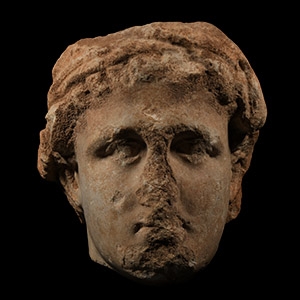
Greek Marble Head of a Ruler
Sold for (Inc. bp): £31,200
Carved in the round with thick wreath of laurel leaves to the brow, short tousled hair, stern face with thick jaw; mounted on a custom-made stand. -
.jpg)
Roman Veined Marble Torso of an Athlete
Sold for (Inc. bp): £48,100
Standing contrapposto with his weight on his right leg and the left leg brought slightly forward; the musculature of the torso displaying well-defined pectoral muscles, prominent abdominal muscles and wide shoulders, the back with equally toned musculature and well-formed rounded buttocks; the veining of the marble accentuating the idealised anatomy; the now-absent head was most probably turned towards the supporting leg and the left arm would have been raised; mounted on a custom-made display stand. -
.jpg)
Large Middle Elamite Cylinder Seal of Kidnu, Chief Overseer of King Tan-Ruhurater II
Sold for (Inc. bp): £15,600
A high-status green chalcedony seal with frieze depicting a seated figure in horned headdress facing a standing figure with arms outstretched, small monkey to the legs; six columns of Akkadian cuneiform text transliterated as: 1. ki-di-nu UGULA KUŠ-MEŠ 2. GAL šà tan-dru-hu- 3. ra-te-er EŠŠANA šu-ši 4. u an-za-an ARAD 5. šà dha-te-ri-iš 6. šak(?) ì-lí-šu 'Kidinu, chief overseer of the equerries(?) of Tan-Ruhurater, King of Susa and Anzan, servant of Haterishshak, his god'. The seal's owner was an official of King Tan-Ruhurater II (circa 1450 B.C.), king of Susa and Anzan. The title used to describe Kidinu is sometimes translated 'high official', elsewhere 'horse groom' or 'animal trainer'; the Elamite deity Haterish is otherwise unknown. -
.jpg)
Mesopotamian Torch Bearer Stand with Lion Tamer
Sold for (Inc. bp): £46,800
A substantial torch bearer depicting a male lion or panther standing with legs firmly planted on a rectangular base, tail extending to the ground, with a massive circular shaped armature or candelabra issuing from its back and wearing an elaborate muzzle, the eyes retaining shell inlay with a circular hollow for the pupils; to the right of the beast a kneeling nude male wearing a large belt-armour and a diadem, eyes inlaid, left hand extended to the side and holding the lion's leash.
-
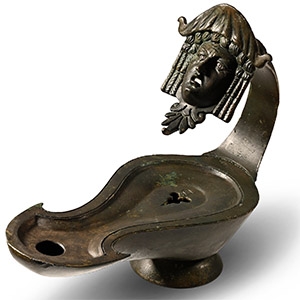
Very Large Roman Bronze Oil Lamp with Actor's Mask
1st-2nd century A.D.Sold for (Inc. bp): £5,720
With an elongated body and a long nozzle with a rounded tip; raised rim enclosing the upper face with an ivy lef-shaped filling hole; wide handle terminating to a female tragic mask with a palmette below the chin, the hair dressed in ringlets with two rows of curls to the brow, eyes inlaid with silver; accompanied by a custom-made display stand. 1.97 kg, 28 cm wide (4.31 kg total, 27.5 cm high including stand)
Old private British collection, pre-1965. Property of a gentleman; acquired in the UK before 2000. Accompanied by a copy of an old black and white photograph and an academic report by Dr Raffaele D’Amato. This lot has been checked against the Interpol Database of stolen works of art and is accompanied by a search certificate number no.12033-215424.
The lamp is of Loeschke type XX (Walters type 6), with many of these lamps made in Italy, but some are also found in the East. The tragic mask appears frequently on lamp handles, probably as an apotropaic subject. The mask was an inseparable element of unity with the past and religious context. -
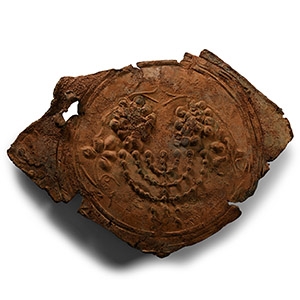
Roman Lead Sarcophagus Fragment with Menorah
2nd-3rd century A.D.Sold for (Inc. bp): £2,340
Irregular fragment with raised concentric rings, low-relief wreath and raised bulbs forming a stem with seven arms. 1.36 kg, 32.5 cm
Acquired on the German art market, 1989-1995. with The Museum Gallery, 19 Bury Place, London, WC1, UK, 1998-2003. Property of a London based academic, 2003-present. This lot has been checked against the Interpol Database of stolen works of art and is accompanied by a search certificate number no.12097-214786.
This fragment of a sarcophagus front is probably a remnant of a Jewish sarcophagus from the Roman period. It belongs to a style of sarcophagi made in the Levant, often decorated with dolphins, sphinxes and other symbols of the hereafter. -
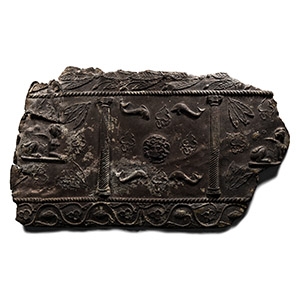
Roman Lead Sarcophagus Panel Fragment
2nd-3rd century A.D.Sold for (Inc. bp): £1,430
Irregular rectangular panel with decoration in three zones: upper area with horizontal laurel leaves and ropework border below; middle area divided by vertical fluted columns, masks of Medusa among dolphins alternating with a sphinx; lower area with running vine tendrils, leaves and bunches of grapes. 8.56 kg, 61 cm
Acquired from Cadogan Tate, Paris, 2011. From the Keane private collection, Kent, UK. Accompanied by a copy of the official shipping document (4,000 euros). Accompanied by an original French certificate of export issued by the French Ministry of Culture, no.129472. -
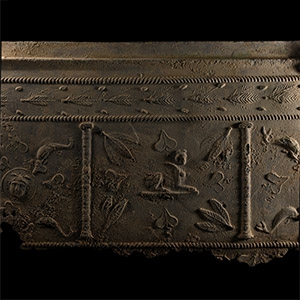
Roman Lead Coffin Panel with Sphinx, Medusa and Dolphins
2nd-3rd century A.DSold for (Inc. bp): £1,430
Decorated with a high-relief pattern comprising sphinxes surrounded by dolphins and masks of Medusa surrounded by laurel leaves all between Corinthian columns; ropework and floral border strips with laurel leaves above and lip below the upper edge. 13.65 kg, 80 cm
Acquired 1970s-early 1990s. Property of a North American collector. London collection, 2016. -
.jpg)
Roman Bronze Figure of the Goddess Flora
Circa 2nd century A.D.Sold for (Inc. bp): £5,720
A rare depiction of Flora standing holding a separately cast garland in her left hand, wearing pointed shoes, a long tunica talaris and a himation as a veil over her head, her hair surmounted by a diadem decorated with rosettes and falling in long wavy tresses in front, the pupils of her eyes indented; mounted on a custom-made tiered base. 617 grams total, 25.7 cm high including stand
From an Egyptian family collection, Alexandria and Cairo, acquired in the early part of the 20th century in Egypt and Europe, and transferred from Egypt to northern European family residences in the early 1950s. Northern European private collection, by direct descent from the above in the 1970s. Acquired from the above by the previous owner in 2002. with Sotheby’s, New York, 5 June 2013, no.88. German private collection. Accompanied by copies of the German cultural export licence and copies of the relevant Sotheby’s catalogue pages. Accompanied by an academic report by Dr Raffaele D’Amato. This lot has been checked against the Interpol Database of stolen works of art and is accompanied by a search certificate number no.12042-216438.
Statuettes like the present one were used in the service of domestic cults and reflected native Greek or Roman cult practices. The Roman household shrine, or lararium, receives its name from the lares, the guardian spirits of the house and household, who were frequently displayed in the shrine, either in painted or sculpted form. -
.jpg)
Roman Bronze Statuette of Helios-Alexander
2nd-3rd century A.D.Sold for (Inc. bp): £1,820
The god standing nude on an ivy-leaf base in contrapposto pose with right arm extended and hand held palm-outwards; mantle pinned at the right shoulder and wrapped around the bent left arm; the head held erect with soft rounded facial features and luxuriant curls, diadem with radiating spikes representing beams of light; mounting stud to the reverse; mounted on a custom-made display stand. 583 grams total, 17.5 cm including stand
From a collection acquired on the UK art market from various auction houses and collections mostly before 2000. From an important Cambridgeshire estate; thence by descent.
The cult of Helios-Apollo intensified in the third century A.D. and the adoration of Sol Invictus, with the radiate crown, was often linked to that of Mithras, the god of legions, whose symbol was the bull. Under Emperor Aurelian, the Sol Invictus became the main god, protector of Rome and the Roman state. -
.jpg)
Roman Bronze Statuette of Athena
2nd-3rd century A.D.Sold for (Inc. bp): £3,640
Standing erect in contrapposto pose, wearing a floor-length himation and with the gorgoneion medallion on her chest; Corinthian helmet on her head tilted backwards to reveal her face; right arm raised and bent with open hand to accept a spear-shaft; mounted on a custom-made display stand. 279 grams total, 13 cm including stand
From a collection acquired on the UK art market from various auction houses and collections mostly before 2000. From an important Cambridgeshire estate; thence by descent.
The figure is a hybrid based on representation of Roman Minerva, closely associated with Greek Athena. The missing attributes are the spear and the shield, according to the type of Minerva of Firenze (Reinach, 1930, p.278). -
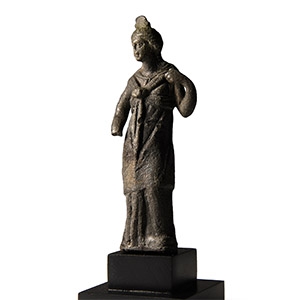
Roman Bronze Statuette of Isis
1st-3rd century A.D.Sold for (Inc. bp): £546
The goddess standing, wearing an Ionic chiton and himation secured by a characteristic knot tied between her breasts, the folds cascading to the floor; her left hand modelled open and held above her breast; her centre-parted wavy locks fastened with a band, pulled back in a chignon at the nape of her neck and surmounted by a hair-comb; mounted on a custom-made display stand. 280 grams total, 13.3 cm including stand
From a collection acquired on the UK art market from various auction houses and collections mostly before 2000. From an important Cambridgeshire estate; thence by descent.
Statuettes of Fortuna, the goddess of chance, were evidently popular during the Roman Imperial times judging by the large number that have been found, and with the advent of the cult of Isis within the Roman Empire, the two divinities were identified as a single goddess. -
.jpg)
Roman Bronze Harpocrates Statuette
3rd century A.D.Sold for (Inc. bp): £247
Modelled nude in advancing pose with right arm bent across the body and fist clenched to support an attribute (absent); the facial details in light relief and small forelock to the brow; mounted on a custom-made display stand. 231 grams total, 12 cm high including stand
From a collection acquired on the UK art market from various auction houses and collections mostly before 2000. From an important Cambridgeshire estate; thence by descent.
The cult of Harpocrates, began in Ptolemaic times, expanding considerably in the Imperial Roman period, and absorbing influences from the cult of ram of Mendes, the ithyphallic Min, the crocodile god Sobek, and Hercules. The missing left hand probably held a small cornucopia. -
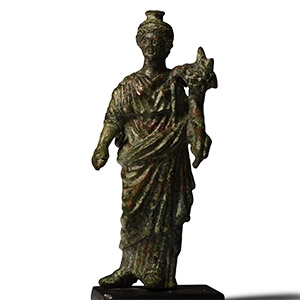
Roman Bronze Figure of Fortuna
1st-2nd century A.D.Sold for (Inc. bp): £715
The goddess standing, wearing an Ionic chiton and himation, the folds cascading to the floor; her left hand holding a cornucopia supported on her forearm and shoulder, her right hand extended, her centre-parted wavy locks fastened with a band, pulled back in a chignon at the nape of her neck and surmounted by a modius; mounted on a custom-made display stand with collector's label to the underside. 230 grams total, 99 mm including stand
From an old French collection. Acquired from Gallery Drees Archéo, 2008. Ex Gilles Grimm collection. Property of a French collector. Accompanied by a copy of the 2008 invoice. -
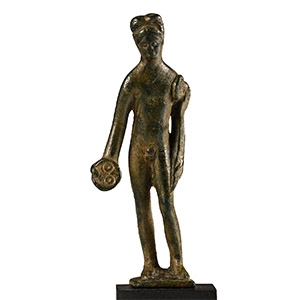
Roman Bronze Statuette of Mercury
2nd-3rd century A.D.Sold for (Inc. bp): £260
Shown standing nude with caduceus resting against the left forearm, a patera in the right hand, bunched lobes and centre-parted hairstyle; mounted on a custom-made display stand. 69 grams total, 98 mm including stand
From a collection acquired on the UK art market from various auction houses and collections mostly before 2000. From an important Cambridgeshire estate; thence by descent.
Mercury is one of the most widespread divinities among the votive statuettes of Roman Age. The god of the Roman pantheon was similar to the Greek Hermes and the Etruscan Turms. -
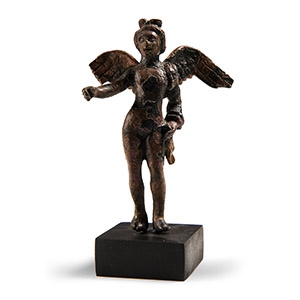
Roman Bronze Statuette of the Goddess Eos
2nd-3rd century A.D.Sold for (Inc. bp): £546
Modelled in the round, Eos (The Dawn) standing nude with left leg slightly flexed; the head with finely detailed face and hair dressed in a chignon; spread wings to the rear with feather detailing; left arm bent and hand resting on the hip with mantle wound about the shoulder and wrist; right arm extended and hand modelled open to accept an attribute; mounted on a custom-made display stand. 150 grams total, 11.2 cm including stand
From a collection acquired on the UK art market from various auction houses and collections mostly before 2000. From an important Cambridgeshire estate; thence by descent.
Eos, the ancient Greek goddess of the dawn, was perhaps the most resplendent of all the beings in the Greek pantheon. With the brilliant dye of saffron as her colour, she was also associated with roses, which also embody the glowing hues of the dawn.
