
Auction Highlights
-
.jpg)
Greek Marble Head of Dionysus
Sold for (Inc. bp): £23,400
Carved in the half-round in three-quarter view, youthful male head with stern features, hair gathered in a browband, horns to the brow; from a frieze or relief; mounted on a custom-made stand. -
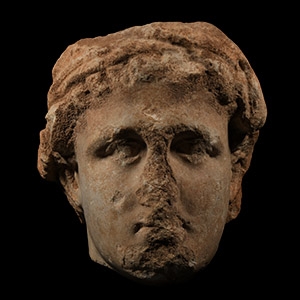
Greek Marble Head of a Ruler
Sold for (Inc. bp): £31,200
Carved in the round with thick wreath of laurel leaves to the brow, short tousled hair, stern face with thick jaw; mounted on a custom-made stand. -
.jpg)
Roman Veined Marble Torso of an Athlete
Sold for (Inc. bp): £48,100
Standing contrapposto with his weight on his right leg and the left leg brought slightly forward; the musculature of the torso displaying well-defined pectoral muscles, prominent abdominal muscles and wide shoulders, the back with equally toned musculature and well-formed rounded buttocks; the veining of the marble accentuating the idealised anatomy; the now-absent head was most probably turned towards the supporting leg and the left arm would have been raised; mounted on a custom-made display stand. -
.jpg)
Large Middle Elamite Cylinder Seal of Kidnu, Chief Overseer of King Tan-Ruhurater II
Sold for (Inc. bp): £15,600
A high-status green chalcedony seal with frieze depicting a seated figure in horned headdress facing a standing figure with arms outstretched, small monkey to the legs; six columns of Akkadian cuneiform text transliterated as: 1. ki-di-nu UGULA KUŠ-MEŠ 2. GAL šà tan-dru-hu- 3. ra-te-er EŠŠANA šu-ši 4. u an-za-an ARAD 5. šà dha-te-ri-iš 6. šak(?) ì-lí-šu 'Kidinu, chief overseer of the equerries(?) of Tan-Ruhurater, King of Susa and Anzan, servant of Haterishshak, his god'. The seal's owner was an official of King Tan-Ruhurater II (circa 1450 B.C.), king of Susa and Anzan. The title used to describe Kidinu is sometimes translated 'high official', elsewhere 'horse groom' or 'animal trainer'; the Elamite deity Haterish is otherwise unknown. -
.jpg)
Mesopotamian Torch Bearer Stand with Lion Tamer
Sold for (Inc. bp): £46,800
A substantial torch bearer depicting a male lion or panther standing with legs firmly planted on a rectangular base, tail extending to the ground, with a massive circular shaped armature or candelabra issuing from its back and wearing an elaborate muzzle, the eyes retaining shell inlay with a circular hollow for the pupils; to the right of the beast a kneeling nude male wearing a large belt-armour and a diadem, eyes inlaid, left hand extended to the side and holding the lion's leash.
-
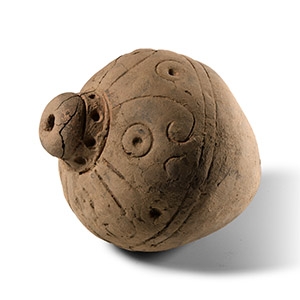
Byzantine 'Greek Fire' Ceramic Fire Bomb or Hand Grenade
9th-11th century A.D.Sold for (Inc. bp): £143
Piriform body with band of impressed scrolls and rings to the shoulder, domed filler-hole, intended to be filled with explosive liquid and wick, used as a hand grenade. 399 grams, 11.5 cm
From a specialist collection of militaria, London, UK, collected 1990s onwards. Accompanied by an academic paper by military specialist Dr Raffaele D'Amato, dated 15 July 2019 and titled 'Eastern Roman Empire - Greek Fire Bomb or Hand Grenade (μεσαίον kακάβιον) 9th-11th century AD'.
Apart from the use of siphons or manual flame-throwers called cheirosiphona, special corps of Roman soldiers employed terracotta grenades, in the form of small jars, abundantly evidenced in archaeological excavations. They were called μεσαία kακαβιά or κυτροκακάβια where the former had a bulbous shape and the latter a more cylindrical form. -
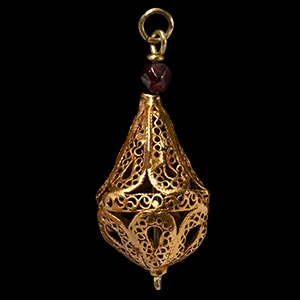
Byzantine Gold Openwork Pendant
12th-14th century A.D. or earlierSold for (Inc. bp): £546
Composed of two opposing flowers forming a teardrop-shape, the panels with intricate loop design; facetted garnet bead above and a separately made suspension bar, possibly a later addition. 3.78 grams, 40 mm
Ex property of a late Japanese collector, 1970-2000s. -
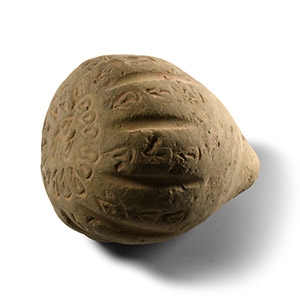
Byzantine 'Greek Fire' Ceramic Fire Bomb or Hand Grenade
9th-11th century A.D.Sold for (Inc. bp): £143
Piriform body with ribs to the shoulder and impressed ovoids to the upper face, recessed filler-hole to the shoulder, intended to be filled with explosive liquid and wick, used as a hand grenade. 520 grams, 10.7 cm
From a specialist collection of militaria, London, UK, collected 1990s onwards. Accompanied by an academic paper by military specialist Dr Raffaele D'Amato, dated 15 July 2019 and titled 'Eastern Roman Empire - Greek Fire Bomb or Hand Grenade (μεσαίον kακάβιον) 9th-11th century AD'.
Apart from the use of siphons or manual flame-throwers called cheirosiphona, special corps of Roman soldiers employed terracotta grenades, in the form of small jars, abundantly evidenced in archaeological excavations. They were called μεσαία kακαβιά or κυτροκακάβια where the former had a bulbous shape and the latter a more cylindrical form. -
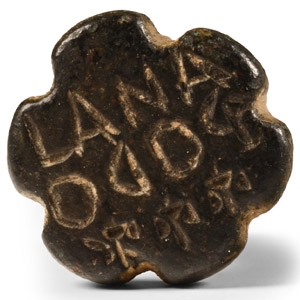
Byzantine Bronze Stamp Seal with Inscription
6th-8th century A.D.Sold for (Inc. bp): £39
With a short shank and oblate pierced finial, hexafoil base; to the underside a reversed legend 'ANAL[Γ} / ΦOΔ[D]O / ***'. 12.3 grams, 19 mm
Acquired on the London, UK, art market in the 1990s. From a gentleman's private collection.
The seal was probably used for stamping bread in a church. Usually these stamps had two parts: a flat surface with inscriptions or geometric shapes, and a handle. The inscription is an enigma: the upper part can be read [Aθ]ANA[TOC] = Immortal and (if we accept the L like an inversed Γ (gamma) [A]Γ[ΙΟϹ] i.e. Saint = Saint Immortal, one of the three invocation to God (Saint God, Saint Mighty, Saint Immortal). However, the second row of letters is in Greek and Latin (φο-do) if we accept the letter D as a transliteration of the Greek letter Delta. -
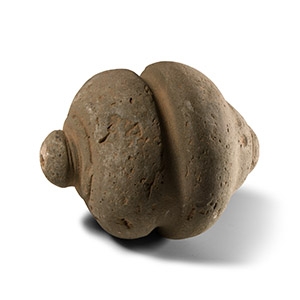
Byzantine 'Greek Fire' Ceramic Fire Bomb or Hand Grenade
9th-11th century A.D.Sold for (Inc. bp): £156
Piriform body with gusset to the equator, domed filler-hole, intended to be filled with explosive liquid and wick, used as a hand grenade. 431 grams, 10.6 cm
From a specialist collection of militaria, London, UK, collected 1990s onwards. Accompanied by an academic paper by military specialist Dr Raffaele D'Amato, dated 15 July 2019 and titled 'Eastern Roman Empire - Greek Fire Bomb or Hand Grenade (μεσαίον kακάβιον) 9th-11th century AD'.
Apart from the use of siphons or manual flame-throwers called cheirosiphona, special corps of Roman soldiers employed terracotta grenades, in the form of small jars, abundantly evidenced in archaeological excavations. They were called μεσαία kακαβιά or κυτροκακάβια where the former had a bulbous shape and the latter a more cylindrical form. -
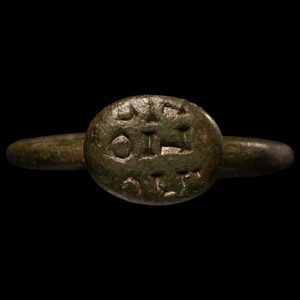
Byzantine Bronze Ring with Inscription
6th-7th century A.D.Sold for (Inc. bp): £52
Comprising a narrow hoop and raised bezel with three line inscription, remains of gilding to the lettering. 3.83 grams, 27.25 mm overall, 19.39 mm internal diameter (approximate size British Q, USA 8, Europe 17.49, Japan 16)
Ex German art market, 2000s. Acquired from an EU collector living in London. From the collection of Surrey, UK, gentleman. -
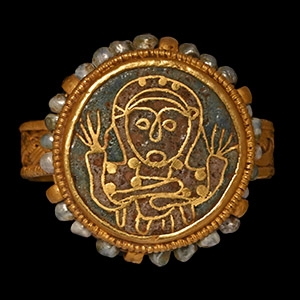
Early Byzantine Gold Ring with Pearls and Later Cloisonne Enamelled Figure
Italy, 7th century A.D. and laterSold for (Inc. bp): £2,080
Flat hoop with beaded wire borders and braided filigree ornament; discoid box bezel with seed pearls on a wire to the outer edge; upper face a (modern) cloisonné enamel panel depicting Mary in orans posture. 6.37 grams, 23.84 mm overall, 18.95 mm internal diameter (approximate size British R, USA 8 1/2, Europe 18 3/4, Japan 18)
From a collection formed in Antwerp, Belgium. Acquired in France in the early 2000s. Accompanied by a copy of a previous illustrated catalogue information page. -
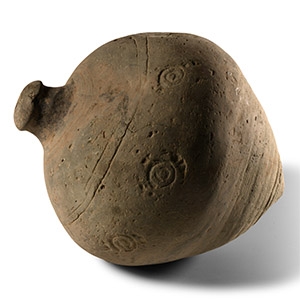
Very Large Byzantine 'Greek Fire' Ceramic Fire Bomb or Hand Grenade
9th-11th century A.D.Sold for (Inc. bp): £143
Piriform body with impressed roundels to the equator, domed filler-hole, intended to be filled with explosive liquid and wick, used as a hand grenade. 1.42 kg, 17 cm
From a specialist collection of militaria, London, UK, collected 1990s onwards. Accompanied by an academic paper by military specialist Dr Raffaele D'Amato, dated 15 July 2019 and titled 'Eastern Roman Empire - Greek Fire Bomb or Hand Grenade (μεσαίον kακάβιον) 9th-11th century AD'.
Apart from the use of siphons or manual flame-throwers called cheirosiphona, special corps of Roman soldiers employed terracotta grenades, in the form of small jars, abundantly evidenced in archaeological excavations. They were called μεσαία kακαβιά or κυτροκακάβια where the former had a bulbous shape and the latter a more cylindrical form. -
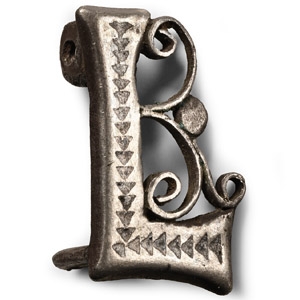
Silver 'L' Plate Brooch
Roman, 3rd century A.D.Sold for (Inc. bp): £208
In the form of the letter 'L' with scrolled wire within the angle and punched triangle detailing to the plate; pin-lug and catchplate to the reverse. 4.25 grams, 24 mm
Previously acquired on the London art market in the 1980s. Property of a Kent lady collector. -
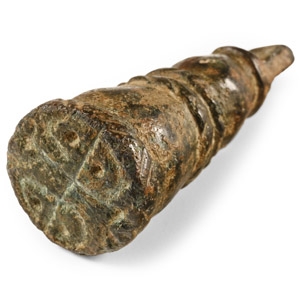
Byzantine Bronze Stamp Seal with Floriate Cross Monogram
6th-8th century A.D.Sold for (Inc. bp): £182
Conical in profile with pierced tip, balustered profile with ropework collars, monogram to underside. 18.8 grams, 30 mm
Acquired on the London, UK, art market in the 1990s. From a gentleman's private collection. -
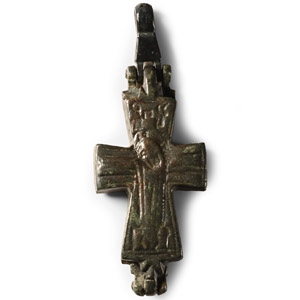
Byzantine Bronze Reliquary Cross Pendant
10th-12th century A.D.Sold for (Inc. bp): £208
Hollow-formed and hinged at the lower edge, with low-relief crucifixion to one face and robed figure to the other. 24.9 grams, 66 mm
Ex German art market, 2000s. Acquired from an EU collector living in London. From the collection of Surrey, UK, gentleman. -
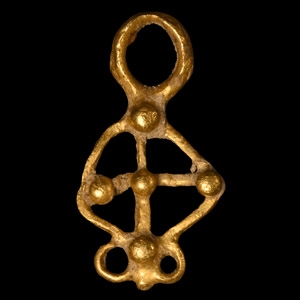
Byzantine Openwork Gold Cross Pendant
Circa 12th-14th century A.D.Sold for (Inc. bp): £143
Formed as an equal-armed cross with pellet terminals within a circlet, two small loops below and a large suspension loop above. 1.00 grams, 17 mm
Ex property of a late Japanese collector, 1970-2000s.
