
Auction Highlights
-
.jpg)
Greek Marble Head of Dionysus
Sold for (Inc. bp): £23,400
Carved in the half-round in three-quarter view, youthful male head with stern features, hair gathered in a browband, horns to the brow; from a frieze or relief; mounted on a custom-made stand. -
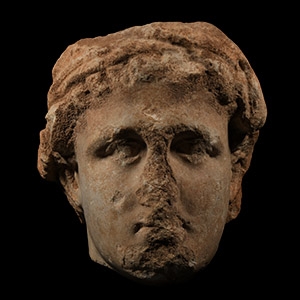
Greek Marble Head of a Ruler
Sold for (Inc. bp): £31,200
Carved in the round with thick wreath of laurel leaves to the brow, short tousled hair, stern face with thick jaw; mounted on a custom-made stand. -
.jpg)
Roman Veined Marble Torso of an Athlete
Sold for (Inc. bp): £48,100
Standing contrapposto with his weight on his right leg and the left leg brought slightly forward; the musculature of the torso displaying well-defined pectoral muscles, prominent abdominal muscles and wide shoulders, the back with equally toned musculature and well-formed rounded buttocks; the veining of the marble accentuating the idealised anatomy; the now-absent head was most probably turned towards the supporting leg and the left arm would have been raised; mounted on a custom-made display stand. -
.jpg)
Large Middle Elamite Cylinder Seal of Kidnu, Chief Overseer of King Tan-Ruhurater II
Sold for (Inc. bp): £15,600
A high-status green chalcedony seal with frieze depicting a seated figure in horned headdress facing a standing figure with arms outstretched, small monkey to the legs; six columns of Akkadian cuneiform text transliterated as: 1. ki-di-nu UGULA KUŠ-MEŠ 2. GAL šà tan-dru-hu- 3. ra-te-er EŠŠANA šu-ši 4. u an-za-an ARAD 5. šà dha-te-ri-iš 6. šak(?) ì-lí-šu 'Kidinu, chief overseer of the equerries(?) of Tan-Ruhurater, King of Susa and Anzan, servant of Haterishshak, his god'. The seal's owner was an official of King Tan-Ruhurater II (circa 1450 B.C.), king of Susa and Anzan. The title used to describe Kidinu is sometimes translated 'high official', elsewhere 'horse groom' or 'animal trainer'; the Elamite deity Haterish is otherwise unknown. -
.jpg)
Mesopotamian Torch Bearer Stand with Lion Tamer
Sold for (Inc. bp): £46,800
A substantial torch bearer depicting a male lion or panther standing with legs firmly planted on a rectangular base, tail extending to the ground, with a massive circular shaped armature or candelabra issuing from its back and wearing an elaborate muzzle, the eyes retaining shell inlay with a circular hollow for the pupils; to the right of the beast a kneeling nude male wearing a large belt-armour and a diadem, eyes inlaid, left hand extended to the side and holding the lion's leash.
-
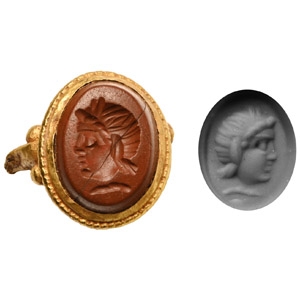
Roman Jasper Gemstone with Head of Pan in Gold Ring Bezel
2nd-3rd century A.D.Sold for (Inc. bp): £416
With incuse profile bust of Pan (Faunus); supplied with a museum-quality impression. 1.40 grams, 12 mm
From the Fadel family collection, London, UK, 1970s. -
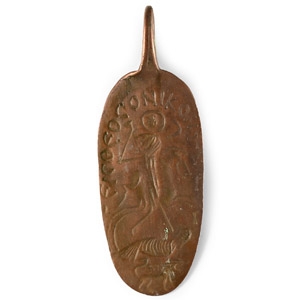
Byzantine Copper Talisman Pendant with Saint George
Circa 6th-8th century A.D.Sold for (Inc. bp): £364
Tongue-shaped pendant with integral loop, obverse with stylised figure of a horseman spearing a creature, lion below and text surrounding 'EIC ΘΕΟϹ Ο ΝΙΚΟΝΤΑ ', reverse with stylised angel and legend '[KONCTA]NTΙΝΟY'. 9.55 grams, 62 mm
From the collection of a gentleman, acquired on the London art market in the 1990s.
The amulet has a prophylactic element asking the divine protection of a military saint (probably Saint Sisinnius, or Saint George or Saint Theodore) with the inscription 'Winning for God'. The amulet seems to belong to a certain Konstantinos, probably a soldier. -
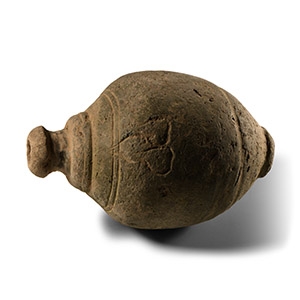
Byzantine 'Greek Fire' Ceramic Fire Bomb or Hand Grenade
9th-11th century A.D.Sold for (Inc. bp): £85
Piriform body with impressed ivy-leaf motifs below the shoulder, tiered shoulder, domed filler-hole, intended to be filled with explosive liquid and wick, used as a hand grenade. 815 grams, 14.5 cm
From a specialist collection of militaria, London, UK, collected 1990s onwards. Accompanied by an academic paper by military specialist Dr Raffaele D'Amato, dated 15 July 2019 and titled 'Eastern Roman Empire - Greek Fire Bomb or Hand Grenade (μεσαίον kακάβιον) 9th-11th century AD'.
Apart from the use of siphons or manual flame-throwers called cheirosiphona, special corps of Roman soldiers employed terracotta grenades, in the form of small jars, abundantly evidenced in archaeological excavations. They were called μεσαία kακαβιά or κυτροκακάβια where the former had a bulbous shape and the latter a more cylindrical form. -
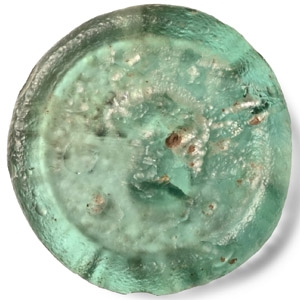
Byzantine Glass Weight with Eparches Inscription
Circa 6th-8th century A.D.Sold for (Inc. bp): £169
Discoid weight with low-relief portrait bust, Greek legend. 2.36 grams, 23 mm
From the property of late Mr SM, London, UK, 1969-1999. -
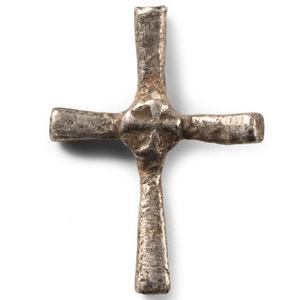
Byzantine Silver Cross with Cross on Body
Circa 6th-8th century A.D.Sold for (Inc. bp): £130
Cruciform amulet with expanding arms, disc to the centre with low-relief cross symbol. 1.45 grams, 22 mm
From the collection of a gentleman, acquired on the London art market in the 1990s. -
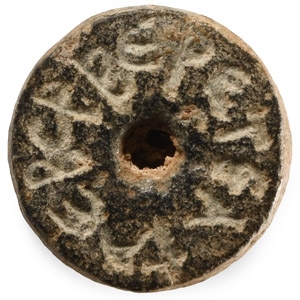
Byzantine Inscribed Lead Spindle Whorl
5th-6th century A.D.Sold for (Inc. bp): £39
Discoid with central void and portion of the shank embedded; inscribed with Greek characters '+AEB Φ BEPETEAI'. 2.66 grams, 18 mm
Acquired on the London, UK, art market in the 1990s. From a gentleman's private collection.
Similar objects could have been manufactured to look like spindle whorls, while they were in fact used as beads and/or amulets. The current evidence may suggest that these items were burial goods for females. They are sometimes seen incised with Greek letters and symbols that seem to suggest a cryptic onomata barbara formula. In this context, they can be viewed as mystical objects with the function of transmitting a message to the Other World, and the sheer mass of letters intended to convey the idea of an authoritative communication inaccessible to ordinary human being. -
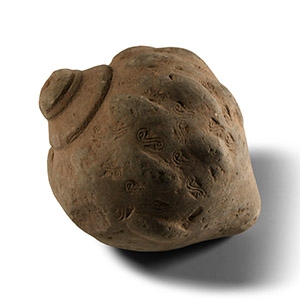
Byzantine 'Greek Fire' Ceramic Fire Bomb or Hand Grenade
9th-11th century A.D.Sold for (Inc. bp): £91
Piriform body with scaphoid flanges to the upper body, domed filler-hole, intended to be filled with explosive liquid and wick, used as a hand grenade. 513 grams, 12.1 cm
From a specialist collection of militaria, London, UK, collected 1990s onwards. Accompanied by an academic paper by military specialist Dr Raffaele D'Amato, dated 15 July 2019 and titled 'Eastern Roman Empire - Greek Fire Bomb or Hand Grenade (μεσαίον kακάβιον) 9th-11th century AD'.
Apart from the use of siphons or manual flame-throwers called cheirosiphona, special corps of Roman soldiers employed terracotta grenades, in the form of small jars, abundantly evidenced in archaeological excavations. They were called μεσαία kακαβιά or κυτροκακάβια where the former had a bulbous shape and the latter a more cylindrical form. -
.jpg)
Byzantine Bronze Horse Harness Boss Pendant
15th century A.D.Sold for (Inc. bp): £33
Large domed centre with low-relief sun wheel design, pellets to the rim and suspension loop above. 28.6 grams, 75 mm
From the collection of a North American gentleman, formed in the 1990s.
In the late Byzantium period, round-shaped buckles and horse harness mounts were often decorated with beaded edges and with floral embossed ornaments, under the influence of the Ottoman Turks. They have the shape of a small shield and impressed decoration of a rose. Belt appliques have an extra boss for attachment, instead of a loop which is usually attached to the horse harness pendants. -
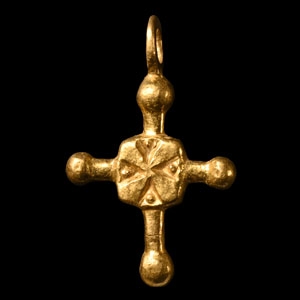
Byzantine Gold Cross Pendant
6th-8th century A.D.Sold for (Inc. bp): £845
Square central panel with four radiating arms, bulb finials, pierced suspension lug above, punched pellet-in-triangle motifs to obverse. 3.27 grams, 24 mm
Acquired 1980-2015. Ex Abelita family collection. -
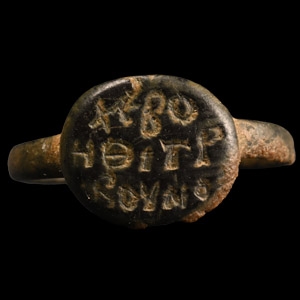
Byzantine Bronze Epigraphic Ring
6th century A.D.Sold for (Inc. bp): £111
With ellipsoid bezel, incised Greek inscription with some of the letter inversed, reading 'ΧζΒΟ ΗϽΙΤΡ βOΥΛΟ'. 1.81 grams, 19.87 mm overall, 17.93 mm internal diameter (approximate size British N 1/2, USA 6 3/4, Europe 14.35, Japan 13)
Acquired 1980-2015. Ex Abelita family collection.
The meaning of the inscription is not clear, although it may be prophylactic, with the letter Chi (Χ) linked with the rho (P) i.e. XP for ‘Christ’ and the other letters referring to the usual expression βΟYTICΗ (protect) βOΥΛIΟ (Doulo? ), therefore intended to be read ‘Christ protect your servant’. The ring was probably engraved by a foreigner with a very limited understanding of Greek. -
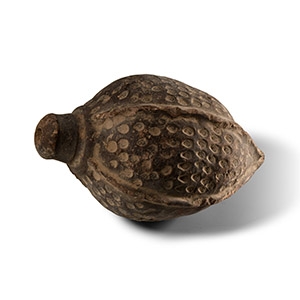
Byzantine 'Greek Fire' Ceramic Fire Bomb or Hand Grenade
9th-11th century A.D.Sold for (Inc. bp): £143
Piriform body with vertical ribs and impressed roundels across the whole surface, domed filler-hole, intended to be filled with explosive liquid and wick, used as a hand grenade. 662 grams, 15.5 cm
From a specialist collection of militaria, London, UK, collected 1990s onwards. Accompanied by an academic paper by military specialist Dr Raffaele D'Amato, dated 15 July 2019 and titled 'Eastern Roman Empire - Greek Fire Bomb or Hand Grenade (μεσαίον kακάβιον) 9th-11th century AD'.
Apart from the use of siphons or manual flame-throwers called cheirosiphona, special corps of Roman soldiers employed terracotta grenades, in the form of small jars, abundantly evidenced in archaeological excavations. They were called μεσαία kακαβιά or κυτροκακάβια where the former had a bulbous shape and the latter a more cylindrical form. -
.jpg)
Byzantine and Post-Byzantine Bronze Cross Group
7th-19th century A.D.Sold for (Inc. bp): £46
Comprising: a cross buckle with pin; the upper plate of a small enkolpion with a praying Virgin or Saint; two orthodox pectoral crosses, both with inscription 'IC' (Iesus) 'XC' (Christos ) 'NIKA' (Christ is victorious); the smallest cross with invocation-prayer engraved on the back. 51.8 grams total, 36-73 mm
Acquired on the UK art market. Property of a Ruislip, UK, gentleman, by inheritance.
The fragment of the simpler Maltese cross mount corresponds to the type E2 of Schulze-Dörrlamm, here with straight arms with rounded corners. It resembles the cross-shaped hinge fittings of the belt buckles from Herrera de Pisuerga and tomb 9 from El Tesorillo from Visigoth Spain, two bronze fittings from Lusitania and the buckle with busts of saints and the Greek inscription 'Light and Life' from Korbous in Tunisia. These kind of buckles were also found in male warrior graves.
