
Auction Highlights
-
.jpg)
Greek Marble Head of Dionysus
Sold for (Inc. bp): £23,400
Carved in the half-round in three-quarter view, youthful male head with stern features, hair gathered in a browband, horns to the brow; from a frieze or relief; mounted on a custom-made stand. -
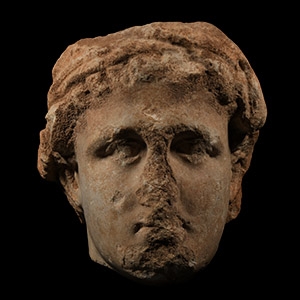
Greek Marble Head of a Ruler
Sold for (Inc. bp): £31,200
Carved in the round with thick wreath of laurel leaves to the brow, short tousled hair, stern face with thick jaw; mounted on a custom-made stand. -
.jpg)
Roman Veined Marble Torso of an Athlete
Sold for (Inc. bp): £48,100
Standing contrapposto with his weight on his right leg and the left leg brought slightly forward; the musculature of the torso displaying well-defined pectoral muscles, prominent abdominal muscles and wide shoulders, the back with equally toned musculature and well-formed rounded buttocks; the veining of the marble accentuating the idealised anatomy; the now-absent head was most probably turned towards the supporting leg and the left arm would have been raised; mounted on a custom-made display stand. -
.jpg)
Large Middle Elamite Cylinder Seal of Kidnu, Chief Overseer of King Tan-Ruhurater II
Sold for (Inc. bp): £15,600
A high-status green chalcedony seal with frieze depicting a seated figure in horned headdress facing a standing figure with arms outstretched, small monkey to the legs; six columns of Akkadian cuneiform text transliterated as: 1. ki-di-nu UGULA KUŠ-MEŠ 2. GAL šà tan-dru-hu- 3. ra-te-er EŠŠANA šu-ši 4. u an-za-an ARAD 5. šà dha-te-ri-iš 6. šak(?) ì-lí-šu 'Kidinu, chief overseer of the equerries(?) of Tan-Ruhurater, King of Susa and Anzan, servant of Haterishshak, his god'. The seal's owner was an official of King Tan-Ruhurater II (circa 1450 B.C.), king of Susa and Anzan. The title used to describe Kidinu is sometimes translated 'high official', elsewhere 'horse groom' or 'animal trainer'; the Elamite deity Haterish is otherwise unknown. -
.jpg)
Mesopotamian Torch Bearer Stand with Lion Tamer
Sold for (Inc. bp): £46,800
A substantial torch bearer depicting a male lion or panther standing with legs firmly planted on a rectangular base, tail extending to the ground, with a massive circular shaped armature or candelabra issuing from its back and wearing an elaborate muzzle, the eyes retaining shell inlay with a circular hollow for the pupils; to the right of the beast a kneeling nude male wearing a large belt-armour and a diadem, eyes inlaid, left hand extended to the side and holding the lion's leash.
-
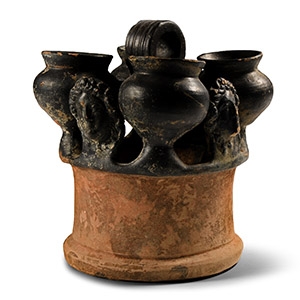
Greek Campanian Black-Glazed Kernos
Late 4th century B.C.Sold for (Inc. bp): £1,560
Comprising a round pedestal supporting four small offering pots, interspersed with four female face protomes; looped handle to the centre with parallel strokes in low-relief. 623 grams, 16 cm high
From the West German collection of H.W. Acquired from the De Mynter, Belgium, in 2011. with Gorny and Mosch, Munich, 3 June 2017, no.52. Private Portuguese R.M. collection. Accompanied by a previous catalogue information slip.
The kernos can be recognised by a series of small cups on the lip, with examples dating back to the Bronze Age. It was used to store offerings made to the gods, specifically in cults pertaining to Demeter and Persephone. The receptacles probably contained foodstuffs, or perhaps flowers, and a lamp was sometimes placed in the centre. Kernoses, such as this, were often carried in processions at the Eleusinian Mysteries (secret initiation rites celebrating the goddesses Demeter and Persephone) and were an important object for Greek religious life. Kernoses are thus closely related to the agrarian cult and to the myth of Persephone and Demeter, the goddess of fertility and agriculture. The myth is recounted in an Homeric Hymn (c. 650 B.C.) according to which Persephone, Demeter’s daughter, was seized by Hades, the king of the underworld, who brought her to his kingdom to make her his wife. Distraught, Demeter caused a terrible drought, which continued until Persephone returned to her mother from the underworld. Having consumed pomegranate seeds whilst she was in the Underworld, she was only able to be with her for a few months of the year. -
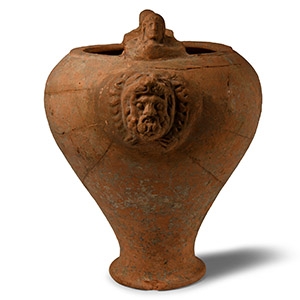
Greek Terracotta Situla
4th century B.C.Sold for (Inc. bp): £1,170
Piriform in profile with broad shoulder, slightly raised rim, two raised lugs each formed as a male bust with crimped headdress, mask of Hercules below wearing the lionskin hood. 1.19 kg, 25 cm high
Ex Marinescu-Roth-Virzi collection, Switzerland, 1970-1993. Accompanied by a copy of a photograph of the artefact on display. -
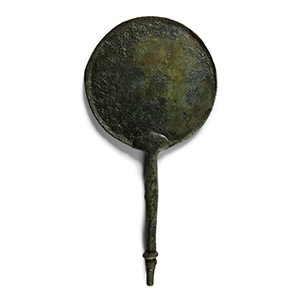
Greek Bronze Handled Mirror
Hellenistic, 2nd-1st century B.C.Sold for (Inc. bp): £585
Comprising a broad disc with raised rim to one face, pelta-shaped junction developing to a balustered handle with acorn finial. 194 grams, 24 cm
From the private collection of a London gentleman, from his grandfather's collection formed before the early 1970s. -
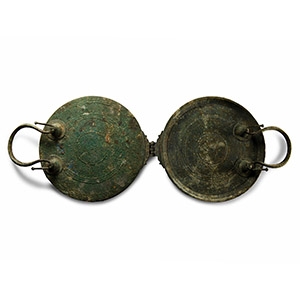
Greek Bronze Folding Travelling Mirror
Hellenistic, 2nd century B.C.Sold for (Inc. bp): £2,080
Discoid mirror with recess to obverse and reverse, each with a looped handle attached to two domed lugs, concentric rings and stepped rim; hinge to lower edge, recessed inner face to one disc and raised equivalent to the other with silvered finish. 305 grams, 12.8 cm
Acquired on the German art market, 1989-1995. with The Museum Gallery, 19 Bury Place, London, WC1A 2JB, 1998-2003. Property of a London based academic, 2003-present. This lot has been checked against the Interpol Database of stolen works of art and is accompanied by a search certificate no.12061-217502.
These kind of mirrors consisted of heavy circular discs with low cylindrical rims. They were made in pairs, and polished (and sometimes silvered) respectively on the recessed and flat sides, the latter being provided with a bevelled edge, into which the other fitted like a cover. Both polished surfaces were thus protected. The unpolished sides were ornamented with concentric-circle ornaments and concentric mouldings. -
.jpg)
Roman Children's Leather Shoe Collection
Circa 1st-2nd century A.D.Sold for (Inc. bp): £7,800
Comprising: the sole of a carbatina type shoe, formed as two thick layers of leather with a third, thinner layer beneath, slits to the upper face to accept securing straps and punched ornamentation (lines of concentric-ring motifs), underside with a line of domed iron studs to the outer edge and others at he middle of the sole and heel; a soft shoe made from a single piece of leather with pierced triangular tags to the open upper face, the toe and heel sewn so that the seam does not contact the ground; a similar soft shoe with openwork sides resembling arcading, no covering at the toes, heel sewn. 150 grams total, 13-17.5 cm
Found City of London, UK. Acquired from mudlark Steve Brooker in the early 2000s. Ian Wilkinson collection, Nottinghamshire, UK, formed since 1985. Accompanied by several original handwritten letters regarding the conservation of the shoes. This lot has been checked against the Interpol Database of stolen works of art and is accompanied by a search certificate number no.12093-214631.
In Great Britain, examples of carbatinai dated to the last quarter of the 1st century A.D. have been found in Castleford. Others dated to the 2nd century have been found in London and Bar Hill. Carbatinae were often worn by children: two well-preserved specimens were discovered at the Vindolanda fort, which housed a mixed population of soldiers and their families. -
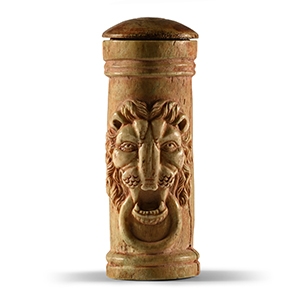
Roman Bone Pyxis with Lion Heads
Circa 1st century B.C.-1st century A.D.Sold for (Inc. bp): £715
Carved with thick rim to each end, ogee above the base and double band beneath the mouth; two facing lion masks modelled in high-relief, each with gaping jaws and a ring held between the jaws; disc to the base, domed lid. 39.7 grams, 71 mm
From the old collection of Colonel Ronde, circa 1980s. Property of a French collector. This lot has been checked against the Interpol Database of stolen works of art and is accompanied by a search certificate number no.12094-214901.
According to archaeologists, the pyxis could have served as a container for cosmetics, medicinal ointments, or perfume. Soldiers’ posessions often included carved vessels and lathe-turned bowls, spoons, spatulas, knives, discs and lids, as well as pyxides, which have been found in high numbers in military camps. -
.jpg)
Roman Inscribed Wooden Wax Tablet, a Legal Document
2nd-3rd century A.D.Sold for (Inc. bp): £5,460
An untranslated reused tablet with a recessed panel with traces of more than 15 lines with the remains of letters written in cursive script, originally the panel was covered by a layer of wax, with a stylus the writer scratched the text into the soft wax and often also into the wooden ground, as such tablets were normally reused several times, traces of different texts can be found on the wooden surface, four lines of large inked text to verso, a record of a transaction in a formulaic legal language; either from a legal document comprising two (diptychon) or three (triptychon) panels; pierced three times for attachment. 20.6 grams 13 x 13 cm
From an important London collection since 1975. Accompanied by a collection of eight 1970s photographs of the the tablet.
The contract follows the standard Roman legal formulae. -
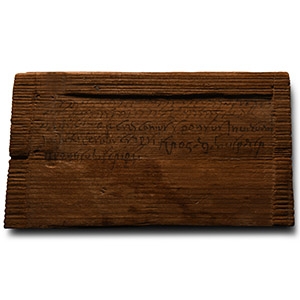
Roman Inked Wooden Legal Document Signed by Felicianus in Actum
Late 4th century A.D.Sold for (Inc. bp): £7,800
A reused tablet with a recessed panel on one side, the lower part absent, on the upper rim one of originally 3 holes necessary for binding together of the tablets of the document, 5 lines in Roman cursive on the recessed panel containing the end of a the record of a legal document in a formulaic legal language; part of a legal document which consisted of two (diptychon) or three tablets (triptychon), with the indication where it was done (actum in …) followed by the so-called chirographum (signature line) of a person called Felicianus, letter forms point to a date in the second half of the 4th century AD; with a recessed slot to verso. 12.4 grams, 14.7 cm
From an important London collection since 1975. Accompanied by a collection of six 1970s photographs of the the tablet.
The contract follows standard Roman legal formulae. -
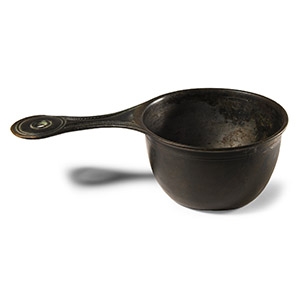
Roman Bronze Patera with Maker's Mark for Licinius
1st-2nd century A.D.Sold for (Inc. bp): £1,820
With drum-shaped bowl and thick rim developing to a short handle with pierced lobe finial; stamped to the upper face of the handle with maker's name '[.]OIYBI'; to the underside of the base, pointillé legend 'LICINI[...]V'. 242 grams, 19.5 cm
Acquired from Munich and London, 1990s. From the collection of a London, UK, gentleman. Accompanied by an academic report by Dr Raffaele D’Amato. This lot has been checked against the Interpol Database of stolen works of art and is accompanied by a search certificate number no.12064-217904.
The owner of the patera seems to be a certain Licinius. In contrast to more elaborate counterparts, paterae such as this were likely carried as part of the standard kit of Roman soldiers, used as a general cooking and eating utensil. -
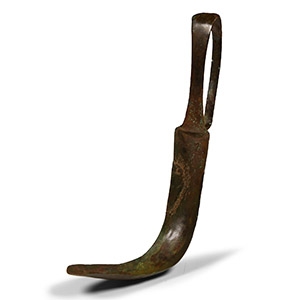
Roman Bronze Strigil
2nd century B.C.-1st century A.D.Sold for (Inc. bp): £780
With C-section profile to the blade, rectangular handle with flare to the upper end, old notch to one edge, repaired. 46 grams, 19 cm
Ex collection Dr. Kuhn-Lucht, Germany. with Kölner Munzkabinett, Cologne, before 2016. Private European collection.
An emblematic instrument of the ancient sporting world, the strigil was mainly used by athletes as a scraper for personal hygiene. After training, which took place in the gymnasiums on tracks and arenas covered with sand, athletes and young people rubbed their skin with olive oil. They then used one of these distinctive scrapers remove the sand-oil mixture before washing in water. These actions are reproduced on famous statues (including Apoxyomenos, one of Lysippus’ masterpieces), on reliefs (such as funerary steles) as well as on countless vase paintings. In Attic and Italian red-figure imagery, the strigil is often depicted on perfume vases, like the aryballos and alabastron. -
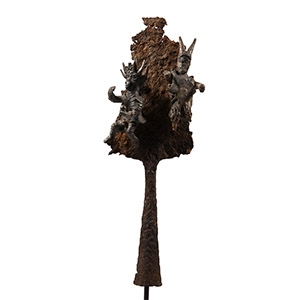
Roman Votive Iron Military Standard with Faunus and Sol Invictus
3rd century A.D.Sold for (Inc. bp): £2,470
Comprising a triangular spearhead-shaped panel with flared split socket; two separate figures attached with rivets: on the left Helios (or Sol) with draped mantle and radiant crown, holding a sphere in his left hand; on the right Faunus (Pan) with two curved horns, a short beard, arms bent forwards, the upper body covered by a hide jerkin and the legs with shaggy fur; mounted on a custom-made display stand. 1.39 kg total, 38 cm including stand
From a collection acquired on the UK art market from various auction houses and collections mostly before 2000. From an important Cambridgeshire estate; thence by descent.
The piece is reminiscent of the votive plates in the Dolichenus cult, or possibly of some other cult. -
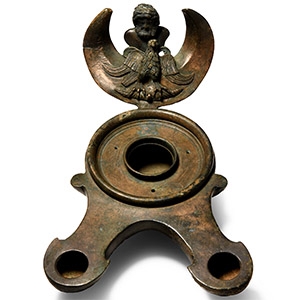
Very Large Roman Bronze Oil Lamp with Jupiter and Eagle
3rd-4th century A.D.Sold for (Inc. bp): £8,450
With a rounded body and double nozzle with volutes; the body flat with engraved volutes, raised rim and basal ring; to the rear a large crescent with Jupiter (Greek Zeus) to the centre and his eagle with spread wings before him; the god depicted with thick locks and voluminous beard, the eagle with detailed plumage and finely detailed face; accompanied by a custom-made display stand. 1.67 kg, 25.7 wide (3.08 kg total,18 cm high including stand)
Old private British collection, pre-1965. Property of a gentleman; acquired in the UK before 2000. Accompanied by a copy of an old black and white photograph. Accompanied by an academic report by Dr Raffaele D’Amato. This lot has been checked against the Interpol Database of stolen works of art and is accompanied by search certificate number no.12034-215425.
Here Jupiter is represented with his attributes connected with the crescent of goddess Luna. According to Bailey, all lamps in the category to which the map belongs, were intended for suspension. Lamps with multiple nozzles gave more light and thus were suitable for lighting large spaces.
