
Auction Highlights
-
.jpg)
Greek Marble Head of Dionysus
Sold for (Inc. bp): £23,400
Carved in the half-round in three-quarter view, youthful male head with stern features, hair gathered in a browband, horns to the brow; from a frieze or relief; mounted on a custom-made stand. -
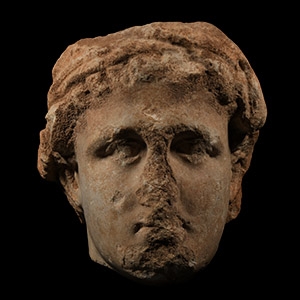
Greek Marble Head of a Ruler
Sold for (Inc. bp): £31,200
Carved in the round with thick wreath of laurel leaves to the brow, short tousled hair, stern face with thick jaw; mounted on a custom-made stand. -
.jpg)
Roman Veined Marble Torso of an Athlete
Sold for (Inc. bp): £48,100
Standing contrapposto with his weight on his right leg and the left leg brought slightly forward; the musculature of the torso displaying well-defined pectoral muscles, prominent abdominal muscles and wide shoulders, the back with equally toned musculature and well-formed rounded buttocks; the veining of the marble accentuating the idealised anatomy; the now-absent head was most probably turned towards the supporting leg and the left arm would have been raised; mounted on a custom-made display stand. -
.jpg)
Large Middle Elamite Cylinder Seal of Kidnu, Chief Overseer of King Tan-Ruhurater II
Sold for (Inc. bp): £15,600
A high-status green chalcedony seal with frieze depicting a seated figure in horned headdress facing a standing figure with arms outstretched, small monkey to the legs; six columns of Akkadian cuneiform text transliterated as: 1. ki-di-nu UGULA KUŠ-MEŠ 2. GAL šà tan-dru-hu- 3. ra-te-er EŠŠANA šu-ši 4. u an-za-an ARAD 5. šà dha-te-ri-iš 6. šak(?) ì-lí-šu 'Kidinu, chief overseer of the equerries(?) of Tan-Ruhurater, King of Susa and Anzan, servant of Haterishshak, his god'. The seal's owner was an official of King Tan-Ruhurater II (circa 1450 B.C.), king of Susa and Anzan. The title used to describe Kidinu is sometimes translated 'high official', elsewhere 'horse groom' or 'animal trainer'; the Elamite deity Haterish is otherwise unknown. -
.jpg)
Mesopotamian Torch Bearer Stand with Lion Tamer
Sold for (Inc. bp): £46,800
A substantial torch bearer depicting a male lion or panther standing with legs firmly planted on a rectangular base, tail extending to the ground, with a massive circular shaped armature or candelabra issuing from its back and wearing an elaborate muzzle, the eyes retaining shell inlay with a circular hollow for the pupils; to the right of the beast a kneeling nude male wearing a large belt-armour and a diadem, eyes inlaid, left hand extended to the side and holding the lion's leash.
-
.jpg)
Roman Bronze Medical Implement with Razor
1st-4th century A.D.Sold for (Inc. bp): £182
Hexagonal-section handle with scooped blade at one end, lentoid-section probe at the other. 11.7 grams, 14.1 cm
Ex German art market, 2000s. Acquired from an EU collector living in London. From the collection of Surrey, UK, gentleman. -
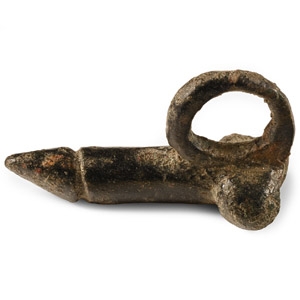
Roman Bronze Phallic Pendant
1st-3rd century A.D.Sold for (Inc. bp): £65
Comprising a thick, elongated body with lateral testes, large suspension loop above. 12.2 grams, 33 mm
Ex German art market, 2000s. Acquired from an EU collector living in London. From the collection of Surrey, UK, gentleman. -
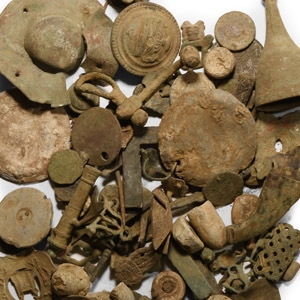
Roman to Post Medieval Artefact Group
1st-20th century A.D.Sold for (Inc. bp): £33
Including hooked tags, cloth seals, keys, a spur rowel, milled coins, mounts and other items. 854 grams total, 9-67 mm
Found Suffolk, UK. -
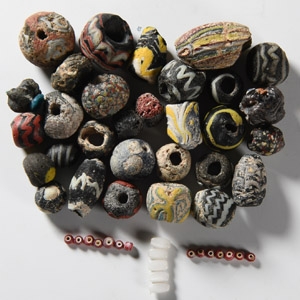
Roman and Other Bead Collection
1st century A.D. and laterSold for (Inc. bp): £46
Including fusiform, oblate, tubular, mosaic and other types 60 grams total, 2-22 mm
Acquired from Silk Road Heritage, LLC, Virginia, USA. Ian Wilkinson collection, Nottinghamshire, UK, formed since 1985. -
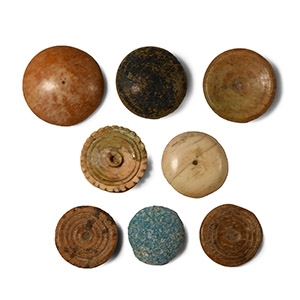
Roman and Other Counter Collection
1st century A.D. and laterSold for (Inc. bp): £338
Comprising plano-convex, discoid and other types in bone and glass. 20 grams total, 17-23 mm
Found on the Thames foreshore, UK. Acquired from Red House Antiques, York, 2009. Ian Wilkinson collection, Nottinghamshire, UK. -
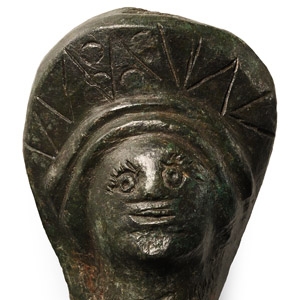
Roman Bronze Figural Attachment
3rd-4th century A.D.Sold for (Inc. bp): £33
Piriform mount with stylised facial features, broad band of hair with incised zigzag and roundels, hollow to the reverse. 71.6 grams, 66 mm
Ex German art market, 2000s. Acquired from an EU collector living in London. From the collection of Surrey, UK, gentleman. -
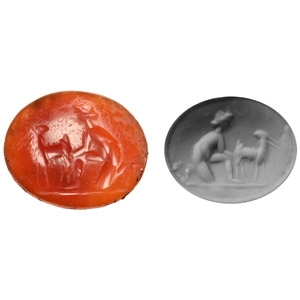
Roman Carnelian Gemstone with Goatherd and Goat
1st-2nd century A.D.Sold for (Inc. bp): £130
Plano-convex with intaglio goatherd kneeling beside a goat on a baseline; supplied with a museum-quality impression. 1.4 grams, 16 mm
From the Fadel family collection, London, UK, 1970s. -
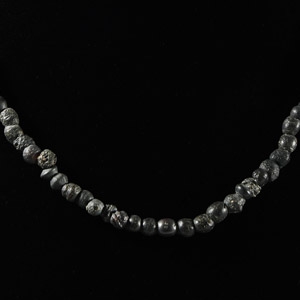
Roman and Other Bead Necklace
1st-4th century A.D. and laterSold for (Inc. bp): £20
A restrung designer necklace including oblate, biconvex and other types. 22.7 grams, 41.5 cm
Acquired on the London, UK, art market in the 1990s. Ex London, UK, gallery. -
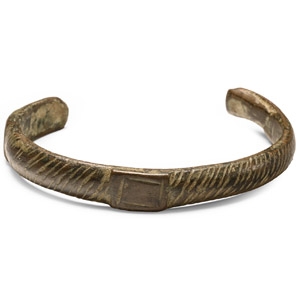
Roman Bronze Bracelet
1st-4th century A.D.Sold for (Inc. bp): £72
Penannular D-section in form with three raised rectangular panels, incised hatching. 16.70 grams, 52 mm
Ex German art market, 2000s. Acquired from an EU collector living in London. From the collection of Surrey, UK, gentleman. -
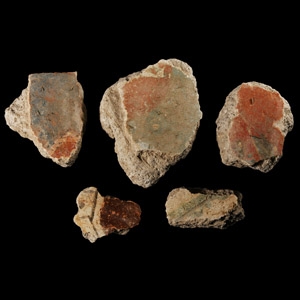
Roman Fresco Wall Plaster Collection
1st century B.C.Sold for (Inc. bp): £33
Second style, painted in red, blue and cream, one with leaf motifs. 622 grams total, 5.7-11.6 cm
Acquired in the 19th century. Ex Jeger collection, Switzerland.
These small fragments, showing similarities with fragments of Pompeii, seem to belong to the second style of Roman painting, red panels profiled with black lines representing highlight and shadow. The panels were probably framed by a green fillet. A couple of fragments show two fields in alternated red and blue. -
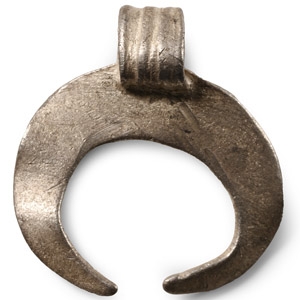
Roman Silver Lunar Pendant
2nd-3rd century A.D.Sold for (Inc. bp): £111
With a flat-section crescentic body and applied ribbed suspension loop. 2.31 grams, 21 mm
Ex German art market, 2000s. Acquired from an EU collector living in London. From the collection of Surrey, UK, gentleman. -
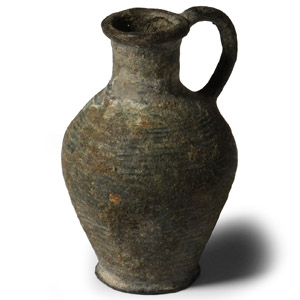
Roman Bronze Miniature Flagon
2nd-3rd century A.D.Sold for (Inc. bp): £91
With piriform body, short neck, everted rim and strap handle, circumferential bands to the body. 10.9 grams, 42 mm
Acquired from Den of Antiquity, Cambridgeshire, UK, 2010. Ian Wilkinson collection, Nottinghamshire, UK.
The small size of this bronze container suggests that it was intended as a toilette object, or as an oil vessel for athletes, generally associated with a strigil. Its could also have been used as a balsamarium.
