
Auction Highlights
-
.jpg)
Greek Marble Head of Dionysus
Sold for (Inc. bp): £23,400
Carved in the half-round in three-quarter view, youthful male head with stern features, hair gathered in a browband, horns to the brow; from a frieze or relief; mounted on a custom-made stand. -
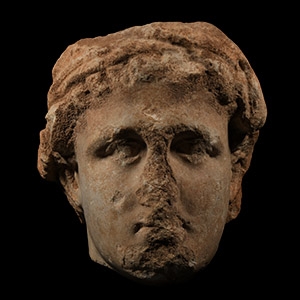
Greek Marble Head of a Ruler
Sold for (Inc. bp): £31,200
Carved in the round with thick wreath of laurel leaves to the brow, short tousled hair, stern face with thick jaw; mounted on a custom-made stand. -
.jpg)
Roman Veined Marble Torso of an Athlete
Sold for (Inc. bp): £48,100
Standing contrapposto with his weight on his right leg and the left leg brought slightly forward; the musculature of the torso displaying well-defined pectoral muscles, prominent abdominal muscles and wide shoulders, the back with equally toned musculature and well-formed rounded buttocks; the veining of the marble accentuating the idealised anatomy; the now-absent head was most probably turned towards the supporting leg and the left arm would have been raised; mounted on a custom-made display stand. -
.jpg)
Large Middle Elamite Cylinder Seal of Kidnu, Chief Overseer of King Tan-Ruhurater II
Sold for (Inc. bp): £15,600
A high-status green chalcedony seal with frieze depicting a seated figure in horned headdress facing a standing figure with arms outstretched, small monkey to the legs; six columns of Akkadian cuneiform text transliterated as: 1. ki-di-nu UGULA KUŠ-MEŠ 2. GAL šà tan-dru-hu- 3. ra-te-er EŠŠANA šu-ši 4. u an-za-an ARAD 5. šà dha-te-ri-iš 6. šak(?) ì-lí-šu 'Kidinu, chief overseer of the equerries(?) of Tan-Ruhurater, King of Susa and Anzan, servant of Haterishshak, his god'. The seal's owner was an official of King Tan-Ruhurater II (circa 1450 B.C.), king of Susa and Anzan. The title used to describe Kidinu is sometimes translated 'high official', elsewhere 'horse groom' or 'animal trainer'; the Elamite deity Haterish is otherwise unknown. -
.jpg)
Mesopotamian Torch Bearer Stand with Lion Tamer
Sold for (Inc. bp): £46,800
A substantial torch bearer depicting a male lion or panther standing with legs firmly planted on a rectangular base, tail extending to the ground, with a massive circular shaped armature or candelabra issuing from its back and wearing an elaborate muzzle, the eyes retaining shell inlay with a circular hollow for the pupils; to the right of the beast a kneeling nude male wearing a large belt-armour and a diadem, eyes inlaid, left hand extended to the side and holding the lion's leash.
-
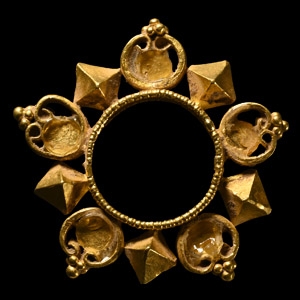
Late Roman Highly Ornate Solid Gold Frame
3rd-7th century A.D.Sold for (Inc. bp): £780
With applied heart-shaped openwork panels and octahedrons on the outer face of a decorative ring band. 12.4 grams, 32.4 mm
From a late Japanese specialist collector, 1970-2000s. -
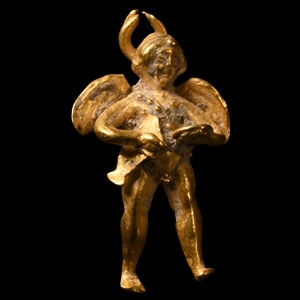
Roman Gold Cupid Pendant
Circa 1st-4th century A.D.Sold for (Inc. bp): £364
Standing nude and holding a patera and lyre, wings spread to the rear, suspension loop to rear of head. 2.44 grams, 18 mm
From the collection of a gentleman, acquired on the London art market in the 1990s. -
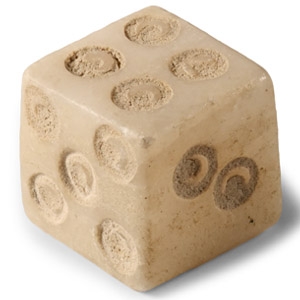
Large Roman Marble Gaming Dice
1st-4th century A.D.Sold for (Inc. bp): £182
Cuboid with ring-and-dot markings disposed 1:5, 2:3, 4:6. 3.12 grams, 11 mm
From the important private collection of dice and gaming pieces of Colin Narbeth, London, UK, collection no.28. -
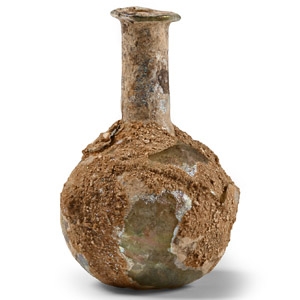
Roman Glass Unguentarium
1st-4th century A.D.Sold for (Inc. bp): £59
Bulbous body with rounded underside, tubular neck with rolled and folded rim, iridescent surface. 13 grams, 62 mm
Acquired 1980-2015. Ex Abelita family collection. -
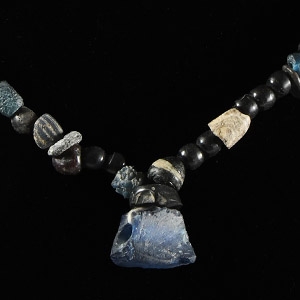
Roman and Other Bead Necklace
1st-4th century A.D. and laterSold for (Inc. bp): £52
Restrung designer necklace with oblate, melon and other beads, the centrepiece a wedge-shaped glass fragment. 15.5 grams, 37 cm
Acquired on the London, UK, art market in the 1990s. Ex London, UK, gallery. -
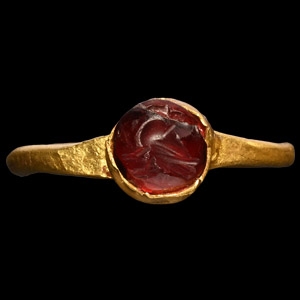
Roman Gold Ring with Bird Gemstone
4th century A.D.Sold for (Inc. bp): £364
Comprising a round-section hoop supporting a cup-shaped bezel, inset domed garnet engraved with a standing bird. 2.39 grams, 23.97 mm overall, 17.15 mm internal diameter (approximate size British N, USA 6 1/2, Europe 13.72, Japan 13)
Ex property of a late Japanese collector, 1970-2000s. -
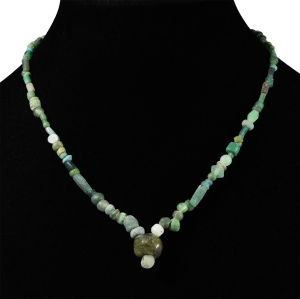
Roman and Other Bead Necklace
1st-4th century A.D. and laterSold for (Inc. bp): £65
Restrung designer necklace including oblate, biconvex, barrel-shaped and other types. 16.6 grams, 38 cm
Acquired on the London, UK, art market in the 1990s. Ex London, UK, gallery. -
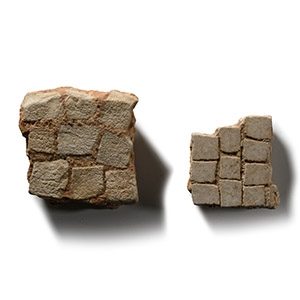
Roman Floor Mosaic Section Group
North Africa, 2nd-4th century A.D.Sold for (Inc. bp): £20
Two mosaic panels with tesserae in matrix; both with old inked inscription: 'SIDI BOU ALI / Tunisia' to verso. 112 grams total, 39-51 mm
From a pre World War II collection, thence by descent. Ian Wilkinson collection, Nottinghamshire, UK, formed since 1985. -
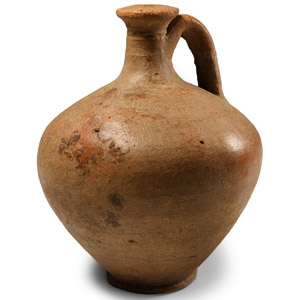
Roman Terracotta Wine Flagon
1st-4th century A.D.Sold for (Inc. bp): £176
Of bulbous profile with slightly flared base, broad shoulder, facetted strap handle and trumpet-shaped mouth. 373 grams, 16.5 cm high
Ex German art market, 2000s. Acquired from an EU collector living in London. From the collection of Surrey, UK, gentleman. -
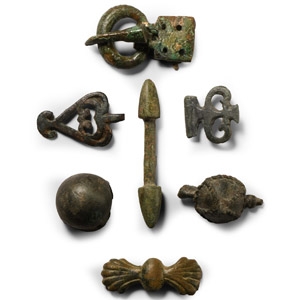
Roman and Later Artefact Group
2nd-3rd century A.D. and laterSold for (Inc. bp): £46
Comprising: a heart-shaped openwork mount; a pelta-shaped openwork mount with stud to the reverse; a buckle; a domed strap divider; a conical strap-slider(?) with rope decoration; a decorative mount with foliate sprays; a bar with conical finials. 60 grams total, 21-56 mm
Property of the vendor's grandfather, thence by family descent, circa 1985. From the private collection of a New York, USA gentleman. -
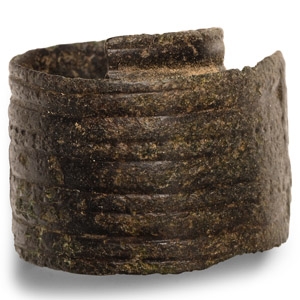
Roman Bronze Finger Ring
1st century A.D.Sold for (Inc. bp): £13
Fragment of a ribbed bracelet with finial, re-used as a finger ring. 6.85 grams, 23.82 mm overall, 16.58 mm internal diameter (approximate size British H, USA 3 3/4, Europe 6.18, Japan 6)
Found Suffolk, UK. Accompanied by a copy of the British Museum's Portable Antiquities Scheme (PAS) report no.SF-37E1B5. -
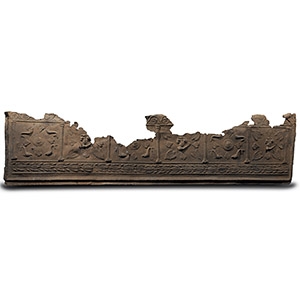
Roman Lead Coffin Panel with Sphinx, Medusa and Dolphins
2nd-3rd century A.D.Sold for (Inc. bp): £1,690
Decorated with stamped patterns including dolphins, gorgoneion, sphinx, floral patterns, motifs with ivy leaves and vertical columns dividing the field into panels. 33.2 kg, 1.72 m
Acquired 1970s-early 1990s. Property of a North American collector. London collection, 2016.
There were many ways of burying bodies during the Roman Empire. Although the majority were buried without coffins, there is evidence for wooden coffins, lead-framed wooden coffins, tile burials and lead and stone coffins. This item belongs to types widespread in the Eastern Mediterranean. The panel is decorated with a columned structure, and within each section are symbols of the outer-world, including gorgons, sphinx and dolphins. The sphinx, having a human head and breasts, legs and paws of a lion, and wings of a bird, was generally associated with protecting imperial tombs and temples. The roundels featuring the head of Medusa, known for her potent gazes that could turn one to stone, was favoured on sarcophagi and architectural ornaments because it was believed that her image would protect those within. The dolphin was considered to ferry the souls of the dead to the afterlife. Very often these sarcophagi were connected by a pipe to the ground above so that mourners could pour offerings into the grave.
