
Auction Highlights
-
.jpg)
Greek Marble Head of Dionysus
Sold for (Inc. bp): £23,400
Carved in the half-round in three-quarter view, youthful male head with stern features, hair gathered in a browband, horns to the brow; from a frieze or relief; mounted on a custom-made stand. -
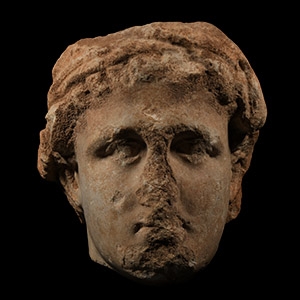
Greek Marble Head of a Ruler
Sold for (Inc. bp): £31,200
Carved in the round with thick wreath of laurel leaves to the brow, short tousled hair, stern face with thick jaw; mounted on a custom-made stand. -
.jpg)
Roman Veined Marble Torso of an Athlete
Sold for (Inc. bp): £48,100
Standing contrapposto with his weight on his right leg and the left leg brought slightly forward; the musculature of the torso displaying well-defined pectoral muscles, prominent abdominal muscles and wide shoulders, the back with equally toned musculature and well-formed rounded buttocks; the veining of the marble accentuating the idealised anatomy; the now-absent head was most probably turned towards the supporting leg and the left arm would have been raised; mounted on a custom-made display stand. -
.jpg)
Large Middle Elamite Cylinder Seal of Kidnu, Chief Overseer of King Tan-Ruhurater II
Sold for (Inc. bp): £15,600
A high-status green chalcedony seal with frieze depicting a seated figure in horned headdress facing a standing figure with arms outstretched, small monkey to the legs; six columns of Akkadian cuneiform text transliterated as: 1. ki-di-nu UGULA KUŠ-MEŠ 2. GAL šà tan-dru-hu- 3. ra-te-er EŠŠANA šu-ši 4. u an-za-an ARAD 5. šà dha-te-ri-iš 6. šak(?) ì-lí-šu 'Kidinu, chief overseer of the equerries(?) of Tan-Ruhurater, King of Susa and Anzan, servant of Haterishshak, his god'. The seal's owner was an official of King Tan-Ruhurater II (circa 1450 B.C.), king of Susa and Anzan. The title used to describe Kidinu is sometimes translated 'high official', elsewhere 'horse groom' or 'animal trainer'; the Elamite deity Haterish is otherwise unknown. -
.jpg)
Mesopotamian Torch Bearer Stand with Lion Tamer
Sold for (Inc. bp): £46,800
A substantial torch bearer depicting a male lion or panther standing with legs firmly planted on a rectangular base, tail extending to the ground, with a massive circular shaped armature or candelabra issuing from its back and wearing an elaborate muzzle, the eyes retaining shell inlay with a circular hollow for the pupils; to the right of the beast a kneeling nude male wearing a large belt-armour and a diadem, eyes inlaid, left hand extended to the side and holding the lion's leash.
-
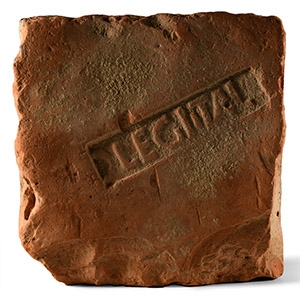
Roman Terracotta LEG I ITAL Legionary Stamped Tile
Late 1st century A.D.Sold for (Inc. bp): £572
A rectangular block with stamped mark 'LEGT I ITAL' (Legio I Italica) for 1st Legion 'Italic'; with collector's label 'Roman brick made by the Ist Italica Legion at Olpia Oescus on the lower Danube, one of Trajan's strategic bases prior to the invasion of Dacia in 106 AD. LEG I ITAL' 4.35 kg, 19 cm
From the collection of a late East Anglian teacher and antiquarian who retired to the Isle of Wight in Hampshire, UK. He amassed a large collection of objects between the 1960s-1980s. Accompanied by a previous catalogue identification card.
The Legio I Italica ("of Italy") was a Roman legion formed by Nero on September 20, 66 or 67 AD and active until the 5th century AD. Its emblems were the boar and sometimes the bull. There are many sources which name army officials employed in supervision of the construction and reconstruction of temples, baths, city walls, towers and gates. CIL VIII 2728, for example, is a letter by evocatus Augusti who was sent to solve engineering problems on a badly surveyed aqueduct at Saldae in the province of Numidia. Pliny (Epistulae X 17b, 39, 41, 61) repeatedly requested an army architect to be sent from Lower Moesia to help inspect some Bithynian building projects. Therefore it is not strange that tiles marked as belonging to a legion should be found all over the provinces. -
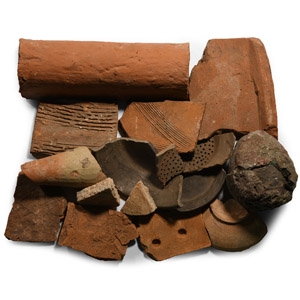
Romano-British Pottery Sherd Collection
1st-4th century A.D.Sold for (Inc. bp): £20
Including roof-ridge channel, floor tile, bowl rim and other items. 6.4 kg total, 6-28.5 cm
Found UK. From the collection of a late East Anglian teacher and antiquarian who retired to the Isle of Wight in Hampshire, UK. He amassed a large collection of objects between the 1960s-1980s. -
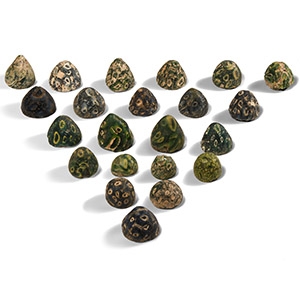
Roman and Later Mosaic Glass Gaming Piece Collection
1st-9th century A.D.Sold for (Inc. bp): £1,560
Set of conical and domed multi-coloured glass studs. 240 grams total, 16-25 mm
London private collection, acquired between 1979-1983. -
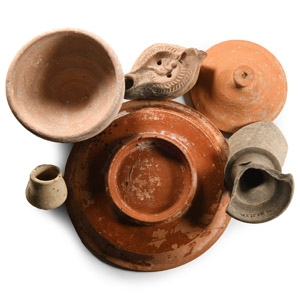
Romano-British Mixed Pottery Sherd Group
1st-4th century A.D.Sold for (Inc. bp): £143
Including a burnished redware dish, lidded bowl and other items. 663 grams total, 4-17 cm
Found UK. From the collection of a late East Anglian teacher and antiquarian who retired to the Isle of Wight in Hampshire, UK. He amassed a large collection of objects between the 1960s-1980s. -
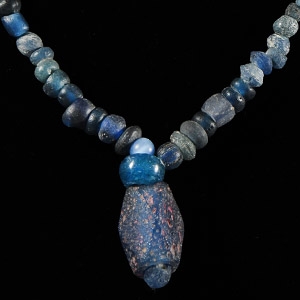
Roman and Other Glass Bead Necklace
1st-4th century A.D. and laterSold for (Inc. bp): £156
Restrung designer group of graduated seed beads, oblate, biconvex and other types, the centrepiece a polyhedral bead. 15.7 grams, 41 cm
Acquired on the London, UK, art market in the 1990s. Ex London, UK, gallery. -
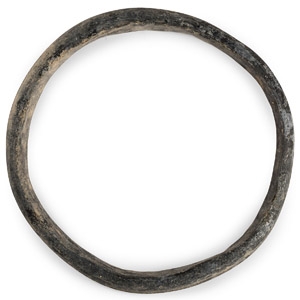
Large Roman Blue Glass Bracelet
1st-3rd century A.D.Sold for (Inc. bp): £130
Comprising an annular D-section hoop with a raised band to the outer face. 22.4 grams, 82 mm
From the property of late Mr SM, London, UK, 1969-1999. -
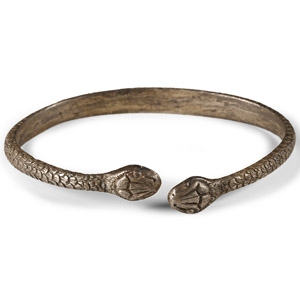
Romano-Egyptian Silver Snake Bracelet
30 B.C.-323 A.D.Sold for (Inc. bp): £1,170
Penannular type with serpent-head ends, scale detailing. 25.4 grams, 74 mm
Ex German art market, 2000s. Acquired from an EU collector living in London. From the collection of Surrey, UK, gentleman. -
.jpg)
Roman Gemstone with Legend
2nd-3rd century A.D.Sold for (Inc. bp): £1,170
Ellipsoid banded agate gemstone with 'IAω' legend beneath a frond. 1.13 grams, 15 mm
From a Swiss collection, 1980s onwards. Property of a North London, UK, gentleman.
IAΩ is a Greek transliteration of the Hebrew 'הוה the four-letter name of God. -
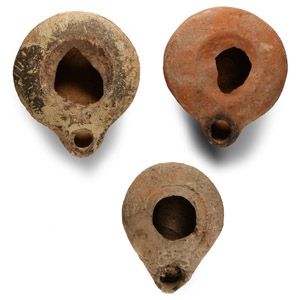
Roman Terracotta Oil Lamp Group
2nd-4th century A.D.Sold for (Inc. bp): £78
Each of low profile with stub nozzle and large filler hole. 122 grams total, 73-86 mm
From the H.N. collection, Milton Keynes, Berkshire, UK, 1990s. -
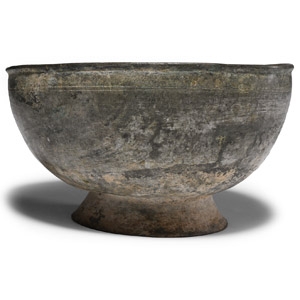
Late Roman Tinned Bronze Bowl
4th-6th century A.D.Sold for (Inc. bp): £72
Hemispherical in profile with applied flared base, thickened rim and two parallel incised lines below. 313 grams, 16 cm
From an old UK collection. Acquired from Red House Antiques, York, 2010. Ian Wilkinson collection, Nottinghamshire, UK.
These bronze vessels were typical of the Late Roman Empire. They were direct forerunners of the Frankish types. They often had Christian inscriptions and have been found with silver spoons for liturgical use. -
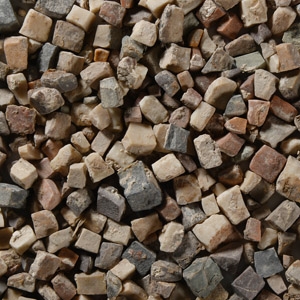
Roman Mosaic Stone Tesserae Group
1st-4th century A.D.Sold for (Inc. bp): £20
A mixed group of over hundred single tesserae of various colours and sizes. 130 grams total, 1-14 mm
Acquired 1980-2015. Ex Abelita family collection. -
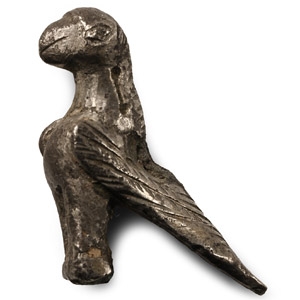
Roman Silver Eagle Statuette
2nd-3rd century A.D.Sold for (Inc. bp): £72
Modelled perching with wings folded, detailed plumage. 7.8 grams, 23 mm
Acquired 1960s-1990s. From the late Alison Barker collection, a retired London barrister.
