
Auction Highlights
-
.jpg)
Greek Marble Head of Dionysus
Sold for (Inc. bp): £23,400
Carved in the half-round in three-quarter view, youthful male head with stern features, hair gathered in a browband, horns to the brow; from a frieze or relief; mounted on a custom-made stand. -
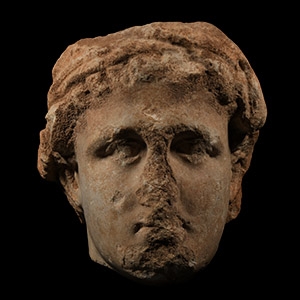
Greek Marble Head of a Ruler
Sold for (Inc. bp): £31,200
Carved in the round with thick wreath of laurel leaves to the brow, short tousled hair, stern face with thick jaw; mounted on a custom-made stand. -
.jpg)
Roman Veined Marble Torso of an Athlete
Sold for (Inc. bp): £48,100
Standing contrapposto with his weight on his right leg and the left leg brought slightly forward; the musculature of the torso displaying well-defined pectoral muscles, prominent abdominal muscles and wide shoulders, the back with equally toned musculature and well-formed rounded buttocks; the veining of the marble accentuating the idealised anatomy; the now-absent head was most probably turned towards the supporting leg and the left arm would have been raised; mounted on a custom-made display stand. -
.jpg)
Large Middle Elamite Cylinder Seal of Kidnu, Chief Overseer of King Tan-Ruhurater II
Sold for (Inc. bp): £15,600
A high-status green chalcedony seal with frieze depicting a seated figure in horned headdress facing a standing figure with arms outstretched, small monkey to the legs; six columns of Akkadian cuneiform text transliterated as: 1. ki-di-nu UGULA KUŠ-MEŠ 2. GAL šà tan-dru-hu- 3. ra-te-er EŠŠANA šu-ši 4. u an-za-an ARAD 5. šà dha-te-ri-iš 6. šak(?) ì-lí-šu 'Kidinu, chief overseer of the equerries(?) of Tan-Ruhurater, King of Susa and Anzan, servant of Haterishshak, his god'. The seal's owner was an official of King Tan-Ruhurater II (circa 1450 B.C.), king of Susa and Anzan. The title used to describe Kidinu is sometimes translated 'high official', elsewhere 'horse groom' or 'animal trainer'; the Elamite deity Haterish is otherwise unknown. -
.jpg)
Mesopotamian Torch Bearer Stand with Lion Tamer
Sold for (Inc. bp): £46,800
A substantial torch bearer depicting a male lion or panther standing with legs firmly planted on a rectangular base, tail extending to the ground, with a massive circular shaped armature or candelabra issuing from its back and wearing an elaborate muzzle, the eyes retaining shell inlay with a circular hollow for the pupils; to the right of the beast a kneeling nude male wearing a large belt-armour and a diadem, eyes inlaid, left hand extended to the side and holding the lion's leash.
-
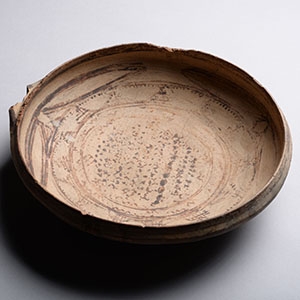
Cypriot Decorated Bowl with Stamped Characters to Reverse
Roman Period, 2nd century B.C.-2nd century A.D.Sold for (Inc. bp): £195
A wide bowl with carinated lip and lateral lug handle on a flat base; decorated on both sides with umber pigment on a white slip; to the outer face, a snake and band motif; to the inner face, multiple bands of crescentic, triangular net and zig-zag motifs; to the underside, low-relief inscription (partly legible). 535 grams, 23.5 cm
Tackey Crist, Cyprus Museum collection, NC, USA. Ex Leland Little auctions. with Cyprus Museum of Jacksonville, North Carolina, USA.
The piece is reminiscent of earlier white-painted wares of the middle-late Cypriot period. Although wheel-made white-painted ware is known from as far back as the Late Cypriot period (1300-1200 B.C.), the present piece must date to the Roman occupation of the island (from approximately the 2nd century B.C. onwards) because of the reserved (not impressed) Latin characters extant on the underside. The characters appear to have been applied to the clay whilst the vessel was wet. The inscription is impossible to decipher fully but contains the characters ... IN... ..AN.... ...DE M..... The use of 'D rather than Greek delta 'Δ' implies a Latin text. -
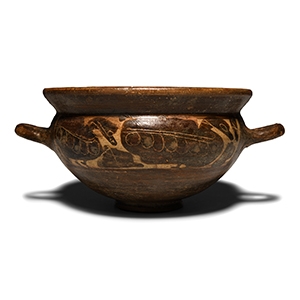
Etrusco-Corinthian Bowl with Painted Ducks
575-550 B.C.Sold for (Inc. bp): £845
Squat skyphos on a low, pared conical base; two small horizontal handles round in section, short flaring everted rim; painted in dark brown with decoration limited to two window-like areas between the handles; on either side of the bowl two large ducks moving to the right with incision and overpaint clarifying the mass of the bodies, wings indicated with two quick horizontal strokes and a row of pendant arcs or scallops with dots of red and white overpaint for a rich, feathered effect; rosettes filling the space around the ducks. 257 grams, 18 cm wide
In the collection of Mr Ulfert Wilke, founding Director of the University of Iowa Museum of Art. Acquired from Ulfert Wilke on 29 May 1968. From the collection of Dr Howard Sirak, Columbus, Ohio, USA. Ex I.M. Chait Gallery, Los Angeles, USA, 14 December 2020, lot 212. Property of a South Australian private collector, with collection reference 20.34. Accompanied by detailed collector's catalogue pages including description and photograph.
The catalogue cites this piece as no. 3.10 from the Wilke Collection and the original sticker is on the base. The catalogue was for the exhibition at the University of Iowa Museum of Art from 17 March to 30 April 1971. -
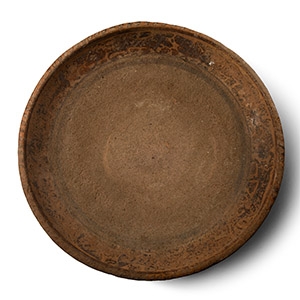
Large Corinthian Mortarium with Frieze of Swans and Lions
Archaic, circa 8th-7th century B.C.Sold for (Inc. bp): £364
Broad dished bowl with carinated profile, flat rim with slashed detailing, band of reserved advancing lions and swans; central panel roughened for grinding. 3.3 kg, 33.5 cm wide
From a collection acquired on the UK art market from various auction houses and collections mostly before 2000. From an important Cambridgeshire estate; thence by descent. Accompanied by a thermoluminescence analysis report no.N124d55 from Oxford Authentication. -
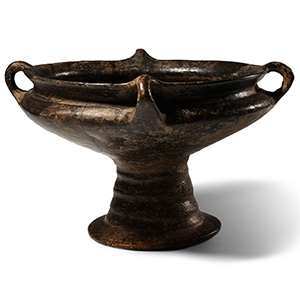
Etruscan Impasto Chalice
Circa 6th century B.C.Sold for (Inc. bp): £468
With ribbed stem tapering to a low wide bowl; four loop handles on outside of bowl connecting outer lip of inverted rim to bowl; inside with nine wide equidistant grooves to centre of grooved circle at base of bowl; some restoration. 755 grams, 22.5 cm
From the George R. Francoeur Trust, Bloomfield Hills, Michigan, with collection inventory no.319; acquired in 1982. Ex Hindman Auctions, Chicago, USA, sale, lot 72. Property of a South Australian private collector, with collection reference 20.09. Accompanied by detailed collector's catalogue pages including description and photograph. Accompanied by a Francoeur Trust inventory card with inventory number 82.319), along with collection label 319 to its base. George R. Francoeur (1934-2019) received his Master’s Degree of Fine Arts from the University of Michigan and was a dedicated arts teacher for many years at Cranbrook Academy of Arts. His collection of ancient art was offered at auction by Hindman Auctions, with the proceeds benefiting the George R. Francoeur Scholarship Fund at Cranbrook Academy of Art.
Impasto and bucchero also share techniques that were used to form and decorate the vessels. Bucchero chalices with distinctive fluted walls were popular products during the first half of the 6th century B.C. at a number of Etruscan sites. It is likely that the inspiration for fluted chalices came from metalwork. Undecorated examples have been found at Poggio Buco. -
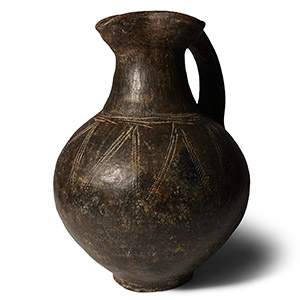
Villanovan Impasto Handled Oinochoe
Circa 9th-7th century B.C.Sold for (Inc. bp): £936
Wheel-thrown and with a highly-burnished surface, comprising a protruding foot beneath the globular body, a tapering cylindrical neck and a trefoil-lipped spout, a wide strap handle joining spout to shoulder; decorated with an incised corded motif formin twisting rope patterns around the neck and zigzag across the body; repaired. 2.38 kg, 30 cm high
Ex Richard Brockway, Vero Beach, Florida, USA. Ex Arte Primitivo, New York, USA, in 1995. with Artemis Gallery, Colorado, USA, 22 February 2019, lot 48E (US$2,500-3,500). Property of a South Australian private collector, with collection reference 20.07. Accompanied by detailed collector's catalogue pages including description and photograph. -
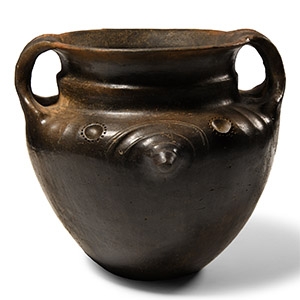
Villanovan Impasto Amphora with Anthropomorphic Decoration
Early 7th century B.C.Sold for (Inc. bp): £780
Burnished impasto amphora with lateral strap handles, everted rim, impressed dimples and other decoration to the broad shoulder; with some repairs. 948 grams, 17 cm high
Ex Galerie am Museum Jürgen Haering, Freiburg, Germany. From the collection of Dr Werner Cordes, Hagen, Germany, 1988. with Hammer Auktionen, Basel, Switzerland, sale 54, lot 121. Property of a South Australian private collector, with collection reference 21.25. Accompanied by detailed collector's catalogue pages including description and photograph. -
.jpg)
Etruscan Bronze Statuette with Offering
4th-3rd century B.C.Sold for (Inc. bp): £845
Modelled in the round as a figure of a lar standing with the left hand raised with palm facing forwards, right arm extending forwards and holding a patera in the hand; wearing a close-fitting short-sleeved tunic with a folded and draped mantle above; the face with aquiline nose, lentoid eyes and a small pursed mouth and with a loose-fitting cap retaining the hair; mounted on a custom-made display stand. 295 grams total, 13.3 cm including stand
From a collection acquired on the UK art market from various auction houses and collections mostly before 2000. From an important Cambridgeshire estate; thence by descent.
The gesture is typical for making sacrifice. The curved hem of the garment, which originally could be seen both behind and in front of the left leg, shows that this is a tebenna, a typical Etruscan male dress, distinguished by its semi-circular shape from the rectangular Greek himation. -
.jpg)
Graeco-Roman Bronze Harpocrates Figure
Circa 1st century B.C.-1st century A.D.Sold for (Inc. bp): £546
Standing nude and supporting a rearing uraeus on his left arm, remains of his side-lock on the right shoulder; mounted on a custom-made stand. 283 grams total, 12.4 cm including stand
Ex Elsa Blohsh-Diener collection, Bern, Switzerland. Property of a French collector. -
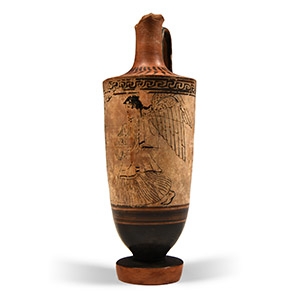
Greek 'Lord Elgin's' Attic White-Ground and Black-Figure Lekythos, Circle of the Aischines Painter
Circa 450 century B.C.Sold for (Inc. bp): £2,860
Attic white-ground and black-figure cylindrical lekythos; circle of the Aischines Painter; on the body an outlined figure of Nike with torch; above, a maeander, and on the shoulder two circles of rays; mouth missing, foot replaced; small hole behind the head filled up, the colour partially rubbed. 173 grams, 17 cm
From the collection of Lord Elgin (BAPD 12703). Ex Coins and Medals, Attic Red-Figure Vases, Basel, Special List N, May 1971, no.48. Ex Imhof collection, Germany. Acquired Bonhams & Brooks, London, 26 April 2001, no.37. From the C.K. private collection, Graz. with Gorny & Mosch, Munich, 30 June 2017, no.15. Property of a North London collector. Accompanied by copies of the relevant Bonhams & Brooks and Gorny & Mosch catalogue pages, and the original Bonhams & Brooks lot tag.
Once in the collection of Lord Elgin. With the corresponding pages of the M&M and Bonhams catalogues (copies). -
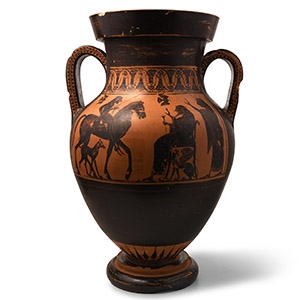
Greek Chalcidian Black-Figure Amphora with Heracles and Nemean Lion
Circa 650-575 B.C.Sold for (Inc. bp): £45,500
With two figural scenes: Side A: the first of the canonical labours of Heracles, the fight against the Nemean lion - in the centre the hero standing over the lion, strangling it with his left arm while thrusting his sword into its neck; two other standing figures witness the fight - on the right Athena, fully armed and ready to defend Heracles with her lance, and to the left Hermes, recognisable by his hat (petasos), winged boots and the caduceus; Side B: a nude horseman, holding his lance and accompanied by his dog, walking towards a king seated on his throne, holding a sceptre in his left hand; on the far right, a standing woman, probably the king's wife; a sphinx under the throne and two flying birds; some restoration. 3.1 kg, 43.5 cm
Some restoration, in general in good condition.
Ex German private collection. with Hampel Kunst Auction, Munich, 2012, no.867. Private European collection, thence by family descent. Accompanied by an academic report by Dr Raffaele D’Amato. This lot has been checked against the Interpol Database of stolen works of art and is accompanied by a search certificate number no.12069-218134.
The shape is typical of the period, and is decorated with black-figured technique, in which the figures were silhouetted in black slip on a reddish clay ground, and linear elements were incised with a needle, with additional details painted with white and cherry red-slip. The amphora seems to belong to one of the sub-types of the ‘Pseudo-Chalcidian’ group (the Poliphemus group), derived from the main Chalcidian series -
Greek Marble Head of a Ruler
Hellenistic, 3rd-1st century B.C.Sold for (Inc. bp): £31,200
Carved in the round with thick wreath of laurel leaves to the brow, short tousled hair, stern face with thick jaw; mounted on a custom-made stand. 23.7 kg total, 42.5 cm including stand
with Artemis Gallery, Munich, Germany, before 1998. with Oliver Forge, London, UK. Private collection, acquired from the above. Accompanied by a copy of an Art Loss Register certificate. Accompanied by an academic report by Prof. Neritan Ceka. This lot has been checked against the Interpol Database of stolen works of art and is accompanied by a search certificate number no.12092-218139.
The life-size head represents an adult male, probably still in his youth. The man is depicted with a short hair, and probably wearing a diadem of which the lower edge is partially visible. The size, the use of marble, and the quality of this work suggest that it was a portrait of a nobleman or possibly a prince of the Hellenistic period. -
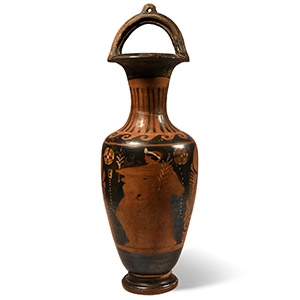
Greek Campanian Red-Figure Bail-Amphora with Male Figures
Circa 4th century B.C.Sold for (Inc. bp): £1,235
Comprising a tapering body and tiered foot, trumpet-shaped mouth with arched handle and bail; vertical rays to the neck, wave pattern to the shoulder, reserved male figure wearing a himation and holding a thyrsus, with tendrils and objects in the field. 733 grams, 36.5 cm
From a British deceased estate. with Christie's, London, 28 April 2009, no.239. Property of a North London collector. Accompanied by copies of the relevant Christie's catalogue pages.
