
Auction Highlights
-
.jpg)
Greek Marble Head of Dionysus
Sold for (Inc. bp): £23,400
Carved in the half-round in three-quarter view, youthful male head with stern features, hair gathered in a browband, horns to the brow; from a frieze or relief; mounted on a custom-made stand. -
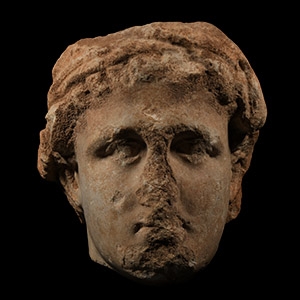
Greek Marble Head of a Ruler
Sold for (Inc. bp): £31,200
Carved in the round with thick wreath of laurel leaves to the brow, short tousled hair, stern face with thick jaw; mounted on a custom-made stand. -
.jpg)
Roman Veined Marble Torso of an Athlete
Sold for (Inc. bp): £48,100
Standing contrapposto with his weight on his right leg and the left leg brought slightly forward; the musculature of the torso displaying well-defined pectoral muscles, prominent abdominal muscles and wide shoulders, the back with equally toned musculature and well-formed rounded buttocks; the veining of the marble accentuating the idealised anatomy; the now-absent head was most probably turned towards the supporting leg and the left arm would have been raised; mounted on a custom-made display stand. -
.jpg)
Large Middle Elamite Cylinder Seal of Kidnu, Chief Overseer of King Tan-Ruhurater II
Sold for (Inc. bp): £15,600
A high-status green chalcedony seal with frieze depicting a seated figure in horned headdress facing a standing figure with arms outstretched, small monkey to the legs; six columns of Akkadian cuneiform text transliterated as: 1. ki-di-nu UGULA KUŠ-MEŠ 2. GAL šà tan-dru-hu- 3. ra-te-er EŠŠANA šu-ši 4. u an-za-an ARAD 5. šà dha-te-ri-iš 6. šak(?) ì-lí-šu 'Kidinu, chief overseer of the equerries(?) of Tan-Ruhurater, King of Susa and Anzan, servant of Haterishshak, his god'. The seal's owner was an official of King Tan-Ruhurater II (circa 1450 B.C.), king of Susa and Anzan. The title used to describe Kidinu is sometimes translated 'high official', elsewhere 'horse groom' or 'animal trainer'; the Elamite deity Haterish is otherwise unknown. -
.jpg)
Mesopotamian Torch Bearer Stand with Lion Tamer
Sold for (Inc. bp): £46,800
A substantial torch bearer depicting a male lion or panther standing with legs firmly planted on a rectangular base, tail extending to the ground, with a massive circular shaped armature or candelabra issuing from its back and wearing an elaborate muzzle, the eyes retaining shell inlay with a circular hollow for the pupils; to the right of the beast a kneeling nude male wearing a large belt-armour and a diadem, eyes inlaid, left hand extended to the side and holding the lion's leash.
-
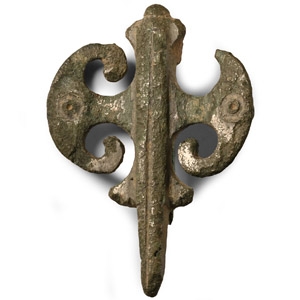
Roman Bronze Double Axe-Shaped Plate Brooch
2nd century A.D.Sold for (Inc. bp): £117
With vertical spine and peltoid lateral extensions with silvered surface, enamelled annular motif to the centre of each; pin and catchplate to the reverse. 10 grams, 42 mm
UK art market, acquired prior to 1980. Property of a Kent lady collector. -
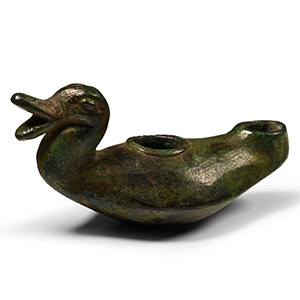
Late Roman Bronze Oil Lamp with Duck Head Handle
5th-7th century A.D.Sold for (Inc. bp): £468
Hollow-formed slipper-shaped oil lamp with central filler hole and short nozzle, basal ring; the handle formed as a duck's head with open beak. 143 grams, 87 mm
Acquired on the German art market, 1989-1995. with The Museum Gallery, 19 Bury Place, London, WC1A 2JB, 1998-2003. Property of a London based academic, 2003-present.
The lamp belongs to the category of lamps with flattened spherical bodies, that have a certain number of variations in their nozzle, handle, lid and base designs. The most common form, like here, is that in which the body is heightened towards the front to form the nozzle. Many examples have oyster shell shaped lids which are connected to the body with hinges. -
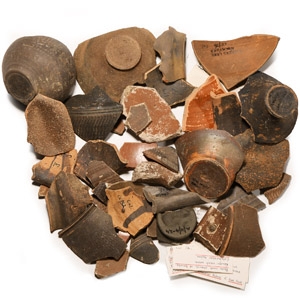
Romano-British Castor Ware and Other Sherd Group
1st-4th century A.D.Sold for (Inc. bp): £130
Mixed group of sherds, many with inked reference number, and collector's display cards including 'Sherd of calcite gritted bowl. Indented rim. Colchester kilns. 4th Cent.', 'NENE VALLEY / NVCIO', 'Col' for Colchester, 'CANVEY ISLAND / CC/6', 'MG/105 / CAMBRIDGE / P.', LONDON / CC/27', 'TINKERS LANE / ROCHFORD / CC/26'. 804 grams total, 2.5-10 cm
Found UK. From the collection of a late East Anglian teacher and antiquarian who retired to the Isle of Wight in Hampshire, UK. He amassed a large collection of objects between the 1960s-1980s. Accompanied by handwritten information display cards. -
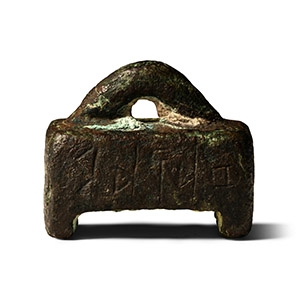
Roman Bronze Epigraphic Codex Ansatus Model
1st-4th century A.D.Sold for (Inc. bp): £351
Rectangular with two supporting bars to the underside, extended loop above; enigmatic (Greek) letters to all faces. 63.7 grams, 33 mm
with Hotel des Ventes, Drouot, Paris, France. From the collection of Mr H. Naudy, Paris, France. Acquired at between 2004-2010. Property of a French collector.
This small counter-weight bears letters indicating numbers: on one of the short sides Α (1), Δ (4), Χ (600); on the other short side they worn and difficult to read; and on one of the longer sides Υ (400), φ (500). The other letters are challenging to read, but the object would have been used as unit of measure. Another possibility is that it belonged to a statuette of a man holding a codex ansatus (box with a handle for carrying writing tablets). -
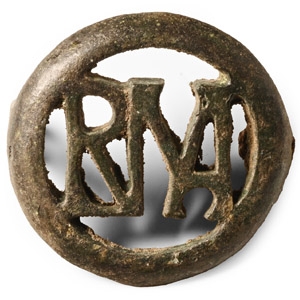
Roman Bronze ROMA Brooch
2nd-3rd century A.D.Sold for (Inc. bp): £208
The discoid body formed as an openwork monogram ROMA in Latin letters, the M and A ligated, the O formed by the brooch frame itself; ROMA also a palindrome for AMOR. 13.9 grams, 32 mm
Ex German art market, 2000s. Acquired from an EU collector living in London. From the collection of Surrey, UK, gentleman.
The brooch is engraved with stylised letters ‘RMA’. When viewed from the default side, RMA + the circle of the brooch form a monogram for ‘Roma’. Roma refers to both the city and its divine personification, the Dea Roma. When RMA is read from right to left (or the brooch is viewed from the opposite side), the letters form a monogram for ‘AMOR’, the Latin name for Cupid, the god of love. The phrase pertains to Roma-Amor, a widely recognised palindrome espousing Roman wordplay in the ancient times. -
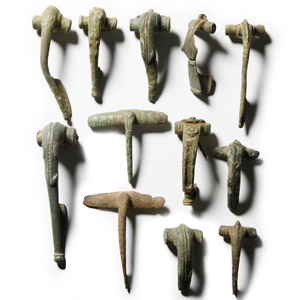
Romano-British 'Gloucestershire' Bow Brooch Collection
Circa 1st-3rd century A.D.Sold for (Inc. bp): £143
Including Langton Down type, dolphin type, and others. 125 grams total, 29-66 mm
Found Gloucestershire, UK. -
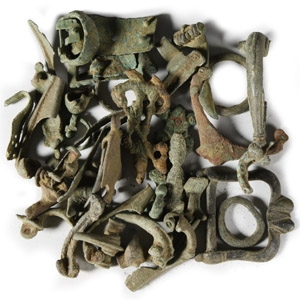
Roman to Post Medieval Artefact Collection
Circa 1st-18th century A.D.Sold for (Inc. bp): £39
Including T-shaped brooches, Langton Down brooches, D-shaped buckle with strap, belt and harness fittings and other items. 200 grams total, 16-56 mm
Found Gloucestershire, UK. -
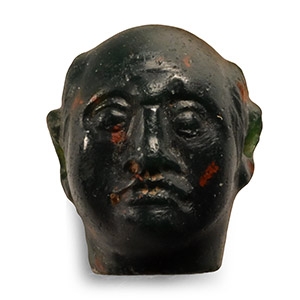
Roman Head of a Philosopher Bead
Circa 1st century B.C.-1st century A.D.Sold for (Inc. bp): £91
Carved with a severe facial expression, short cropped hair, pierced at the ears, old collector's label '018' to the underside. 3.05 grams, 14 mm
From the glyptic collection of Mr X; thence by descent. Acquired Hotel des Ventes, Drouot, Eve SVV, Paris, France, 28 June 2017, no.152 (Part). Property of a French collector. -
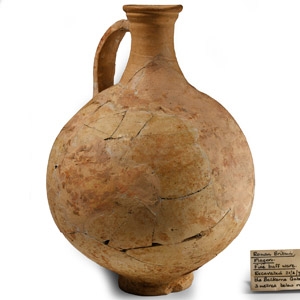
Romano-British 'Colchester' Buff Ware Jug
Circa 2nd century A.D.Sold for (Inc. bp): £182
Globular vessel with gusseted strap handle and trumpet-shaped mouth; accompanied by old collector's display label 'Roman Britain / Flagon / Fine buff ware 2nd. Cent. A.D. / Excavated 21/3/76. 15 metres S.W of / the Balkerne gate, Colchester / 3 metres below road surface'. 640 grams, 22.5 cm
Excavated near Balkerne Gate, Colchester, UK, on 21st March 1976, by R. McCluskey. From the collection of a late East Anglian teacher and antiquarian who retired to the Isle of Wight in Hampshire, UK. He amassed a large collection of objects between the 1960s-1980s. Accompanied by an old handwritten information card. -
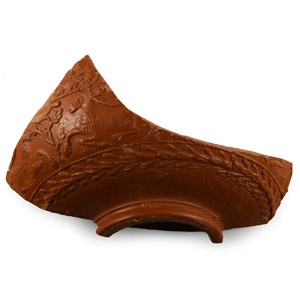
Romano-British 'Colchester' Samian Ware Sherd
1st century A.D.Sold for (Inc. bp): £78
Large fragment with portion of base and low-relief laurel wreath, stags, tree and other ornament; inked inscription 'Colchester 149/001256 / NE Car Ditch 10.5.72' and typed record card 'Section of Bowl. / Provenance: Colchester. / Dragendorff. Type 37.'. 155 grams, 15.7 cm
Found Colchester, Essex, UK, 1972. From the collection of a late East Anglian teacher and antiquarian who retired to the Isle of Wight in Hampshire, UK. He amassed a large collection of objects between the 1960s-1980s. -
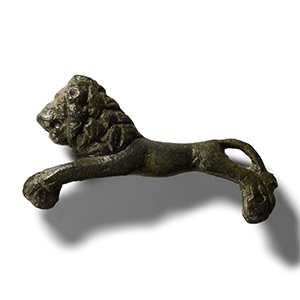
Roman 'Essex' Bronze Lion Military Folding Knife Handle
3rd-4th century A.D.Sold for (Inc. bp): £247
Formed as a leaping lion with pivot holes to the forepaws, split to the hindlegs to accommodate the blade. 63 grams, 74 mm
Found Essex, UK. Property of an Essex collector. -
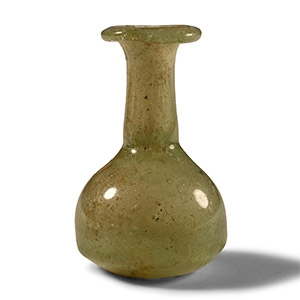
Late Roman Green Glass Vessel
4th-6th century A.D.Sold for (Inc. bp): £98
With squat oblate body, tubular neck with occlusion at the lower end and flared returned rim, pontil base. 44.8 grams, 70 mm
Acquired from Allan Cherry, Bournemouth, UK, 2004. Ian Wilkinson collection, Nottinghamshire, UK.
