
Auction Highlights
-
.jpg)
Greek Marble Head of Dionysus
Sold for (Inc. bp): £23,400
Carved in the half-round in three-quarter view, youthful male head with stern features, hair gathered in a browband, horns to the brow; from a frieze or relief; mounted on a custom-made stand. -
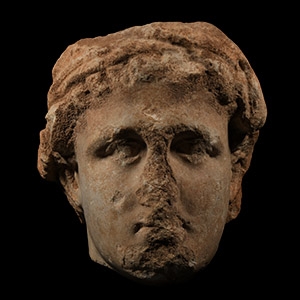
Greek Marble Head of a Ruler
Sold for (Inc. bp): £31,200
Carved in the round with thick wreath of laurel leaves to the brow, short tousled hair, stern face with thick jaw; mounted on a custom-made stand. -
.jpg)
Roman Veined Marble Torso of an Athlete
Sold for (Inc. bp): £48,100
Standing contrapposto with his weight on his right leg and the left leg brought slightly forward; the musculature of the torso displaying well-defined pectoral muscles, prominent abdominal muscles and wide shoulders, the back with equally toned musculature and well-formed rounded buttocks; the veining of the marble accentuating the idealised anatomy; the now-absent head was most probably turned towards the supporting leg and the left arm would have been raised; mounted on a custom-made display stand. -
.jpg)
Large Middle Elamite Cylinder Seal of Kidnu, Chief Overseer of King Tan-Ruhurater II
Sold for (Inc. bp): £15,600
A high-status green chalcedony seal with frieze depicting a seated figure in horned headdress facing a standing figure with arms outstretched, small monkey to the legs; six columns of Akkadian cuneiform text transliterated as: 1. ki-di-nu UGULA KUŠ-MEŠ 2. GAL šà tan-dru-hu- 3. ra-te-er EŠŠANA šu-ši 4. u an-za-an ARAD 5. šà dha-te-ri-iš 6. šak(?) ì-lí-šu 'Kidinu, chief overseer of the equerries(?) of Tan-Ruhurater, King of Susa and Anzan, servant of Haterishshak, his god'. The seal's owner was an official of King Tan-Ruhurater II (circa 1450 B.C.), king of Susa and Anzan. The title used to describe Kidinu is sometimes translated 'high official', elsewhere 'horse groom' or 'animal trainer'; the Elamite deity Haterish is otherwise unknown. -
.jpg)
Mesopotamian Torch Bearer Stand with Lion Tamer
Sold for (Inc. bp): £46,800
A substantial torch bearer depicting a male lion or panther standing with legs firmly planted on a rectangular base, tail extending to the ground, with a massive circular shaped armature or candelabra issuing from its back and wearing an elaborate muzzle, the eyes retaining shell inlay with a circular hollow for the pupils; to the right of the beast a kneeling nude male wearing a large belt-armour and a diadem, eyes inlaid, left hand extended to the side and holding the lion's leash.
-
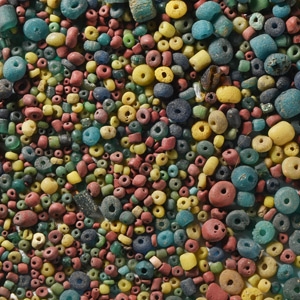
Roman and Other Mixed Glass Bead Group
1st-4th century A.D. and laterSold for (Inc. bp): £91
Including spherical, annular and other types including some 'trade wind beads'. 140 grams total, 1-9 mm
From the private collection of the late Mrs Belinda Ellison, a long time member of the Egyptian Exploration Society, c.1940-2020. -
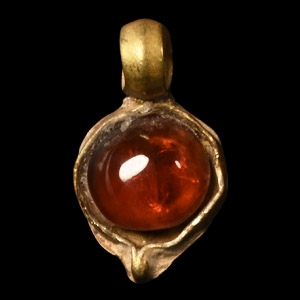
Roman Gold Pendant with Cabochon Garnet
1st-4th century A.D.Sold for (Inc. bp): £182
Discoid pendant with cell, inset cabochon garnet, integral loop above. 0.16 grams, 8 mm
Ex property of a late Japanese collector, 1970s. -
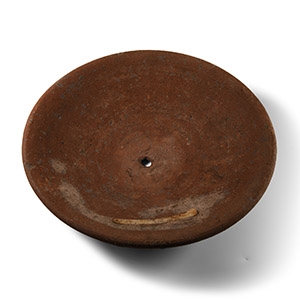
Roman 'Columbarium at Ostia' Terracotta Sepulchral Urn Lid
1st-4th century A.D.Sold for (Inc. bp): £46
Of domed profile with central vent; old handwritten label to reverse 'Lid from an urn from Columbarium at Ostia. [...] 1867' and another, typed, to the obverse 'Lid of sepulchral Urn from Columbarium at Ostia (From Rev. J. Pyke'. 492 grams, 21 cm
Found Columbarium at Ostia, Italy, in 1867. From the 19th century collection of Rev J. Pyke. From the collection of a late East Anglian teacher and antiquarian who retired to the Isle of Wight in Hampshire, UK. He amassed a large collection of objects between the 1960s-1980s. -
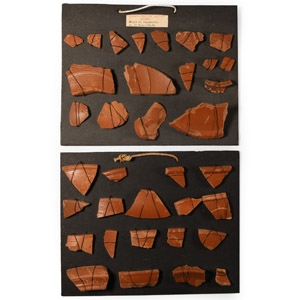
Romano-British 'Hampshire' Samian Ware Sherd Collection on Display Cards
Late 1st century B.C.-early 1st century A.D.Sold for (Inc. bp): £59
Mixed group of decorated Samian ware fragments mounted on card display boards, one with old typed label: 'COARSE BEAD RIM POTTERY SHERDS. / Found in Hampshire. / c. 25 B.C.-25A.D.'. 534 grams total, 25.5 x 20.5 cm each
Found Hampshire UK. From the collection of a late East Anglian teacher and antiquarian who retired to the Isle of Wight in Hampshire, UK. He amassed a large collection of objects between the 1960s-1980s. -
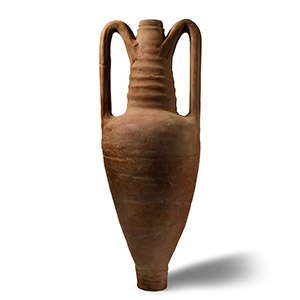
Large Roman Aegean Terracotta Amphora
Early 3rd century B.C.Sold for (Inc. bp): £1,950
Tall and with a narrow base, two sturdy ribbed strap handles and a conical neck with a stepped profile; restored. 7.8 kg, 69 cm
From a collection acquired on the UK art market from various auction houses and collections mostly before 2000. From an important Cambridgeshire estate; thence by descent. -
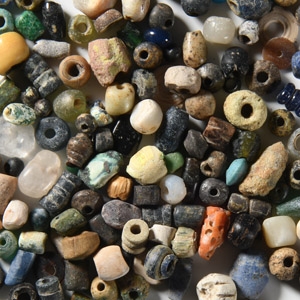
Roman Glass and Other Bead Group
1st-4th century A.D.Sold for (Inc. bp): £117
Including oblate, melon, tubular, fusiform and other types. 29 grams total, 2-11 mm
Acquired from Allan Cherry at the Birmingham Coin & Antiquities Fair, UK, in 2006. Ian Wilkinson collection, Nottinghamshire, UK. -
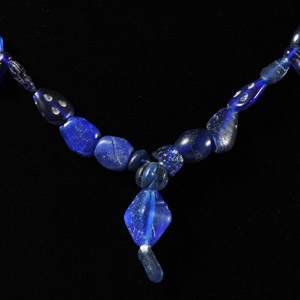
Roman and Other Bead Necklace
1st-4th century A.D. and laterSold for (Inc. bp): £78
Restrung designer necklace composed of stone and glass beads of tubular, biconvex, polyhedral and other types, large biconvex bead as centrepiece. 19 grams, 38 cm
Acquired on the London, UK, art market in the 1990s. Ex London, UK, gallery. -
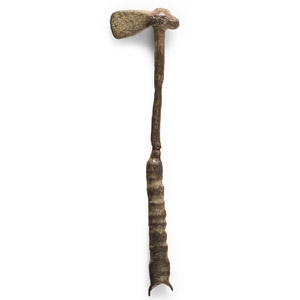
Roman 'Essex' Bronze Votive Axehead Amulet
1st-2nd century A.D.Sold for (Inc. bp): £52
Comprising a round-section shaft with ribbed handle detailing, loop finial, head with trapezoidal blade. 2.16 grams, 50 mm
Found Essex, UK. Property of an Essex collector. -
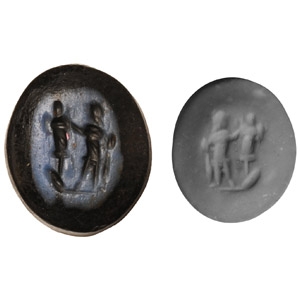
Roman Gem with Emperor with Trophy
2nd-3rd century A.D.Sold for (Inc. bp): £169
Glass imitating nicolo with incuse motif of a triumphant emperor holding up a trophaeum; supplied with a museum-quality impression. 0.56 grams, 11 mm
From the Fadel family collection, London, UK, 1970s. -
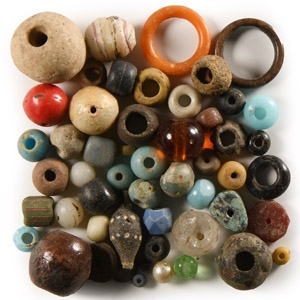
'Thames' Bead Collection
1st-2nd millennium A.D.Sold for (Inc. bp): £156
Including annular, spherical, tabular and other types in various materials. 66 grams total, 3-22 mm
Found Billingsgate spoil from the Thames foreshore, London, UK, circa 1984. Property of an Essex collector. -
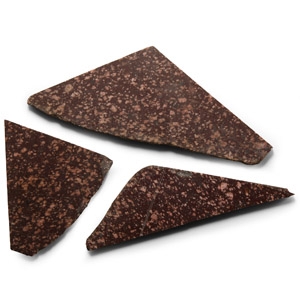
Roman Historic Cut & Polished Porphyry Slice Group
1st-5th century A.D. and laterSold for (Inc. bp): £104
Comprising three lacquered porphyry slices of rectangular shape, cut on both faces and polished on one face; probably from recycled material mined in ancient Roman times between the 1st and 5th century A.D.; intended for use as inlay panels. 81 grams total, 5.8-12.2 cm
From Egypt. Ex Mineral Imports, London, UK. Gregory, Bottley & Lloyd (Gregory's).
Mons Porphyrites (today Jabal Abu Dukhkhan) is the mountainous site of a group of ancient quarries in the Red Sea Hills of the inhospitable eastern desert in Egypt, a five day trip from the Nile during Roman times. They were discovered by Caius Cominus Leugas in 18 A.D., and during the Roman Empire the mines officially belonged to the emperor and were the only known source of the Imperial Porphyry, Mons Porphyrites. This dark purple stone was associated with royalty and used for prestigious sculpture and architecture. The location of the mines was lost some time in the 5th century, and rediscovered in the early 19th century. Excavations in the area have revealed the well-preserved quarries and the dwelling places of the quarry men, and also thousands of ostraca have been discovered containing messages that provide details of how the quarrying took place, and of how the highly skilled quarrymen ordered their food. -
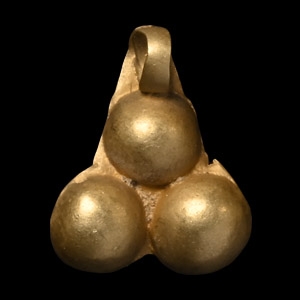
Roman Gold Trefoil Pendant
1st-3rd century A.D.Sold for (Inc. bp): £104
With three hollow-formed bulbs and flat backplate, integral loop. 0.19 grams, 8 mm
Ex property of a late Japanese collector, 1970s.
