
Auction Highlights
-
.jpg)
Greek Marble Head of Dionysus
Sold for (Inc. bp): £23,400
Carved in the half-round in three-quarter view, youthful male head with stern features, hair gathered in a browband, horns to the brow; from a frieze or relief; mounted on a custom-made stand. -
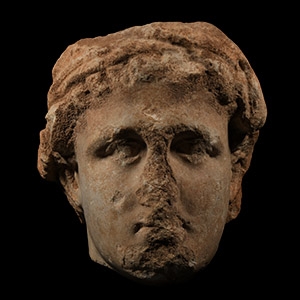
Greek Marble Head of a Ruler
Sold for (Inc. bp): £31,200
Carved in the round with thick wreath of laurel leaves to the brow, short tousled hair, stern face with thick jaw; mounted on a custom-made stand. -
.jpg)
Roman Veined Marble Torso of an Athlete
Sold for (Inc. bp): £48,100
Standing contrapposto with his weight on his right leg and the left leg brought slightly forward; the musculature of the torso displaying well-defined pectoral muscles, prominent abdominal muscles and wide shoulders, the back with equally toned musculature and well-formed rounded buttocks; the veining of the marble accentuating the idealised anatomy; the now-absent head was most probably turned towards the supporting leg and the left arm would have been raised; mounted on a custom-made display stand. -
.jpg)
Large Middle Elamite Cylinder Seal of Kidnu, Chief Overseer of King Tan-Ruhurater II
Sold for (Inc. bp): £15,600
A high-status green chalcedony seal with frieze depicting a seated figure in horned headdress facing a standing figure with arms outstretched, small monkey to the legs; six columns of Akkadian cuneiform text transliterated as: 1. ki-di-nu UGULA KUŠ-MEŠ 2. GAL šà tan-dru-hu- 3. ra-te-er EŠŠANA šu-ši 4. u an-za-an ARAD 5. šà dha-te-ri-iš 6. šak(?) ì-lí-šu 'Kidinu, chief overseer of the equerries(?) of Tan-Ruhurater, King of Susa and Anzan, servant of Haterishshak, his god'. The seal's owner was an official of King Tan-Ruhurater II (circa 1450 B.C.), king of Susa and Anzan. The title used to describe Kidinu is sometimes translated 'high official', elsewhere 'horse groom' or 'animal trainer'; the Elamite deity Haterish is otherwise unknown. -
.jpg)
Mesopotamian Torch Bearer Stand with Lion Tamer
Sold for (Inc. bp): £46,800
A substantial torch bearer depicting a male lion or panther standing with legs firmly planted on a rectangular base, tail extending to the ground, with a massive circular shaped armature or candelabra issuing from its back and wearing an elaborate muzzle, the eyes retaining shell inlay with a circular hollow for the pupils; to the right of the beast a kneeling nude male wearing a large belt-armour and a diadem, eyes inlaid, left hand extended to the side and holding the lion's leash.
-
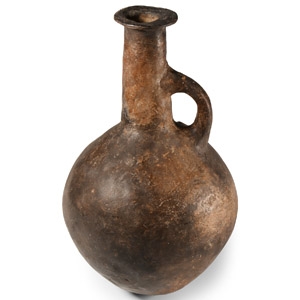
Cypriot Brown Ware Jug
Late Bronze Age, circa 1700 B.C.Sold for (Inc. bp): £156
Comprising a bulbous body with slightly conical underside, tapering tubular neck and everted flange rim, loop handle to the shoulder; restored. 1.03 kg, 25.5 cm
From a collection acquired on the UK art market from various auction houses and collections mostly before 2000. From an important Cambridgeshire estate; thence by descent.
Wheelmade red lustrous ware was a ceramic of foreign origin which found its way into Cyprus during the Late Bronze Age, when international trade was widespread. According to Karageorghis it originated in Anatolia during the early Bronze Age but was known in Alasya (Cyprus) during the Late Bronze Age II. -
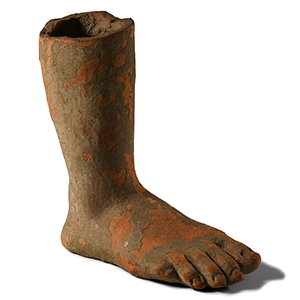
Etruscan Terracotta Foot
Circa 6th-2nd century B.C.Sold for (Inc. bp): £845
Right foot from a statue, hollow-formed and modelled in naturalistic style, with toes slightly curled; with surface deposits and traces of pigment. 868 grams, 19 cm
From the private collection of C.H., Niedersachsen, acquired between the 1960s and 1987. Acquired from Gorny & Mosch, Munich, Germany, 18 December 2018, lot 94 (part). Property of a South Australian private collector, with collection reference 18.10. Accompanied by detailed collector's catalogue pages including description and photograph. Accompanied by a copy of the Gorny & Mosch invoice. -
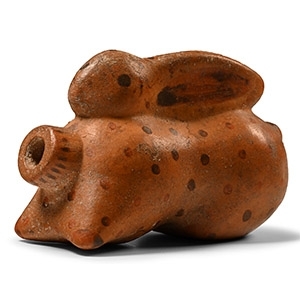
Apulian Terracotta Hare Oil Flask
7th century B.C.Sold for (Inc. bp): £520
Hollow-formed in the shape of a hare at rest with long ears parallel to the spine, vent to the chest; with spot markings to the flanks. 82 grams, 86 mm
Acquired on the German art market, 1989-1995. with The Museum Gallery, 19 Bury Place, London, WC1A 2JB, 1998-2003. Property of a London based academic, 2003-present.
Mould-made aryballoi (perfume flasks) in the shapes of animals were popular in Greece in the 7th and 6th centuries B.C. Aristocratic men gave real hares as gifts to younger male lovers; this vessel might have performed a similar function. -
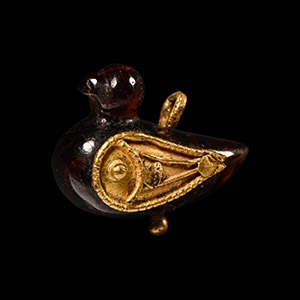
Greek Garnet and Gold Bird Pendant
4th-3rd century B.C.Sold for (Inc. bp): £468
Comprising a carved garnet model bird with applied old wings decorated with beaded wire and granules, gold loop above and stud beneath. 2.77 grams, 15 mm
Ex German art market, 2000s. Acquired from an EU collector living in London. From the collection of Surrey, UK, gentleman. -
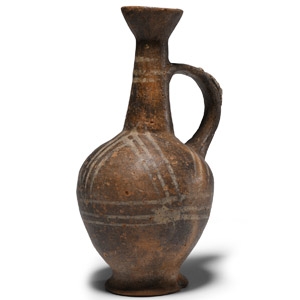
Cypriot Brown Burnished Ware 'Bilbil' Vessel
Late Bronze Age II, 1400-1200 B.C.Sold for (Inc. bp): £260
Unglazed tall juglet (bilbil) with flared foot, piriform body, tapering neck and flared mouth. strap handle; bands of bilinear ornament to the shoulder and neck. 103 grams, 13.7 cm
From a collection acquired on the UK art market from various auction houses and collections mostly before 2000. From an important Cambridgeshire estate; thence by descent. -
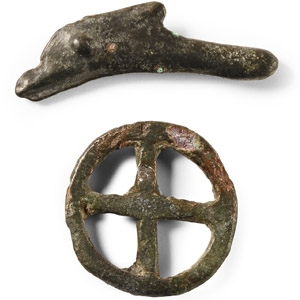
Greek Bronze Dolpin and Wheel Proto-Money Group
Circa 6th century B.C.Sold for (Inc. bp): £78
Comprising: flat-section dolphin-shaped casting with raised eye; wheel-shaped casting with four spokes. 3.98 grams total, 19-29 mm
From a collection acquired on the UK art market from various auction houses and collections mostly before 2000. From an important Cambridgeshire estate; thence by descent.
The dolphin coins were made in Thrace to honour the god Apollo Delphinios. -
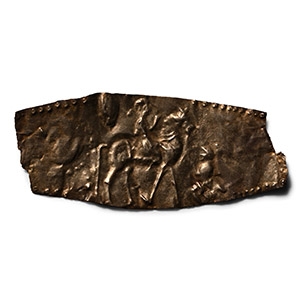
Hellenistic Silver Diadem
4th-3rd century B.C.Sold for (Inc. bp): £124
Leaf-shaped with repoussé frieze of an advancing horseman and kneeling figure; pellets to the border and other ornament. 1.96 grams, 68 mm
From a Northamptonshire collection in early 1990s. Ex Den of Antiquity, Cambridgeshire, UK. -
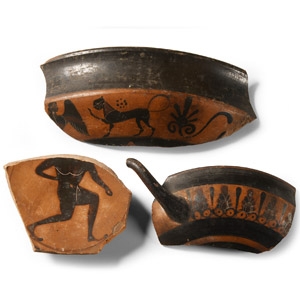
Greek Terracotta Attic Black Figure Vessel Fragment Group
6th century B.C.Sold for (Inc. bp): £546
Comprising: carinated rim fragment from a bowl with reserved siren, panther, rosette and other ornament; bowl base with reserved advancing nude male or satyr on a red field, sgraffito detailing; skyphos rim fragment with part of the handle, reserved egg-and-dart band. 106 grams total, 7.4-13 cm
From an early 20th century collection. By descent the property of a UK lady. Ian Wilkinson collection, Nottinghamshire, UK, formed since 1985. Accompanied by a previous handwritten note including provenance.
The body of the panther resembles the style of the school of Sophilos, an Attic painter active circa 580-560 B.C. The naked image (a dancing satyr?) recalls the Attic black figure depictions of ithyphallic satyrs, with torso, arms, legs and incision for internal details in white paint, made around 500 B.C. -
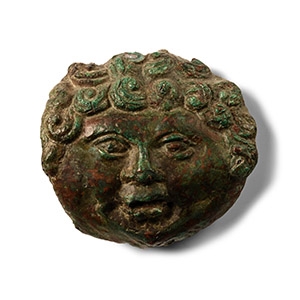
Greek Bronze Medusa Mount
4th-2nd century B.C.Sold for (Inc. bp): £416
Discoid appliqué with gorgoneion motif in high-relief; hollow to reverse. 27.4 grams, 35 mm
Ex German art market, 2000s. Acquired from an EU collector living in London. From the collection of Surrey, UK, gentleman. -
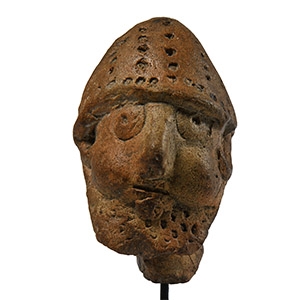
Cypriot Terracotta Head of a Warrior
1st millennium B.C.Sold for (Inc. bp): £117
With conical helmet bearing vertical lines of impressed points (representing rivets), applied square-cut beard and domed eyes; mounted on a custom-made display stand. 95 grams total, 87 mm including stand
Ex Sotheby's 2003-2005. From an important Cambridgeshire estate; thence by descent. -
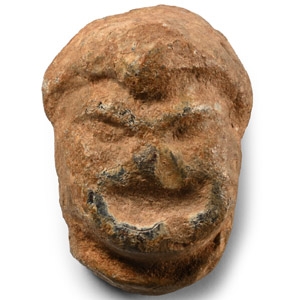
Greek Lead Actor's Mask Weight
Circa 4th-2nd century B.C.Sold for (Inc. bp): £39
D-shaped and plano-convex in section with raised hair, lentoid eyes, large cup-shaped mouth. 31.1 grams, 26 mm
From a collection acquired on the UK art market from various auction houses and collections mostly before 2000. From an important Cambridgeshire estate; thence by descent. -
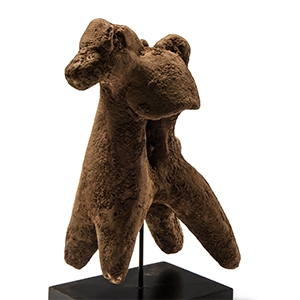
Archaic Greek Terracotta Figure of Mounted Warrior with Shield
7th-5th century B.C.Sold for (Inc. bp): £156
Comprising a stylised horse with elongated neck, mounted by a bearded rider figure holding a shield with right arm bent, restored; mounted on a custom-made display stand. 220 grams total, 13 cm including stand
Acquired before 1990. From an old German collection.
