
Auction Highlights
-
.jpg)
Greek Marble Head of Dionysus
Sold for (Inc. bp): £23,400
Carved in the half-round in three-quarter view, youthful male head with stern features, hair gathered in a browband, horns to the brow; from a frieze or relief; mounted on a custom-made stand. -
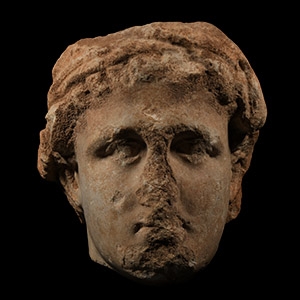
Greek Marble Head of a Ruler
Sold for (Inc. bp): £31,200
Carved in the round with thick wreath of laurel leaves to the brow, short tousled hair, stern face with thick jaw; mounted on a custom-made stand. -
.jpg)
Roman Veined Marble Torso of an Athlete
Sold for (Inc. bp): £48,100
Standing contrapposto with his weight on his right leg and the left leg brought slightly forward; the musculature of the torso displaying well-defined pectoral muscles, prominent abdominal muscles and wide shoulders, the back with equally toned musculature and well-formed rounded buttocks; the veining of the marble accentuating the idealised anatomy; the now-absent head was most probably turned towards the supporting leg and the left arm would have been raised; mounted on a custom-made display stand. -
.jpg)
Large Middle Elamite Cylinder Seal of Kidnu, Chief Overseer of King Tan-Ruhurater II
Sold for (Inc. bp): £15,600
A high-status green chalcedony seal with frieze depicting a seated figure in horned headdress facing a standing figure with arms outstretched, small monkey to the legs; six columns of Akkadian cuneiform text transliterated as: 1. ki-di-nu UGULA KUŠ-MEŠ 2. GAL šà tan-dru-hu- 3. ra-te-er EŠŠANA šu-ši 4. u an-za-an ARAD 5. šà dha-te-ri-iš 6. šak(?) ì-lí-šu 'Kidinu, chief overseer of the equerries(?) of Tan-Ruhurater, King of Susa and Anzan, servant of Haterishshak, his god'. The seal's owner was an official of King Tan-Ruhurater II (circa 1450 B.C.), king of Susa and Anzan. The title used to describe Kidinu is sometimes translated 'high official', elsewhere 'horse groom' or 'animal trainer'; the Elamite deity Haterish is otherwise unknown. -
.jpg)
Mesopotamian Torch Bearer Stand with Lion Tamer
Sold for (Inc. bp): £46,800
A substantial torch bearer depicting a male lion or panther standing with legs firmly planted on a rectangular base, tail extending to the ground, with a massive circular shaped armature or candelabra issuing from its back and wearing an elaborate muzzle, the eyes retaining shell inlay with a circular hollow for the pupils; to the right of the beast a kneeling nude male wearing a large belt-armour and a diadem, eyes inlaid, left hand extended to the side and holding the lion's leash.
-
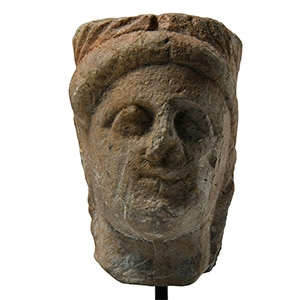
Greek Stone Head of a Caryatid
4th-2nd century B.C.Sold for (Inc. bp): £221
Modelled in the half-round with D-shaped face and short neck, transverse band of hair above the brow and ribbed panel above, flat-topped; slot to lower rear for attachment; mounted on a custom-made display stand. 426 grams total, 14.2 cm including stand
From a collection acquired on the UK art market from various auction houses and collections mostly before 2000. From an important Cambridgeshire estate; thence by descent. -
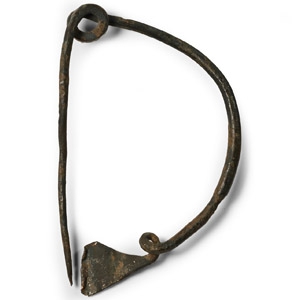
Greek Archaic Bronze Brooch
7th century B.C.Sold for (Inc. bp): £59
Comprising a simple arched bow, coiled pin and a flaring catch-plate. 2.58 grams, 47 mm
Property of the vendor's grandfather, thence by family descent, circa 1985. From the private collection of a New York, USA gentleman. -
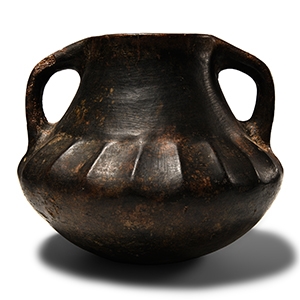
Villanovan Impasto Amphora
Circa 10th-8th century B.C.Sold for (Inc. bp): £364
With a scalloped design on the body and twin symmetrical handles rising from the shoulder; restored. 790 grams, 18.5 cm wide
From the Rempte collection, Upstate New York, USA; acquired before 1980. Ex Artemis Gallery, Colorado, USA, 4 August 2016, lot 10. with a Chicago, USA, collection. Ex Harlan J. Berk Ltd, Chicago, USA. Acquired from Palmyra Heritage Gallery, New York, 27 April 2020, lot 2. Property of a South Australian private collector, with collection reference 20.22. Accompanied by detailed collector's catalogue pages including description and photograph.
The terracotta has a distinctive shape, characterised by vertical grooves and frequently incised double spirals. The style was indigenous to Italy. The handles were thin and flat, while their sharp curves imply that the vessel’s shape originated from metallic prototypes, like shown by silver examples with gold handles found in the Regolini-Galassi Tomb in Caere (modern Cerveteri). -
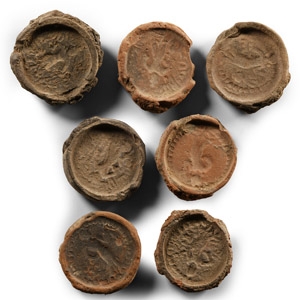
Indo-Greek Terracotta Forger's Mould Group
Circa 2nd-1st century B.C.Sold for (Inc. bp): £390
Group of discoid clay moulds for casting contemporary counterfeit coins. 40.1 grams total, 29-31 mm
Private collection formed in the 1990s. Acquired from a central London gallery. Property of an Essex, UK, gentleman. -
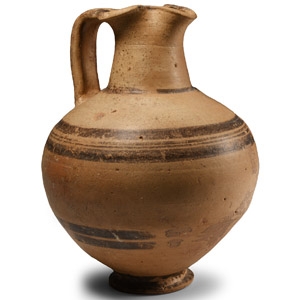
Cypriot Painted Ceramic Oinochoe
Iron Age, circa 700-475 B.C.Sold for (Inc. bp): £247
With trefoil folded rim to the mouth, painted bands to the strap handle, shoulder and lower body. 732 grams, 20 cm
Private estate Cheshire, UK, 1990s. Property of a Bristol, UK, gentleman. -
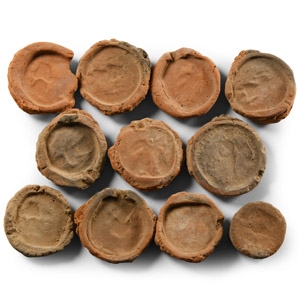
Indo-Greek Terracotta Forger's Mould Group
Circa 2nd-1st century B.C.Sold for (Inc. bp): £260
Group of discoid clay moulds for casting contemporary counterfeit coins. 47 grams total, 20-29 mm
Private collection formed in the 1990s. Acquired from a central London gallery. Property of an Essex, UK, gentleman. -
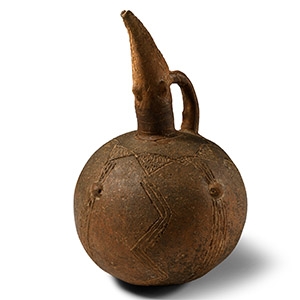
Bronze Age Cypriot Terracotta Burnished Pottery Jug with Handle
Circa 1900-1650 B.C.Sold for (Inc. bp): £468
Comprising a spherical body with tall tubular neck with bulbs and U-section pouring spout, large strap handle to the rear; panels of hatched incised ornament to the body, pierced bulbs. 329 grams, 19.3 cm
Private family collection for the last 50 years. with Bonhams, London, 15 May 2008, no.375 (part). Property of a North London collector. Accompanied by copies of the relevant Bonhams catalogue pages and the original lot tag. -
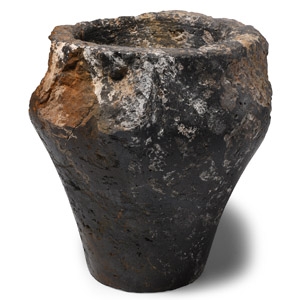
Minoan Black Stone Vessel
AM II-MHIB/IIA, circa 30th-19th century B.C.Sold for (Inc. bp): £195
Substantial carved mortar with narrow base and biconvex body; heavily chipped. 2.1 kg, 13 cm
From a collection acquired on the UK art market from various auction houses and collections mostly before 2000. From an important Cambridgeshire estate; thence by descent.
The vessel corresponds to the Warren type 28, with similar Egyptian parallels and correspondent typologies, with small differences on the edges (see Karetsou et al., 2000, nos.15a and 19a). -
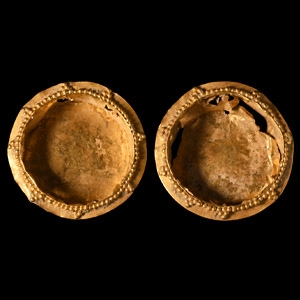
Hellenistic Gold Mount Pair
2nd-1st century B.C.Sold for (Inc. bp): £169
Comprising discoid cells each with shallow sidewall and flange rim, granule collar with radiating clusters. 1.62 grams total, 19 mm each
From a late Japanese specialist collector, 1970-2000s. -
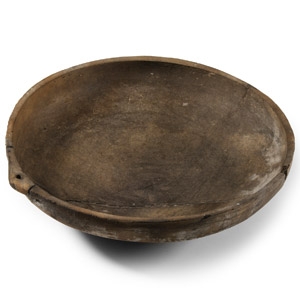
Cypriot Grey Ware Pottery Bowl
Iron Age, Cypro-Geometric, 950-850 B.C.Sold for (Inc. bp): £98
Broad shallow body with disc base, thick rim with pierced lug handle; repaired. 635 grams, 24.5 cm wide
From a collection acquired on the UK art market from various auction houses and collections mostly before 2000. From an important Cambridgeshire estate; thence by descent.
Important Cypro-Geometric ceramic types include white-painted and bichrome wares, often decorated with geometric motifs and showing inventive shapes; slightly later, a distinctive black-on-red wares was developed on Cyprus, partly as a result of contact with the Levant. -
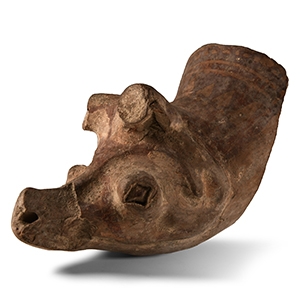
Greek Painted Terracotta Rhyton Fragment
Circa 4th-2nd century B.C.Sold for (Inc. bp): £111
Finial from a rhyton with stylised zoomorphic detailing: elongated snout, applied lozengiform eyes in lobe protrusions, horns or antlers above; curved conical body with tiered inner face, applied red pigment detailing. 442 grams, 15.5 cm
From a collection acquired on the UK art market from various auction houses and collections mostly before 2000. From an important Cambridgeshire estate; thence by descent. -
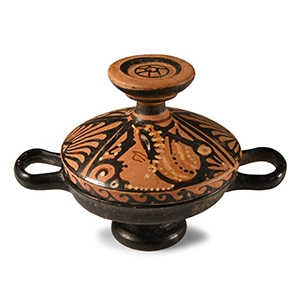
Greek Apulian Red-Figure Pottery Lekanis
Apulian South Italy, 4th century B.C.Sold for (Inc. bp): £546
With black-glazed pale tan body and original matching lid decorated with two heads of ladies of fashion, palmettes between, radial lines on the knob handle and a waveband around the rim. 182 grams total, 9.3-14.2 cm wide
Old Belgian private collection, thence André Munter Archéologie, Brussels, Belgium. Property of a Bristol, UK, gentleman.
