
Auction Highlights
-
.jpg)
Greek Marble Head of Dionysus
Sold for (Inc. bp): £23,400
Carved in the half-round in three-quarter view, youthful male head with stern features, hair gathered in a browband, horns to the brow; from a frieze or relief; mounted on a custom-made stand. -
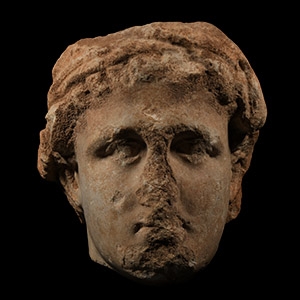
Greek Marble Head of a Ruler
Sold for (Inc. bp): £31,200
Carved in the round with thick wreath of laurel leaves to the brow, short tousled hair, stern face with thick jaw; mounted on a custom-made stand. -
.jpg)
Roman Veined Marble Torso of an Athlete
Sold for (Inc. bp): £48,100
Standing contrapposto with his weight on his right leg and the left leg brought slightly forward; the musculature of the torso displaying well-defined pectoral muscles, prominent abdominal muscles and wide shoulders, the back with equally toned musculature and well-formed rounded buttocks; the veining of the marble accentuating the idealised anatomy; the now-absent head was most probably turned towards the supporting leg and the left arm would have been raised; mounted on a custom-made display stand. -
.jpg)
Large Middle Elamite Cylinder Seal of Kidnu, Chief Overseer of King Tan-Ruhurater II
Sold for (Inc. bp): £15,600
A high-status green chalcedony seal with frieze depicting a seated figure in horned headdress facing a standing figure with arms outstretched, small monkey to the legs; six columns of Akkadian cuneiform text transliterated as: 1. ki-di-nu UGULA KUŠ-MEŠ 2. GAL šà tan-dru-hu- 3. ra-te-er EŠŠANA šu-ši 4. u an-za-an ARAD 5. šà dha-te-ri-iš 6. šak(?) ì-lí-šu 'Kidinu, chief overseer of the equerries(?) of Tan-Ruhurater, King of Susa and Anzan, servant of Haterishshak, his god'. The seal's owner was an official of King Tan-Ruhurater II (circa 1450 B.C.), king of Susa and Anzan. The title used to describe Kidinu is sometimes translated 'high official', elsewhere 'horse groom' or 'animal trainer'; the Elamite deity Haterish is otherwise unknown. -
.jpg)
Mesopotamian Torch Bearer Stand with Lion Tamer
Sold for (Inc. bp): £46,800
A substantial torch bearer depicting a male lion or panther standing with legs firmly planted on a rectangular base, tail extending to the ground, with a massive circular shaped armature or candelabra issuing from its back and wearing an elaborate muzzle, the eyes retaining shell inlay with a circular hollow for the pupils; to the right of the beast a kneeling nude male wearing a large belt-armour and a diadem, eyes inlaid, left hand extended to the side and holding the lion's leash.
-
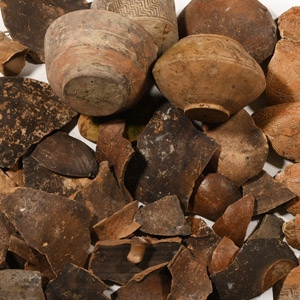
Greek and Other Pottery Fragment Group
Circa 1st millennium B.C.Sold for (Inc. bp): £98
Including squat and biconical bowls, amphora sherds and other types. 3.34 kg total, 4-19 cm
From a collection acquired on the UK art market from various auction houses and collections mostly before 2000. From an important Cambridgeshire estate; thence by descent. -
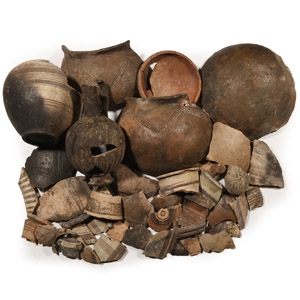
Greek and Other Pottery Fragment Group
Circa 1st millennium B.C.Sold for (Inc. bp): £98
Including amphora, bowl, cup and other vessel fragments, some painted. 5 kg total, 2-22.5 cm
From a collection acquired on the UK art market from various auction houses and collections mostly before 2000. From an important Cambridgeshire estate; thence by descent. -
.jpg)
Eastern Greek Gold Horse Earrings with Pendants
Circa 4th century B.C. and laterSold for (Inc. bp): £1,950
Each composed of a pair of bifacial addorsed horse-heads with filigree and granule detailing, filigree loop to each mouth, coil to each forehead, six loops to the underside each with a chain and sheet gold fruit pendant; to each face an inset glass cabochon; one with twisted wire ear hook above; both earrings with ancient chain dangles, one with a replicant horse. 18.08 grams total, 58-64 mm
Previously acquired on the UK art market between 1978-1980. Ex property of a North West London gentleman. -
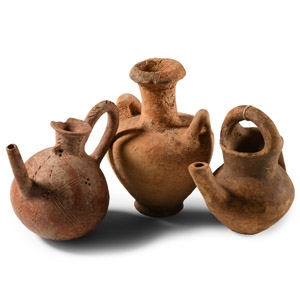
Cypriot Mixed Terracotta Vessel Group
2nd-1st millennium B.C.Sold for (Inc. bp): £169
Comprising: miniature amphora with two loop handles to the shoulder; spherical ewer with tall spout, trumpet-shaped neck and loop handle; biconical ewer with broad neck, spout and transverse strap handle. 350 grams total, 82-92 mm
From a collection acquired on the UK art market from various auction houses and collections mostly before 2000. From an important Cambridgeshire estate; thence by descent. -
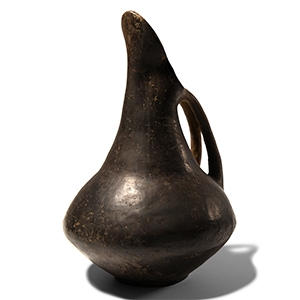
Villanovan Impasto Oinochoe with Graffiti
Circa 8th century B.C.Sold for (Inc. bp): £624
Three-lobed mouth with elongated beak, truncated-conical neck, shoulder with a convex profile, biconical body, low and flat foot, double rod handle set on the mouth and shoulder; small hole below equator. 592 grams, 21 cm high
Showplace Auction Centre, auction 308, lot 174. Property of a South Australian private collector, with collection reference 23.09. Accompanied by detailed collector's catalogue pages including description and photograph.
There is a similar vessel in Collection CA p18 n17 without decoration. The form is the same (height 25cm). Different varieties of it are known depending on the high or short neck, the flattened or globular or ovoid body, the flat or ring-shaped or splayed foot, the ribbon-like handle or the single or multiple rod. The known specimens come from different localities: Narce, Faleri, Bisenzio, Vetulonia, Tarquinia, Volsiniese countryside, upper Fiora valley. For parallel with ribs, see Antikenmuseum Basel + Sammlung Ludwig, p. 19, E 9, Schnabelkanne aus Impasto, first half seventh century, height 22.6cm. The shape of this handmade pot is particularly bold and simple. The few attached ribs, the bar handles brought together at the top, the high neck and the steep, cloverleaf-shaped mouth form ascending lines, but at the same time contribute to the balance of the shape due to their curve. These pots have primarily been found in Bisenzio, where they were probably made. -
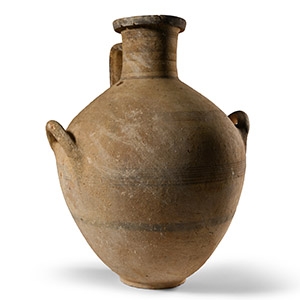
Large Cypriot Bichrome Ware Pottery Amphora
Iron Age, Cypro-Geometric, 950-850 B.C.Sold for (Inc. bp): £286
Wheel-made amphora with narrow basal ring, two broad loop handles to the shoulder, tubular mouth with strap handle to the rear; horizontal black painted bands to the neck, shoulder and body; painted handles; cracked. 3 kg, 38 cm
From a collection acquired on the UK art market from various auction houses and collections mostly before 2000. From an important Cambridgeshire estate; thence by descent. -
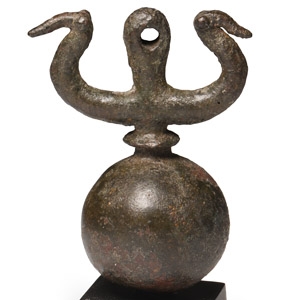
Etruscan Globular Pendant with Birds' Heads
Circa 8th-7th century B.C.Sold for (Inc. bp): £104
Comprising a spherical body with biconvex collar, lateral arms ending in stylised bird-heads, pierced lobe above; mounted on a custom-made display stand. 113 grams total, 69 mm including stand
From a collection acquired on the UK art market from various auction houses and collections mostly before 2000. From an important Cambridgeshire estate; thence by descent.
These globular pendants surmounted by two opposed birds heads belong to the early Iron Age phase of the Etruscan-Villanovan culture. The heads are those of aquatic birds, whose motif is often repeated on the embossed belt-cuirasses decorating the waists of high-status men and women. -
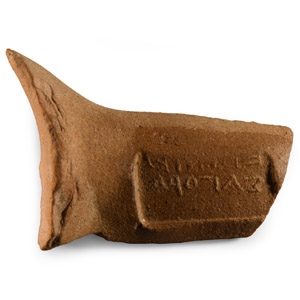
Greek Rhodian Stamped Amphora Handle Fragment
131 B.C.Sold for (Inc. bp): £26
With stamped retrograde inscription and rectangular panel : 'ΕΠΙ NΙΚΑΣΑΓΟΡΑ[Σ]' = under Nikasagoras. 49 grams, 82 mm
Acquired in the 1970s. From the private collection of a retired East Anglian teacher.
This fragment of Rhodian Amphora carries the Eponym official 'Nikasagoras', referring to the Eponym Officer of Rhodes of the year in which the amphora was produced and stamped. He is a well known eponym, also attested by an inscription. His stamps are individualised in comparison to those of the other two namesakes, Nikasagoras the Elder (circa 240 B.C.) and Nikasagoras 1 (circa 172–171 B.C.). These officers seem to have been those of the annually chosen priests of Helios who were the dating authorities of the Rhodian state. -
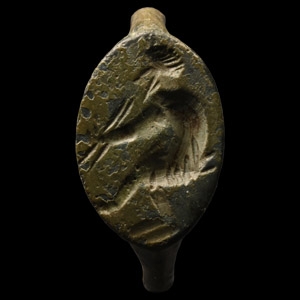
Greek Bronze Signet Ring with Pan
4th-3rd century B.C.Sold for (Inc. bp): £208
With scaphoid bezel, intaglio seated faun with syrinx. 3.55 grams, 20.92 mm overall, 17.06 mm internal diameter (approximate size British M, USA 6, Europe 12.46, Japan 12)
Ex German art market, 2000s. Acquired from an EU collector living in London. From the collection of Surrey, UK, gentleman. -
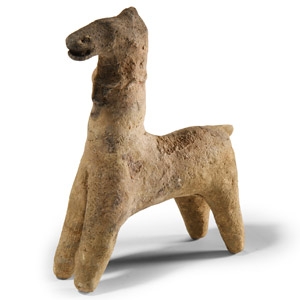
Boeotian Terracotta Horse Statuette
6th century B.C.Sold for (Inc. bp): £182
In static stance with forelegs straight and head erect, applied harness detailing. 130 grams, 11.1 cm high
From a collection acquired on the UK art market from various auction houses and collections mostly before 2000. From an important Cambridgeshire estate; thence by descent. -
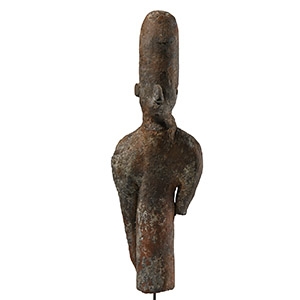
Cypriot Terracotta Male Idol
1st millennium B.C.Sold for (Inc. bp): £195
Columnar figure with tall headdress and applied facial features; robe with floor-length sleeves (one partly absent); mounted on a custom-made display stand. 387 grams total, 23.5 cm including stand
From a collection acquired on the UK art market from various auction houses and collections mostly before 2000. From an important Cambridgeshire estate; thence by descent. -
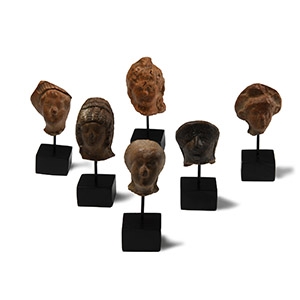
Greek Terracotta Head Collection
3rd-2nd century B.C.Sold for (Inc. bp): £312
Including hollow-formed and solid moulded and hand-formed types in various types of ceramic; each mounted on a custom-made display stand. 184 grams total, 63-77 mm including stand
From a collection acquired on the UK art market from various auction houses and collections mostly before 2000. From an important Cambridgeshire estate; thence by descent.
