
Auction Highlights
-
.jpg)
Greek Marble Head of Dionysus
Sold for (Inc. bp): £23,400
Carved in the half-round in three-quarter view, youthful male head with stern features, hair gathered in a browband, horns to the brow; from a frieze or relief; mounted on a custom-made stand. -
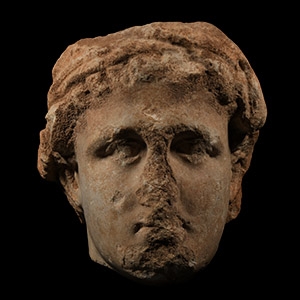
Greek Marble Head of a Ruler
Sold for (Inc. bp): £31,200
Carved in the round with thick wreath of laurel leaves to the brow, short tousled hair, stern face with thick jaw; mounted on a custom-made stand. -
.jpg)
Roman Veined Marble Torso of an Athlete
Sold for (Inc. bp): £48,100
Standing contrapposto with his weight on his right leg and the left leg brought slightly forward; the musculature of the torso displaying well-defined pectoral muscles, prominent abdominal muscles and wide shoulders, the back with equally toned musculature and well-formed rounded buttocks; the veining of the marble accentuating the idealised anatomy; the now-absent head was most probably turned towards the supporting leg and the left arm would have been raised; mounted on a custom-made display stand. -
.jpg)
Large Middle Elamite Cylinder Seal of Kidnu, Chief Overseer of King Tan-Ruhurater II
Sold for (Inc. bp): £15,600
A high-status green chalcedony seal with frieze depicting a seated figure in horned headdress facing a standing figure with arms outstretched, small monkey to the legs; six columns of Akkadian cuneiform text transliterated as: 1. ki-di-nu UGULA KUŠ-MEŠ 2. GAL šà tan-dru-hu- 3. ra-te-er EŠŠANA šu-ši 4. u an-za-an ARAD 5. šà dha-te-ri-iš 6. šak(?) ì-lí-šu 'Kidinu, chief overseer of the equerries(?) of Tan-Ruhurater, King of Susa and Anzan, servant of Haterishshak, his god'. The seal's owner was an official of King Tan-Ruhurater II (circa 1450 B.C.), king of Susa and Anzan. The title used to describe Kidinu is sometimes translated 'high official', elsewhere 'horse groom' or 'animal trainer'; the Elamite deity Haterish is otherwise unknown. -
.jpg)
Mesopotamian Torch Bearer Stand with Lion Tamer
Sold for (Inc. bp): £46,800
A substantial torch bearer depicting a male lion or panther standing with legs firmly planted on a rectangular base, tail extending to the ground, with a massive circular shaped armature or candelabra issuing from its back and wearing an elaborate muzzle, the eyes retaining shell inlay with a circular hollow for the pupils; to the right of the beast a kneeling nude male wearing a large belt-armour and a diadem, eyes inlaid, left hand extended to the side and holding the lion's leash.
-
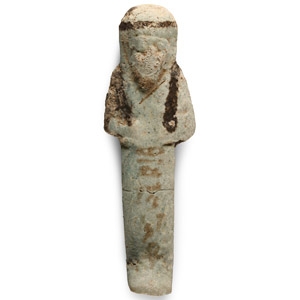
Egyptian Faience Hieroglyphic Shabti For Djed-Bastet-iuef-ankh
Third Intermediate Period, 1069-702 B.C.Sold for (Inc. bp): £156
With pale blue surface and applied black detailing to hair, seed-bag and tools; faint hieroglyphs to lower body giving the dedication 'The Osiris, Djed-Bastet-iuef-ankh'. 18.9 grams, 80 mm
From a UK collection in the 1990s. Property of a Cambridgeshire, UK, gentleman. -
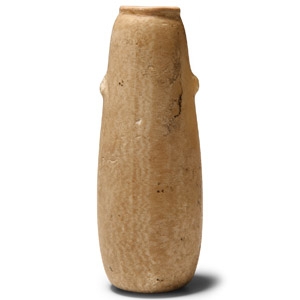
Egyptian Alabaster Cosmetic Jar
Late Period, 664-332 B.C.Sold for (Inc. bp): £124
Carved cosmetics jar, tapering gradually towards the top, with two small lugs at the shoulders, a collared rim, and flattened base. 77 grams, 87 mm
Private collection, Zurich, acquired in 1975 when the owners lived in Cairo (1975-1980). with Bonhams London, Antiquities, 23 July 2020, lot 119 (part). Property of a Bristol, UK, gentleman. -
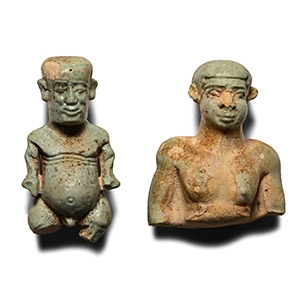
Egyptian Blue Faience Pataikos Amulet Pair
Late Period, 664-525 B.C.Sold for (Inc. bp): £312
Each in pale blue composition, the larger a bust with bale to rear of the neck, the smaller the full nude form (minus the lower legs). 22 grams total, 40-43 mm
Acquired on the German art market, 1989-1995. with The Museum Gallery, 19 Bury Place, London, WC1, UK, 1998-2003. Property of a London based academic, 2003-present.
Pataikos is a representation of the creator deity Ptah, and his diminutive form is a symbol of his immense magical power. -
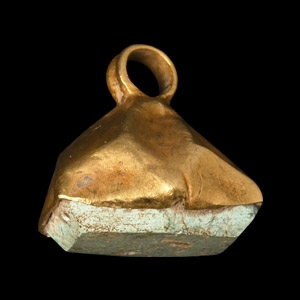
Egyptian Gold Mounted Feldspar(?) Pendant
Late Period, 664-332 B.C. and laterSold for (Inc. bp): £195
A hexagonal faience plaque set into a possibly later polyhedral gold cup with loop to the apex. 2.00 grams, 13 mm
Ex property of a late Japanese collector, 1970-2000s. -
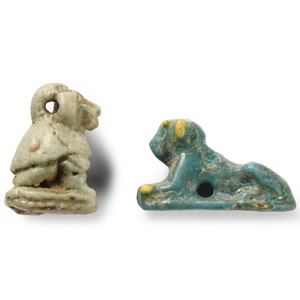
Egyptian Faience Amulet Group
Late Period, 664-332 B.C.Sold for (Inc. bp): £247
Comprising a resting lioness on a rectangular base and the god Thoth in baboon form. 1.30 grams total, 12-15 mm
From the collection of Doctor Girard, a collector for over 60 years. with Hotel des Ventes de Clermont-Ferrand, 22 May 2017. Property of a French collector.
Throughout ancient Egyptian mythology, lioness goddesses played a significant role in the religious beliefs of the people. These goddesses, including Sekhmet, Bastet, and Wadjet were revered as powerful and fierce protectors. Their presence was believed to ward off evil and safeguard the people from harm. The baboon was an animal manifestation of the god Thoth. Thoth was revered for his association with knowledge, writing, and healing. It is likely that the popularity of Thoth amulets as mummy amulets is linked to his role as the recorder of the final judgment, which determined whether the deceased had lived a life of virtue. -
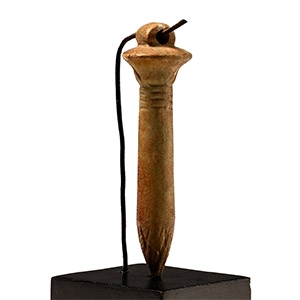
Egyptian Faience Papyrus Sceptre Pendant
Late Period, 664-332 B.C.Sold for (Inc. bp): £117
Amulet in the form of a wadj papyrus sceptre with suspension loop; with light encrustations; supplied with a wooden display stand. 7.15 grams, 64 mm (34.4 grams total, 94 mm including stand)
Ex Foxwell collection. Acquired from a London gallery. Ex Mr A.S. collection, 1990s. Property of a Bristol, UK, gentleman.
The papyrus column or wadj amulet is typically made out of turquoise feldspar or faience, as is prescribed in the Book of the Dead. The word wadj, meaning “green”, evokes concepts of well-being and vitality. Papyrus amulets were often placed around the neck of the deceased to ensure eternal youth in the afterlife. They were particularly popular during the Late Period (664-332 B.C.). -
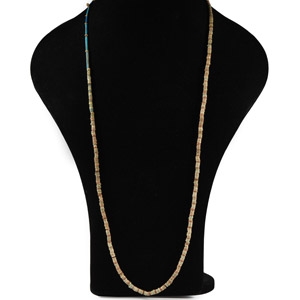
Egyptian Faience Mummy Bead Necklace
Late Period, 664-332 B.C.Sold for (Inc. bp): £65
Restrung group of annular and tubular beads. 17.9 grams, 95 cm long
From an old English deceased estate. Acquired on the London art market in the early 1990s. Property of a London, UK, collector. -
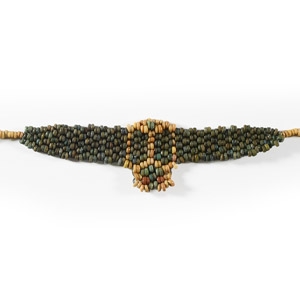
Egyptian Faience Bead Necklace with Winged Scarab Motif
Ptolemaic Period, 332-30 B.C.Sold for (Inc. bp): £208
Composed of annular beads in several colours, restrung and with a modern catch. 12.4 grams, 50 cm long
Property of a late lady collector, acquired 1940-1990s.
Winged scarabs were often used as funerary amulets and were believed to symbolise the rebirth and regeneration of the deceased. -
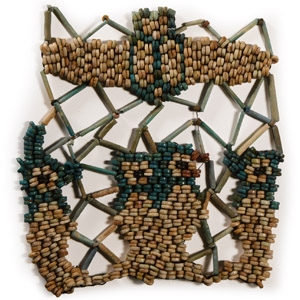
Egyptian Beaded Mummy Mask Panel with Four Sons of Horus
Ptolemaic Period, 332-30 B.C.Sold for (Inc. bp): £117
Openwork restrung panel depicting Imsety, Hapy, Duamutef, and Qebehsenuef, the Four Sons of Horus with a winged scarab above; restrung with some later beads. 57 grams, 16 cm
Ex Mariaud de Serres, Paris, France, 1980-1990s. From a London, UK, collection. Accompanied by an old collection ticket.
The Four Sons of Horus were deities responsible for protecting the internal organs of the deceased. The human-headed Imsety protected the liver, the baboon-headed Hapy protected the lungs, the jackal-headed Duamutef protected the stomach, and the falcon-headed Qebehsenuef protected the intestines. -
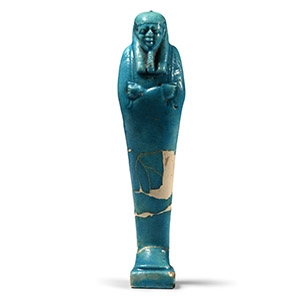
Egyptian Blue Glazed Shabti
Late Period, 664-332 B.C.Sold for (Inc. bp): £364
Faience shabti with detailed face, beard and wig, holding a pick and hoe, dorsal pillar and seed bag to left shoulder; some loss to surface; repaired. 162 grams, 16.5 cm
Ex Gilles Grimm collection, Paris, France. Acquired by the current owner from Aguttes, 19 December 2018, no.451. Property of a French collector. -
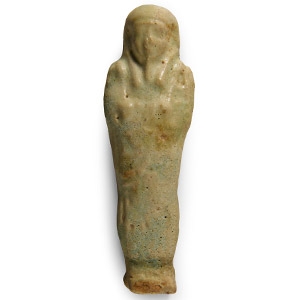
Egyptian Blue Glazed Faience Shabti
Late Period, 664-332 B.C.Sold for (Inc. bp): £111
With dorsal pillar, hands folded across the chest holding a pick and hoe, with a front panel of faintly impressed hieroglyphic text. 72 grams, 10.7 cm
Ex M.S. Ciappara collection, Norfolk, UK, 1939-1950.
Shabti figures were created to carry out heavy manual tasks on behalf of a person in the afterlife. They were often depicted with tools in their hands, such as baskets, mattocks, and hoes. Over time, the number of shabtis in a standard elite burial increased, from one in the Eighteenth Dynasty to several in the Nineteenth Dynasty, to one for every day of the year by the Third Intermediate Period. The number of shabtis remained in the hundreds during the Late Period. -
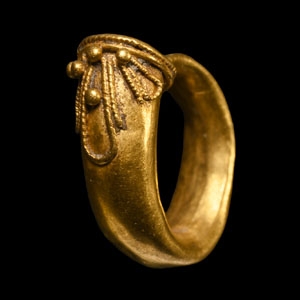
Greek Gold Earring
Circa 4th-3rd century B.C.Sold for (Inc. bp): £286
Formed as a horn with applied filigree and granule detailing below the rim. 0.59 grams, 12 mm
Ex collection of the Chierroni family, Paris, France, formed between 1980-1990s. Property of a French collector.
