
Auction Highlights
-
.jpg)
Greek Marble Head of Dionysus
Sold for (Inc. bp): £23,400
Carved in the half-round in three-quarter view, youthful male head with stern features, hair gathered in a browband, horns to the brow; from a frieze or relief; mounted on a custom-made stand. -
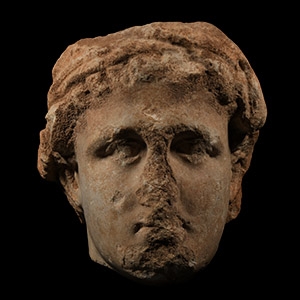
Greek Marble Head of a Ruler
Sold for (Inc. bp): £31,200
Carved in the round with thick wreath of laurel leaves to the brow, short tousled hair, stern face with thick jaw; mounted on a custom-made stand. -
.jpg)
Roman Veined Marble Torso of an Athlete
Sold for (Inc. bp): £48,100
Standing contrapposto with his weight on his right leg and the left leg brought slightly forward; the musculature of the torso displaying well-defined pectoral muscles, prominent abdominal muscles and wide shoulders, the back with equally toned musculature and well-formed rounded buttocks; the veining of the marble accentuating the idealised anatomy; the now-absent head was most probably turned towards the supporting leg and the left arm would have been raised; mounted on a custom-made display stand. -
.jpg)
Large Middle Elamite Cylinder Seal of Kidnu, Chief Overseer of King Tan-Ruhurater II
Sold for (Inc. bp): £15,600
A high-status green chalcedony seal with frieze depicting a seated figure in horned headdress facing a standing figure with arms outstretched, small monkey to the legs; six columns of Akkadian cuneiform text transliterated as: 1. ki-di-nu UGULA KUŠ-MEŠ 2. GAL šà tan-dru-hu- 3. ra-te-er EŠŠANA šu-ši 4. u an-za-an ARAD 5. šà dha-te-ri-iš 6. šak(?) ì-lí-šu 'Kidinu, chief overseer of the equerries(?) of Tan-Ruhurater, King of Susa and Anzan, servant of Haterishshak, his god'. The seal's owner was an official of King Tan-Ruhurater II (circa 1450 B.C.), king of Susa and Anzan. The title used to describe Kidinu is sometimes translated 'high official', elsewhere 'horse groom' or 'animal trainer'; the Elamite deity Haterish is otherwise unknown. -
.jpg)
Mesopotamian Torch Bearer Stand with Lion Tamer
Sold for (Inc. bp): £46,800
A substantial torch bearer depicting a male lion or panther standing with legs firmly planted on a rectangular base, tail extending to the ground, with a massive circular shaped armature or candelabra issuing from its back and wearing an elaborate muzzle, the eyes retaining shell inlay with a circular hollow for the pupils; to the right of the beast a kneeling nude male wearing a large belt-armour and a diadem, eyes inlaid, left hand extended to the side and holding the lion's leash.
-
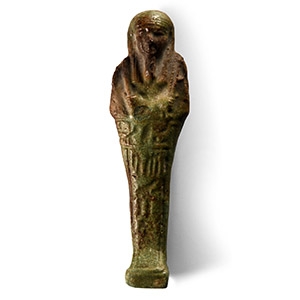
Egyptian Green Glazed Shabti
Late Period, 664-332 B.C.Sold for (Inc. bp): £390
With arms crossed at the chest holding pick, hoe and cord for seed bag, dorsal pillar, horizontal and vertical panels to the lower body with hieroglyphic text. 73 grams, 12.5 cm
Acquired from Hotel des Ventes, Drouot, in the early 1980s. Ex collection of a private collector. Property of a French collector. -
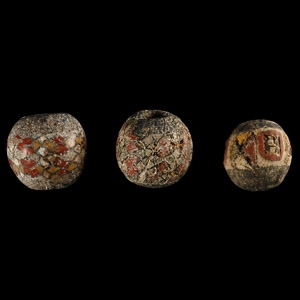
Egyptian Millefiori Glass Bead Group
Roman Period, 30 B.C.-323 A.D.Sold for (Inc. bp): £208
Three spherical glass beads decorated with geometric millefiori patterns. 10 grams total, 12-15 mm
Collected from 1969-1999. From the collection of the late Mr S.M., London, UK. -
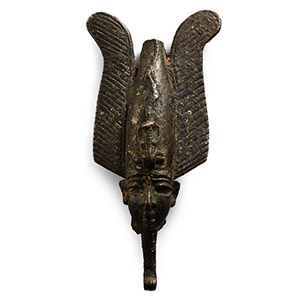
Large Egyptian Gilt Bronze Head of Osiris
Late Period, 664-525 B.C.Sold for (Inc. bp): £650
Modelled in the round wearing the atef crown (hedjet with lateral ostrich feathers) and uraeus to the brow with tail extending up the crown, detailed false beard with coiled finial; eyes recessed to accept inlays; tip of crown missing. 199 grams, 11.4 cm
Acquired on the German art market, 1989-1995. with The Museum Gallery, 19 Bury Place, London, WC1, UK, 1998-2003. Property of a London based academic, 2003-present.
Osiris is a deity who represents death and fertility and is commonly regarded as the quintessential god of rebirth. Though he was once a mortal ruler, as a deceased entity, his domain was the Underworld. Abydos was the primary centre of Osiris’ cult, where a renowned yearly celebration of the god was held. This head comes from a once sizeable statuette of the god. -
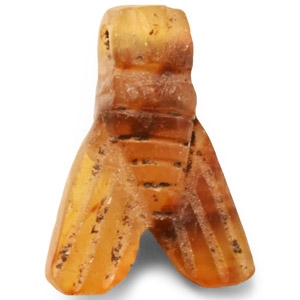
Egyptian Hardstone Fly Amulet
Late Period, 664-332 A.D.Sold for (Inc. bp): £117
With linear detailing to body and wings, pierced at the neck. 0.38 grams, 12 mm
From the H.N. collection, Milton Keynes, Berkshire, UK, 1990s.
Fly amulets were believed to protect against insect bites and ward off flying creatures through apotropaic magic. Additionally, the pharaoh would give gold fly-shaped pendants as military awards to recognise the bravery and persistence of soldiers in battle. -
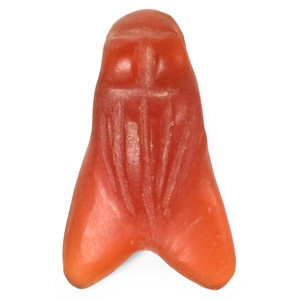
Egyptian Carnelian Fly Amulet
Late Period, 664-332 B.C.Sold for (Inc. bp): £312
Carved with simple body and eye detailing and polished; drilled through the eyes for suspension. 0.44 grams, 13 mm
From an early 20th century collection, Surrey, UK.
Considering Egyptian artists often depicted fly whisks in the hands of pharaohs and high officials, one might assume that flies were simply a nuisance. However, the Egyptians held flies in high regard due to their quick speed, reactions, and persistence. Small fly amulets were made from various materials, including gold, silver, lapis lazuli, carnelian, amethyst, faience, and bone. These amulets were believed to protect against insect bites and ward off flying creatures through apotropaic magic. -
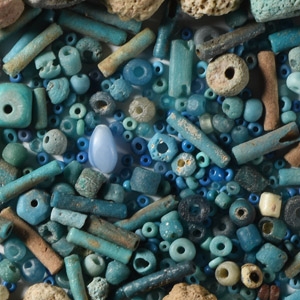
Egyptian Mixed Faience Bead Group
Late-Roman Period, 664 B.C.-323 A.D.Sold for (Inc. bp): £111
Including tubular, melon, annular and other types. 5.1.8 grams total, 2-20 mm
From the private collection of the late Mrs Belinda Ellison, a long time member of the Egyptian Exploration Society, c.1940-2020. -
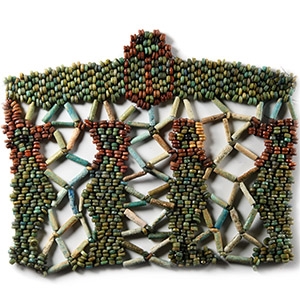
Large Egyptian Bead Panel with Four Sons of Horus and Winged Scarab
Ptolemaic Period, 332-30 B.C.Sold for (Inc. bp): £117
Restrung as an openwork panel with a winged scarab above and the Four Sons of Horus below as two opposing pairs; restrung with some later beads. 33 grams, 14 cm
Ex Mariaud de Serres, Paris, France, 1980-1990s. From a London, UK, collection.
The Four Sons of Horus were deities responsible for protecting the internal organs of the deceased. The human-headed Imsety protected the liver, the baboon-headed Hapy protected the lungs, the jackal-headed Duamutef protected the stomach, and the falcon-headed Qebehsenuef protected the intestines. -
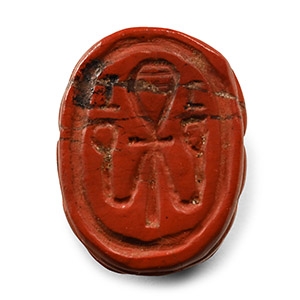
Egyptian Orange Jasper Scarab
New Kingdom, 1550-1069 B.C.Sold for (Inc. bp): £286
Carved with design to the underside of a central ankh symbol flanked by stylised rearing cobras. 1.52 grams, 13 mm
From an early 20th century collection. -
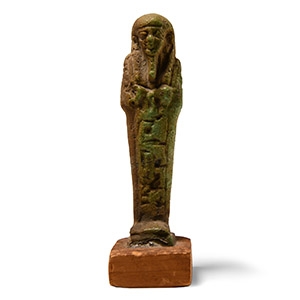
Egyptian Blue Glazed Hieroglyphic Shabti for Akhet
27th-30th Dynasty 525-343 B.C.Sold for (Inc. bp): £494
Olive-green with dorsal pillar, false beard and agricultural tools; vertical band of hieroglyphic text to the lower body and another to the dorsal pillar. 48 grams total, 11.4 cm including stand
Acquired in Egypt by Lieutenant James Alexander Goodman in the 1920s. Thence by descent to his grandson.
Lieutenant Goodman served in the 4th Battalion Welsh Regiment during World War I and saw action in Palestine during the capture of Bethlehem, (for which he won an MC). After the war, he setup a business selling Fordson trucks and tractors in Alexandria, Egypt. A keen antiquarian, he collected ancient objects during his time in Alexandria and when he visited the pyramids at Giza. After his first marriage failed, he returned to the UK in the early 1930s. On his death in 1959 he passed his small collection of Egyptian objects on to his second wife, Ruby Goodman. On Ruby’s death in 1994, they were left to their second daughter, Rosemary Johnson, (née Goodman), and are currently in the possession of her son. -
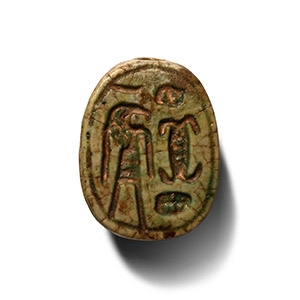
Egyptian Steatite Scarab with Thoth Standing
New Kingdom-Late Period, 1550-332 B.C.Sold for (Inc. bp): £286
Underside with standing figure of Thoth facing the symbol for the goddess Neith. 1.65 grams, 14 mm
Ex North London gentleman's collection, 1990s. Property of a Cambridgeshire, UK, gentleman.
Thoth was revered for his association with knowledge, writing, and healing. In a funerary context, Thoth was probably linked to his role as the recorder of the final judgment, which determined whether the deceased had lived a life of virtue. A positive report ensured the rebirth of the deceased in the eternal Afterlife. Neith was a prominent deity in ancient Egyptian mythology, revered as a warrior and mother goddess. Her cult gained significant importance during the Ramesside dynasties when she became closely associated with the sun god. Neith was known for her fierce protection and maternal guidance. -
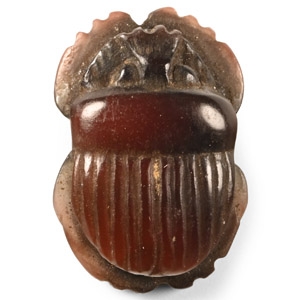
Egyptian Carnelian Heart Scarab
Late Period, 664-332 B.C.Sold for (Inc. bp): £260
With ridged detailing to the carapace, loop to the underside. 1.43 grams, 17 mm
From an early 20th century collection. -
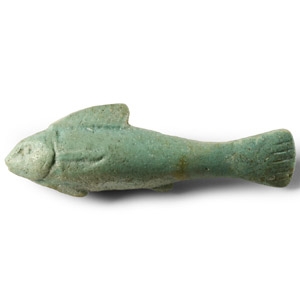
Egyptian Faience Fish Amulet
Late Period, 664-332 B.C.Sold for (Inc. bp): £390
Tilapia fish modelled in the round; tail restored. 3.20 grams, 43 mm
From the collection of Doctor Girard, a collector for over 60 years. with Hotel des Ventes de Clermont-Ferrand, 22 May 2017. Property of a French collector.
This amulet represents a ‘Tilapia nilotica’ or ‘bolti’, a prevalent fish species found in the Nile. Not only was it esteemed for its delicious taste, but it was also revered as a symbol of rebirth and resurrection due to its unique ability to carry its eggs in its mouth, suggesting self-creation.
