
Auction Highlights
-
.jpg)
Greek Marble Head of Dionysus
Sold for (Inc. bp): £23,400
Carved in the half-round in three-quarter view, youthful male head with stern features, hair gathered in a browband, horns to the brow; from a frieze or relief; mounted on a custom-made stand. -
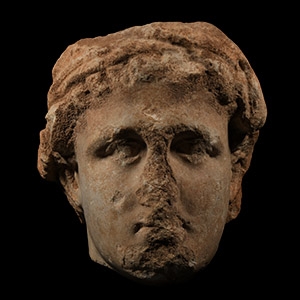
Greek Marble Head of a Ruler
Sold for (Inc. bp): £31,200
Carved in the round with thick wreath of laurel leaves to the brow, short tousled hair, stern face with thick jaw; mounted on a custom-made stand. -
.jpg)
Roman Veined Marble Torso of an Athlete
Sold for (Inc. bp): £48,100
Standing contrapposto with his weight on his right leg and the left leg brought slightly forward; the musculature of the torso displaying well-defined pectoral muscles, prominent abdominal muscles and wide shoulders, the back with equally toned musculature and well-formed rounded buttocks; the veining of the marble accentuating the idealised anatomy; the now-absent head was most probably turned towards the supporting leg and the left arm would have been raised; mounted on a custom-made display stand. -
.jpg)
Large Middle Elamite Cylinder Seal of Kidnu, Chief Overseer of King Tan-Ruhurater II
Sold for (Inc. bp): £15,600
A high-status green chalcedony seal with frieze depicting a seated figure in horned headdress facing a standing figure with arms outstretched, small monkey to the legs; six columns of Akkadian cuneiform text transliterated as: 1. ki-di-nu UGULA KUŠ-MEŠ 2. GAL šà tan-dru-hu- 3. ra-te-er EŠŠANA šu-ši 4. u an-za-an ARAD 5. šà dha-te-ri-iš 6. šak(?) ì-lí-šu 'Kidinu, chief overseer of the equerries(?) of Tan-Ruhurater, King of Susa and Anzan, servant of Haterishshak, his god'. The seal's owner was an official of King Tan-Ruhurater II (circa 1450 B.C.), king of Susa and Anzan. The title used to describe Kidinu is sometimes translated 'high official', elsewhere 'horse groom' or 'animal trainer'; the Elamite deity Haterish is otherwise unknown. -
.jpg)
Mesopotamian Torch Bearer Stand with Lion Tamer
Sold for (Inc. bp): £46,800
A substantial torch bearer depicting a male lion or panther standing with legs firmly planted on a rectangular base, tail extending to the ground, with a massive circular shaped armature or candelabra issuing from its back and wearing an elaborate muzzle, the eyes retaining shell inlay with a circular hollow for the pupils; to the right of the beast a kneeling nude male wearing a large belt-armour and a diadem, eyes inlaid, left hand extended to the side and holding the lion's leash.
-
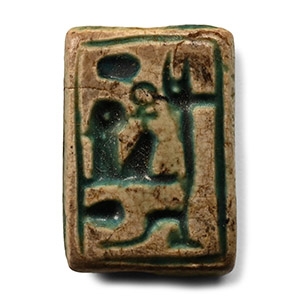
Egyptian Faience Block Bead for Ramesses II
New Kingdom, 19th Dynasty, 1279-1213 B.C.Sold for (Inc. bp): £442
Rectangular bead pierced for suspension, hieroglyphic text to both broad faces, one giving the throne name of Ramesses II, 'User-Maat-Re Setep-en-Re', the other, 'Ramesses, beloved of Amun'. 1.18 grams, 14 mm
Ex Emile Bouillon Bey, c. 1880. From the Gaston Maspero Archaeological Fund. with Hotel des Ventes du Perigord, Bergerac, 24 June 2007. Property of a French collector. -
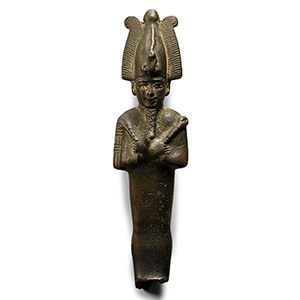
Egyptian Bronze Statuette of Osiris
Late Period, 664-525 B.C.Sold for (Inc. bp): £910
Modelled in the round wearing the atef crown with a uraeus to the brow, arms crossed on the chest holding the nekhakha (flail) and heka (crook); loop to rear of the neck; feet absent and damage to left shoulder revealing original lead core. 74 grams, 92 mm
Acquired on the German art market, 1989-1995. with The Museum Gallery, 19 Bury Place, London, WC1, UK, 1998-2003. Property of a London based academic, 2003-present.
Osiris was a deity who represents death and fertility and is commonly regarded as the quintessential god of rebirth. Though he was once a mortal ruler, as a deceased entity, his domain was the Underworld. Small figurines like this example were dedicated to the god to ensure his good favour. -
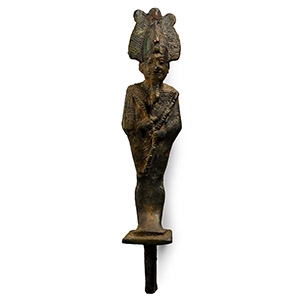
Egyptian Bronze Statue of the God Osiris
Late Period, 664-525 B.C.Sold for (Inc. bp): £650
Modelled in the round wearing the Atef crown with a uraeus to the brow, arms crossed on the chest holding the nekhakha (flail) and heka (crook); trapezoidal base with long tenon beneath. 136 grams, 14 cm
Acquired on the German art market, 1989-1995. with The Museum Gallery, 19 Bury Place, London, WC1, UK, 1998-2003. Property of a London based academic, 2003-present.
Osiris is a deity who represents death and fertility and is commonly regarded as the quintessential god of rebirth. Though he was once a mortal ruler, as a deceased entity, his domain was the Underworld. Abydos was the primary centre of Osiris’ cult, where a renowned yearly celebration of the god was held. Many small figurines like this were dedicated to the god at temples throughout Egypt. -
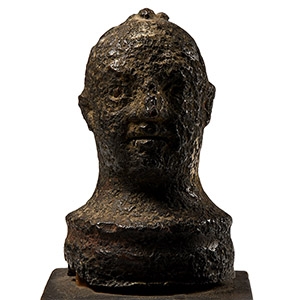
Bronze Bust with Phallus
Roman, 1st-2nd century A.D.Sold for (Inc. bp): £364
Modelled as a grotesque male head, depicted clean-shaven and hairless apart from a small tuft of hair to the rear with a raised phallus above; the neck developing to a broad circular socket with flange rim; mounted on a custom-made display stand. 377 grams total, 14.5 cm including stand
From an old Nevers collection, acquired before 1960. Ex Hotel des Ventes de Nevers. Property of a French collector. This lot has been checked against the Interpol Database of stolen works of art and is accompanied by a search certificate number no.12035-214900.
The exact meaning of these grotesque busts surmounted by a phallus is disputed, although Rolland (p.106) believes that they originated in Alexandria among the priests of the cult of Isis. Similar busts have been discovered in the Roman Gallia, at Bavay and Strasbourg. -
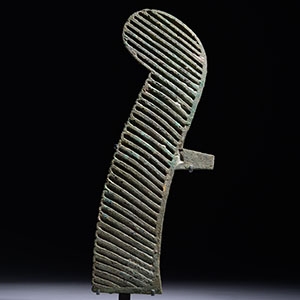
Monumental Egyptian Bronze Atef Crown Feather From a Life-Sized Statue
Late Period, circa 664-332 B.C.Sold for (Inc. bp): £1,820
Ostrich feather with deep recessed cells to accept inlay, with tapering mounting lug to one side; remnants of gilding; mounted on a custom-made display stand. 1.21 kg, 33.5 cm high including stand
Seward Kennedy collection, acquired 1960s. This lot has been checked against the Interpol Database of stolen works of art and is accompanied by search certificate number no.11840-207822.
This large feather is part of an Atef crown that would have been attached to a wooden statue of Osiris, the powerful underworld deity. The crown combines the Hedjet, the White Crown of Upper Egypt, flanked by ostrich feathers on each side to form the Atef crown. -
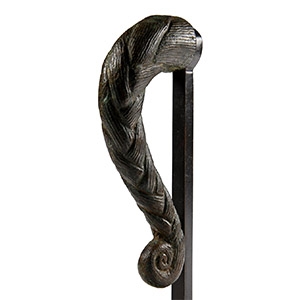
Egyptian Bronze Braided Sidelock of Harpocrates
Ptolemaic Period, circa 332-30 B.C.Sold for (Inc. bp): £624
Accessory from a statue, S-curved with braid detailing to the surface and coiled end; mounted on a custom-made display stand. 372 grams total, 14.3 cm high including stand
Jean P. Bourgis, Beaulieu Sur-Mer, France; acquired 1980. -
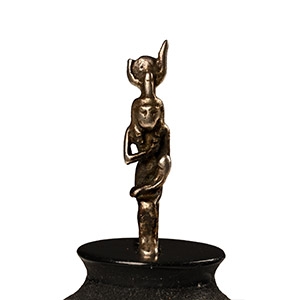
Egyptian Silver Isis Amulet
Late Period, 664-332 B.C.Sold for (Inc. bp): £338
Isis enthroned wearing a cow's horn headdress with a solar disc, suckling the infant Horus on her lap; loop to rear of crown; mounted on a custom-made stand. 6.2 grams, 39 mm (20.7 grams total, 62 mm including stand)
Ex Mythes & Legend. Ex Cohen collection 2011. Property of a French collector.
In ancient Egyptian mythology, Isis was the sister-wife of Osiris and the mother of the sky god Horus. She is associated with aspects of fertility and motherhood and is often depicted in various artworks seated in a nursing pose with her son Horus on her lap, as here. -
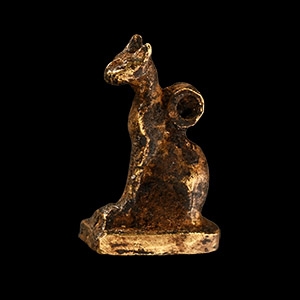
Egyptian Gold Goddess Bastet Cat Amulet
Late New Kingdom-Third Intermediate Period, circa 1069-900 B.C.Sold for (Inc. bp): £1,170
Modelled seated on a tongue-shaped base, with simple facial detailing and suspension loop to the back. 0.48 grams, 8 mm
From an early 20th century French collection.
The goddess Bastet was believed to be the daughter of the sun god and was shown with the features of a lion up until about 1000 B.C. when she was first portrayed as a cat or human with a cat head. As the daughter of Ra she was associated with the rage inherent in the sun god's eye which was considered to be his instrument of vengeance. Her development into a cat goddess occurred during the New Kingdom but did not fully develop until the Late Period. She was still associated with the destructive power of the sun and was shown on the prow of the solar boat, decapitating the evil serpent Apophis in the Book of the Dead. The maternal, protective and hunting characteristics of the cat are obvious in Bastet and she was seen as a protector of pregnant women and young children. In the Pyramid Texts she is invoked by the deceased king to act as his protector and to help him reach the sky to join the sun god; the king proclaims that Bastet is his mother and nurse. Like her counterpart, Sekhmet, Bastet has an aggressive side and, in a text from Karnak, Amenhotep II described his enemies being slaughtered like the victims of Bastet. The goddess had a shrine at Karnak, where she is known as the 'Lady of Asheru' which aligns her closely with the goddess Mut, the consort of Amun-Ra. Her most famous shrine was in the north-east Delta region, at Bubastis, and was known as Per-Bastet or 'the House of Bastet.' Herodotus describes the festival of Bastet as one of the most elaborate in all of Egypt and identifies her with the Greek Artemis. Cemeteries of cats have been excavated at Bubastis and at Saqqara and Memphis. -
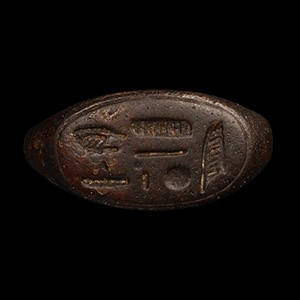
Egyptian Bronze Ring with Hieroglyphs
1st millennium B.C.Sold for (Inc. bp): £4,550
Ellipsoid bezel with a group of incuse hieroglyphs to the plaque naming Amun-Re. 9.62 grams, 24.22 mm overall, 18.25 mm internal diameter (approximate size British O, USA 7, Europe 14.98, Japan 14)
Acquired in the mid 1980s-1990s. From the family collection of Mr S.A., Switzerland, thence by descent. Private collection since the late 1990s. -
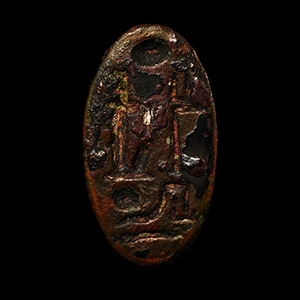
Egyptian Bronze Ring for Ramesses II
New Kingdom, 19th Dynasty, 1303-1213 B.C.Sold for (Inc. bp): £2,340
D-shaped hoop and ellipsoid plaque, hieroglyphic text in low relief giving the regnal name of Ramesses II (User-Maat-Re Setep-en-Re). 6.78 grams, 23.72 mm overall, 17.94 mm internal diameter (approximate size British Q, USA 8, Europe 17.49, Japan 16)
Ex R.K. collection, early 1980s. UK private collection before 2000. Property of a London gentleman. This lot has been checked against the Interpol Database of stolen works of art and is accompanied by a search certificate number no.12082-217353. -
.jpg)
Egyptian Amethyst Scarab in Gold Frame
Late Period, 664-332 B.C. and laterSold for (Inc. bp): £572
Carved with lightly incised carapace, chipped to the obverse; set in a 19th century gold frame. 12.45 grams, 52 mm
From an early 20th century collection. -
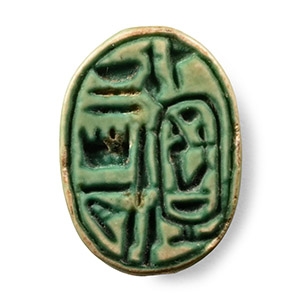
Egyptian Faience Scarab for Amenhotep III
New Kingdom, 18th Dynasty, 1410-1372 B.C.Sold for (Inc. bp): £1,300
Modelled with carapace and mouth details, the underside with hieroglyphic text giving the dedication: 'the good god, lord of the Two Lands, beloved of Amun', with the cartouche containing the throne name of Amenhotep III (Neb-Maat-Re). 2.53 grams, 17 mm
From the collection of Doctor Girard, a collector for over 60 years. with Hotel des Ventes de Clermont-Ferrand, 22 May 2017. Property of a French collector.
