
Auction Highlights
-
.jpg)
Greek Marble Head of Dionysus
Sold for (Inc. bp): £23,400
Carved in the half-round in three-quarter view, youthful male head with stern features, hair gathered in a browband, horns to the brow; from a frieze or relief; mounted on a custom-made stand. -
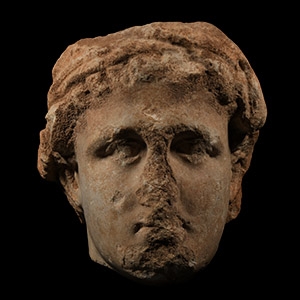
Greek Marble Head of a Ruler
Sold for (Inc. bp): £31,200
Carved in the round with thick wreath of laurel leaves to the brow, short tousled hair, stern face with thick jaw; mounted on a custom-made stand. -
.jpg)
Roman Veined Marble Torso of an Athlete
Sold for (Inc. bp): £48,100
Standing contrapposto with his weight on his right leg and the left leg brought slightly forward; the musculature of the torso displaying well-defined pectoral muscles, prominent abdominal muscles and wide shoulders, the back with equally toned musculature and well-formed rounded buttocks; the veining of the marble accentuating the idealised anatomy; the now-absent head was most probably turned towards the supporting leg and the left arm would have been raised; mounted on a custom-made display stand. -
.jpg)
Large Middle Elamite Cylinder Seal of Kidnu, Chief Overseer of King Tan-Ruhurater II
Sold for (Inc. bp): £15,600
A high-status green chalcedony seal with frieze depicting a seated figure in horned headdress facing a standing figure with arms outstretched, small monkey to the legs; six columns of Akkadian cuneiform text transliterated as: 1. ki-di-nu UGULA KUŠ-MEŠ 2. GAL šà tan-dru-hu- 3. ra-te-er EŠŠANA šu-ši 4. u an-za-an ARAD 5. šà dha-te-ri-iš 6. šak(?) ì-lí-šu 'Kidinu, chief overseer of the equerries(?) of Tan-Ruhurater, King of Susa and Anzan, servant of Haterishshak, his god'. The seal's owner was an official of King Tan-Ruhurater II (circa 1450 B.C.), king of Susa and Anzan. The title used to describe Kidinu is sometimes translated 'high official', elsewhere 'horse groom' or 'animal trainer'; the Elamite deity Haterish is otherwise unknown. -
.jpg)
Mesopotamian Torch Bearer Stand with Lion Tamer
Sold for (Inc. bp): £46,800
A substantial torch bearer depicting a male lion or panther standing with legs firmly planted on a rectangular base, tail extending to the ground, with a massive circular shaped armature or candelabra issuing from its back and wearing an elaborate muzzle, the eyes retaining shell inlay with a circular hollow for the pupils; to the right of the beast a kneeling nude male wearing a large belt-armour and a diadem, eyes inlaid, left hand extended to the side and holding the lion's leash.
-
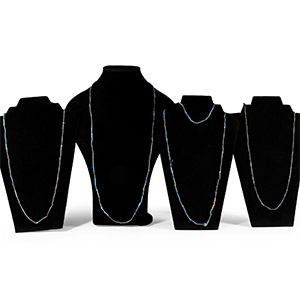
Egyptian Faience Mummy Bead Necklace Group
Late Period, 664-332 B.C.Sold for (Inc. bp): £221
Comprising four necklace strings with tubular and annular beads. 23 grams total, 72-95 cm long
From an old English deceased estate. Acquired on the London art market in the early 1990s. Property of a London, UK, collector. -
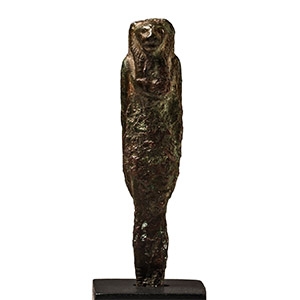
Egyptian Bronze Sekhmet Statuette
Late Period, 664-332 B.C.Sold for (Inc. bp): £338
Standing figure of Sekhmet with arms held at her sides, wearing a wig and tight-fitting robe; mounted on a custom-made display stand. 30 grams total, 73 mm including stand
From a collection acquired on the UK art market from various auction houses and collections mostly before 2000. From an important Cambridgeshire estate; thence by descent.
Sekhmet was a ferocious and aggressive deity, the consort of Ptah, and closely associated with the king. An amulet would imbue its wearer with her power. -
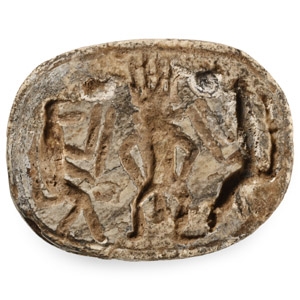
Egyptian Hardstone Scarab with Bes
Late Period, 664-332 B.C.Sold for (Inc. bp): £208
Plano-convex in section with detailed obverse, the underside with the figure of Bes flanked by adoring baboons and sun disks. 10.7 grams, 31 mm
Ex London, UK collection, 1990s.
Bes became one of ancient Egypt's most popular apotropaic deities from the New Kingdom onwards. Despite his somewhat fearful appearance, Bes was the patron and protector of pregnant women and children and believed to protect the wearer from snakes. The depiction of baboons flanking Bes with their arms raised before the sun disk was a common feature on temple wall reliefs. In ancient Egyptian religious literature, baboons heralded the dawn and, thus, the rebirth of the sun. -
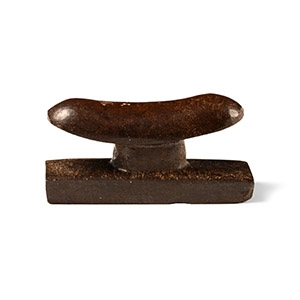
Egyptian Hardstone Head Rest Amulet
Late Period, 664-332 B.C.Sold for (Inc. bp): £143
Carved miniature headrest with rectangular base. 5.74 grams, 26 mm
Old French collection. Acquired from Hotel des Ventes, Drouot, Paris, France, early 2000. From the collection of Mr D. Property of a French collector.
The headrest, or weres amulet, was placed under the mummy's head to protect it from damage and ensure the deceased's rebirth. -
.jpg)
Egyptian Hardstone Amulet Group
Late Period, 664-332 B.C.Sold for (Inc. bp): £39
Comprising: a melon bead; double plume with inked collector's reference to the reverse 'ES.7'. 3.61 grams total, 14-23 mm
Left Amulet: Brought by missionaries in the 19th century. Acquired in 1962. Ex Haeberlin collection. From a North German private collection E.S. with Gorny Mosch, Munich, Germany, 16 December 2015, 828 (Part) Right Amulet: From the collection of Doctor Girard, a collector for over 60 years. with Hotel des Ventes de Clermont-Ferrand, 22 May 2017. Property of a French collector. -
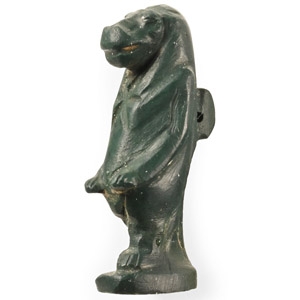
Egyptian Hardstone Tawaret Amulet
Late Period, 664-332 B.C.Sold for (Inc. bp): £442
Modelled in the round as a standing hippopotamus (Tawaret) figure on a rectangular base with loop to the rear. 1.98 grams, 24 mm
From the collection of Doctor Girard, a collector for over 60 years. with Hotel des Ventes de Clermont-Ferrand, 22 May 2017. Property of a French collector.
The goddess Tawaret was a female hippopotamus with the arms and legs of a lion and the back and tail of a crocodile. Despite her fearsome appearance, Tawaret was a household deity and protector of women in childbirth. -
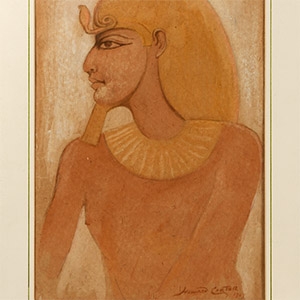
Egyptian Pharaoh Watercolour Attributed to Howard Carter
Dated 1917 A.D.Sold for (Inc. bp): £1,430
Profile bust of an Egyptian male in nemes headcloth with uraeus to the brow, wesekh segmented collar; signed bottom right 'Howard Carter, 1905'; board to reverse with pencilled note 'Hatshepsu' and inked 'Watercolour painting signed H carter 1905 / remnants of an old Philips auction label on verso', with pencilled star motif. 898 grams total, 38.5 x 31 cm
with old Phillips label to the verso.
Hatshepsut was the longest-reigning female ruler in Egyptian history (1473-1458 B.C.), who undertook several military expeditions. Howard Carter's father, Samuel, was an illustrator for the Illustrated London News in the later 1800s. In 1891, Howard Carter accompanied Percy Newberry on an expedition focussing on First Intermediate Period tombs at the Middle Egyptian site of Beni Hasan, from which many of his original pieces survive. During his time at El-Amarna, the excavator Flinders-Petrie took Carter to visit the newly discovered royal tomb of Pharaoh Akhenaten. Carter made some sketches there which were published in The Daily Graphic on March 23, 1892, accompanying Petrie’s article on the tomb. These sketches were the first Egyptian drawings published by Howard Carter, and the first to convey the uniqueness of Amarna art to the European public. -
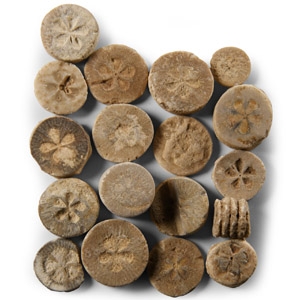
Egyptian Limestone 'Floral' Inlay Group
Roman Period, 30 B.C.-323 A.D.Sold for (Inc. bp): £52
Group of discoid inlay plaques or gaming counters, crinoids with cinquefoil motif. 36 grams total, 11-18 mm
From a central London ADA dealership, 1980-1990. -
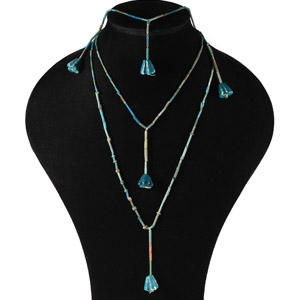
Egyptian Faience Mummy Bead Necklace with Lotus Flower Amulets
Late Period, 664-332 B.C.Sold for (Inc. bp): £208
Restrung group of mainly tubular beads with five faience lotus-flower pendants. 24.9 grams, 111 cm long
From an old English deceased estate. Acquired on the London art market in the early 1990s. Property of a London, UK, collector. -
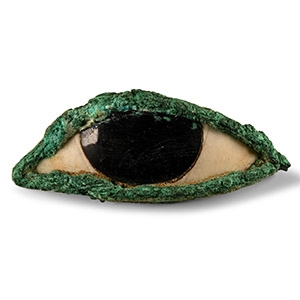
Egyptian Bronze Eye Inlay
Late Period, 664-332 B.C.Sold for (Inc. bp): £715
Comprising a bronze frame with a delicately modelled tear duct, inset with a white hardstone scalera and a large black glass pupil. 33 grams, 62 mm
Ex AB collection, 1920s-1930s. Accompanied by an old collection ticket.
Mummy masks were used as a protection over the deceased and were first introduced during the First Intermediate Period. The eyes were thought to fend off evil by reflecting it back to the one bestowing it. -
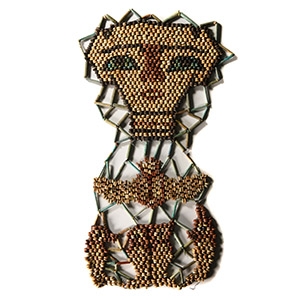
Large Egyptian Faience Beaded Mummy Mask with Sons of Horus
Ptolemaic Period, 332-30 B.C.Sold for (Inc. bp): £351
Restrung netted beadwork panel of annular and tubular glazed composition beads in blues, greens, black, cream and red-brown colours, depicting a mummy face mask with false beard, a scarab with extended wings below, the 'Four Sons of Horus’ beneath the scarab, joined together with areas of open netting of tubular beads; restrung with some later beads. 123 grams, 30 cm
Ex Mariaud de Serres, Paris, France, 1980-1990s. From a London, UK, collection.
The Four Sons of Horus were deities responsible for protecting the internal organs of the deceased. The human-headed Imsety protected the liver, the baboon-headed Hapy protected the lungs, the jackal-headed Duamutef protected the stomach, and the falcon-headed Qebehsenuef protected the intestines. -
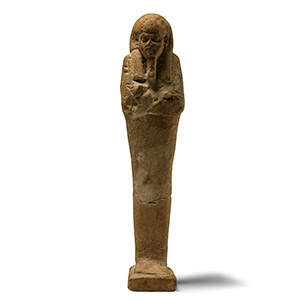
Egyptian Faience Shabti for Horemakhbit
Late Period, 664-332 B.C.Sold for (Inc. bp): £416
Of long, slender mummiform shape, wearing a tripartite wig and holding a pick and hoe, with a dorsal pillar bearing a hieroglyphic dedication to 'the Osiris, Horemakhbit'; repaired. 102 grams, 15.7 cm
Ex M.S. Ciappara collection, Norfolk, UK, 1939-1950.
Shabti figures were created to carry out heavy manual tasks on behalf of a person in the afterlife. The body of a shabti was usually in the form of a mummy and often depicted with tools in their hands, such as baskets, picks, and hoes. During the Late Period, it was customary to be buried with hundreds of shabtis.
