
Auction Highlights
-
.jpg)
Greek Marble Head of Dionysus
Sold for (Inc. bp): £23,400
Carved in the half-round in three-quarter view, youthful male head with stern features, hair gathered in a browband, horns to the brow; from a frieze or relief; mounted on a custom-made stand. -
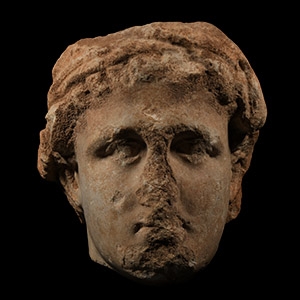
Greek Marble Head of a Ruler
Sold for (Inc. bp): £31,200
Carved in the round with thick wreath of laurel leaves to the brow, short tousled hair, stern face with thick jaw; mounted on a custom-made stand. -
.jpg)
Roman Veined Marble Torso of an Athlete
Sold for (Inc. bp): £48,100
Standing contrapposto with his weight on his right leg and the left leg brought slightly forward; the musculature of the torso displaying well-defined pectoral muscles, prominent abdominal muscles and wide shoulders, the back with equally toned musculature and well-formed rounded buttocks; the veining of the marble accentuating the idealised anatomy; the now-absent head was most probably turned towards the supporting leg and the left arm would have been raised; mounted on a custom-made display stand. -
.jpg)
Large Middle Elamite Cylinder Seal of Kidnu, Chief Overseer of King Tan-Ruhurater II
Sold for (Inc. bp): £15,600
A high-status green chalcedony seal with frieze depicting a seated figure in horned headdress facing a standing figure with arms outstretched, small monkey to the legs; six columns of Akkadian cuneiform text transliterated as: 1. ki-di-nu UGULA KUŠ-MEŠ 2. GAL šà tan-dru-hu- 3. ra-te-er EŠŠANA šu-ši 4. u an-za-an ARAD 5. šà dha-te-ri-iš 6. šak(?) ì-lí-šu 'Kidinu, chief overseer of the equerries(?) of Tan-Ruhurater, King of Susa and Anzan, servant of Haterishshak, his god'. The seal's owner was an official of King Tan-Ruhurater II (circa 1450 B.C.), king of Susa and Anzan. The title used to describe Kidinu is sometimes translated 'high official', elsewhere 'horse groom' or 'animal trainer'; the Elamite deity Haterish is otherwise unknown. -
.jpg)
Mesopotamian Torch Bearer Stand with Lion Tamer
Sold for (Inc. bp): £46,800
A substantial torch bearer depicting a male lion or panther standing with legs firmly planted on a rectangular base, tail extending to the ground, with a massive circular shaped armature or candelabra issuing from its back and wearing an elaborate muzzle, the eyes retaining shell inlay with a circular hollow for the pupils; to the right of the beast a kneeling nude male wearing a large belt-armour and a diadem, eyes inlaid, left hand extended to the side and holding the lion's leash.
-
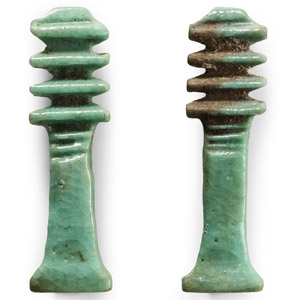
Egyptian Faience Djed Pillar Amulet Group
Late Period, 664-332 B.C.Sold for (Inc. bp): £195
Each a square-section column with flared base, transverse ribs, pierced at the top. 1.29 grams total, 23 mm each
From the collection of Doctor Girard, a collector for over 60 years. with Hotel des Ventes de Clermont-Ferrand, 22 May 2017. Property of a French collector.
The djed pillar signifies the concepts of 'enduring' and 'stability' and was a common funerary amulet from the Old Kingdom onwards. It was first associated with the gods Ptah and Sokar but later became a symbol of Osiris, representing the god's backbone. In this context, the djed pillar appears in Chapter 155 of the Book of the Dead, concerned with the deceased's resurrection. -
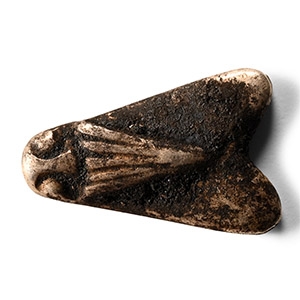
Egyptian Silver Fly Amulet
Late Period, 664-332 B.C.Sold for (Inc. bp): £338
Pendant formed as a fly with domed eyes. 1.13 grams, 16 mm
From an early 20th century collection.
Considering Egyptian artists often depicted fly whisks in the hands of pharaohs and high officials, one might assume that flies were simply a nuisance. However, the Egyptians held flies in high regard due to their quick speed, reactions, and persistence. Small fly amulets were made from various materials, including gold, silver, lapis lazuli, carnelian, amethyst, faience, and bone. They were believed to protect against insect bites and ward off flying creatures through apotropaic magic. Additionally, the pharaoh would give gold fly-shaped pendants as military awards to recognise the bravery and persistence of soldiers in battle. -
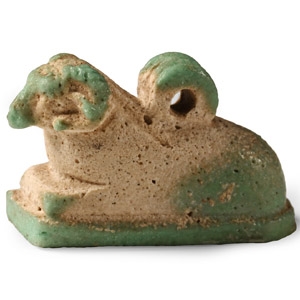
Egyptian Blue Faience Ram Amulet
Late Period, 664-332 B.C.Sold for (Inc. bp): £143
Modelled resting on a tongue-shaped base with ribbed suspension loop. 2.15 grams, 23 mm
From the collection of Doctor Girard, a collector for over 60 years. with Hotel des Ventes de Clermont-Ferrand, 22 May 2017. Property of a French collector.
Various gods were depicted in the form of rams. The downturned horns on this amulet indicate that the ram is a representation of Amun. The ram was symbolically linked to concepts of revival and fecundity. Eventually, it became associated with Osiris and was recognised as the god's soul or ba. -
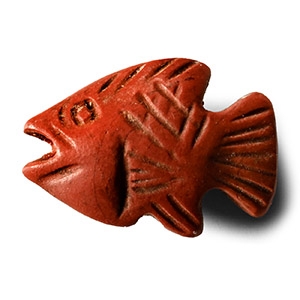
Egyptian Jasper Fish Amulet
Late Period, 664-332 B.C.Sold for (Inc. bp): £182
Pierced longitudinally with hatched detailing to the flanks. 0.80 grams, 14 mm
From an early 20th century collection.
Fish amulets were worn by young women and children, often at the end of a plait of hair, to guard against the risk of drowning. -
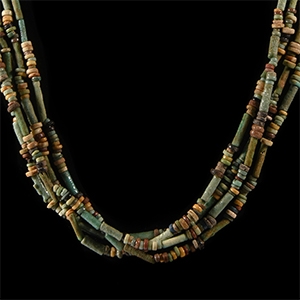
Egyptian Multi-Stranded Faience Mummy Bead Necklace
Late Period, 664-525 B.C.Sold for (Inc. bp): £124
Composed of polychrome beads of mainly tubular and annular types; modern clasp. 31 grams, 72 cm long
Acquired before 1979. From the private collection of Mr F. A., South Kensington, London, UK; thence by descent 2014.
For thousands of years, artisans in Egypt created vibrant ceramics to echo the beauty of rare jewels. These ornaments were created with almost every material, colour and texture imaginable and they come from across Egypt and beyond: vibrant blue lapis lazuli from Afghanistan, glossy black obsidian from Turkey, and aqua-green turquoise from the Sinai. They were worn in life and, after death, they served as precious ornamentation for mummies. -
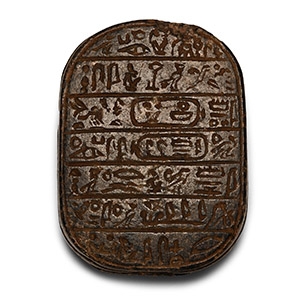
Egyptian Style Heart Scarab with Hieroglyphs
Late 19th-early 20th century A.D.Sold for (Inc. bp): £416
Substantial carved scarab with detailed carapace; underside with seven columns of hieroglyphic text, including two cartouches. 72 grams, 50 mm.
Private collection, UK; acquired prior to 2013. -
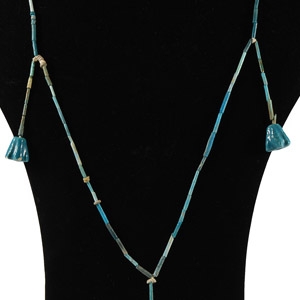
Egyptian Faience Mummy Bead Necklace with Papyrus Flower Amulets
Late Period, 664-332 B.C.Sold for (Inc. bp): £208
Restrung group of mainly tubular beads with five faience papyrus-flower pendants. 25 grams, 102 cm long
From an old English deceased estate. Acquired on the London art market in the early 1990s. Property of a London, UK, collector. -
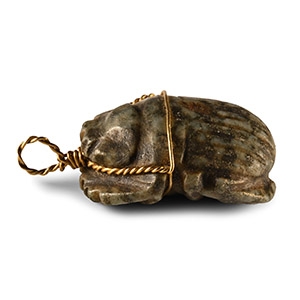
Egyptian Hardstone Heart Scarab in Gold Mount
Late Period, 664-332 B.C. and laterSold for (Inc. bp): £286
Carved scarab with textured carapace and detailed legs; set in a 19th century gold mount. 6.02 grams, 28 mm
From an early 20th century collection. -
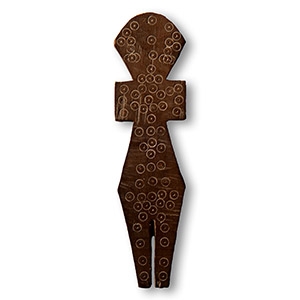
Egyptian Wooden Doll with Circular Decorations
Coptic, 7th-11th centuries A.D. or laterSold for (Inc. bp): £117
Flat anthropomorphic panel with incised ring-and-dot ornament to obverse, single central ring-and-dot to the reverse. 16 grams, 12.4 cm
Acquired on the German art market, 1989-1995. with The Museum Gallery, 19 Bury Place, London, WC1A 2JB, 1998-2003. Property of a London based academic, 2003-present.
In the late Roman Egypt or early Islamic period (7th–11th century A.D.) a new type of figurine appeared in the archaeological record: small, crudely crafted human figures made of bone. Some researchers considered them as toys meant to prepare girls for motherhood; others saw them as fertility figurines. They are mostly referred to as early Christian or “Coptic dolls”. In Egypt and Palestine they seem to appear suddenly in the 7th century, coinciding with the Arab conquests, but they might have existed earlier. With the new Muslim empire bridging former Roman and Sassanian lands, these dolls found their way to Egypt and Palestine where they were reproduced in huge numbers, becoming popular in all levels of society of the 8th and 9th century. By the end of the 11th century they disappeared as quickly as they appeared, probably because of restrictions placed on their production by Islamic laws. -
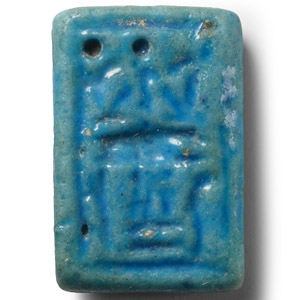
Egyptian Faience Bead for Ramesses II
New Kingdom, 19th Dynasty, 1279-1213 B.C.Sold for (Inc. bp): £286
Rectangular bead with faintly impressed hieroglyphs on both broad faces, giving Ramesses II's birth and throne names. 3.59 grams, 23 mm
From the old Belfort collection, expert Jean Roudillon. Ex Hotel des Ventes de Belfort. Property of a French collector. -
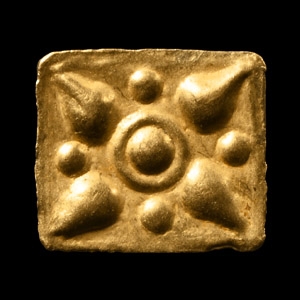
Egyptian Gold Setting with Glass Inlay
Late Period, 664-332 B.C.Sold for (Inc. bp): £169
Square sheet gold cell with repoussé quatrefoil to the underside, inset glass panel in red glass and pale turquoise faience. 1.18 grams, 10 mm
From a late Japanese specialist collector, 1970-2000s. -
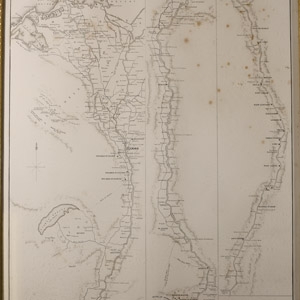
David Roberts Print
19th century A.D.Sold for (Inc. bp): £52
Printed map of Egypt and Nubia with locations marked of the sketches of David Roberts, RA on his 1849 expedition; mounted in a glazed wooden frame. 2.2 kg, 46 x 64 cm
From the private collection of the late Mrs Belinda Ellison, a long time member of the Egyptian Exploration Society, c.1940-2020.
