
Auction Highlights
-
.jpg)
Greek Marble Head of Dionysus
Sold for (Inc. bp): £23,400
Carved in the half-round in three-quarter view, youthful male head with stern features, hair gathered in a browband, horns to the brow; from a frieze or relief; mounted on a custom-made stand. -
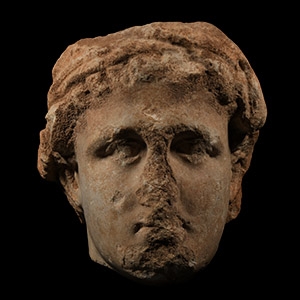
Greek Marble Head of a Ruler
Sold for (Inc. bp): £31,200
Carved in the round with thick wreath of laurel leaves to the brow, short tousled hair, stern face with thick jaw; mounted on a custom-made stand. -
.jpg)
Roman Veined Marble Torso of an Athlete
Sold for (Inc. bp): £48,100
Standing contrapposto with his weight on his right leg and the left leg brought slightly forward; the musculature of the torso displaying well-defined pectoral muscles, prominent abdominal muscles and wide shoulders, the back with equally toned musculature and well-formed rounded buttocks; the veining of the marble accentuating the idealised anatomy; the now-absent head was most probably turned towards the supporting leg and the left arm would have been raised; mounted on a custom-made display stand. -
.jpg)
Large Middle Elamite Cylinder Seal of Kidnu, Chief Overseer of King Tan-Ruhurater II
Sold for (Inc. bp): £15,600
A high-status green chalcedony seal with frieze depicting a seated figure in horned headdress facing a standing figure with arms outstretched, small monkey to the legs; six columns of Akkadian cuneiform text transliterated as: 1. ki-di-nu UGULA KUŠ-MEŠ 2. GAL šà tan-dru-hu- 3. ra-te-er EŠŠANA šu-ši 4. u an-za-an ARAD 5. šà dha-te-ri-iš 6. šak(?) ì-lí-šu 'Kidinu, chief overseer of the equerries(?) of Tan-Ruhurater, King of Susa and Anzan, servant of Haterishshak, his god'. The seal's owner was an official of King Tan-Ruhurater II (circa 1450 B.C.), king of Susa and Anzan. The title used to describe Kidinu is sometimes translated 'high official', elsewhere 'horse groom' or 'animal trainer'; the Elamite deity Haterish is otherwise unknown. -
.jpg)
Mesopotamian Torch Bearer Stand with Lion Tamer
Sold for (Inc. bp): £46,800
A substantial torch bearer depicting a male lion or panther standing with legs firmly planted on a rectangular base, tail extending to the ground, with a massive circular shaped armature or candelabra issuing from its back and wearing an elaborate muzzle, the eyes retaining shell inlay with a circular hollow for the pupils; to the right of the beast a kneeling nude male wearing a large belt-armour and a diadem, eyes inlaid, left hand extended to the side and holding the lion's leash.
-
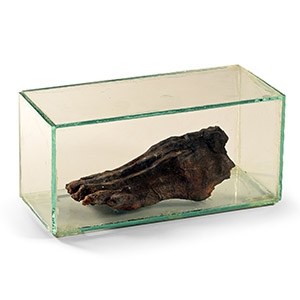
Foot of an Egyptian Mummy
Late Period, 664-332 B.C.Sold for (Inc. bp): £3,640
Preserved left foot from a mummy with bones (calcaneus and navicular) visible at the rear, phalanges; mounted in a sturdy glass display case. 753 grams total, 21.2 x 9.2 x 10 cm including box
Acquired from a licenced dealer in Cairo, Egypt, prior to 1975. On loan to Walton Primary School as an educational exhibit circa 2001. Property of a private collector, Walton on the Naze, UK.
Please note that this item is for collection only. -
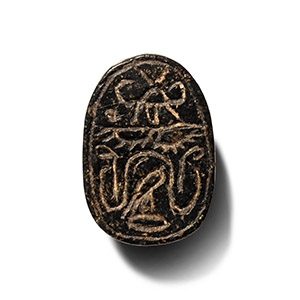
Egyptian Black Stone Scarab with Uraei and Falcon
New Kingdom-Late Period, 1550-332 B.C.Sold for (Inc. bp): £286
Scarab with carapace detailing, falcon figure to the underside. 3.09 grams, 18 mm
Ex North London gentleman's collection, 1990s. Property of a Cambridgeshire, UK, gentleman. -
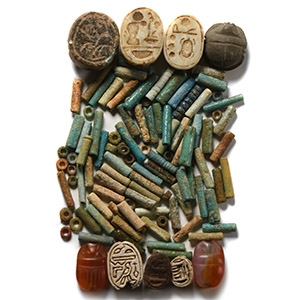
Egyptian Faience Bead and Scarab Collection
New Kingdom-Late Period, circa 1400-332 B.C.Sold for (Inc. bp): £624
Including tubular and annular beads, scarabs and scaraboids with inscriptions, including the prenomen of Amenhotep III (Neb-Maat-Re) and the nomen of Amenhotep II (A-Kheperu-Re). 22.4 grams total, 3-18 mm
From an early to mid 20th century collection, West country, UK. -
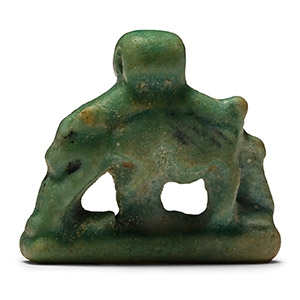
Egyptian Faience Amulet of Nut
Late Period, 664-332 B.C.Sold for (Inc. bp): £98
Amulet of a sow representing the goddess Nut; suspension loop on top. 2.63 grams, 24 mm
From the Florence Rosetti collection, UK, circa 1950s. Property of a Cambridgeshire, UK, gentleman.
This miniature sow pendant features a loop at the top and was worn as an amulet. The sow is often associated with the sky goddess Nut, who was believed to give birth to the stars every night, and then consume them at dawn. Despite the sow's reputation for devouring its offspring, Nut, in this form, was revered as a nurturing and safeguarding deity. A sow-shaped amulet was likely intended to offer protection to its wearer. -
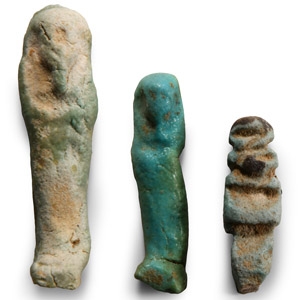
Egyptian Faience Shabti and Amulet Group
Late Period-Ptolemaic Period, 664-30 B.C.Sold for (Inc. bp): £78
Two mummiform shabti figurines, one faded pale green and the other bright turquoise; one amuletic figurine, possibly of a ram or baboon-headed deity with sun disk headdress, applied black pigment detailing. 20 grams total, 41-65 mm
From the H.N. collection, Milton Keynes, Berkshire, UK, 1990s.
Shabti figures were created to carry out heavy manual tasks on behalf of a person in the afterlife. From the Third Intermediate Period into the Late Period burials were often provided with several hundred shabtis. -
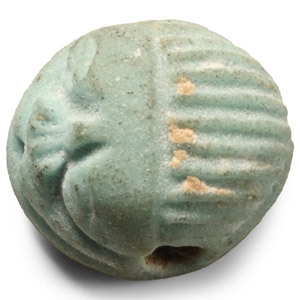
Phoenician Faience Scarab with Face
6th-4th century B.C.Sold for (Inc. bp): £98
Discoid scarab with plain reverse, stylised human face. 0.55 grams, 10 mm
From the Fadel family collection, London, UK, 1970s. -
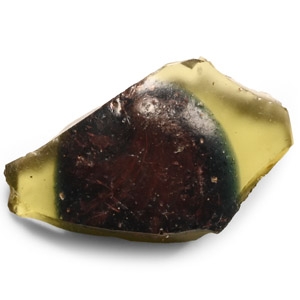
Egyptian Glass Eye Fragment
Late Period, 664-332 B.C.Sold for (Inc. bp): £59
The sclera formed of translucent yellow glass, a large dark blue pupil with dark red hue to the centre. 1.08 grams, 20 mm
Ex London, Mayfair, UK, gallery. Property of a North London, UK, gentleman. -
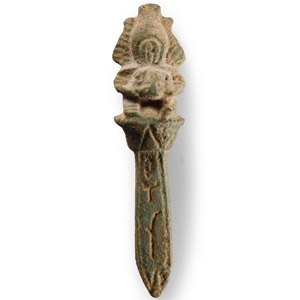
Egyptian Faience Wadj Amulet
Late Period, 664-332 B.C.Sold for (Inc. bp): £468
Square-section wadj papyrus stalk amulet surmounted by a ram's head wearing the Atef crown; the front inscribed with ankh (life) and renpet (year) hieroglyphs. 1.92 grams, 39 mm
From the collection of Doctor Girard, a collector for over 60 years. with Hotel des Ventes de Clermont-Ferrand, 22 May 2017. Property of a French collector.
The papyrus column or wadj amulet is typically made out of turquoise feldspar or faience, as is prescribed in the Book of the Dead. The word wadj, meaning “green”, evokes concepts of well-being and vitality. Papyrus amulets were often placed around the neck of the deceased to ensure eternal youth in the afterlife. The ram's head is associated with the god Amun and the Atef crown with Osiris, ruler of the Underworld. -
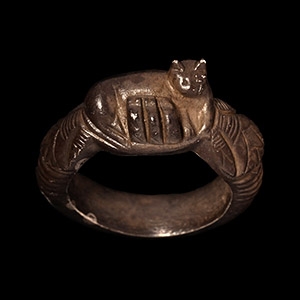
Romano-Egyptian Silver Ring with Bastet and Kittens
Roman Period, 30 B.C.-323 AD.Sold for (Inc. bp): £1,235
D-section hoop with lotus flowers on the shoulders, bezel formed as a reclining cat and three kittens. 15.21 grams, 28.80 mm overall, 17.01 mm internal diameter (approximate size British N, USA 6 1/2, Europe 13.72, Japan 13)
Ex London, UK collection, 1990s.
The cat was sacred to Bastet, a protective mother goddess and the daughter of the sun god Re. When shown with kittens, as here, Bastet's maternal role as a fierce protector of offspring is emphasised. -
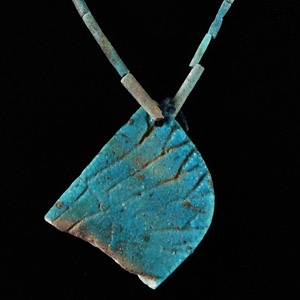
Egyptian Faience Mummy Bead Necklace
Late Period, 664-332 B.C.Sold for (Inc. bp): £52
Restrung group of mainly tubular beads with centrepiece a fragment of the extended wing from a pectoral. 11.9 grams, 94 cm long
From an old English deceased estate. Acquired on the London art market in the early 1990s. Property of a London, UK, collector. -
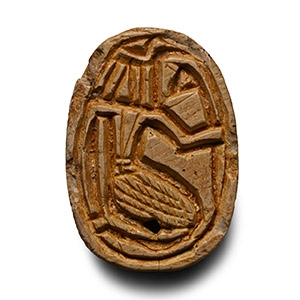
Egyptian White Stone Scarab with Falcon-headed God
New Kingdom-Late Period, 1550-332 B.C.Sold for (Inc. bp): £286
Underside with low-relief image of falcon-headed god holding a papyrus stem. 2.36 grams, 18 mm
From the private collection of P. Champman. Acquired 1992. Ex C.J. Martin, London, UK. -
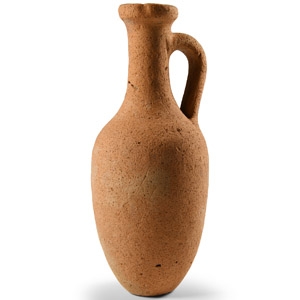
Phoenician Terracotta Jug
1st millennium B.C.Sold for (Inc. bp): £65
Ovoid body with narrow base, tall columnar neck and flared mouth. single strap handle to the shoulder. 249 grams, 15 cm
From the H.N. collection, Milton Keynes, Berkshire, UK, 1990s.
