
Auction Highlights
-
.jpg)
Greek Marble Head of Dionysus
Sold for (Inc. bp): £23,400
Carved in the half-round in three-quarter view, youthful male head with stern features, hair gathered in a browband, horns to the brow; from a frieze or relief; mounted on a custom-made stand. -
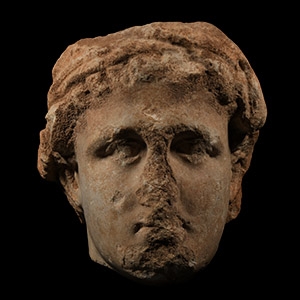
Greek Marble Head of a Ruler
Sold for (Inc. bp): £31,200
Carved in the round with thick wreath of laurel leaves to the brow, short tousled hair, stern face with thick jaw; mounted on a custom-made stand. -
.jpg)
Roman Veined Marble Torso of an Athlete
Sold for (Inc. bp): £48,100
Standing contrapposto with his weight on his right leg and the left leg brought slightly forward; the musculature of the torso displaying well-defined pectoral muscles, prominent abdominal muscles and wide shoulders, the back with equally toned musculature and well-formed rounded buttocks; the veining of the marble accentuating the idealised anatomy; the now-absent head was most probably turned towards the supporting leg and the left arm would have been raised; mounted on a custom-made display stand. -
.jpg)
Large Middle Elamite Cylinder Seal of Kidnu, Chief Overseer of King Tan-Ruhurater II
Sold for (Inc. bp): £15,600
A high-status green chalcedony seal with frieze depicting a seated figure in horned headdress facing a standing figure with arms outstretched, small monkey to the legs; six columns of Akkadian cuneiform text transliterated as: 1. ki-di-nu UGULA KUŠ-MEŠ 2. GAL šà tan-dru-hu- 3. ra-te-er EŠŠANA šu-ši 4. u an-za-an ARAD 5. šà dha-te-ri-iš 6. šak(?) ì-lí-šu 'Kidinu, chief overseer of the equerries(?) of Tan-Ruhurater, King of Susa and Anzan, servant of Haterishshak, his god'. The seal's owner was an official of King Tan-Ruhurater II (circa 1450 B.C.), king of Susa and Anzan. The title used to describe Kidinu is sometimes translated 'high official', elsewhere 'horse groom' or 'animal trainer'; the Elamite deity Haterish is otherwise unknown. -
.jpg)
Mesopotamian Torch Bearer Stand with Lion Tamer
Sold for (Inc. bp): £46,800
A substantial torch bearer depicting a male lion or panther standing with legs firmly planted on a rectangular base, tail extending to the ground, with a massive circular shaped armature or candelabra issuing from its back and wearing an elaborate muzzle, the eyes retaining shell inlay with a circular hollow for the pupils; to the right of the beast a kneeling nude male wearing a large belt-armour and a diadem, eyes inlaid, left hand extended to the side and holding the lion's leash.
-
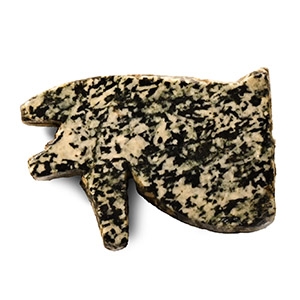
Egyptian Diorite Wedjat Eye Amulet
Late Period, 664-332 B.C.Sold for (Inc. bp): £72
With transverse piercing for suspension. 7.55 grams, 30 mm
From the old Belfort collection, expert Jean Roudillon. Ex Hotel des Ventes de Belfort. Property of a French collector.
The wedjat-eye amulet represents the healed eye of the god Horus, featuring both human and falcon elements. The name wedjat in ancient Egyptian means ‘the one that is sound.’ According to Egyptian mythology, Horus' eye was wounded or taken by the god Seth and restored by Thoth. The wedjat-eye amulet was thought to protect its wearer and bestow the power of recovery and regeneration onto them. As such, it was used by both the living and the dead. -
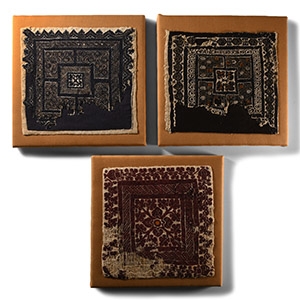
Egyptian Fabric Panel Group
Coptic, 4th century A.D.Sold for (Inc. bp): £130
Comprising: square panel with border of repeated motif of an amphora and vine issuing from the top, guilloche, radiating foliage; similar with guilloche enclosing repeating ring motifs, knotwork band and central radiating fleur-de-lys motifs; similar with concentric bands of roundels and central floret; each mounted on a wooden-framed fabric backing. 1.08 kg total, 25.3 x 25.5 cm each
Acquired from Esther Fitzgerald Rare Textiles, London, UK. Property of a North American gallery. -
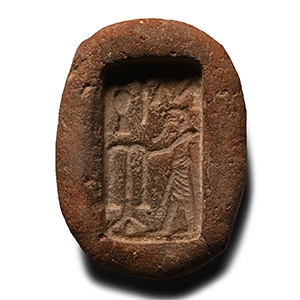
Egyptian Terracotta Nile God Hapi Amulet Mould
Late Period, 664-332 B.C.Sold for (Inc. bp): £390
Plano-convex ceramic mould with an incuse image of Hapi standing before a libating vessel and sacred knot. 22 grams, 50 mm
Ex D. Smith collection, 1990s. Property of a Cambridgeshire, UK, gentleman.
In ancient Egyptian mythology, Hapi was considered the embodiment of the annual inundation of the River Nile and the source of life for all living beings in Egypt, including people, animals, and plants. His distinct headdress of papyrus stalks was often used to identify him. -
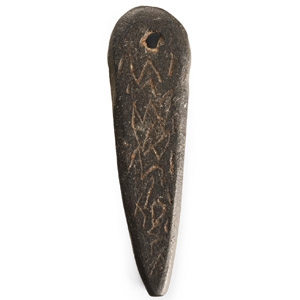
Egyptian Hardstone Pendant with Inscription
Late Period, 664-332 B.C.Sold for (Inc. bp): £46
Teardrop-shaped flat pendant pierced at the broad end, with incised text to both faces. 1.70 grams, 36 mm
From the collection of Doctor Girard, a collector for over 60 years. with Hotel des Ventes de Clermont-Ferrand, 22 May 2017. Property of a French collector. -
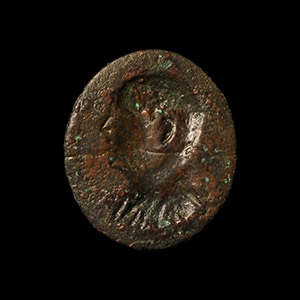
Egyptian Bronze Ring with Bust
Ptolemaic Period, 332-30 B.C.Sold for (Inc. bp): £338
With discoid bezel with incuse profile facing left. 7.03 grams, 23.09 mm overall, 17.15 mm internal diameter (approximate size British G 1/2, USA 3 1/2, Europe 5.55, Japan 5)
Acquired 1980-2015. Ex Abelita family collection. -
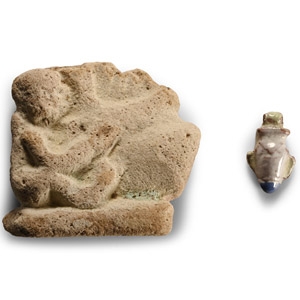
Egyptian Faience Phallic Figural Amulet
Late Period, 664-332 B.C.Sold for (Inc. bp): £46
Figurine of a naked male seated on a rectangular base, his phallus extended forward on which the harp he is playing rests; sold with a later white-glazed heart with blue finial, possibly after the antique. 24.5 grams total, 18-44 mm
From the collection of Doctor Girard, a collector for over 60 years. with Hotel des Ventes de Clermont-Ferrand, 22 May 2017. Property of a French collector. -
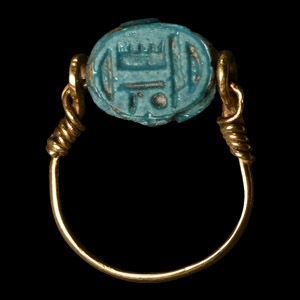
Egyptian Bright Blue Faience Scarab in Gold Ring
Late Period, 664-332 B.C. and laterSold for (Inc. bp): £494
Scarab with detailed carapace and legs, impressed hieroglyphs to the underside; set in a 19th century gold ring. 2.44 grams, 23.63 mm overall, 17.57 x 16.48 mm internal diameter (approximate size British M, USA 6, Europe 12.46, Japan 12)
From an early 20th century collection. -
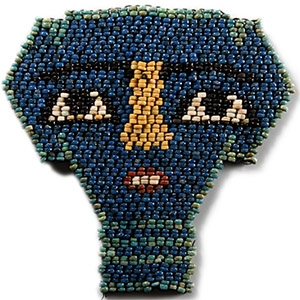
Egyptian Faience Mummy Bead Mask
Ptolemaic Period, 332-30 B.C. and laterSold for (Inc. bp): £169
Restrung beadwork panel of exceptional colour depicting a mummy face mask with false beard; restrung with some later beads. 17.3 grams, 89 mm
Ex Mariaud de Serres, Paris, France, 1980-1990s. From a London, UK, collection. -
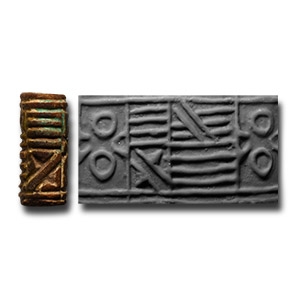
Egyptian Faience Cylinder Seal with Geometric Decoration
Late Period, 664-332 B.C.Sold for (Inc. bp): £234
With horizontal ribbing and reserved geometric design; old stock label '8752'. 5.78 grams, 31 mm
Private collection, Oxford, UK. Acquired from Helios Gallery, December 2009. Private collection, London, UK, -
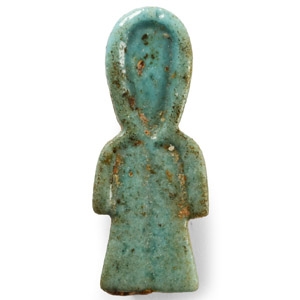
Egyptian Blue Faience Tyet 'Isis Knot' Amulet
Late Period, 664-332 B.C.Sold for (Inc. bp): £104
With dorsal pillar, pierced for suspension. 1.76 grams, 25 mm
From the collection of Doctor Girard, a collector for over 60 years. with Hotel des Ventes de Clermont-Ferrand, 22 May 2017. Property of a French collector.
The tyet amulet was associated with the goddess Isis and was often referred to as the "knot" or "girdle" of Isis. It was commonly placed within the mummy wrappings on the upper torso of the deceased, with the belief that it would invoke Isis' protection and safeguard the body, thus ensuring their rebirth in the afterlife. -
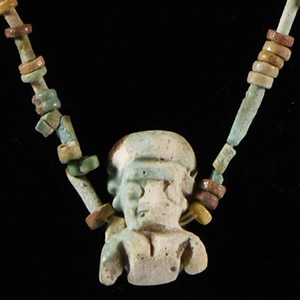
Egyptian Faience Mummy Bead Necklace
Late Period, 664-332 B.C.Sold for (Inc. bp): £85
Restrung group of tubular and annular beads, centrepiece a pendant bust of Pataikos. 8.46 grams, 64 cm long
From an old English deceased estate. Acquired on the London art market in the early 1990s. Property of a London, UK, collector.
Pataikos is a representation of the creator deity Ptah, and his diminutive form is a symbol of his immense magical power. -
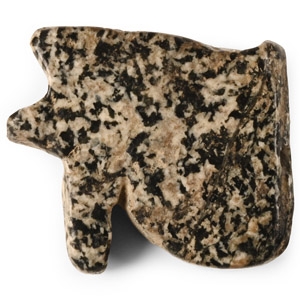
Egyptian Diorite Eye of Horus Amulet
Late Period-Ptolemaic Period, 664-30 B.C.Sold for (Inc. bp): £59
Carved wedjat amulet with angled suspension hole. 7.08 grams, 26 mm
Ex M.S. Ciappara collection, Norfolk, UK, 1939-1950.
The wedjat-eye amulet represents the healed eye of the god Horus, featuring both human and falcon elements. The name wedjat in ancient Egyptian means ‘the one that is sound.’ According to Egyptian mythology, Horus' eye was wounded or taken by the god Seth and restored by Thoth. The wedjat-eye amulet was thought to protect its wearer and bestow the power of recovery and regeneration onto them. It was very popular and used by both the living and the dead.
