
Auction Highlights
-
.jpg)
Greek Marble Head of Dionysus
Sold for (Inc. bp): £23,400
Carved in the half-round in three-quarter view, youthful male head with stern features, hair gathered in a browband, horns to the brow; from a frieze or relief; mounted on a custom-made stand. -
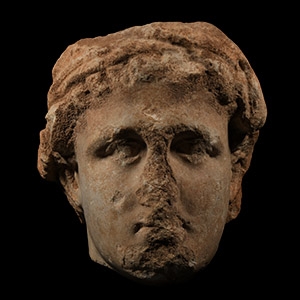
Greek Marble Head of a Ruler
Sold for (Inc. bp): £31,200
Carved in the round with thick wreath of laurel leaves to the brow, short tousled hair, stern face with thick jaw; mounted on a custom-made stand. -
.jpg)
Roman Veined Marble Torso of an Athlete
Sold for (Inc. bp): £48,100
Standing contrapposto with his weight on his right leg and the left leg brought slightly forward; the musculature of the torso displaying well-defined pectoral muscles, prominent abdominal muscles and wide shoulders, the back with equally toned musculature and well-formed rounded buttocks; the veining of the marble accentuating the idealised anatomy; the now-absent head was most probably turned towards the supporting leg and the left arm would have been raised; mounted on a custom-made display stand. -
.jpg)
Large Middle Elamite Cylinder Seal of Kidnu, Chief Overseer of King Tan-Ruhurater II
Sold for (Inc. bp): £15,600
A high-status green chalcedony seal with frieze depicting a seated figure in horned headdress facing a standing figure with arms outstretched, small monkey to the legs; six columns of Akkadian cuneiform text transliterated as: 1. ki-di-nu UGULA KUŠ-MEŠ 2. GAL šà tan-dru-hu- 3. ra-te-er EŠŠANA šu-ši 4. u an-za-an ARAD 5. šà dha-te-ri-iš 6. šak(?) ì-lí-šu 'Kidinu, chief overseer of the equerries(?) of Tan-Ruhurater, King of Susa and Anzan, servant of Haterishshak, his god'. The seal's owner was an official of King Tan-Ruhurater II (circa 1450 B.C.), king of Susa and Anzan. The title used to describe Kidinu is sometimes translated 'high official', elsewhere 'horse groom' or 'animal trainer'; the Elamite deity Haterish is otherwise unknown. -
.jpg)
Mesopotamian Torch Bearer Stand with Lion Tamer
Sold for (Inc. bp): £46,800
A substantial torch bearer depicting a male lion or panther standing with legs firmly planted on a rectangular base, tail extending to the ground, with a massive circular shaped armature or candelabra issuing from its back and wearing an elaborate muzzle, the eyes retaining shell inlay with a circular hollow for the pupils; to the right of the beast a kneeling nude male wearing a large belt-armour and a diadem, eyes inlaid, left hand extended to the side and holding the lion's leash.
-
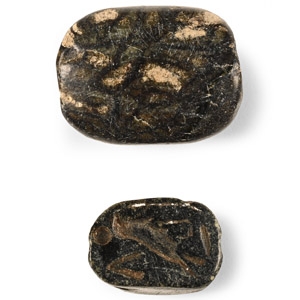
Egypto-Phoenician Stone Scaraboid Group
1st millennium B.C.Sold for (Inc. bp): £52
One with incuse bird, chevron and other motifs to the underside, the other in mottled hardstone. 4.69 grams total, 13-18 mm
From a collection acquired on the UK art market from various auction houses and collections mostly before 2000. From an important Cambridgeshire estate; thence by descent. -
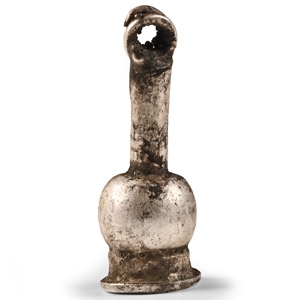
Egyptian Silver Poppy Head Amulet
Late Period, 664-332 B.C.Sold for (Inc. bp): £65
With bulb and disc finial, integral shank and gusseted suspension loop. 1.03 grams, 17 mm
From an early 20th century collection.
Amulets in the form of poppies were utilised for healing and alleviating pain, as well as for warding off death. These types of amulets were also linked to Osiris, the Egyptian deity of agriculture, death, and the afterlife. -
.jpg)
Egyptian Carnelian Poppy Head Amulet
New Kingdom, 18th Dynasty, 1550-1292 B.C.Sold for (Inc. bp): £104
Polished and with integral pierced suspension loop. 0.53 grams, 13 mm
UK gallery, early 2000s. -
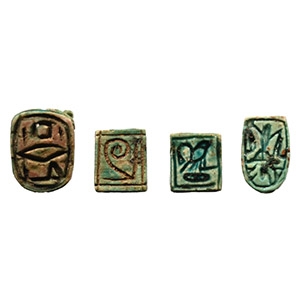
Egyptian 'Maspero' Faience Bead Group with Hieroglyphs
New Kingdom, 19th-20th Dynasty, 1279-1081 B.C.Sold for (Inc. bp): £338
Including two scarabs with hieroglyphs to the underside, and two rectangular beads with hieroglyphs. 1.32 grams total, 7-10 mm
Ex Emile Bouillon Bey, c. 1880. From the Gaston Maspero Archaeological Fund. with Hotel des Ventes du Perigord, Bergerac, 24 June 2007. Property of a French collector. -
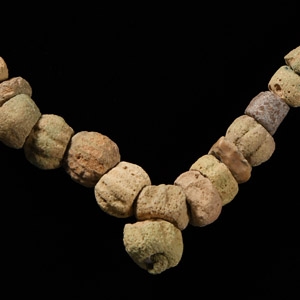
Phoenician Faience and Stone Bead Necklace String
Late 1st millennium B.C.Sold for (Inc. bp): £33
Restrung designer group of melon, spherical and other beads. 39 grams, 44 cm long
From the H.N. collection, Milton Keynes, Berkshire, UK, 1990s. -
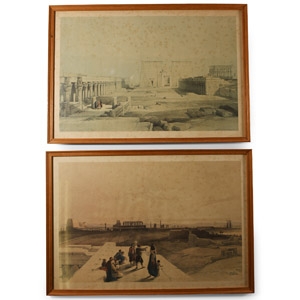
David Roberts Print of Karnak
19th century A.D.Sold for (Inc. bp): £65
Hand-tinted lithographs of a view over the temple complex at Karnak, and of a view of the Great Hypostyle Hall; each mounted in a glazed wooden frame. 2.9 kg total, 34.5 x 50 cm each
From the private collection of the late Mrs Belinda Ellison, a long time member of the Egyptian Exploration Society, c.1940-2020. -
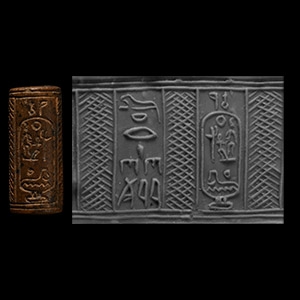
Egyptian Cylinder Seal with Cartouche of Ramesses II
New Kingdom, 19th Dynasty 1304-1237 B.C.Sold for (Inc. bp): £1,235
With crisp detail of crosshatched panels, hieroglyphic text in one and a cartouche in the other with the regnal name of Ramesses II (User-Maat-Re-setep-en-Re), supplied with a museum-quality impression. 5.01 grams, 25 mm
Gustave Mustaki, Alexandria, Egypt; exported from Egypt to the UK c.1950. Elsa McLellan, UK; by descent from the above. Private collection, London, UK; by descent from the above. -
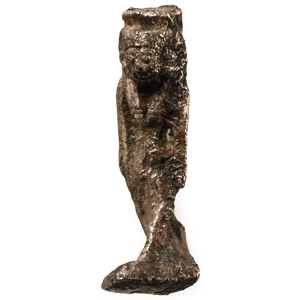
Egyptian Silver Neith Amulet
Late Period, 664-332 B.C.Sold for (Inc. bp): £46
Modelled in the round with hands to her sides, dished panel above the head. 4.03 grams, 24 mm
Acquired from a London, UK, collection in 1980. From the personal collection of a West London, UK, gentleman. -
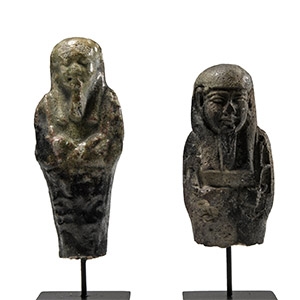
Egyptian Green Glazed Shabti Group
Late Period, 664-332 B.C.Sold for (Inc. bp): £130
Comprising: one upper body with crisply formed facial details, dorsal pillar, agricultural tools and seed bag to the reverse; one knee-length with a hieroglyphic inscription to the lower body; each mounted on a custom-made display stand. 135 grams total, 10.2-11.3 cm including stand
From a collection acquired on the UK art market from various auction houses and collections mostly before 2000. From an important Cambridgeshire estate; thence by descent. -
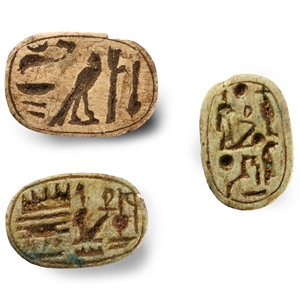
Egyptian Faience Scarab Group
Late Period, 664-332 B.C.Sold for (Inc. bp): £416
Group of three scarabs, each with a hieroglyphic inscription to the underside. 5.05 grams total, 16-18 mm
Acquired on the UK art market from various auction houses and collections mostly before 2000. From an important Cambridgeshire estate; thence by descent. -
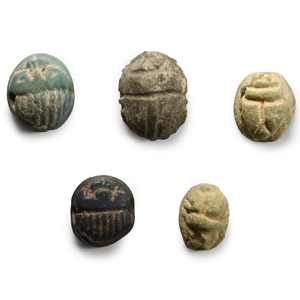
Phoenician Faience Scarab Group
1st millennium B.C.Sold for (Inc. bp): £117
Mixed scarab and scaraboid group, two with design to the underside. 2.47 grams total, 8-11 mm
From the H.N. collection, Milton Keynes, Berkshire, UK, 1990s. -
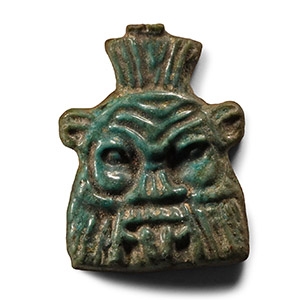
Egyptian 'Maspero' Green Faience Amulet
Late Period, 664-332 B.C.Sold for (Inc. bp): £312
Mask of Bes in low-relief with lentoid eyes and tongue extended. 2.09 grams, 28 mm
Ex Emile Bouillon Bey, c. 1880. From the Gaston Maspero Archaeological Fund. with Hotel des Ventes du Perigord, Bergerac, 24 June 2007. Property of a French collector.
Bes became one of ancient Egypt's most popular apotropaic deities from the New Kingdom onwards. Despite his somewhat fearful appearance, Bes was the patron and protector of pregnant women and children. He was also believed to protect from snakes.
