
Auction Highlights
-
.jpg)
Greek Marble Head of Dionysus
Sold for (Inc. bp): £23,400
Carved in the half-round in three-quarter view, youthful male head with stern features, hair gathered in a browband, horns to the brow; from a frieze or relief; mounted on a custom-made stand. -
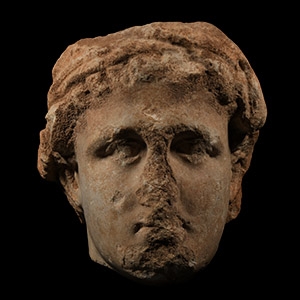
Greek Marble Head of a Ruler
Sold for (Inc. bp): £31,200
Carved in the round with thick wreath of laurel leaves to the brow, short tousled hair, stern face with thick jaw; mounted on a custom-made stand. -
.jpg)
Roman Veined Marble Torso of an Athlete
Sold for (Inc. bp): £48,100
Standing contrapposto with his weight on his right leg and the left leg brought slightly forward; the musculature of the torso displaying well-defined pectoral muscles, prominent abdominal muscles and wide shoulders, the back with equally toned musculature and well-formed rounded buttocks; the veining of the marble accentuating the idealised anatomy; the now-absent head was most probably turned towards the supporting leg and the left arm would have been raised; mounted on a custom-made display stand. -
.jpg)
Large Middle Elamite Cylinder Seal of Kidnu, Chief Overseer of King Tan-Ruhurater II
Sold for (Inc. bp): £15,600
A high-status green chalcedony seal with frieze depicting a seated figure in horned headdress facing a standing figure with arms outstretched, small monkey to the legs; six columns of Akkadian cuneiform text transliterated as: 1. ki-di-nu UGULA KUŠ-MEŠ 2. GAL šà tan-dru-hu- 3. ra-te-er EŠŠANA šu-ši 4. u an-za-an ARAD 5. šà dha-te-ri-iš 6. šak(?) ì-lí-šu 'Kidinu, chief overseer of the equerries(?) of Tan-Ruhurater, King of Susa and Anzan, servant of Haterishshak, his god'. The seal's owner was an official of King Tan-Ruhurater II (circa 1450 B.C.), king of Susa and Anzan. The title used to describe Kidinu is sometimes translated 'high official', elsewhere 'horse groom' or 'animal trainer'; the Elamite deity Haterish is otherwise unknown. -
.jpg)
Mesopotamian Torch Bearer Stand with Lion Tamer
Sold for (Inc. bp): £46,800
A substantial torch bearer depicting a male lion or panther standing with legs firmly planted on a rectangular base, tail extending to the ground, with a massive circular shaped armature or candelabra issuing from its back and wearing an elaborate muzzle, the eyes retaining shell inlay with a circular hollow for the pupils; to the right of the beast a kneeling nude male wearing a large belt-armour and a diadem, eyes inlaid, left hand extended to the side and holding the lion's leash.
-
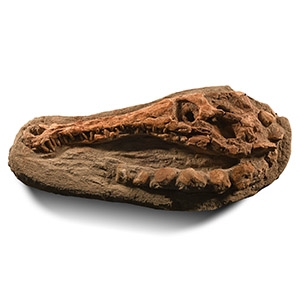
Natural History - Fossil Crocodile Skull and Vertebrae
Paleocene Epoch, circa 66-56 million years B.P.Sold for (Inc. bp): £520
Displaying the left side of the skull and jaws with teeth, with a number of vertebrae to the side, set on a sandstone matrix; possibly Argochampsa krebsi. 5.3 kg, 50.5 cm
From a Cambridgeshire, UK, collection. Property of a Cambridgeshire, UK, gentleman. -
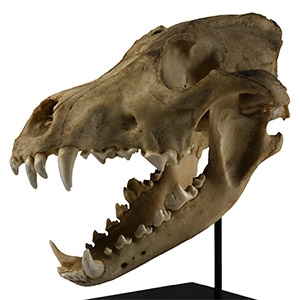
Natural History - Canis Teilhardi Wolf's Skull
Late Pliocene-early Pleistocene Period, circa 5.3 million-60,000 years B.P.Sold for (Inc. bp): £1,105
A near complete example retaining many of the animal's teeth; mounted on a custom-made display stand. 1.72 kg total, 24.5 cm including stand
From a collection acquired on the UK art market from various auction houses and collections mostly before 2000. From an important Cambridgeshire estate; thence by descent. -
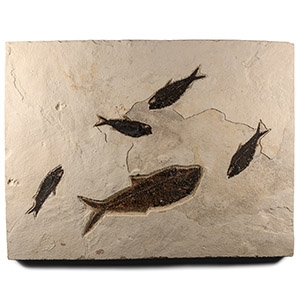
Natural History - Large Fossil Fish Plate
Eocene Period, 58-36 million years B.P.Sold for (Inc. bp): £624
A large rectangular matrix with four variously sized Diplomystus sp. and a Knightia alta sp. fish. 13 kg, 59 cm
From a Lincolnshire, UK, collection. Property of a Cambridgeshire, UK, gentleman. -
.jpg)
Natural History - Large African 'T-Rex' Fossil Dinosaur Tooth with Root
Cretaceous Period, circa 110 million years B.P.Sold for (Inc. bp): £468
A large Carcharodontosaurus saharicus dinosaur tooth with much of the root remaining and visible serrations; repaired. 100 grams, 15.7 cm
From Morocco, North Africa. Acquired from Richard and Mark Hawkes of Stone Treasures, Nottinghamshire, UK. Ian Wilkinson collection, Nottinghamshire, UK, formed since 1985. Accompanied by a Stone Treasures identification card. -
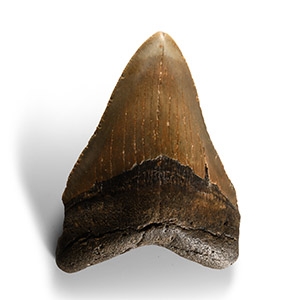
Natural History - Large Fossil Megalodon Giant Shark Tooth
Pliocene Period, circa 5.2-2.5 million years B.P.Sold for (Inc. bp): £585
Of exceptional quality, showing some serrations to the edges. 274 grams, 13.3 cm
From a Cambridgeshire, UK, collection. Property of a Cambridgeshire, UK, gentleman.
Carcharodon megalodon is regarded as one of the largest and most powerful marine predators in vertebrate history and likely had a profound impact on structuring of the marine communities. Fossil remains indicate that this giant shark reached a length of more than 16 metres (52 ft) and also affirm that it had a cosmopolitan distribution. Scientists suggest that in life it looked like a stockier version of the great white shark, Carcharodon carcharias. -
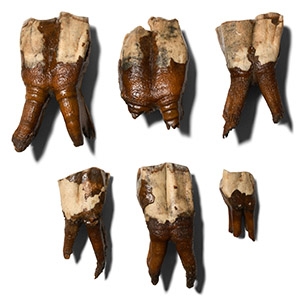
Natural History - Woolly Rhinoceros Lower Right Jaw Tooth Set
Ice Age, 50,000-20,000 years B.P.Sold for (Inc. bp): £416
Group of six teeth from the jaw of a woolly rhinoceros, rare as from the same animal. 703 grams total, 5.7-11 cm
From Yakutsk, Perma Frost Region, Siberia. Acquired from an old Dutch collection. From the collection of a Norfolk, UK, lady collector. -
.jpg)
Natural History - Large Fossil Diplomystus Fish Plate
Eocene Period, 58-36 million years B.P.Sold for (Inc. bp): £845
A large Diplomystus sp. fossil fish on a matrix slab. 8.95 kg, 59 cm
From a Lincolnshire, UK, collection. Property of a Cambridgeshire, UK, gentleman. -
.jpg)
Natural History - British Sigaloceras Fossil Ammonite Display
Jurassic Period, Callovian Stage, circa 165-160 million years B.P.Sold for (Inc. bp): £91
Comprising a number of Sigaloceras sp. fossil ammonites, together with a partial belemnite; in a freestanding bowl-shaped matrix. 1.17 kg, 16.5 cm
From exhausted South Cave Quarry, Yorkshire, UK. -
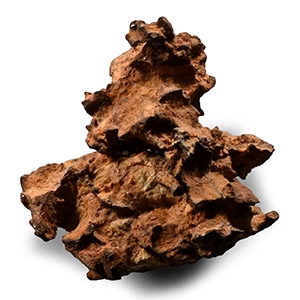
Natural History - Spectacular Imilac Pallasite Meteorite
Discovered in 2010 A.D.Sold for (Inc. bp): £234
Meteorite classified as a stony-iron pallasite, in collector's lidded box with documentation. 10.4 grams, 23 mm
Found in Chile's Atacama desert while filming an episode of the TV series Meteorite Men, the find was caught on camera and is shown in the Meteorite Men 'Chile' episode, at about the 14th minute. Acquired from Steve Arnold, co-star of 'Meteorite Men'. Ian Wilkinson collection, Nottinghamshire, UK. Accompanied by a signed certificate of authenticity card from Steve Arnold, a copy of the sales listing, and an aluminium identification plaque.
Imilac specimens are highly prized by meteorite collectors; the finding of this specimen was caught on camera and formed part of an episode of the TV show 'Meteorite Men'. -
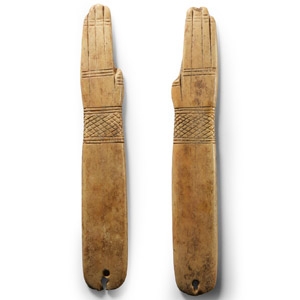
Large Egyptian Bone Doll's Arms
Coptic, circa 5th-8th century A.D.Sold for (Inc. bp): £572
Matched pair, carved with creases to the fingers, hatched cuff at the wrist, pierced at the shoulder. 80 grams total, 16 cm each
Ex London, UK collection, 1990s. -
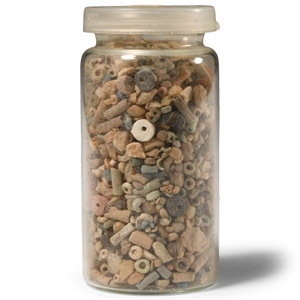
Egyptian Faience Bead Collection
New Kingdom-Late Period, circa 1550-332 B.C.Sold for (Inc. bp): £52
Mainly tubular, annular and oblate types in various colours. 61 grams total, 64 mm
Acquired from Ancient & Oriental, circa 1987. Ian Wilkinson collection, Nottinghamshire, UK, formed since 1985.
The faience of the New Kingdom period is frequently decorated with an expanded palette of red, black, and yellow. This polychrome decoration was often accomplished by inlaying one colour of paste onto another. -
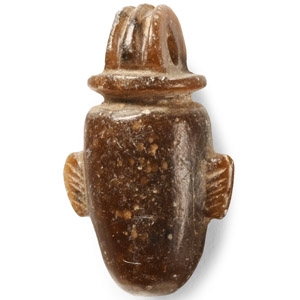
Egyptian Hardstone Heart Amulet
Late Period, 664-332 B.C.Sold for (Inc. bp): £156
Modelled in the round with ribbed loop above, flange and two lateral tabs. 1.64 grams, 18 mm
From the collection of Doctor Girard, a collector for over 60 years. with Hotel des Ventes de Clermont-Ferrand, 22 May 2017. Property of a French collector.
According to ancient Egyptian beliefs, the heart (ib) was considered to be the centre of intelligence, emotions, and behaviour. The heart was also believed to store an individual's memories. During the Weighing of the Heart ceremony in the afterlife, the heart could speak up for the deceased and account for their lifetime of actions before Osiris. For this reason, heart amulets were placed on the mummy to safeguard the organ and ensure a favourable outcome during judgment.
